
LAWU-301 · Lesson 5 of 12 · 24 min
Supreme Court review of state courts
▶ Video coming soon A video version of this lesson is on the way.
Sefton introduces a new character in the Marchbank file. Cass Deverell, a wildlife photographer in another Westmarch county, flew a drone near a power substation in July 2026 to photograph nesting ospreys on a transmission tower and was charged under the Critical Infrastructure Airspace Act. At a bench trial in the Merrin County District Court, Deverell's lawyer argued that the Act was unconstitutionally vague, but did not raise the First Amendment until after the verdict, in a motion for a new trial. Deverell was convicted and fined. On appeal, the Westmarch Supreme Court reversed in an opinion that said the Act's definition of "critical infrastructure" was too indefinite to give fair notice, "under the Due Process Clause of the Fourteenth Amendment and article I, section 7 of the Westmarch Constitution," citing federal and state cases interchangeably. It declined to reach the First Amendment because Westmarch's contemporaneous objection rule requires constitutional objections to be raised before verdict. The State wants Supreme Court review. Deverell, the case and the court opinion are all fictional.
The Supreme Court's power to review state courts comes from Article III, Martin v. Hunter's Lessee (1816) and 28 U.S.C. section 1257(a). The statute allows review by writ of certiorari of final judgments or decrees rendered by the highest court of a state in which a decision could be had, where the validity of a federal treaty or statute is drawn in question, where the validity of a state statute is drawn in question on the ground of its being repugnant to the Constitution, treaties or laws of the United States, or where any title, right, privilege or immunity is claimed under federal law. Since 1988, all such review has been discretionary; Congress abolished the old mandatory appeals from state courts in the Supreme Court Case Selections Act. The Court receives thousands of petitions a year and grants a small fraction, typically to resolve conflicts among state supreme courts and federal courts of appeals on questions of federal law.
Three limits shape every petition from a state court. First, finality: the judgment must be final, meaning the state courts have finished with the case. Cox Broadcasting Corp. v. Cohn (1975) recognized four categories of cases in which the Court treats a judgment as final even though further state proceedings remain, the most important being cases in which the federal issue has been finally decided and later review would be foreclosed or the outcome of further proceedings could not affect the federal issue. Second, the highest state court in which a decision could be had: a petition may come from an intermediate appellate court if the state supreme court declined discretionary review. Third, and most important for today, the Court reviews only questions of federal law, and it will not review a judgment that rests on an adequate and independent state ground.
Murdock v. City of Memphis (1875) settled the first part of that principle. The 1867 amendments to the Judiciary Act had dropped language limiting the Court to federal questions, and the petitioner argued that the Court could now review state law questions too. The Court disagreed: Congress had not intended so radical a change, and the Court's role in reviewing state courts is to vindicate federal law, not to second-guess state courts on the meaning of their own law. State supreme courts are the final authorities on state law. The Supreme Court accepts their interpretations of state statutes and state constitutions, and when a state court construes a state statute narrowly to avoid a federal constitutional problem, the Supreme Court takes the statute as the state court has construed it.
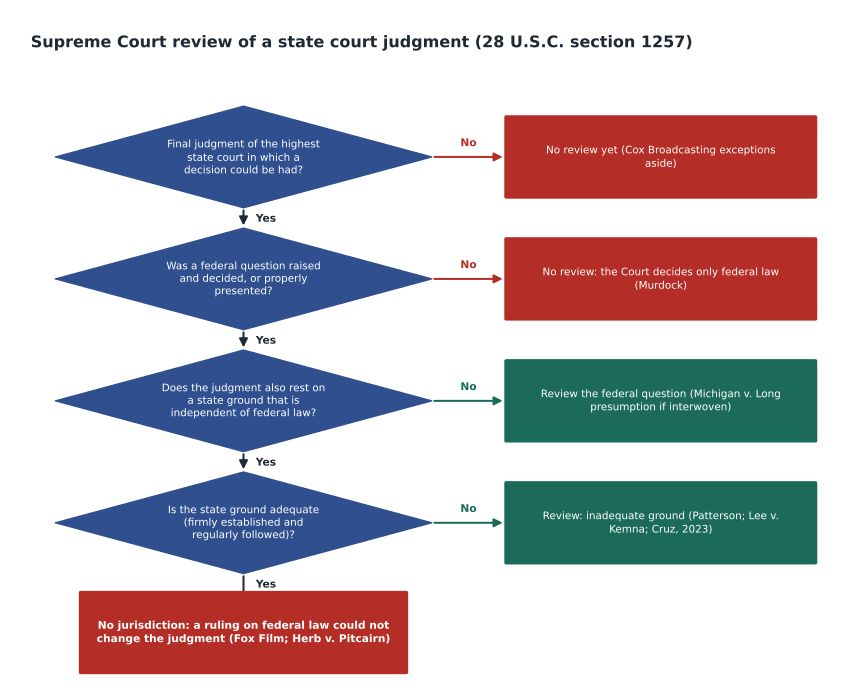
The adequate and independent state ground doctrine follows from the limit on advisory opinions. If a state court judgment would stand on a state law ground no matter how the Supreme Court decided the federal question, a federal ruling would change nothing. Fox Film Corp. v. Muller (1935) held that where a state court judgment rests on two grounds, one federal and one not, and the nonfederal ground is independent of the federal ground and adequate to support the judgment, the Court has no jurisdiction. Herb v. Pitcairn (1945) explained why: the Court's "only power over state judgments is to correct them to the extent that they incorrectly adjudge federal rights," and if the same judgment would be rendered after the Court corrected its views of federal law, the review could amount to nothing more than an advisory opinion. The doctrine thus applies whether the state ground is substantive, such as a state constitutional holding, or procedural, such as a forfeiture rule.
Independence is the first question. A state ground is not independent if the state court's interpretation of state law was itself driven by federal law, as when a state court reads its own constitution in lockstep with the federal one because it believes federal law requires it. For many years the Court handled ambiguous state opinions inconsistently, sometimes dismissing, sometimes remanding for clarification, sometimes examining state law itself. Michigan v. Long (1983) adopted a presumption. When a state court decision fairly appears to rest primarily on federal law, or to be interwoven with federal law, and the adequacy and independence of any possible state law ground is not clear from the face of the opinion, the Court will accept as the most reasonable explanation that the state court decided the case the way it did because it believed federal law required it. A state court that wants to insulate its decision can say so with a plain statement that federal cases are used only for guidance and do not themselves compel the result.
In Long itself, police found marijuana in a car during a protective search, and the Michigan Supreme Court suppressed it, citing both the Fourth Amendment and the Michigan Constitution but relying almost entirely on federal cases. The Supreme Court presumed the decision rested on federal law, reached the merits and reversed, holding the search reasonable under Terry v. Ohio principles. Justice Stevens dissented, arguing that the Court should not spend its limited resources correcting state court decisions that gave citizens more protection than federal law required, since the state could always reinstate the result under its own constitution. That critique has real force: after a reversal under the Long presumption, the state court on remand may reach the same result on state grounds, and nothing in federal law prevents it. Several state supreme courts now routinely decide state constitutional questions first and include plain statements.
Applied to Deverell, the vagueness holding looks interwoven. The Westmarch Supreme Court cited the Fourteenth Amendment and the state constitution together, relied on federal and state cases interchangeably, and gave no plain statement that its state holding was independent. Under Long, the Supreme Court would presume the decision rested on federal due process law and could grant review of the State's petition. Priya Natarajan points out the irony: if the Court took the case and reversed, the Westmarch Supreme Court on remand could reinstate the reversal under article I, section 7 alone, so long as it said clearly that it was interpreting the state constitution independently. "That is federalism," Sefton says. "The Supreme Court has the last word on what the Fourteenth Amendment means. It has no word at all on what the Westmarch Constitution means."
Adequacy is the second question, and it matters most for procedural grounds. A state procedural rule that bars consideration of a federal claim is adequate only if it is firmly established and regularly followed, as James v. Kentucky (1984) and Ford v. Georgia (1991) put it. NAACP v. Alabama ex rel. Patterson (1958) refused to honor a state court's dismissal of the NAACP's appeal on a novel procedural ground that the NAACP could not have anticipated, at the height of the state's campaign against the organization. Lee v. Kemna (2002) recognized that in exceptional cases even a generally sound rule may be inadequate when applied in an exorbitant way that serves no legitimate state interest. Cruz v. Arizona (2023) applied the principle when Arizona's highest court held that a Supreme Court decision applying Simmons v. South Carolina to Arizona was not a significant change in the law that would allow a successive petition. In an opinion by Justice Sotomayor for five Justices, the Court held that this novel and unforeseeable reading of the state rule was not an adequate ground. Justice Barrett, joined by three others, dissented.
Deverell's First Amendment claim illustrates adequacy. The Westmarch Supreme Court refused to reach it because of the contemporaneous objection rule. If the rule is firmly established and regularly followed, it is an adequate and independent state ground for not deciding the First Amendment claim, and the Supreme Court could not review that claim on the State's or Deverell's petition. Marcus Webb notes that this matters only if Deverell ever loses: since he won on vagueness, the First Amendment question would come up only if the Supreme Court reversed on vagueness and the state courts then reinstated the conviction. But the same rule will matter enormously in federal habeas corpus, where a state procedural default can bar federal review of a claim, a subject for Lesson 10. The adequacy standards there are closely related.
Independence also fails when a state ground depends on a federal antecedent. Ake v. Oklahoma (1985) held that when a state court's application of a procedural bar depends on an antecedent ruling of federal law, the state ground is not independent. Glossip v. Oklahoma (2025) applied similar reasoning. Oklahoma's Attorney General confessed error in Richard Glossip's capital case after evidence emerged that the prosecution had failed to correct false testimony from its key witness. The Oklahoma Court of Criminal Appeals nonetheless denied relief under the state's post-conviction statute. The Supreme Court held that it had jurisdiction because the state court's ruling rested on its rejection of the federal Napue claim, and then held that the prosecution's failure to correct the testimony violated due process and required a new trial. Justice Gorsuch did not participate; the other Justices divided over the merits and the remedy, with Justices Thomas and Alito dissenting.
A related set of cases involves federal rights that depend on state law. Some federal constitutional protections turn on whether a state-law right exists: the Contracts Clause protects contracts, the Takings Clause protects property and the Due Process Clause protects property interests often defined by state law. If state courts could define those antecedent state-law questions however they liked, they could defeat federal rights. So the Court independently reviews such questions, while giving weight to the state court. Indiana ex rel. Anderson v. Brand (1938) decided for itself whether a teacher had a contract with a school district for Contracts Clause purposes. Moore v. Harper (2023) extended a similar idea to federal elections. It rejected the independent state legislature theory, holding that the Elections Clause does not insulate state legislatures from review by state courts under state constitutions, but it also held that state courts may not transgress the ordinary bounds of judicial review when interpreting state law in cases governing federal elections, leaving federal courts a limited role in policing that line.
Review of state courts has another corollary: lower federal courts cannot do it. Under the Rooker-Feldman doctrine, named for Rooker v. Fidelity Trust Co. (1923) and District of Columbia Court of Appeals v. Feldman (1983), a federal district court lacks jurisdiction over a case brought by a state court loser complaining of injuries caused by a state court judgment rendered before the federal proceedings began and inviting the district court to review and reject that judgment. Exxon Mobil Corp. v. Saudi Basic Industries Corp. (2005) confined the doctrine to that narrow situation, and Skinner v. Switzer (2011) held that a prisoner could bring a section 1983 suit challenging a state statute's DNA testing procedures as unconstitutional, even after losing in state court, because he challenged the statute rather than the judgment. Only the Supreme Court, by certiorari under section 1257, may directly review a state court judgment, and preclusion law, applied under the Full Faith and Credit Act, does the rest of the work.
Jordan Kimura asks what state courts must do with federal precedent. State courts are bound by the Supreme Court's interpretations of federal law under the Supremacy Clause and Martin. They are not bound by the decisions of lower federal courts, including the federal court of appeals for their own region, though they often find them persuasive. That produces occasional conflicts in which a state supreme court and the regional federal circuit disagree about the meaning of a federal statute or constitutional provision, and such conflicts are a classic reason for the Supreme Court to grant certiorari. Federal courts, conversely, are bound by state supreme courts' interpretations of state law. When state law is unsettled, a federal court predicts what the state supreme court would do or, where the state allows it, certifies the question to that court.
Daniel Reyes asks about the practical side. Sefton describes the petition stage. A petition must be filed within ninety days after entry of the judgment or the denial of rehearing, under 28 U.S.C. section 2101(c), extendable for good cause. The petition must show that the federal question was raised and decided below, or properly presented, because the Court generally will not consider federal claims that were not pressed or passed upon in the state courts. Respondents often argue that a state ground bars review, and the Court considers the question on its own. When the Court grants, vacates and remands in light of a new decision, the state court gets the first opportunity to apply the new law. "Most of all," she says, "preserve the federal claim at every stage in state court, in terms, with citations. Deverell's lawyer learned that lesson the hard way."
Hannah Lindqvist asks why the doctrine is designed to give state courts so much room. Sefton offers three reasons. First, the dual sovereignty of the American system: states are independent sources of law and of rights, and a state constitution may protect liberties more broadly than the federal one, as Justice Brennan urged in a famous 1977 article encouraging state courts to do just that. Second, institutional capacity: the Supreme Court decides only several dozen cases a year and cannot supervise fifty state judicial systems. Third, respect for state procedure: states have legitimate interests in requiring timely objections so that trial judges can fix errors when they occur. The doctrine is the price of a system in which federal law is supreme but state courts do most of the judging.
Worked problem
May the Supreme Court review Deverell?
The State petitions for certiorari from the Westmarch Supreme Court's decision reversing Deverell's conviction on vagueness grounds under the federal Due Process Clause and article I, section 7 of the Westmarch Constitution. The opinion cites state and federal cases interchangeably and contains no plain statement. Deverell argues that the decision rests on an adequate and independent state ground. Deverell also cross-petitions on his First Amendment claim, which the state court refused to reach under its contemporaneous objection rule.
Show solution
- Finality and court: the Westmarch Supreme Court's reversal is a final judgment of the state's highest court, so section 1257 is satisfied.
- Vagueness: under Michigan v. Long, the opinion fairly appears to rest primarily on federal law or to be interwoven with it, and the independence of the state ground is not clear from its face. The Court will presume a federal basis and may review the federal vagueness holding.
- Effect: if the Court reversed, the Westmarch Supreme Court on remand could reinstate its judgment on independent state constitutional grounds with a plain statement.
- First Amendment: the contemporaneous objection rule is an independent state procedural ground. If firmly established and regularly followed (James; Ford), it is adequate, and the Court cannot review the unpreserved First Amendment claim. Deverell would have to show the rule is novel or applied exorbitantly (Patterson; Lee v. Kemna; Cruz).
Practice problems
Work each problem on paper first, then reveal the answer to check.
What did Murdock v. City of Memphis (1875) hold?
Show answer
That the Supreme Court, on review of state court judgments, decides only federal questions and accepts state courts' interpretations of state law.
Why does the adequate and independent state ground doctrine exist?
Show answer
Because if a state judgment would stand on a state ground regardless of the federal question, a Supreme Court ruling on federal law would change nothing and would be an advisory opinion (Herb v. Pitcairn).
What did Cruz v. Arizona (2023) hold?
Show answer
That the Arizona Supreme Court's novel and unforeseeable interpretation of its rule on significant changes in the law was not an adequate state ground barring review of a Simmons claim.
Can a federal district court hear a suit asking it to overturn a state court judgment as unconstitutional?
Show answer
No. Under Rooker-Feldman, only the Supreme Court may directly review state court judgments. But a plaintiff may challenge a state statute or rule itself, as in Skinner v. Switzer (2011).
Summary and key terms
- Section 1257 allows discretionary Supreme Court review of final judgments of a state's highest court on federal questions.
- The Court decides only federal law and accepts state courts' interpretations of state law (Murdock).
- An adequate and independent state ground bars review, because a federal ruling would not change the judgment (Fox Film; Herb v. Pitcairn).
- Under Michigan v. Long, interwoven opinions without a plain statement are presumed to rest on federal law.
- State procedural grounds are adequate only if firmly established and regularly followed and not applied in a novel or exorbitant way (James; Patterson; Lee v. Kemna; Cruz, 2023).
- A state ground that depends on a federal antecedent is not independent (Ake; Glossip, 2025).
- The Court independently reviews antecedent state-law questions on which federal rights depend (Anderson v. Brand; Moore v. Harper).
- Lower federal courts may not review state court judgments (Rooker-Feldman, narrowed by Exxon Mobil).
Lesson quiz · 5 questions
Score 60% or more to complete this lesson.
Create a free account to save your progress, take quizzes and earn a certificate.