
LAWU-301 · Lesson 4 of 12 · 24 min
Federal question jurisdiction
▶ Video coming soon A video version of this lesson is on the way.
Sefton begins with a short story that every Civil Procedure student has heard and that she insists every Federal Courts student must understand properly. In 1871, Erasmus and Annie Mottley were injured in a train collision and settled their claims with the Louisville and Nashville Railroad in exchange for free lifetime passes. In 1907 the railroad stopped honoring the passes, citing a 1906 federal statute that forbade free transportation. The Mottleys sued in federal court for specific performance, alleging that the statute did not apply to them and, if it did, that it was unconstitutional. They won in the circuit court. The Supreme Court, raising the question on its own, ordered the case dismissed for want of jurisdiction. "The Mottleys lost a case they had already won," Sefton says, "because their lawyer put the federal issue in the wrong part of the complaint."
Louisville and Nashville Railroad v. Mottley (1908) established the well-pleaded complaint rule. Whether a case arises under federal law for purposes of the general federal question statute, now 28 U.S.C. section 1331, depends on the plaintiff's statement of her own claim, unaided by anything alleged in anticipation of a defense. The Mottleys' claim was for breach of contract, a state-law claim; the federal statute entered the case only as the railroad's expected defense, and their constitutional argument was a reply to that defense. Neither anticipating a federal defense nor replying to one makes a case arise under federal law. The rule is statutory, not constitutional. Article III's arising under clause is much broader, and Osborn v. Bank of the United States (1824) held that it reaches any case in which a federal question forms an ingredient of the original cause, even if the question is never actually contested.
The gap between Osborn and Mottley is deliberate. Article III allows Congress to give federal courts jurisdiction over nearly any case with a federal ingredient, and some statutes do; the federal officer removal statute, 28 U.S.C. section 1442, allows federal officers sued in state court to remove based on a colorable federal defense, as Mesa v. California (1989) explained, and Verlinden B.V. v. Central Bank of Nigeria (1983), upheld jurisdiction over suits by foreign plaintiffs against foreign states under the Foreign Sovereign Immunities Act, because the federal immunity statute supplies a federal ingredient in every case. But section 1331, enacted in 1875 with language nearly identical to Article III, has always been read more narrowly. The reasons are practical: a well-pleaded complaint rule lets courts determine jurisdiction at the outset from the complaint alone, and it keeps the federal docket from absorbing every state case in which someone might raise a federal defense.
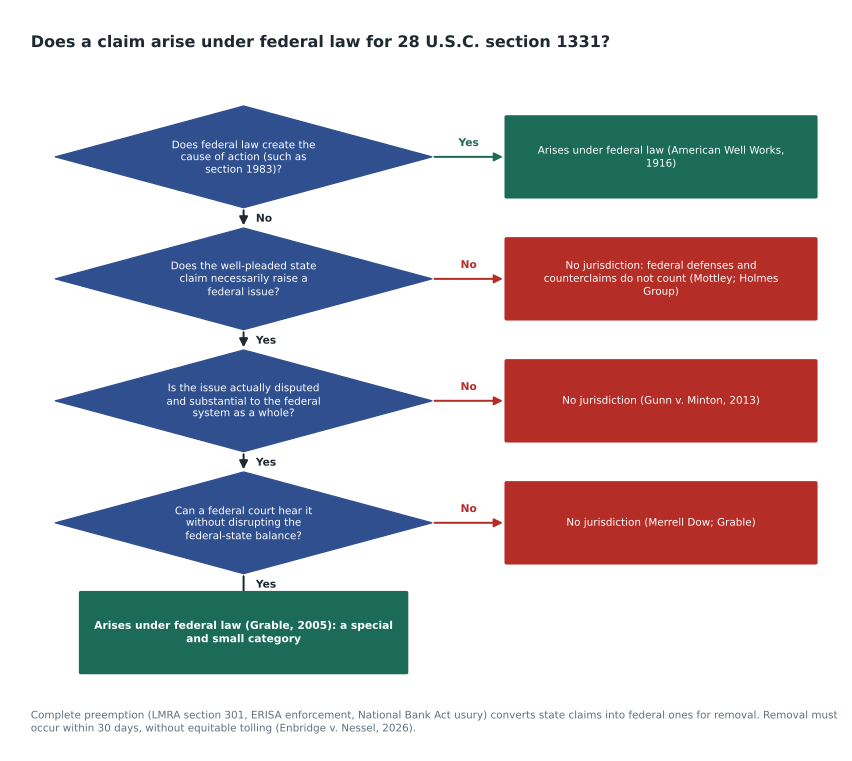
Most federal question cases are easy because federal law creates the cause of action. Justice Holmes stated the classic test in American Well Works Co. v. Layne and Bowler Co. (1916): "A suit arises under the law that creates the cause of action." A claim under 42 U.S.C. section 1983, the Fair Labor Standards Act, Title VII or the federal securities laws arises under federal law whatever defenses are raised. Vashti Marchbank's First Amendment claim against Director Thorsby is brought under section 1983, a federal cause of action, so it falls within section 1331 and the civil rights jurisdiction statute, 28 U.S.C. section 1343. Her claim that the Act is preempted by federal aviation law is also within section 1331. Shaw v. Delta Air Lines (1983) recognized in a footnote that a suit to enjoin state regulation on the ground that federal law preempts it presents a federal question, and Armstrong v. Exceptional Child Center (2015) explained that such suits rest on the courts' traditional equitable power to enjoin unlawful action by state officers, not on any private right of action created by the Supremacy Clause.
The harder category is a state-law claim with an embedded federal issue. Smith v. Kansas City Title and Trust Co. (1921) upheld jurisdiction over a shareholder's state-law suit to stop a company from buying federal farm loan bonds, because the claim depended on whether the federal statute authorizing the bonds was constitutional. Merrell Dow Pharmaceuticals v. Thompson (1986) went the other way. Plaintiffs alleged that a drug's mislabeling under the Federal Food, Drug, and Cosmetic Act was negligence per se under state tort law. Because Congress had not created a private federal remedy for such violations, the Court held that the federal element was not enough to make the claim arise under federal law. For two decades lower courts read Merrell Dow as requiring a federal cause of action in every case, until the Court clarified the test.
Grable and Sons Metal Products v. Darue Engineering and Manufacturing (2005) involved a quiet title action under Michigan law. The IRS had seized Grable's land for unpaid taxes and sold it to Darue. Grable sued to quiet title, alleging that the IRS had not given notice in the manner the Internal Revenue Code required, so Darue's title was invalid. Darue removed, and a unanimous Court, in an opinion by Justice Souter, upheld federal jurisdiction. The question, the Court said, is whether a state-law claim necessarily raises a stated federal issue, actually disputed and substantial, which a federal forum may entertain without disturbing any congressionally approved balance of federal and state judicial responsibilities. The meaning of the federal tax notice provision was the only contested issue in the case, the government has a strong interest in prompt and certain collection of taxes and in the clear title of property it sells, and few quiet title cases would turn on federal tax law, so federal jurisdiction would not flood the courts.
Gunn v. Minton (2013) restated Grable as a four-part test and showed how rarely it is met. Vernon Minton lost a patent infringement suit when his patent was held invalid under the on-sale bar, and his lawyers had failed to raise an argument that might have saved it. He sued them for legal malpractice in Texas state court. The question was whether the malpractice claim arose under federal patent law, which would give federal courts exclusive jurisdiction under 28 U.S.C. section 1338. A unanimous Court, in an opinion by Chief Justice Roberts, held that federal jurisdiction over a state-law claim lies if a federal issue is necessarily raised, actually disputed, substantial and capable of resolution in federal court without disrupting the federal-state balance approved by Congress. The patent issue was necessarily raised and disputed, but it was not substantial in the relevant sense. Substantiality looks to the importance of the issue to the federal system as a whole, not to the parties, and a hypothetical, backward-looking question in a malpractice case would not change any real patent or bind federal courts.
Sefton gives the class a Marchbank variation. Bram Kessling, Vashti's neighbor, pleaded guilty in Merrin County to violating the Act in October 2026 on his lawyer's advice. He later sues the lawyer in Westmarch state court for malpractice, alleging that a competent lawyer would have moved to dismiss on the ground that federal aviation law preempts the Act. The lawyer wants to remove. Jordan Kimura applies Gunn. The preemption question is necessarily raised, because Kessling must prove he would have won, and it is actually disputed. But it is not substantial to the federal system: a state court's answer, in a malpractice case about a closed prosecution, will not bind federal courts or change how the federal government regulates airspace, and state courts routinely decide preemption questions. The case stays in state court. "Grable is a narrow door," Sefton says. "The Court has called it a special and small category, in Empire HealthChoice Assurance v. McVeigh (2006). Do not count on it."
Declaratory judgments get the same treatment. The Declaratory Judgment Act, 28 U.S.C. section 2201, is procedural only; it does not expand federal jurisdiction. Skelly Oil Co. v. Phillips Petroleum Co. (1950) held that a party cannot obtain federal jurisdiction by seeking a declaration that would put a federal defense in the complaint. Courts look to the coercive action that the declaratory defendant could bring: if that hypothetical suit would arise under federal law, the declaratory action does too. Franchise Tax Board v. Construction Laborers Vacation Trust (1983) applied that approach and held that a state tax authority's suit in state court, seeking a declaration that ERISA did not preempt its levy, did not arise under federal law and could not be removed. Steffel-type suits are different: when a person threatened with enforcement of a state law sues the state officer to enjoin it on federal grounds, the claim itself is federal, as in the Marchbank case.
The exception to the well-pleaded complaint rule is complete preemption. In a handful of areas, the Court has found that a federal statute so completely preempts state law that any claim within its scope is necessarily federal, even if pleaded as a state claim, and so removable. Avco Corp. v. Aero Lodge No. 735 (1968) applied the doctrine to claims for breach of a collective bargaining agreement under section 301 of the Labor Management Relations Act. Metropolitan Life Insurance Co. v. Taylor (1987) applied it to claims for benefits under ERISA's civil enforcement provision, and Beneficial National Bank v. Anderson (2003) applied it to usury claims against national banks. Ordinary preemption, by contrast, is a defense and cannot support removal. Caterpillar Inc. v. Williams (1987) emphasized that the plaintiff is the master of the complaint and may avoid federal jurisdiction by relying exclusively on state law. Aviation safety law has not been placed in the complete preemption category by the Supreme Court, so a state suit against Vashti would not become federal merely because she would raise preemption.
Counterclaims do not count either. Holmes Group v. Vornado Air Circulation Systems (2002) held that a counterclaim arising under patent law does not make the case one arising under patent law for appellate purposes, and Vaden v. Discover Bank (2009) held that a federal counterclaim cannot establish jurisdiction to compel arbitration under the Federal Arbitration Act. Home Depot U.S.A. v. Jackson (2019) held that a third-party counterclaim defendant is not a "defendant" who may remove under the general removal statute. In each case the Court looked to the plaintiff's complaint and to the text of the removal statute and declined to let later pleadings change the forum. The result is a system that is predictable but sometimes produces odd outcomes, as when a federal question that dominates the litigation is decided entirely in state court, subject only to Supreme Court review.
Removal is the mirror image of original jurisdiction. Under 28 U.S.C. section 1441(a), a defendant may remove any civil action brought in state court of which the federal district courts have original jurisdiction. All properly joined and served defendants must consent, and the notice of removal must be filed within thirty days after the defendant receives the initial pleading, under section 1446(b). Enbridge Energy, LP v. Nessel (2026) involved Michigan's suit to shut down a pipeline under the Straits of Mackinac. Enbridge removed years after it was served, arguing that the deadline should be equitably tolled. In April 2026 a unanimous Court, in an opinion by Justice Sotomayor, held that the thirty-day deadline is mandatory and cannot be equitably tolled, pointing to the statute's text, the specific exceptions Congress wrote, and the removal scheme's emphasis on resolving forum questions early. The case was remanded to state court. A motion to remand for a procedural defect must be made within thirty days of removal, but a lack of subject matter jurisdiction may be raised at any time.
Supplemental jurisdiction lets federal courts hear related state claims. Under 28 U.S.C. section 1367(a), which codified United Mine Workers v. Gibbs (1966), a district court with original jurisdiction may hear claims that form part of the same case or controversy, meaning they derive from a common nucleus of operative fact. Vashti's state-law claim against Trooper Garrity for conversion of her drone arises from the same seizure as her federal Fourth Amendment claim, so it fits. Section 1367(c) lets a court decline supplemental jurisdiction when the state claim raises novel or complex state issues, predominates, or remains after all federal claims are dismissed. Royal Canin U.S.A. v. Wullschleger (2025) addressed a removed case in which the plaintiff amended her complaint to delete her federal claims. A unanimous Court, in an opinion by Justice Kagan, held that when a plaintiff amends to eliminate the federal claims on which removal rested, the federal court loses supplemental jurisdiction over the remaining state claims and the case must be remanded.
Remand orders are mostly final. Section 1447(d) provides that an order remanding a case to state court is not reviewable on appeal, except in cases removed under the federal officer statute, section 1442, or the civil rights removal statute, section 1443. BP p.l.c. v. Mayor and City Council of Baltimore (2021) held that when a case was removed in part under one of those statutes, the court of appeals may review the entire remand order, including other grounds for removal. Hannah Lindqvist observes that these rules turn forum fights into high-stakes early skirmishes: a defendant who loses a remand motion usually has no appeal, and a plaintiff who wins one keeps the case in state court for good. That is why lawyers draft complaints with forum in mind from the first sentence.
Marcus Webb asks how Vashti's lawyer should draft for federal court. Sefton lists the choices. Plead the First Amendment and Fourth Amendment claims under section 1983, which creates the cause of action. Plead preemption as a claim for equitable relief against Director Thorsby in his official capacity, citing the Supremacy Clause and the courts' equitable power under Armstrong, while recognizing that Armstrong held Congress can displace that power by providing other remedies, and that an aviation preemption claim must show that the specific federal statute or regulation actually preempts the state rule. Plead the state-law conversion claim under section 1367. And include nothing that depends on Grable unless necessary. "Build your jurisdiction on a federal cause of action," she says. "It is the one ground no one can take away from you by clever pleading."
Daniel Reyes asks the opposite question, from the defense side. Suppose the Westmarch Attorney General sues Vashti in state court for civil penalties under the Act. Can she remove? Under Mottley, no: the State's complaint pleads only state law, and her First Amendment and preemption arguments are defenses. Complete preemption does not apply. Federal officer removal is unavailable because she is not a federal officer or acting under one. Civil rights removal under section 1443 is limited by Georgia v. Rachel (1966) and City of Greenwood v. Peacock (1966) to claims based on specific federal laws providing for racial equality, which she cannot invoke. Her federal defenses will be decided by the Westmarch courts, with possible Supreme Court review, unless she can bring her own federal suit first. That possibility, and the doctrines that limit it, are the subject of Lesson 9.
Worked problem
Which claims belong in federal court?
Four claims arise from the drone Act. (A) Vashti sues Director Thorsby under section 1983 for an injunction, alleging the Act violates the First Amendment. (B) Westmarch sues Vashti in state court for civil penalties; she wants to remove because she will argue federal preemption. (C) Kessling sues his former lawyer in state court for malpractice, alleging the lawyer failed to argue preemption. (D) After Vashti's federal suit is filed, she adds a Westmarch-law conversion claim against Trooper Garrity. Which may be heard in federal court?
Show solution
- (A) Yes. Section 1983 creates the cause of action, so the claim arises under federal law under the Holmes test; sections 1331 and 1343 supply jurisdiction.
- (B) No. Under the well-pleaded complaint rule from Mottley, a federal defense does not create federal question jurisdiction, aviation law has not been held to completely preempt state claims, and section 1443 does not apply. Federal jurisdiction would also be unavailable if she sought a declaratory judgment that her defense is valid, under Skelly Oil and Franchise Tax Board.
- (C) No. Under Gunn v. Minton, the federal issue is necessarily raised and disputed but not substantial to the federal system, because a malpractice ruling about a closed case affects no real federal interest.
- (D) Yes, under section 1367(a): the conversion claim arises from the same seizure as her federal claims. The court may decline it under section 1367(c) if the federal claims are dismissed early.
Practice problems
Work each problem on paper first, then reveal the answer to check.
Why did the Supreme Court dismiss the Mottleys' case?
Show answer
Their claim was a state-law contract claim, and the federal statute entered only as the railroad's anticipated defense. Under the well-pleaded complaint rule, a federal defense does not make a case arise under federal law.
What made the federal issue in Grable substantial when the issue in Gunn v. Minton was not?
Show answer
In Grable, the meaning of a federal tax notice provision mattered to the government's ability to collect taxes and sell seized property with clear title. In Gunn, a hypothetical patent question in a malpractice case had no importance to the federal system as a whole.
What did Royal Canin v. Wullschleger (2025) hold?
Show answer
When a plaintiff in a removed case amends to delete the federal claims, the federal court loses supplemental jurisdiction over the state claims and must remand.
Can a defendant remove a case years late if the delay was excusable?
Show answer
No. Enbridge Energy v. Nessel (2026) held that the thirty-day removal deadline in section 1446(b)(1) cannot be equitably tolled.
Summary and key terms
- Article III's arising under clause is broad (Osborn), but section 1331 is read narrowly under the well-pleaded complaint rule (Mottley).
- Most federal question cases arise because federal law creates the cause of action (American Well Works); suits to enjoin preempted state laws rest on equity (Shaw; Armstrong).
- State claims with embedded federal issues qualify only in a special and small category: necessarily raised, actually disputed, substantial and consistent with the federal-state balance (Grable; Gunn).
- Declaratory judgment actions are judged by the hypothetical coercive suit (Skelly Oil; Franchise Tax Board).
- Complete preemption converts claims under a few statutes into federal claims; ordinary preemption is only a defense (Caterpillar).
- Counterclaims and third-party claims do not create removal jurisdiction (Holmes Group; Vaden; Home Depot).
- The thirty-day removal deadline cannot be equitably tolled (Enbridge, 2026); deleting federal claims after removal requires remand (Royal Canin, 2025); remand orders are generally unreviewable (section 1447(d)).
Lesson quiz · 5 questions
Score 60% or more to complete this lesson.
Create a free account to save your progress, take quizzes and earn a certificate.