
LAWU-301 · Lesson 11 of 12 · 24 min
Remedies and the scope of federal relief
▶ Video coming soon A video version of this lesson is on the way.
Sefton opens with a question from Vashti Marchbank, relayed by her lawyer. Vashti does not only want to fly her own drone. She wants a federal court to stop Westmarch from enforcing the Critical Infrastructure Airspace Act against any journalist anywhere in the state, and preferably to declare the law void for everyone. "Clients often think a federal court strikes down a statute the way a legislature repeals one," Sefton says. "That is not how it works. A federal court decides a case between parties and awards remedies to those parties. How far a remedy may reach beyond them has become one of the most important questions in federal courts law, and in 2025 the Supreme Court gave a major answer." The class spends the session on remedies: what federal courts can order, against whom, for whom and on what showing.
Equitable relief comes first. A plaintiff seeking a permanent injunction must show, under eBay Inc. v. MercExchange (2006), that she has suffered an irreparable injury, that legal remedies such as damages are inadequate, that the balance of hardships favors equitable relief and that the public interest would not be disserved. A preliminary injunction, which preserves the status quo pending trial, requires a showing under Winter v. Natural Resources Defense Council (2008) that the plaintiff is likely to succeed on the merits, likely to suffer irreparable harm without relief, that the balance of equities tips in her favor and that an injunction is in the public interest; when the government is the opposing party, the last two factors merge. Elrod v. Burns (1976) held that the loss of First Amendment freedoms, for even minimal periods of time, unquestionably constitutes irreparable injury, which is why First Amendment plaintiffs who show likely success often obtain preliminary relief.
Federal courts' equitable power has a historical limit. Grupo Mexicano de Desarrollo v. Alliance Bond Fund (1999) held that the equitable jurisdiction conferred by the Judiciary Act of 1789 encompasses the remedies traditionally accorded by courts of equity at the founding, so a district court lacked power to freeze a debtor's assets before judgment in a suit for money damages, a remedy English chancery had not provided. Changes to that tradition are for Congress. The same historical approach underlies Armstrong v. Exceptional Child Center (2015), which described suits to enjoin unlawful action by state officers as a creation of courts of equity reflecting a long history of judicial review, while holding that Congress can displace that power by implication, as it did for the Medicaid provision at issue there. And it is the foundation of the Court's 2025 decision on universal injunctions.
Universal injunctions, sometimes called nationwide injunctions, bar the government from enforcing a law or policy against anyone, not just the plaintiffs. They were rare before the 1960s and became common in the last two decades, issued against administrations of both parties on immigration, health care, environmental regulation and other matters. Critics argued that they encouraged forum shopping, prevented the development of law in multiple courts, forced the Supreme Court to decide important questions on emergency applications and gave a single district judge the power to block national policy. Defenders argued that they were sometimes the only way to give plaintiffs complete relief, that they prevented chaotic patchworks of different rules in different places and that the government could seek a stay. Justice Gorsuch had criticized them in a concurrence in Department of Homeland Security v. New York (2020) and again in Labrador v. Poe (2024), and Justice Thomas in Trump v. Hawaii (2018).
Trump v. CASA, Inc. (2025) arose from challenges to Executive Order 14160, which directed federal agencies to deny documents recognizing citizenship to children born in the United States to mothers unlawfully or temporarily present and fathers who were not citizens or lawful permanent residents. Three district courts issued universal injunctions against its enforcement. The government asked the Supreme Court only to narrow the injunctions, not to rule on the order's legality. On June 27, 2025, the Court granted partial stays in a six-to-three opinion by Justice Barrett. It held that universal injunctions likely exceed the equitable authority Congress gave federal courts in the Judiciary Act of 1789, because no analogous form of relief was traditionally available in English chancery, where suits in equity generally bound only the parties. A federal court may issue an injunction no broader than necessary to provide complete relief to each plaintiff with standing to sue.
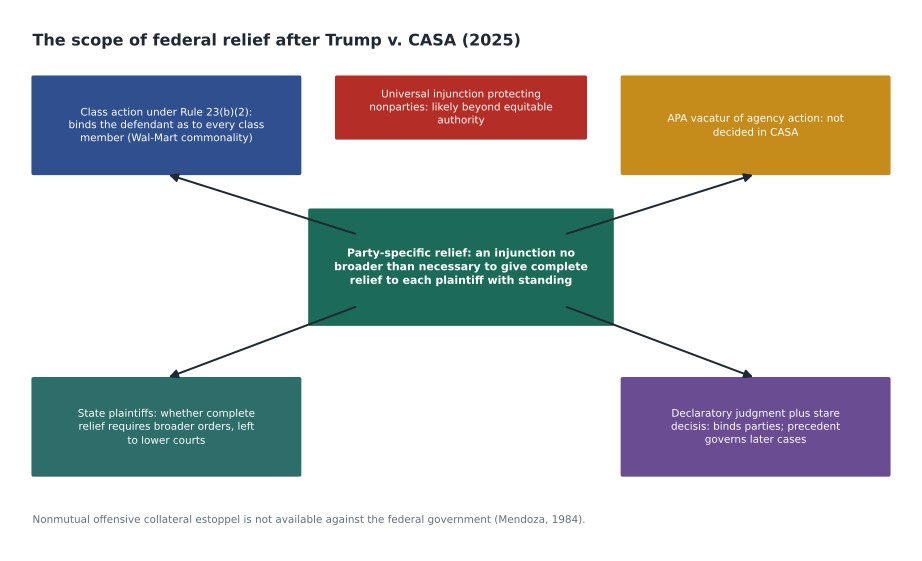
CASA left important questions open. The Court did not decide whether the executive order was lawful. It did not decide whether the state plaintiffs, who argued that a patchwork of citizenship rules would injure them in ways only broad relief could cure, needed broader injunctions to receive complete relief, and it sent that question to the lower courts. It expressly noted that its decision did not resolve whether the Administrative Procedure Act authorizes federal courts to vacate agency action, a remedy many lower courts treat as operating on the rule itself rather than on the parties. And it emphasized that Rule 23 class actions remain available. Justice Alito, joined by Justice Thomas, concurred to warn lower courts against using lax class certification or third-party standing to recreate universal relief, while Justice Kavanaugh's concurrence emphasized that the Supreme Court itself will often be the decision maker on interim status for major national policies. Justice Sotomayor, joined by Justices Kagan and Jackson, dissented, and Justice Jackson wrote separately, warning of a zone of lawlessness in which the executive could violate the rights of anyone who had not sued.
The aftermath showed how the open questions work. Within weeks, a federal district court in New Hampshire certified a nationwide class of children affected by the order and granted a preliminary injunction protecting the class, the route CASA had endorsed. The Supreme Court then took up the merits on an expedited basis, granting certiorari before judgment in Trump v. Barbara and hearing argument in April 2026. On June 30, 2026, the Court held, in an opinion by Chief Justice Roberts joined by Justices Sotomayor, Kagan, Barrett and Jackson, that the executive order violates the Fourteenth Amendment's Citizenship Clause. Justice Kavanaugh concurred in the judgment on statutory grounds, and Justices Thomas, Alito and Gorsuch dissented. Hannah Lindqvist observes that the remedial question and the merits question traveled separately: CASA narrowed who could be protected pending decision, and Barbara decided the legal question for everyone through precedent rather than through an injunction.
Class actions are therefore the main route to broad relief against government policies. Rule 23(b)(2) authorizes a class action when the party opposing the class has acted or refused to act on grounds that apply generally to the class, so that final injunctive or declaratory relief is appropriate respecting the class as a whole. The class must still meet Rule 23(a)'s requirements of numerosity, commonality, typicality and adequacy of representation, and Wal-Mart Stores v. Dukes (2011) held that commonality requires a common contention capable of classwide resolution, one whose truth or falsity will resolve an issue central to each claim in one stroke. Civil rights class actions under Rule 23(b)(2) were the model the rule's drafters had in mind in 1966. In A.A.R.P. v. Trump (2025), decided the month before CASA, the Court granted temporary relief to a putative class of detainees facing removal under the Alien Enemies Act, recognizing that courts may issue interim relief to a putative class while certification is pending.
For Vashti, the remedial lesson is concrete. An injunction in her individual case should protect Vashti, and an associational plaintiff like Friends of Harlan Creek can obtain relief for its members, but under CASA neither can obtain an injunction protecting every journalist in Westmarch. If she wants broader protection, her lawyer should file a class action on behalf of all persons who gather news using drones near covered facilities in Westmarch, seek certification under Rule 23(b)(2) and move for classwide preliminary relief. Marcus Webb points out that the state-court forfeiture action complicates matters: under Younger, as Lesson 9 showed, the federal court must abstain from relief that would interfere with the pending proceeding against Vashti, so another class representative not facing enforcement may be needed. Sefton adds that a class definition tied to concrete conduct, rather than viewpoint or profession alone, will make commonality easier to show.
Declaratory judgments are the other major remedy. The Declaratory Judgment Act authorizes a federal court, in a case of actual controversy within its jurisdiction, to declare the rights and other legal relations of any interested party. Steffel v. Thompson (1974) explained that declaratory relief is a milder alternative to an injunction, appropriate when a prosecution is threatened but not pending. A declaratory judgment binds only the parties, but it has practical force beyond them. A state official who loses a declaratory judgment that a statute is unconstitutional usually stops enforcing it against everyone, both to avoid contempt in later cases and because the decision has precedential weight in the district and, if affirmed, throughout the circuit. Stare decisis, not the injunction, is the mechanism by which federal judicial decisions ordinarily govern people who were not parties.
Preclusion rules reinforce the party-specific model. Taylor v. Sturgell (2008) rejected virtual representation and held that a nonparty is generally not bound by a judgment except in limited categories, such as when the nonparty was adequately represented in a properly certified class action or controlled the prior litigation. United States v. Mendoza (1984) held that the federal government is not subject to nonmutual offensive collateral estoppel: a person who was not a party to an earlier case the government lost may not use that judgment to bar the government from relitigating the issue. The Court reasoned that the government litigates constitutional questions across many cases and circuits and should be able to seek review in more than one court. Mendoza allows legal questions to percolate among the circuits before the Supreme Court resolves them, the very value that critics of universal injunctions said those injunctions defeated.
Structural injunctions are a distinctive federal remedy. After Brown v. Board of Education, Brown II (1955) directed district courts to supervise desegregation with all deliberate speed, and Swann v. Charlotte-Mecklenburg Board of Education (1971) approved busing and other broad remedies. Milliken v. Bradley (1974) limited remedies to the scope of the violation, rejecting an interdistrict remedy where suburban districts had not themselves discriminated, and Missouri v. Jenkins (1995) rejected remedial measures designed to attract white students from outside the district. Lewis v. Casey (1996) held that a prison access-to-courts remedy must be tailored to actual injuries proved. Brown v. Plata (2011) upheld a three-judge court's order requiring California to reduce its prison population to remedy unconstitutional medical and mental health care. The Prison Litigation Reform Act requires that prospective relief in prison cases be narrowly drawn, extend no further than necessary and be the least intrusive means of correcting the violation, and allows termination of relief after two years absent ongoing violations. Rufo v. Inmates of Suffolk County Jail (1992) and Horne v. Flores (2009) allow modification of decrees when circumstances change.
Damages complete the remedial picture. Compensatory damages in section 1983 cases are governed by common law tort principles, as Carey v. Piphus (1978) held, so a plaintiff denied procedural due process who cannot prove actual injury recovers only nominal damages. Punitive damages are available against individual officers who acted with reckless or callous indifference to federally protected rights under Smith v. Wade (1983), but not against municipalities. Nominal damages, as Uzuegbunam v. Preczewski (2021) held, redress completed violations and keep cases alive. And section 1988 allows a prevailing party to recover reasonable attorney's fees. Buckhannon Board and Care Home v. West Virginia Department of Health and Human Resources (2001) rejected the catalyst theory, under which a plaintiff whose suit prompted a voluntary change counted as prevailing. Lackey v. Stinnie (2025) held, seven to two in an opinion by Chief Justice Roberts, that a plaintiff who obtains a preliminary injunction but whose case becomes moot before final judgment is not a prevailing party, because preliminary relief does not conclusively resolve the rights of the parties on the merits.
Daniel Reyes connects Lackey to the Marchbank file. Suppose Vashti obtains a preliminary injunction in January 2027, and the legislature then amends the Act to exempt journalists, mooting her prospective claims. Under Lackey, she would not be a prevailing party entitled to fees for the injunction, and under Buckhannon the legislature's response to her suit would not count either. Her damages claims, if they survive qualified immunity, might still produce a judgment that makes her a prevailing party. Sefton says this is the kind of practical calculation that shapes civil rights litigation: plaintiffs' lawyers working on fee-shifting cases must think about how a case might end, not only how it begins, and a defendant can sometimes avoid a fee award by changing its policy before final judgment.
Emergency relief in the Supreme Court has become a remedial arena of its own. When a lower court grants or denies a preliminary injunction against a major government policy, the losing party often asks the Supreme Court for a stay or an injunction pending appeal. The Court applies the Nken v. Holder (2009) factors for stays, including likelihood of success and irreparable harm, and it has said that a stay applicant must also show a reasonable probability that the Court would grant certiorari. Since 2020 the Court has decided many significant questions on this emergency docket, sometimes with short unsigned orders and sometimes with full opinions after argument, as in CASA. Jordan Kimura notes that the Court's 2025 grant-termination orders in Department of Education v. California and NIH v. American Public Health Association, discussed in Lesson 7, came through that docket, and lower courts have treated such orders as signals about how the Court is likely to rule.
Sefton closes with the theme of the course. Each doctrine studied this semester, standing, ripeness, mootness, sovereign immunity, abstention and the limits of habeas, narrows who may sue whom in federal court and when. The law of remedies narrows what the court can give when a plaintiff wins. Together they describe a judiciary that decides cases between parties, leaves broad questions to the political branches and the states where it can, and relies on precedent rather than sweeping orders to make its decisions general. "You can admire that design or criticize it," she says, "and many thoughtful judges and scholars do each. But you cannot litigate effectively in federal court without understanding it, because every case you file will be measured against it from the caption to the remedy."
Worked problem
Designing the relief request
Vashti's lawyer drafts the prayer for relief. She wants (a) an injunction barring enforcement of the Act against any journalist in Westmarch; (b) a declaration that the Act is unconstitutional; (c) a preliminary injunction while the case proceeds; (d) compensatory, nominal and punitive damages; and (e) attorney's fees. How should each request be framed after CASA?
Show solution
- (a) Under Trump v. CASA (2025), an injunction must be no broader than necessary to give complete relief to each plaintiff with standing. Limit it to Vashti and the identified members of Friends of Harlan Creek, or file a Rule 23(b)(2) class action on behalf of drone newsgatherers near covered facilities and seek classwide relief, satisfying commonality under Wal-Mart.
- (b) A declaration binds only the parties, but it will have precedential effect and will usually lead the State to stop enforcement generally; request it against Director Thorsby, the proper Ex parte Young defendant.
- (c) A preliminary injunction requires likely success, irreparable harm (Elrod v. Burns treats lost First Amendment freedoms as irreparable), and balance of equities and public interest (Winter). Younger may bar relief interfering with the pending forfeiture action against Vashti herself.
- (d) Compensatory and nominal damages against Trooper Garrity (subject to qualified immunity) and the City (Monell); punitive damages only against Garrity and only on a showing of reckless or callous indifference (Smith v. Wade).
- (e) Fees under section 1988 only if she prevails on the merits; under Lackey v. Stinnie (2025), a preliminary injunction alone does not make her a prevailing party if the case becomes moot.
Practice problems
Work each problem on paper first, then reveal the answer to check.
What did Trump v. CASA (2025) hold about universal injunctions?
Show answer
That they likely exceed the equitable authority Congress gave federal courts in the Judiciary Act of 1789, because no analogous relief was traditionally available in equity; injunctions may be no broader than necessary to give complete relief to each plaintiff with standing.
What questions did CASA leave open?
Show answer
The legality of the executive order, whether the state plaintiffs needed broader relief for complete relief, and whether the APA authorizes vacatur of agency action; it also confirmed that Rule 23 class actions remain available.
Why does United States v. Mendoza matter to the debate over nationwide relief?
Show answer
Because it bars nonparties from using offensive collateral estoppel against the federal government, preserving relitigation and percolation among circuits, which universal injunctions tended to cut short.
What did Lackey v. Stinnie (2025) hold?
Show answer
That a plaintiff who wins a preliminary injunction but whose case becomes moot before final judgment is not a prevailing party entitled to fees under section 1988.
Summary and key terms
- Permanent injunctions require the eBay factors; preliminary injunctions require the Winter factors; lost First Amendment freedoms are irreparable harm.
- Federal equitable power is measured by traditional equity at the founding (Grupo Mexicano).
- Trump v. CASA (2025) held universal injunctions likely exceed federal courts' authority; relief must be no broader than necessary for complete relief to plaintiffs with standing.
- CASA left open state plaintiffs' need for broader relief and APA vacatur, and preserved Rule 23 class actions; a nationwide class followed, and Trump v. Barbara (2026) decided the merits.
- Declaratory judgments bind parties, but stare decisis gives decisions general effect; Mendoza bars nonmutual offensive estoppel against the federal government.
- Structural injunctions must match the scope of the violation (Milliken; Lewis v. Casey), with PLRA limits in prison cases.
- Damages follow tort principles (Carey); punitive damages lie against individuals (Smith v. Wade); fees require prevailing on the merits (Buckhannon; Lackey, 2025).
Lesson quiz · 5 questions
Score 60% or more to complete this lesson.
Create a free account to save your progress, take quizzes and earn a certificate.