
LAWU-301 · Lesson 1 of 12 · 25 min
The federal judicial power and congressional control
▶ Video coming soon A video version of this lesson is on the way.
Professor Ludmila Sefton begins the first class of Federal Courts by writing a single sentence on the board: "Before you ask whether you win, ask whether this court may hear you." Sefton clerked for a federal district judge and then at the Supreme Court, spent seven years in a federal defender's capital habeas unit, and then spent four years in the Westmarch Attorney General's office defending state officers in civil rights suits. "I have argued both sides of almost every doctrine in this course," she tells Section B, now in its third year. "That is the point of the course. Federal courts law is the law of who decides. Every doctrine you will meet is an answer to one question: when should a federal judge, appointed for life and answerable to no voter, decide a dispute instead of a state court, an agency or the political branches?"
She then introduces the file the class will carry through the semester. Vashti Marchbank is a freelance journalist in Brennan Falls who publishes a newsletter called Merrin Skywatch. She uses a small camera drone to photograph public infrastructure, and in the summer of 2026 she began photographing the exterior of the Harlan Creek Correctional Facility, a state prison, after reports of overcrowding. Westmarch had just enacted the Critical Infrastructure Airspace Act, which makes it a misdemeanor to fly a drone below 400 feet within 500 feet of a prison, power substation or water treatment plant without a permit. In August 2026 Trooper Neil Garrity of the Westmarch State Patrol stopped her on a county road, seized her drone and told her she would be charged if she flew again. All of these people and places are fictional. "Vashti wants to go to federal court," Sefton says. "Our job is to find out whether she can, against whom, and for what."
The starting point is Article III. Section 1 vests "the judicial power of the United States" in one Supreme Court and "in such inferior courts as the Congress may from time to time ordain and establish," and gives judges tenure during good behavior and salaries that cannot be reduced. Section 2 lists nine categories of cases and controversies to which the judicial power extends. Some depend on the subject matter: cases arising under the Constitution, federal laws and treaties; cases affecting ambassadors; admiralty and maritime cases. Others depend on the parties: controversies to which the United States is a party, controversies between two or more states, between citizens of different states, and several others involving states, foreign states and their citizens. Section 2 also gives the Supreme Court original jurisdiction in cases affecting ambassadors and those in which a state is a party, and appellate jurisdiction in the rest, "with such exceptions, and under such regulations as the Congress shall make."
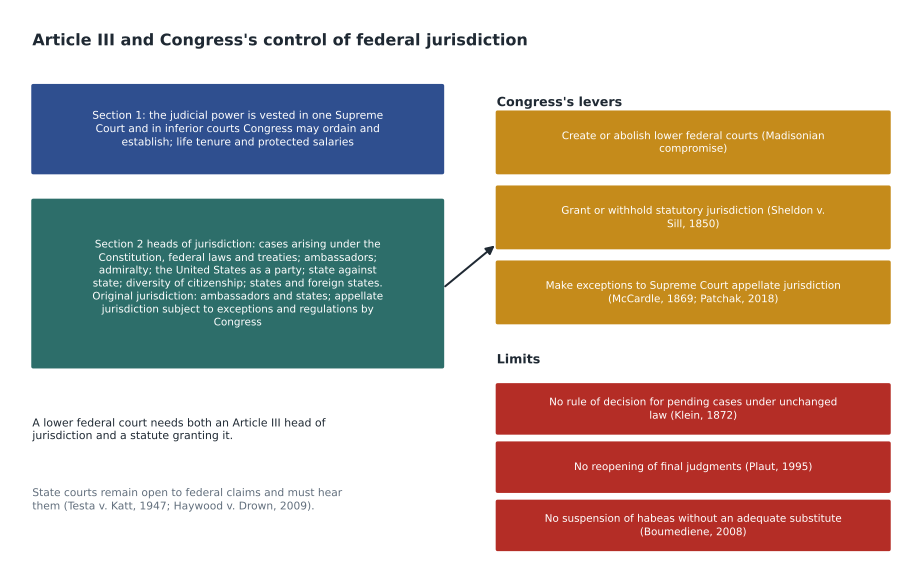
Two features of that text shape the whole course. First, Article III sets the outer limit of federal judicial power, but it does not itself confer jurisdiction on any lower court. Because Congress need not create lower federal courts at all, the traditional view, stated in Sheldon v. Sill (1850), is that Congress may give them as much or as little of the Article III menu as it chooses. Lower federal courts therefore need two things for every case: a head of Article III jurisdiction and a statute granting it. For many decades after 1789 Congress did not give the lower courts general federal question jurisdiction at all; that grant arrived only in 1875 and survives as 28 U.S.C. section 1331. Second, the words "cases" and "controversies" limit what kind of dispute a federal court may decide, which is the source of standing, ripeness, mootness and the political question doctrine in the next two lessons.
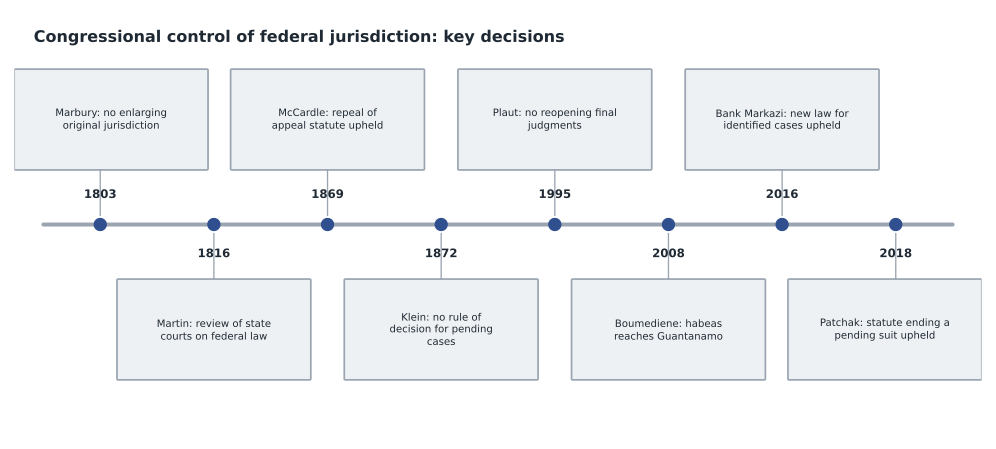
Marbury v. Madison (1803) is usually taught for judicial review, but Sefton teaches it as a jurisdiction case. William Marbury sought a writ of mandamus in the Supreme Court's original jurisdiction, relying on section 13 of the Judiciary Act of 1789. Chief Justice Marshall held that Marbury had a right to his commission and a remedy, but that Congress could not add to the Supreme Court's original jurisdiction beyond the categories in Article III, so section 13 was unconstitutional as applied and the Court lacked jurisdiction. "Notice the structure," Sefton says. "The Court asserted the power to say what the law is in the very case in which it said it could not give Marbury anything." The lesson for litigators is that jurisdiction comes first, and a court that lacks it has no power to reach the merits, a principle the modern Court restated in Steel Co. v. Citizens for a Better Environment (1998), which rejected so-called hypothetical jurisdiction.
Martin v. Hunter's Lessee (1816) established the other pillar: the Supreme Court's appellate power over state courts in federal cases. Virginia's highest court refused to obey a Supreme Court mandate in a land dispute governed by a treaty, reasoning that the Supreme Court could not review the judgment of a sovereign state's court. Justice Story rejected that view. Article III extends the judicial power to all cases arising under federal law, whatever court they begin in, and uniformity of federal law across the states requires a single court with the last word. Cohens v. Virginia (1821) extended the principle to criminal cases in which a state is a party. Lesson 5 returns to how that review works today under 28 U.S.C. section 1257, including the adequate and independent state ground doctrine.
Congress's power over jurisdiction is broad but not unlimited, and the class spends most of the hour on the cases at its edges. Ex parte McCardle (1869) is the famous example of power. William McCardle, a Mississippi newspaper editor held by the military under Reconstruction legislation, appealed the denial of habeas corpus to the Supreme Court under an 1867 statute. After argument, Congress repealed the part of the 1867 Act that authorized the appeal. The Court dismissed for want of jurisdiction, saying that without jurisdiction it could not proceed at all. But the Court added that its jurisdiction under the Judiciary Act of 1789 remained, and later that year, in Ex parte Yerger (1869), it confirmed that it could still review habeas cases through an original writ. McCardle thus shows both a real congressional power to withdraw an avenue of review and the importance of whether another avenue remains open.
United States v. Klein (1872) marks the limit. Congress had promised to return the property of Confederate sympathizers who proved loyalty, and the Court had held that a presidential pardon proved loyalty. Congress then passed a statute providing that a pardon was proof of disloyalty and directing courts to dismiss such claims for want of jurisdiction. The Court refused to apply it, holding that Congress had passed the limit between legislative and judicial power by prescribing a rule of decision for a pending case and by impairing the effect of a pardon. Klein is famously hard to apply, and the modern Court has read it narrowly. In Bank Markazi v. Peterson (2016), the Court upheld a statute that changed the law applicable to a specific, identified set of consolidated cases, because Congress had amended the law and left the courts to apply it to the facts.
Patchak v. Zinke (2018) pushed further. David Patchak sued to challenge the Interior Department's acquisition of land in trust for a tribe to operate a casino. While the suit was pending, Congress passed the Gun Lake Trust Land Reaffirmation Act, which provided that actions relating to that land "shall not be filed or maintained in a Federal court" and "shall be promptly dismissed." A plurality led by Justice Thomas held that the statute was a valid exercise of Congress's power to strip jurisdiction, because it changed the law by removing jurisdiction over a class of cases rather than directing a result under old law. Chief Justice Roberts, dissenting with Justices Kennedy and Gorsuch, argued that a statute aimed at one pending lawsuit and commanding its dismissal was exactly what Klein forbade. Priya Natarajan, who wants to be an appellate lawyer, points out that the plurality, combined with concurrences on other grounds, left the scope of Klein unsettled.
Two more limits are settled. Plaut v. Spendthrift Farm (1995) holds that Congress may not require federal courts to reopen final judgments, because Article III gives courts the power to render dispositive judgments, not advisory ones that the legislature may revise. Hayburn's Case (1792), the old pension case, stands for a related principle: federal judges may not be made to issue decisions subject to revision by the executive. And Congress may not use its jurisdiction power to accomplish ends forbidden by other parts of the Constitution, such as stripping jurisdiction only over claims brought by members of one religion. Scholars debate a deeper question that the Court has never resolved: whether Congress may close every federal forum, including the Supreme Court's appellate jurisdiction, to an entire category of constitutional claims. Justice Story, in Martin, suggested that Congress was obliged to vest the whole judicial power in some federal court; Professor Henry Hart, in a famous 1953 dialogue, suggested that exceptions may not destroy the Supreme Court's essential role in the constitutional plan; others read the text as plenary.
When a statute is ambiguous, the Court avoids the hard constitutional question. Webster v. Doe (1988) held that a statute giving the CIA director discretion to fire employees did not bar colorable constitutional claims, because the Court requires a clear statement before reading a statute to deny any judicial forum for constitutional claims. INS v. St. Cyr (2001) applied the same clear statement approach to habeas corpus and read immigration statutes to preserve review of questions of law. Boumediene v. Bush (2008) went further and held that the Military Commissions Act of 2006 unconstitutionally suspended the writ for detainees at Guantanamo Bay, because Congress had not provided an adequate substitute. "So the answer to how far Congress can go," Sefton says, "is that Congress can go far, but the Court will make it say so clearly, and there is a floor when liberty or a constitutional right would be left with no court at all."
The other structural question is which tribunals may exercise the judicial power at all. Article III judges have life tenure and protected salaries, but Congress has created many decision makers without those protections: territorial courts, military courts, bankruptcy judges, magistrate judges and agency adjudicators. Section B studied the agency side in Administrative Law with Professor Haverford, including the public rights doctrine and SEC v. Jarkesy (2024), which held that the Seventh Amendment required a jury when the SEC sought civil penalties for securities fraud. In federal courts, the key cases are Northern Pipeline (1982) and Stern v. Marshall (2011), which held that non-Article III bankruptcy judges could not enter final judgment on certain state-law counterclaims, and Wellness International Network v. Sharif (2015), which held that litigants may knowingly consent to adjudication by a bankruptcy judge. Magistrate judges, likewise, may conduct civil trials with the parties' consent under 28 U.S.C. section 636(c).
Sefton closes the history with the modern structure. There are 94 federal district courts, with at least one in every state, and 13 courts of appeals: 11 numbered regional circuits, the District of Columbia Circuit and the Federal Circuit, which hears patent appeals and appeals from the Court of Federal Claims and other specialized tribunals. The Supreme Court's appellate jurisdiction is almost entirely discretionary, by writ of certiorari, under 28 U.S.C. sections 1254 and 1257; mandatory appeals survive mainly for decisions of three-judge district courts under 28 U.S.C. section 1253, such as some redistricting cases. For the semester, Westmarch is assumed to have one federal district, the District of Westmarch, sitting in Brennan Falls before Judge Leocadia Bramwell, and its appeals go to a fictional regional circuit that the class simply calls "the circuit."
Marcus Webb, the engineer, asks the practical question. "If Vashti files in the District of Westmarch, what has to be true on page one?" Sefton answers with the checklist the class will use all term. First, a statutory grant: section 1331 for federal questions, section 1332 for diversity, section 1343 for civil rights actions or a specific statute. Second, a constitutional head of jurisdiction: here, a case arising under the First Amendment and perhaps federal aviation law. Third, a justiciable case or controversy: standing, ripeness and mootness. Fourth, no barrier from sovereign immunity or another immunity. Fifth, no reason for the federal court to decline jurisdiction that it has, under abstention or a statute like the Anti-Injunction Act. Sixth, a cause of action and a remedy the court may award. "Every week, we add a box," she says.
The Westmarch legislature gives the class a live hypothetical. Suppose Congress, lobbied by utilities, passes a federal Critical Infrastructure Protection Act of 2027 that does three things. Section 1 preempts state drone laws stricter than federal rules. Section 2 provides that no federal district court shall have jurisdiction to hear a First Amendment challenge to any state drone law, leaving those claims to state courts with Supreme Court review. Section 3 provides that in Marchbank v. Thorsby, a pending case, the court shall enter judgment for the defendants. Hannah Lindqvist, the former history teacher, works through it aloud. Section 2 looks like Sheldon v. Sill: Congress may withhold lower court jurisdiction, and state courts and the Supreme Court remain available, so a forum exists. Section 3 is Klein in its purest form, a direction to decide a named pending case for one side without changing any law. Even after Bank Markazi and Patchak, a command to enter judgment for named defendants under unchanged law is very likely unconstitutional.
Jordan Kimura raises the federalism side. State courts are courts of general jurisdiction, presumed competent to hear federal claims, and under the Supremacy Clause they may not refuse to hear them out of hostility to federal law. Testa v. Katt (1947) held that a state court could not refuse to enforce a federal statute when it heard analogous state claims, and Haywood v. Drown (2009) held that New York could not strip its courts of jurisdiction over section 1983 damages suits against prison guards while hearing similar claims. That is part of why Congress's power to withhold lower federal court jurisdiction is less frightening than it sounds: the state courts remain bound to apply federal law, and the Supreme Court can review them. Federal jurisdiction is exclusive only where Congress makes it so, as for federal criminal prosecutions, patent claims, bankruptcy and some securities claims.
Sefton ends with a warning about vocabulary that the class will see all semester. The word "jurisdictional" has consequences: a jurisdictional rule cannot be waived or forfeited, courts must raise it on their own, and a judgment entered without jurisdiction can be attacked on direct appeal at any time. The Court has spent two decades policing the label. Arbaugh v. Y and H Corp. (2006) adopted a clear statement rule: a statutory limit is jurisdictional only if Congress clearly says so; otherwise it is a claim-processing rule or an element of the claim. Recent cases follow that approach, holding many filing deadlines nonjurisdictional. The 2026 decision in Enbridge Energy v. Nessel, discussed in Lesson 4, held that the thirty-day removal deadline cannot be equitably tolled. "When you read a statute," Sefton says, "ask whether it speaks to the court's power or to the parties' obligations. The answer can decide your case before anyone reaches the merits."
Worked problem
Can Congress do this?
A hypothetical federal statute provides: (1) No court of the United States other than the Supreme Court shall have jurisdiction over any claim that a state drone law violates the First Amendment. (2) The Supreme Court shall have no appellate jurisdiction over state court judgments in such cases. (3) In any such case pending on the date of enactment, the court shall dismiss with prejudice. Evaluate each section.
Show solution
- Section 1 withdraws lower federal court jurisdiction over a category of federal claims. Under Sheldon v. Sill and the traditional view of the Madisonian compromise, Congress may decline to vest lower courts with any particular part of the Article III menu. State courts remain open and must hear the claims under Testa and Haywood, so the provision is very likely valid, subject only to the rule that jurisdiction may not be withdrawn for an independently unconstitutional purpose.
- Section 2 is harder. Combined with Section 1 it would leave state courts as the final word on a federal constitutional question, with no federal review at all. McCardle supports broad power over the Supreme Court's appellate jurisdiction, but the Court has never upheld a statute that closed every federal door to a class of constitutional claims, and Webster v. Doe and St. Cyr show it will demand a clear statement. Many scholars argue such a statute would undermine the Supreme Court's essential function of keeping federal law uniform.
- Section 3 commands dismissal with prejudice of pending cases. If it merely applied new jurisdictional rules to pending cases, Patchak suggests it might survive. But dismissal with prejudice is a merits disposition, and if it reaches cases already decided, Plaut forbids it. Applied to pending cases without changing substantive law, it most closely resembles Klein.
- A careful brief would argue Sections 2 and 3 separately and ask the court to sever them from Section 1.
Practice problems
Work each problem on paper first, then reveal the answer to check.
Why does a federal district court need both Article III and a statute to hear a case?
Show answer
Article III sets the outer limit of federal judicial power but does not itself vest jurisdiction in lower courts. Because Congress need not create lower courts, it decides how much of the Article III menu to give them, as Sheldon v. Sill (1850) held.
What did Ex parte McCardle hold, and why does Ex parte Yerger matter to it?
Show answer
McCardle upheld Congress's repeal of the statute authorizing McCardle's habeas appeal, even after argument. Yerger, decided later the same year, confirmed that the Supreme Court could still review habeas cases by original writ under the 1789 Act, so the repeal closed one avenue but not all.
How did the plurality in Patchak v. Zinke distinguish Klein?
Show answer
It said the Gun Lake Act changed the law by withdrawing jurisdiction over a class of cases, rather than directing a result under old law, so it was a valid exercise of Congress's power over jurisdiction.
What does Plaut v. Spendthrift Farm forbid?
Show answer
Congress may not require federal courts to reopen final judgments, because Article III gives courts the power to render dispositive judgments.
Summary and key terms
- Article III, section 2, lists nine categories of cases and controversies; it is the outer limit of federal judicial power.
- Lower federal courts need a statutory grant as well as an Article III head of jurisdiction, because Congress may create them and define their jurisdiction.
- Marbury v. Madison held that Congress cannot enlarge the Supreme Court's original jurisdiction; Martin v. Hunter's Lessee established Supreme Court review of state courts on federal questions.
- Ex parte McCardle and Patchak v. Zinke show broad congressional power to withdraw jurisdiction; Klein forbids prescribing a rule of decision without changing the law; Plaut forbids reopening final judgments.
- The Court requires a clear statement before reading a statute to deny any forum for constitutional claims, and Boumediene shows that the Suspension Clause sets a floor for habeas.
- State courts must hear federal claims (Testa v. Katt, Haywood v. Drown), which tempers the effect of withdrawing lower court jurisdiction.
- A limit is jurisdictional only if Congress clearly makes it so (Arbaugh).
Lesson quiz · 5 questions
Score 60% or more to complete this lesson.
Create a free account to save your progress, take quizzes and earn a certificate.