
LAWU-301 · Lesson 7 of 12 · 24 min
Sovereign immunity
▶ Video coming soon A video version of this lesson is on the way.
Sefton puts the caption of Vashti Marchbank's draft complaint on the screen. It names six defendants: the State of Westmarch; the Westmarch Department of Public Safety; Rupert Thorsby, Director of the Department, "in his official capacity"; Trooper Neil Garrity, "individually"; Felicity Crane, Merrin County Attorney, "in her official capacity"; and the City of Brennan Falls, whose police department helps enforce the Act near the city's water treatment plant. It seeks a declaration that the Act is unconstitutional, an injunction against enforcement, return of the drone, compensatory damages and nominal damages. "Two of these defendants should not be in this caption," Sefton says, "and the relief requested has to be matched defendant by defendant. That is what sovereign immunity doctrine is for. It is the single most important filter on suits against state governments."
The doctrine's history begins with a surprise. In Chisholm v. Georgia (1793), the executor of a South Carolina merchant sued Georgia in the Supreme Court's original jurisdiction to collect a Revolutionary War debt. The Court held, four to one, that Article III's grant of jurisdiction over controversies between a state and citizens of another state allowed the suit. The reaction was swift. Congress proposed, and the states ratified in 1795, the Eleventh Amendment: "The Judicial power of the United States shall not be construed to extend to any suit in law or equity, commenced or prosecuted against one of the United States by Citizens of another State, or by Citizens or Subjects of any Foreign State." Read literally, the text bars only suits against a state by citizens of other states or of foreign countries in federal court.
The Court has never read it literally. Hans v. Louisiana (1890) held that a Louisiana citizen could not sue Louisiana in federal court to collect on state bonds, even though his claim arose under the Contracts Clause and the text of the Amendment did not cover him. The Court reasoned that the Amendment confirmed a background principle of state sovereign immunity that the Constitution had always preserved, and that Chisholm had misread. Later cases extended the principle to suits by foreign nations (Principality of Monaco v. Mississippi, 1934), suits by Indian tribes (Blatchford v. Native Village of Noatak, 1991), admiralty suits (Ex parte New York, 1921) and federal agency adjudications brought by private parties (Federal Maritime Commission v. South Carolina State Ports Authority, 2002). The immunity, in the modern Court's phrase, is not derived from the Eleventh Amendment but from the structure of the original Constitution.
Alden v. Maine (1999) took the next step. Probation officers sued Maine in its own courts for overtime under the federal Fair Labor Standards Act after their federal suit had been dismissed. In a five-to-four opinion by Justice Kennedy, the Court held that Congress cannot subject nonconsenting states to private suits for damages in their own courts under Article I powers, because the immunity is a fundamental aspect of state sovereignty that the states enjoyed before ratification. Franchise Tax Board of California v. Hyatt (2019), also five to four, overruled Nevada v. Hall (1979) and held that states are immune from private suits in the courts of other states. Justice Breyer's dissents in these cases argued that the Court was enforcing an unwritten immunity at odds with the constitutional text and with the principle that every right should have a remedy.
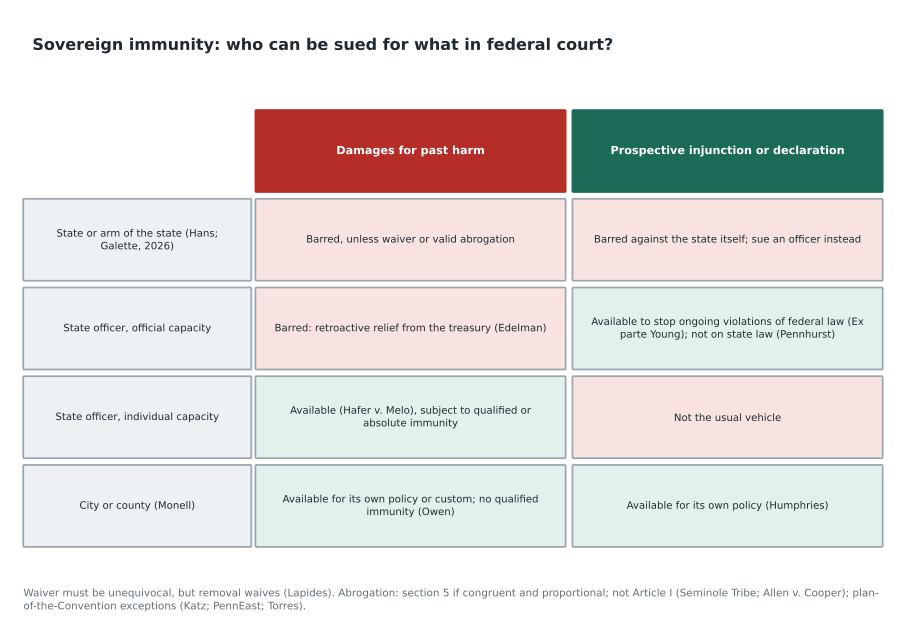
Who counts as "the state"? The state itself and its departments and agencies are protected. Political subdivisions such as counties, cities and school districts are not: Lincoln County v. Luning (1890) and Mount Healthy City School District v. Doyle (1977) treated them like corporations, and they may be sued in federal court subject to other doctrines. In between are entities the state creates, such as transit authorities, universities and bistate compacts. Hess v. Port Authority Trans-Hudson Corp. (1994) emphasized whether a judgment against the entity would be paid from the state treasury. Galette v. New Jersey Transit Corp. (2026), decided unanimously in March 2026 in an opinion by Justice Sotomayor, addressed whether NJ Transit could claim New Jersey's interstate sovereign immunity in suits by people injured by its buses in New York and Pennsylvania. The Court held it could not, focusing mainly on whether the state structured the entity as legally separate and responsible for its own judgments: NJ Transit was a corporation with ordinary corporate powers, and state law barred holding New Jersey liable for its debts, so substantial state control and a statutory label calling it an instrumentality of the state did not make it an arm of the state.
There are three ways around a state's immunity. The first is consent. A state may waive its immunity, but the Court requires an unequivocal expression, and College Savings Bank v. Florida Prepaid Postsecondary Education Expense Board (1999) rejected the idea of constructive waiver by participating in a federally regulated activity. Sossamon v. Texas (2011) held that a state's acceptance of federal funds under a statute authorizing "appropriate relief" against governments did not waive immunity from damages. Waiver by litigation conduct is different. Lapides v. Board of Regents of the University System of Georgia (2002) held that a state that removes a case from its own courts to federal court waives its immunity from suit in federal court on the state-law claims it removed, because a state cannot invoke federal jurisdiction and then deny it. State tort claims acts that consent to suit in state court do not, without more, consent to suit in federal court.
The second way around immunity is abrogation by Congress. Fitzpatrick v. Bitzer (1976) held that Congress may abrogate state immunity when it legislates under section 5 of the Fourteenth Amendment, because that Amendment was specifically designed to limit state power. Seminole Tribe of Florida v. Florida (1996) held that Congress may not abrogate state immunity under its Article I powers, such as the Commerce Clause, overruling Pennsylvania v. Union Gas (1989). Section 5 legislation, in turn, must be congruent and proportional to a pattern of unconstitutional state conduct under City of Boerne v. Flores (1997). Applying that test, the Court has struck down abrogation in the Age Discrimination in Employment Act (Kimel, 2000) and Title I of the Americans with Disabilities Act (Garrett, 2001), but upheld it for the family leave provisions of the Family and Medical Leave Act (Nevada v. Hibbs, 2003) and for Title II of the ADA as applied to access to courts (Tennessee v. Lane, 2004).
Allen v. Cooper (2020) is the cleanest modern example. Frederick Allen, a videographer, documented the salvage of Blackbeard's flagship, the Queen Anne's Revenge, off North Carolina, and sued the state for posting his copyrighted videos online. Congress had abrogated state immunity for copyright infringement in the Copyright Remedy Clarification Act of 1990. The Court, unanimous in the judgment, held the abrogation invalid in an opinion by Justice Kagan. Article I's Intellectual Property Clause could not support it under Seminole Tribe, and Congress had not shown a pattern of intentional, unremedied state infringement sufficient to justify the statute as section 5 legislation, as Florida Prepaid had held for a similar patent statute in 1999. The result is that a state university may infringe a copyright or patent and the owner may be unable to recover damages from the state, though suits for prospective relief against officials remain available.
The Court has also recognized that the states, by ratifying the Constitution, surrendered their immunity in a few areas, the "plan of the Convention" exceptions. Central Virginia Community College v. Katz (2006) held that states cannot assert immunity against a bankruptcy trustee's proceedings to recover preferential transfers. PennEast Pipeline Co. v. New Jersey (2021) held that states consented in the plan of the Convention to the federal government's eminent domain power, including when Congress delegates it to private pipeline companies. Torres v. Texas Department of Public Safety (2022) held that states consented to suits under Congress's power to raise and support armed forces, allowing a returning Army reservist to sue his state employer under the Uniformed Services Employment and Reemployment Rights Act. Each was five to four, and the boundaries of the category remain contested.
The third way around immunity is the most important in practice: suits against state officers. Ex parte Young (1908) arose when Minnesota enacted railroad rate laws with crushing penalties. Railroad shareholders sued in federal court to enjoin the state attorney general, Edward Young, from enforcing them. When Young defied the injunction by suing in state court, he was held in contempt and sought habeas corpus in the Supreme Court. The Court held that a suit to enjoin a state officer from enforcing an unconstitutional statute is not a suit against the state, because an officer who acts unconstitutionally is "stripped of his official or representative character." The reasoning is a famous fiction, since the same act counts as state action for Fourteenth Amendment purposes, but it is the foundation of modern civil rights litigation. The officer must have some connection with enforcement of the challenged law, and the suit must seek prospective relief against an ongoing violation of federal law.
The prospective-retrospective line was drawn in Edelman v. Jordan (1974). Illinois officials had wrongfully delayed welfare payments, and the district court ordered them to pay the benefits that had been wrongfully withheld. The Court held that the order, although framed as equitable relief against officers, was in practice an award of damages from the state treasury for past violations and was barred. Prospective relief that has an ancillary effect on the treasury, such as the cost of complying with a desegregation decree in Milliken v. Bradley (1977) or attorney's fees, is permitted. Verizon Maryland v. Public Service Commission (2002) described the inquiry as a straightforward one: does the complaint allege an ongoing violation of federal law and seek relief properly characterized as prospective? Vashti's request for an injunction against future enforcement fits easily. Her request that Director Thorsby pay for her drone does not.
Young has limits. Pennhurst State School and Hospital v. Halderman (1984) held that federal courts may not enjoin state officials on the basis of state law, because a federal court instructing state officers how to conform their conduct to state law intrudes on state sovereignty more than any other remedy and does not vindicate the supreme authority of federal law. So Vashti cannot ask the federal court to enjoin Thorsby for violating the Westmarch Constitution. Seminole Tribe held that when Congress has created a detailed remedial scheme for enforcing a statutory right against a state, courts should not allow Young suits that would bypass it. Idaho v. Coeur d'Alene Tribe (1997) refused to allow a Young suit that was the functional equivalent of a quiet title action to submerged lands. And Will v. Michigan Department of State Police (1989) held that neither a state nor its officials acting in official capacity are "persons" who may be sued for damages under section 1983, though officials sued for prospective relief are persons for that purpose.
Whole Woman's Health v. Jackson (2021) tested Young's limits in an unusual setting. Texas's Senate Bill 8 banned most abortions after about six weeks and was enforced exclusively through private civil suits, with no state official charged with enforcement. Abortion providers sued state judges, court clerks, the attorney general and licensing officials. The Court held that Young does not allow suits against state judges or clerks, who adjudicate disputes rather than enforce laws, and that the attorney general had no enforcement authority under the statute. It allowed the suit to proceed only against licensing officials who might take disciplinary action based on violations. The case showed that a state can design a law to make pre-enforcement federal review very difficult, and it led to proposals in several states to copy the private enforcement model in other areas.
The federal government has its own immunity, which Congress has waived in part. The Federal Tort Claims Act allows damages suits for torts by federal employees, subject to exceptions including the discretionary function exception, and Martin v. United States (2025) held unanimously that the Supremacy Clause does not bar FTCA claims against the government arising from an FBI raid on the wrong house, remanding for consideration of the discretionary function exception. The Tucker Act gives the Court of Federal Claims jurisdiction over contract claims against the United States, and the Administrative Procedure Act waives immunity for suits seeking relief other than money damages. In Department of Education v. California (2025) and NIH v. American Public Health Association (2025), the Court, in emergency orders, indicated that suits seeking to require payment of terminated federal grants likely belong in the Court of Federal Claims under the Tucker Act, not in district court. And GEO Group v. Menocal (2026), a unanimous opinion by Justice Kagan, held that a federal contractor's derivative sovereign immunity defense under Yearsley is a merits defense, not an immunity from suit, so its denial is not immediately appealable.
That last point connects to a procedural advantage that true sovereign immunity carries. Puerto Rico Aqueduct and Sewer Authority v. Metcalf and Eddy (1993) held that a state entity may immediately appeal the denial of a claim of Eleventh Amendment immunity under the collateral order doctrine, because the immunity protects the state from the burdens of litigation, not just from liability. Sefton, who defended such motions in the Westmarch Attorney General's office, tells the class that this is why government lawyers raise immunity early and why plaintiffs should plead around it carefully. A case caption that names the state and its agency invites a motion to dismiss and an interlocutory appeal that can delay a case by a year or more, even if the claims against the proper defendants are strong.
Daniel Reyes revises the caption. The State of Westmarch and the Department of Public Safety come out: they are immune from suit in federal court absent waiver or abrogation, section 1983 does not abrogate state immunity, as Quern v. Jordan (1979) held, and Will makes them improper defendants under section 1983 in any event. Director Thorsby stays in his official capacity for declaratory and injunctive relief under Young; he enforces the Act through the State Patrol. Trooper Garrity stays in his individual capacity for damages; Hafer v. Melo (1991) holds that state officials sued personally for damages are persons under section 1983 and cannot invoke the state's immunity, even if the state will indemnify them. The City of Brennan Falls stays, because municipalities have no sovereign immunity, though Lesson 8 shows that it is liable only for its own policies. The County Attorney is a harder question, because circuits disagree about whether a county prosecutor enforcing state criminal law acts for the state or the county, and Sefton asks the class to research it for next week.
Worked problem
Match the relief to the defendant
Vashti seeks (a) an injunction against future enforcement of the Act, (b) an order requiring the State to pay 1,800 dollars for her drone, (c) a declaration that the Act violates the Westmarch Constitution's free press clause and (d) damages for the seizure. Which forms of relief may she obtain from which defendants in federal court?
Show solution
- (a) Injunction: available against Director Thorsby in his official capacity under Ex parte Young, because it is prospective relief against an ongoing violation of federal law by an officer connected with enforcement. Not available against the State or the Department.
- (b) Payment from the State: barred. An order to pay from the state treasury for a past violation is retroactive relief barred by Edelman v. Jordan, and the State is not a section 1983 person under Will.
- (c) State constitutional declaration: barred against state officials in federal court by Pennhurst, which forbids federal injunctions or declarations against state officers based on state law. She may pursue it in Westmarch state court.
- (d) Damages for the seizure: available, if she overcomes qualified immunity, against Trooper Garrity in his individual capacity under Hafer v. Melo, and against the City only if a city policy caused the seizure. The State's indemnification of Garrity does not make the suit one against the State.
Practice problems
Work each problem on paper first, then reveal the answer to check.
Why did Hans v. Louisiana bar a suit that the Eleventh Amendment's text did not cover?
Show answer
The Court read the Amendment as confirming a broader background principle of state sovereign immunity preserved by the Constitution, so a state's own citizens also cannot sue it in federal court without consent.
What did Allen v. Cooper (2020) hold?
Show answer
That the Copyright Remedy Clarification Act's abrogation of state immunity was invalid, because Article I powers cannot abrogate immunity and the statute was not congruent and proportional section 5 legislation.
Under Lapides, what happens when a state removes a state-law case to federal court?
Show answer
It waives its immunity from suit in federal court on the claims removed, because it cannot invoke federal jurisdiction and then claim immunity from it.
Why did Whole Woman's Health v. Jackson refuse to allow the providers to sue state court clerks and judges?
Show answer
Because judges and clerks adjudicate disputes rather than enforce laws, so they are not proper Ex parte Young defendants.
Summary and key terms
- Chisholm v. Georgia prompted the Eleventh Amendment, but Hans v. Louisiana treats state immunity as a structural principle broader than the text.
- States are immune in federal court, in their own courts (Alden) and in other states' courts (Hyatt, 2019); counties and cities are not immune.
- Arm-of-the-state status turns mainly on legal separateness and responsibility for judgments (Galette, 2026).
- Waiver requires an unequivocal expression, but removal waives immunity (Lapides).
- Congress may abrogate under section 5 if congruent and proportional, not under Article I (Seminole Tribe; Allen v. Cooper), subject to plan of the Convention exceptions (Katz; PennEast; Torres).
- Ex parte Young permits prospective relief against state officers; Edelman bars retroactive monetary relief; Pennhurst bars relief based on state law.
- Officials sued individually for damages cannot invoke state immunity (Hafer v. Melo).
- Federal immunity is waived by the FTCA, Tucker Act and APA; grant payment claims likely belong in the Court of Federal Claims (Department of Education; NIH, 2025).
Lesson quiz · 5 questions
Score 60% or more to complete this lesson.
Create a free account to save your progress, take quizzes and earn a certificate.