
LAWU-214 · Lesson 9 of 12 · 24 min
Default and enforcement
▶ Video coming soon A video version of this lesson is on the way.
Lisowski opens the enforcement unit with two telephone calls, both invented for the course and both, he says, the kind he took many times in practice. The first comes from Merrin Valley Bank's loan officer in late October 2026: Juniper Hill has drawn the line of credit to its 600,000-dollar limit, its borrowing base certificate shows less eligible inventory and receivables than the loan balance, and Northgate, now disputing its contract, has stopped paying invoices. "Can we sweep the account and grab the cheese tonight?" the officer asks. The second comes from Owen Marsh at seven in the morning a week later: a tow truck took his personal pickup out of his driveway at three in the morning, with his fishing gear inside, after he fell two payments behind with Crestline Auto Credit. Owen ran outside and shouted at the driver to stop. "Can they do that?" he asks. "Both answers," Lisowski says, "are in Part 6 of Article 9."
What counts as default
Article 9 does not define default. Section 9-601(a) gives a secured party rights "after default," and the parties define default in their agreement. Commercial security agreements define it broadly. The bank's agreement lists failure to pay any installment when due, breach of any covenant (including the borrowing base and financial ratio covenants), any representation proving false, the debtor's insolvency or bankruptcy, a material adverse change in the debtor's financial condition, the entry of a judgment above a stated amount, and the bank's good-faith determination that the prospect of payment is impaired. Consumer agreements are usually narrower and are often limited by state consumer credit statutes, some of which require a notice of default and a right to cure before acceleration or repossession.
Two Code provisions police how creditors use these clauses. Section 1-309 says that a term allowing a party to accelerate payment "at will" or when the party "deems itself insecure" means that the party may do so only if it in good faith believes that the prospect of payment or performance is impaired, and the burden of establishing lack of good faith is on the party against which the power has been exercised. And section 1-304 imposes an obligation of good faith in the performance and enforcement of every contract or duty within the Code. In K.M.C. Co. v. Irving Trust Co., 757 F.2d 752 (6th Cir. 1985), a bank's sudden refusal, without notice, to advance funds under a line of credit to a grocery distributor that was within its limit was held to breach the duty of good faith, even though the agreement gave the bank discretion; the court said the bank owed the borrower notice so it could seek other financing. Later courts have read K.M.C. narrowly, but its lesson for lenders remains: give notice before pulling the plug unless the agreement plainly permits otherwise.
Waiver is the other trap. A secured party that repeatedly accepts late payments without objection may be found to have waived strict compliance with the payment schedule, or to be estopped from repossessing without first warning the debtor that it will insist on timely payment in the future. Many security agreements contain anti-waiver clauses saying that acceptance of late payments does not waive the right to declare a default, and courts are divided about how much those clauses help a creditor whose course of dealing says otherwise. The cautious practice is a written notice that future payments must be made on time before treating a late payment as a default.
The secured party's menu
After default, section 9-601(a) gives the secured party the rights in Part 6 and those provided by agreement, and it may reduce its claim to judgment, foreclose or otherwise enforce the claim or security interest by any available judicial procedure. The rights are cumulative and may be exercised simultaneously (section 9-601(c)). A secured party can sue the debtor on the note and, at the same time, take steps to realize on the collateral. If it obtains a judgment and levies on the collateral, section 9-601(e) says the lien of the levy relates back to the earliest of the date of perfection, the date of filing or, in some cases, the date of attachment, so the secured party does not lose its priority by choosing the judicial route. A secured party in possession of collateral must use reasonable care in its custody and preservation (section 9-207).
The debtor's rights are protected by a list of rules that cannot be waived or varied before default. Section 9-602 forbids waiver of, among others, the duty of commercial reasonableness in collection and disposition, the rules on notification before disposition, the application of proceeds and the debtor's liability for a deficiency, the restrictions on strict foreclosure, the debtor's right to redeem and the right to damages for noncompliance. Section 9-603 lets parties set standards for these duties if the standards are not manifestly unreasonable, and section 9-624 lets a debtor or secondary obligor waive notification of disposition, mandatory disposition of consumer goods and redemption, but only by an agreement entered into and signed after default. The balance reflects the drafters' view that before default the debtor is in no position to bargain over remedies.
Collecting rights to payment
For receivables, enforcement is a matter of redirecting payments. Under section 9-607(a), after default, or earlier if the debtor so agrees, a secured party may notify an account debtor or other person obligated on collateral to make payment to the secured party, and may take any proceeds to which it is entitled. If it holds a security interest in a deposit account perfected by control, it may apply the balance to the secured obligation, and if it is the depositary bank it may do so directly. Under section 9-406(a), once the account debtor receives a signed notification that the account has been assigned and that payment is to be made to the assignee, the account debtor may discharge its obligation only by paying the assignee. The bank can therefore send Northgate and the restaurants a notice directing payment to the bank, and any customer that pays Juniper Hill afterward pays at its peril.
Collection must be commercially reasonable if the secured party is entitled to charge back uncollected collateral or otherwise has recourse against the debtor (section 9-607(c)), and the secured party must apply what it collects to the debt and account for any surplus (section 9-608). The bank's answer to its loan officer is thus partly yes. It may, after a default, apply the funds in the operating account, which it controls, and notify customers to pay it directly. Sweeping the account without a default, or in bad faith, would expose it to liability for wrongful dishonor of Juniper Hill's checks and to the good-faith claims in K.M.C. The cheese is a harder question, because it is goods, and goods must be repossessed.
Self-help repossession and the breach of the peace
Section 9-609(a) says that after default a secured party may take possession of the collateral and, without removal, may render equipment unusable and dispose of it on the debtor's premises. Section 9-609(b) says it may proceed under judicial process or without judicial process, if it proceeds without breach of the peace. Section 9-609(c) lets the security agreement require the debtor to assemble the collateral and make it available at a place designated by the secured party that is reasonably convenient to both. Self-help is cheap and fast and is the dominant method of repossessing cars: repossession agents locate vehicles by license plate readers and tracking devices and tow them, usually at night, without ever speaking to the debtor.
Article 9 does not define breach of the peace, and the meaning comes from case law. Courts generally find a breach of the peace when the repossession involves violence or a threat of violence, an entry into the debtor's closed or locked premises without consent, trickery that amounts to a false claim of legal authority, the participation of police officers who do more than keep the peace, or, in most jurisdictions, continuation of the repossession over the debtor's contemporaneous objection. They generally find no breach when the collateral is taken from a public street or an open driveway without confrontation. In Williams v. Ford Motor Credit Co., 674 F.2d 717 (8th Cir. 1982), agents towed the debtor's car from her driveway in the early morning; she came outside, spoke with them and did not resist, and the court held that the repossession did not breach the peace.
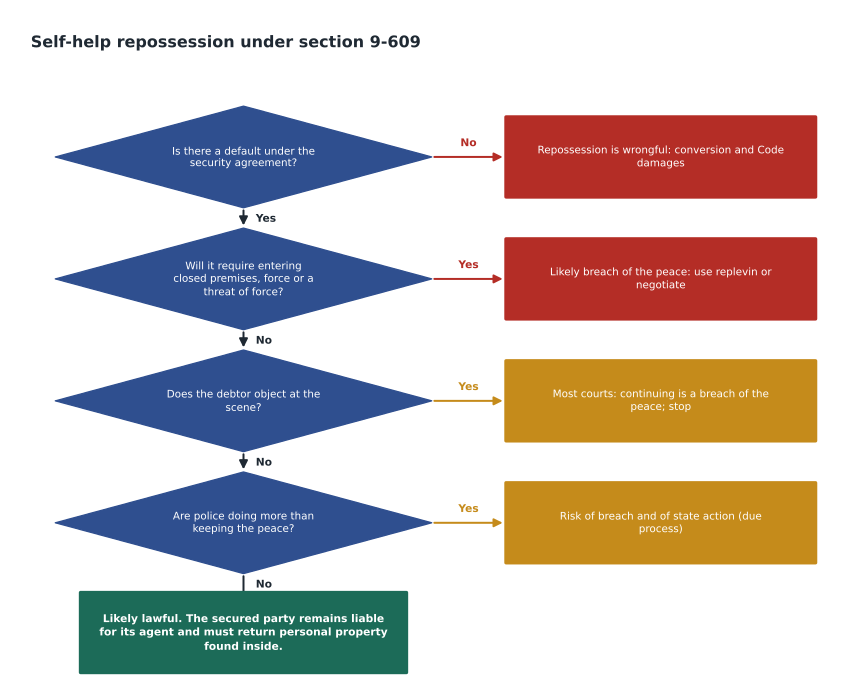
The duty not to breach the peace is nondelegable. In Clark v. Associates Commercial Corp., 877 F. Supp. 1439 (D. Kan. 1994), a finance company hired an independent repossessor, who subcontracted the job to a recovery company; an agent entered the cab of the debtor's tractor at a Tennessee truck stop while the debtor was resting in the sleeper, and a fight followed. Applying Tennessee's version of the Code, the court held that the secured party could not escape liability by pointing to its independent contractors, and that the debtor's testimony that the agent dared him to try to remove him and threatened to have him arrested raised a fact question whether there were threats of violence. A secured party that breaches the peace has converted the collateral, and it may be liable for the value of the collateral less the debt, consequential losses and, under some states' law, punitive damages, as well as the Code remedies in section 9-625.
Owen's pickup puts the rules to work. The tow truck came at three in the morning, the pickup was in an open driveway, and no one entered a building. Owen came out and shouted at the driver to stop. Under the majority view, the driver should have stopped when Owen objected, because continuing in the face of an objection invites the confrontation the rule exists to prevent. Owen says the driver ignored him, hooked the truck and drove away. If those are the facts, Crestline has a breach-of-the-peace problem in most jurisdictions. Separately, the fishing gear in the cab is not collateral, and Crestline and its agent must return it; many states' consumer laws also require a post-repossession notice explaining how to recover personal property and how to redeem.
Daniel Reyes asks about devices that let a lender shut off a car remotely. Section 9-609(a)(2) permits a secured party to render equipment unusable on the debtor's premises after default, but it does not address consumer vehicles, and starter-interrupt and GPS devices are regulated by a growing patchwork of state laws and by the Consumer Financial Protection Bureau's enforcement of the prohibition on unfair, deceptive or abusive acts and practices. Jordan Kimura adds a federal rule he learned in the Army. The Servicemembers Civil Relief Act, 50 U.S.C. section 3952, forbids repossession of property bought on installment by a servicemember before entering military service, after a deposit or installment has been paid, while the servicemember is in military service, except by court order. A creditor that repossesses an active-duty servicemember's car without one may face criminal penalties and civil liability.
Judicial process
When self-help would breach the peace, the secured party goes to court. Every state has a replevin or claim-and-delivery action that lets a secured party obtain an order directing the sheriff to seize the collateral, often on an expedited basis with a bond. The Supreme Court's due process cases, including Fuentes v. Shevin, 407 U.S. 67 (1972), and Mitchell v. W.T. Grant Co., 416 U.S. 600 (1974), require that prejudgment seizure statutes provide adequate procedural safeguards, such as a judge's involvement and a prompt post-seizure hearing. Self-help repossession, by contrast, is generally not state action, so the Fourteenth Amendment does not apply to it unless police officers actively assist, which is one reason officers are instructed to keep the peace and not to help the repossessor.
The bank's cheese is a case for judicial process or negotiation. Most of it is in the creamery's aging room, behind a locked door in the barn. Entering the barn without consent would very likely breach the peace. The 6,000 pounds at Ambler Cold Storage are different: the bank holds the negotiable warehouse receipt (Lesson 5), so it can demand the cheese from the warehouse, which must deliver to the holder of a negotiable receipt (section 7-403). For the rest, the bank can seek a replevin order, invoke the security agreement's assembly clause and ask Juniper Hill to make the cheese available, or negotiate a consensual plan under which Juniper Hill sells the cheese in the ordinary course and remits the proceeds. Lisowski says that, in his experience, the negotiated path recovers the most, because aged cheese sold by its maker brings more than cheese sold by a bank.
Redemption and the debtor's options
Until the secured party has collected, disposed of or contracted to dispose of the collateral, or accepted it in satisfaction of the debt, the debtor, any secondary obligor and any other secured party or lienholder may redeem the collateral by tendering fulfillment of all obligations secured, plus reasonable expenses and attorney's fees (section 9-623). Because acceleration clauses make the whole debt due on default, redemption under Article 9 usually means paying the whole balance, not just the missed payments. Reinstatement, catching up on past-due payments and keeping the loan in place, is not an Article 9 right, though many state consumer laws and many lenders provide it, and in Chapter 13 bankruptcy a debtor can cure defaults over time under a plan.
Worked problem
Advising the bank and advising Owen
Advise Merrin Valley Bank on what it may do now, given a borrowing base deficiency that is an event of default under the agreement, unpaid Northgate invoices, cheese in the locked aging room and at Ambler under a negotiable receipt the bank holds, and an operating account at the bank. Then advise Owen about his pickup, taken at 3 a.m. from his open driveway over his shouted objection, with fishing gear inside.
Show solution
- Default: the borrowing base deficiency is an express event of default, so the bank need not rely on an insecurity clause. To be safe under K.M.C., it should send a written notice of default and of its intent to exercise remedies.
- Accounts: under sections 9-607(a) and 9-406(a), the bank may notify Northgate and the other customers to pay the bank directly; payments to Juniper Hill after notice do not discharge them.
- Operating account: as depositary bank with control, it may apply the balance to the debt after default (section 9-607(a)(4)), but it must account for any surplus, and it should consider the effect on payroll and on its own negotiating position.
- Cheese: it may demand delivery of the Ambler cheese as holder of the negotiable receipt. It should not break into the barn; it should seek replevin, invoke the assembly clause or negotiate a cooperative sale.
- Owen: under the majority rule, continuing a repossession over the debtor's contemporaneous objection is a breach of the peace. Crestline is liable for its agent's conduct (Clark). Owen may have a conversion claim and Code damages under section 9-625, and Crestline must return the fishing gear. He may redeem under section 9-623 by paying the accelerated balance and expenses before disposition, or negotiate reinstatement.
Summary and key terms
- Default is defined by agreement; insecurity and at-will acceleration require good faith (section 1-309), and courts may require notice before cutting off credit (K.M.C.).
- Accepting late payments can waive strict compliance; send notice before reinstating strict terms.
- Part 6 remedies are cumulative: judgment, judicial foreclosure, collection and self-help; a later levy relates back to perfection (section 9-601(e)).
- Many debtor protections cannot be waived before default (section 9-602).
- Secured parties may collect receivables by notifying account debtors, who must then pay the secured party (sections 9-607 and 9-406).
- Self-help repossession is allowed without breach of the peace: no violence, no entry into closed premises, no active police help and, in most states, no continuing over the debtor's objection.
- The duty not to breach the peace is nondelegable; breach is conversion and triggers damages.
- The SCRA, state consumer laws and due process rules for replevin add limits; the debtor may redeem by paying the full secured debt before disposition.
Practice problems
Work each problem on paper first, then reveal the answer to check.
A repossession agent finds the debtor's car in a closed but unlocked garage and drives it out while the debtor is asleep. Breach of the peace?
Show answer
Very likely. Entry into the debtor's closed premises without consent is generally treated as a breach of the peace, whether or not the door was locked.
A lender's agent asks a police officer to accompany him and the officer tells the debtor, 'You have to let him take it.' What problems arise?
Show answer
Active police participation can make the repossession a breach of the peace and can make it state action, raising due process claims. Officers should only keep the peace.
A security agreement signed at the loan closing says the debtor waives all notice of any disposition of collateral. Is the waiver effective?
Show answer
No. Section 9-602 forbids pre-default waiver of the notification rules; section 9-624 allows waiver only by an agreement signed after default.
Can a debtor whose car was repossessed recover it by paying only the two missed installments?
Show answer
Not under Article 9 if the debt was accelerated. Redemption requires tender of all secured obligations plus expenses (section 9-623). Reinstatement may be available under state consumer law, by agreement or in Chapter 13.
Lesson quiz · 5 questions
Score 60% or more to complete this lesson.
Create a free account to save your progress, take quizzes and earn a certificate.