
LAWU-214 · Lesson 10 of 12 · 25 min
Disposition, deficiency and strict foreclosure
▶ Video coming soon A video version of this lesson is on the way.
In Lisowski's version of the file, the negotiations of early November 2026 failed. Juniper Hill could not cure the borrowing base default, Northgate was still withholding payment, and Lena and Owen agreed in a signed letter that the bank could take over the inventory and the non-titled equipment and sell them. The bank's total claim, including accrued interest, was 780,000 dollars. "Now," Lisowski tells Section B, "comes the part of Article 9 that produces the most litigation by volume. Repossession is a moment. Disposition is a process, and every step of it can be second-guessed by a debtor who thinks the price was too low."
The duty of commercial reasonableness
Section 9-610(a) says that after default a secured party may sell, lease, license or otherwise dispose of any or all of the collateral in its present condition or following any commercially reasonable preparation or processing. Section 9-610(b) adds the central standard: every aspect of a disposition, including the method, manner, time, place and other terms, must be commercially reasonable. The secured party may dispose of collateral by public or private proceedings, by one or more contracts, as a unit or in parcels, at any time and place and on any terms. The Code thus gives the secured party broad discretion about how to sell and holds it accountable for how it uses that discretion. The duty cannot be waived before default (section 9-602(7)), though the parties may set standards that are not manifestly unreasonable (section 9-603).
Section 9-627 gives guidance. The fact that a greater amount could have been obtained by a disposition at a different time or in a different method is not of itself sufficient to preclude the secured party from establishing that the disposition was commercially reasonable (section 9-627(a)). A disposition is commercially reasonable if made in the usual manner on any recognized market, at the price current in any recognized market at the time of the disposition, or otherwise in conformity with reasonable commercial practices among dealers in the type of property (section 9-627(b)). A disposition approved in a judicial proceeding, by a bona fide creditors' committee, by a representative of creditors or by an assignee for the benefit of creditors is commercially reasonable (section 9-627(c)). Courts nonetheless treat a very low price as a signal that warrants close scrutiny of the procedure.
Public and private dispositions have different consequences. A public disposition is one at which the price is determined after the public has had a meaningful opportunity for competitive bidding, which requires some form of advertisement or public notice and public access. The secured party may buy at a public disposition (section 9-610(c)(1)). At a private disposition it may buy only if the collateral is of a kind customarily sold on a recognized market or the subject of widely distributed standard price quotations (section 9-610(c)(2)), such as publicly traded stock. Cheese and used dairy equipment have no recognized market in this sense, so the bank cannot buy them at a private sale. Section 9-615(f) adds a special rule for a disposition to the secured party, a person related to it or a secondary obligor at a price significantly below the range of proceeds a complying disposition to an unrelated buyer would have brought: the deficiency or surplus is calculated as if the collateral had sold for that higher amount.
The aging cheese raises the timing question in a vivid form. Young cheddar sold at three months brings much less per pound than cheddar aged to twelve months, and aging costs money: storage, turning, waxing and the risk of spoilage. Section 9-610(a) allows disposition after commercially reasonable preparation or processing, but does not require the secured party to improve the collateral. Lisowski asks whether the bank must keep the cheese aging. Hannah Lindqvist answers that the Code does not require it but that a debtor will argue that the usual practice among cheese makers is to sell at maturity, and that a sale of young cheese at a distressed price was unreasonable in time and manner. Lisowski adds that the bank's best protection is to ask the experts: a cheese broker who sells to distributors in the ordinary course, at the price current in that trade, gives the bank a strong argument under section 9-627(b)(3).
Notification before disposition
Section 9-611(b) requires the secured party to send a reasonable authenticated, now signed, notification of disposition before it disposes of collateral. The recipients are listed in section 9-611(c): the debtor; any secondary obligor, such as a guarantor; and, if the collateral is other than consumer goods, any other person from whom the secured party has received a signed notification of a claim of an interest in the collateral, any other secured party or lienholder that, ten days before the notification date, held a security interest perfected by a financing statement filed against the debtor covering the collateral, and any secured party perfected by compliance with a certificate-of-title statute. The secured party must therefore search the filing records shortly before sending its notices. The notification is not required if the collateral is perishable or threatens to decline speedily in value or is of a type customarily sold on a recognized market (section 9-611(d)).
The bank's notices must go to the partnership, as debtor; to Lena and Owen, who as general partners are liable for the partnership's obligations and who also signed personal guaranties; and to the other secured parties of record. A search of the Westmarch filings run on November 9, 2026 shows Harrowgate's late financing statement for the wrapping machine, Calloway's August 4 filing for the cold storage system, Osgood's filing for the reefer unit and Beaumont Packaging's filing for packaging inventory. Each must receive notice of any disposition of collateral its filing covers. Corrigan State Bank, which sent the bank a signed notification of its claim to the cheese made from Pullman's milk, must also receive notice under section 9-611(c)(3)(A).
Timing and content are spelled out. In a transaction other than a consumer transaction, a notification sent after default and ten days or more before the earliest time of disposition is sent within a reasonable time (section 9-612(b)). Section 9-613 lists the contents of a notification in a non-consumer transaction: a description of the debtor and secured party, the collateral, the method of intended disposition, a statement that the debtor is entitled to an accounting of the unpaid indebtedness and the charge for it, and the time and place of a public disposition or the time after which a private disposition will be made. Section 9-613(5) provides a safe-harbor form. For consumer-goods transactions, section 9-614 requires more, including a description of any liability for a deficiency, a telephone number from which the amount to redeem is available, and a telephone number or address from which additional information is available, and it too provides a form.
Application of proceeds, surplus and deficiency
Section 9-615(a) sets the order in which cash proceeds of a disposition are applied. First come the reasonable expenses of retaking, holding, preparing for disposition, processing and disposing, and, to the extent provided for by agreement and not prohibited by law, reasonable attorney's fees and legal expenses. Second comes satisfaction of the obligations secured by the security interest under which the disposition is made. Third come obligations secured by any subordinate security interest or lien, if the secured party receives a signed demand for proceeds from the holder before distribution is completed. Senior interests are not paid from the proceeds; under section 9-617, a transferee for value takes the debtor's rights and discharges the security interest under which the disposition is made and subordinate interests, but takes subject to senior interests. A junior secured party who sells therefore sells subject to the senior lender's interest, and buyers adjust the price accordingly.
Any surplus goes to the debtor, and the obligor is liable for any deficiency (section 9-615(d)), unless the transaction is a sale of accounts, chattel paper, payment intangibles or promissory notes, in which case there is no surplus or deficiency unless the agreement provides otherwise (section 9-615(e)). In a consumer-goods transaction, section 9-616 requires the secured party to send the debtor an explanation of how it calculated any surplus or deficiency, before or when it demands payment of a deficiency, with a statement of the components of the calculation.
When the secured party gets it wrong
A secured party that does not comply with Part 6 faces two kinds of consequences. Section 9-625(b) makes it liable for damages in the amount of any loss caused by the failure, and section 9-625(c)(2) gives a consumer debtor, in a consumer-goods transaction, a minimum recovery of an amount not less than the credit service charge plus ten percent of the principal amount of the obligation or the time-price differential plus ten percent of the cash price, without proof of loss. That statutory minimum makes defective notice in consumer car repossessions a staple of consumer class actions. Section 9-625(e) adds statutory damages of 500 dollars for some specific failures, such as failing to send an explanation under section 9-616 as part of a pattern or practice.
The second consequence affects the deficiency. For transactions other than consumer transactions, section 9-626 adopts the rebuttable presumption rule. If the secured party's compliance is placed in issue, the secured party has the burden of establishing that its collection, enforcement, disposition or acceptance was conducted in accordance with Part 6. If it fails to do so, the amount of proceeds that would have been realized in a complying disposition is presumed to equal the sum of the secured obligation, expenses and attorney's fees, which wipes out the deficiency, unless the secured party proves that a complying disposition would have yielded a smaller amount. The secured party can then recover only the difference. Before the 1998 revision, courts were divided among this rule, an absolute bar to any deficiency, and a setoff-for-damages approach.
For consumer transactions the drafters again took no position. Section 9-626(b) says the limitation of the rebuttable presumption rule to non-consumer transactions is intended to leave to the court the determination of the proper rules in consumer transactions and that the court may not infer from that limitation the nature of the proper rule. Some states apply the absolute bar rule in consumer cases, holding that a secured party that fails to give proper notice forfeits any deficiency; others apply the rebuttable presumption rule; and many state consumer credit statutes have their own rules, including outright prohibitions on deficiency judgments after repossession of goods with a small cash price.
Strict foreclosure: acceptance in satisfaction
Instead of selling, a secured party may propose to keep the collateral in full or partial satisfaction of the debt. Section 9-620(a) permits that acceptance only if the debtor consents, the secured party does not receive a timely objection from any person entitled to notice, the collateral is not consumer goods in the possession of the debtor, and the mandatory-disposition rule for consumer goods does not apply. The debtor consents to an acceptance in partial satisfaction only by agreeing to its terms in a record signed after default (section 9-620(c)(1)). The debtor consents to an acceptance in full satisfaction either by signing such a record or by failing to object within twenty days after the secured party sends a proposal (section 9-620(c)(2)). The secured party must send the proposal to secondary obligors and to other secured parties and lienholders of the kind entitled to notice of a disposition (section 9-621), and an objection by any of them within twenty days blocks the acceptance.
Strict foreclosure saves the cost and delay of a sale and is often used for collateral that is hard to sell, such as a closely held business interest or specialized equipment. Its risk for the debtor is that the secured party may keep collateral worth more than the debt, since there is no surplus. That is why the Code protects consumers in two ways. Section 9-620(e) requires a secured party that has taken possession of consumer goods to dispose of them within ninety days if sixty percent of the cash price of a purchase-money security interest, or sixty percent of the principal of a nonpurchase-money obligation, has been paid, unless the debtor waives the right after default (section 9-624(b)). And section 9-620(g) forbids acceptance in partial satisfaction in a consumer transaction. Section 9-622 says that an effective acceptance discharges the obligation to the extent consented to, transfers the debtor's rights in the collateral to the secured party and discharges subordinate interests.
Lisowski returns to Owen's pickup. The cash price was 42,000 dollars when Owen bought it in 2023 with financing from Crestline Auto Credit, and he had paid about 27,000 dollars of the principal when he defaulted, roughly sixty-four percent. Crestline would like to keep the truck in full satisfaction of the remaining 15,000-dollar balance, because trucks of that model are bringing about 24,000 dollars at dealer auctions. It cannot. Because more than sixty percent of the cash price of a purchase-money obligation has been paid on consumer goods, section 9-620(e) requires Crestline to dispose of the truck within ninety days, unless Owen signs a waiver after default. A complying sale at around 24,000 dollars would pay the balance and expenses and leave Owen a surplus of several thousand dollars, exactly the value the mandatory-disposition rule protects.
Worked problem
The bank's disposition and the Marshes' deficiency
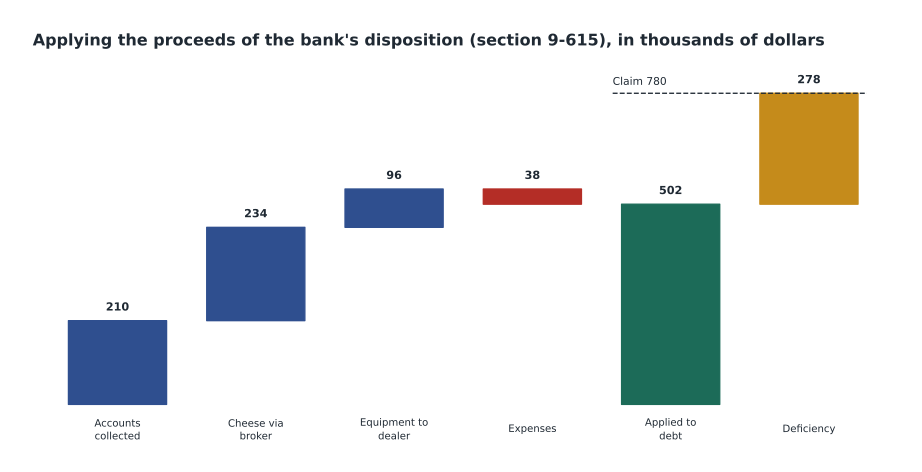
After default the bank collects 210,000 dollars of accounts; sells the cheese, through a cheese broker, to distributors over six weeks for 234,000 dollars; and sells the vats, press and wrapping machine at a private sale to a used dairy equipment dealer for 96,000 dollars. Expenses of collection, storage, broker's commission, notices and attorney's fees total 38,000 dollars. The bank's claim was 780,000 dollars. It sent notices to the partnership, Lena and Owen, Harrowgate, Osgood, Beaumont and Corrigan twelve days before the equipment sale, but forgot Calloway, though Calloway's filing covers 'equipment sold hereunder' and the sale did not include the Calloway system. Calculate the deficiency and consider the Marshes' defenses.
Show solution
- Gross recovery: 210,000 + 234,000 + 96,000 = 540,000 dollars. Expenses first under section 9-615(a)(1): 540,000 - 38,000 = 502,000 dollars applied to the debt.
- Deficiency: 780,000 - 502,000 = 278,000 dollars. The partnership is liable under section 9-615(d)(2), and Lena and Owen are liable as general partners (RUPA section 306) and as guarantors. Under RUPA section 307(d), a judgment creditor must generally exhaust partnership assets before levying on a partner's own property unless an exception, such as a guaranty, applies.
- Timing: ten days or more before a non-consumer disposition is reasonable under section 9-612(b). Calloway did not need notice, because its filing did not cover the vats, press or wrapping machine, and the Calloway system was not sold.
- Commercial reasonableness: sales through a broker to distributors in the ordinary course of the cheese trade, at current prices, fit section 9-627(b). The private sale to an equipment dealer is defensible if the bank solicited competing offers. The bank could not have bought the equipment itself at a private sale (section 9-610(c)(2)).
- If the Marshes put compliance in issue and the bank cannot prove it, section 9-626 presumes that a complying disposition would have paid the whole debt, eliminating the deficiency, unless the bank proves a complying disposition would have brought less. Good records of the broker's process are therefore worth more than the 38,000 dollars of expenses.
Summary and key terms
- After default the secured party may dispose of collateral by public or private sale, but every aspect must be commercially reasonable (section 9-610(b)).
- A low price alone does not prove unreasonableness; sales on recognized markets, at current prices or in conformity with dealer practices are reasonable (section 9-627).
- The secured party may buy at a public sale, and at a private sale only collateral with a recognized market or standard price quotations.
- Signed notification must go to the debtor, secondary obligors and, for non-consumer goods, other secured parties of record and claimants; ten days is reasonable in commercial cases.
- Proceeds go to expenses, then the secured debt, then subordinate interests that demand; the debtor gets any surplus and owes any deficiency.
- Noncompliance gives damages, a consumer minimum recovery, and, in commercial cases, the rebuttable presumption rule that can eliminate the deficiency.
- Strict foreclosure requires debtor consent and no objection; partial strict foreclosure needs a signed post-default agreement and is barred in consumer transactions.
- Consumer goods with sixty percent of the cash price or principal paid must be sold within ninety days unless the debtor waives after default.
Practice problems
Work each problem on paper first, then reveal the answer to check.
A secured party sells repossessed restaurant equipment at a private sale to its own subsidiary for 20,000 dollars; similar sales bring 45,000 dollars. How is the deficiency calculated?
Show answer
Under section 9-615(f), because the transferee is related to the secured party and the price is significantly below what a complying sale to an unrelated buyer would bring, the deficiency is calculated as if the equipment had sold for that higher amount. The secured party also likely violated section 9-610(c)(2) by buying at a private sale.
In a commercial loan, the secured party sends notice of a private sale to the debtor but not to the guarantor. Can it recover a deficiency from the guarantor?
Show answer
Possibly only a reduced one. The guarantor is a secondary obligor entitled to notice under section 9-611(c)(2). If the guarantor puts compliance in issue, section 9-626 presumes that a complying disposition would have paid the debt unless the secured party proves otherwise.
A lender proposes to keep repossessed equipment in full satisfaction of a 100,000-dollar debt. The debtor says nothing for twenty-five days. A junior secured party objected on day fifteen. Is the acceptance effective?
Show answer
No. Although the debtor's silence for twenty days is consent to acceptance in full satisfaction under section 9-620(c)(2), a timely objection by a person entitled to the proposal under section 9-621 blocks it.
A consumer has paid seventy percent of the cash price of a financed motorcycle when it is repossessed. Can the lender keep it in satisfaction of the debt?
Show answer
Not unless the consumer waives the right to a disposition in a record signed after default. Section 9-620(e) requires disposition within ninety days when sixty percent of the cash price has been paid.
Lesson quiz · 5 questions
Score 60% or more to complete this lesson.
Create a free account to save your progress, take quizzes and earn a certificate.