
LAWU-214 · Lesson 12 of 12 · 25 min
Capstone: working a secured financing file
▶ Video coming soon A video version of this lesson is on the way.
For the last class Lisowski sets the Juniper Hill file aside and hands out a new one, his capstone problem. "Every problem in this course," he says, "can be worked with the same seven questions, in the same order. Juniper Hill taught you the rules one at a time. This file makes you use them all at once, the way a trustee or a lender's lawyer does on the first morning of a case." The file concerns Thistledown Cider Works LLC, a fictional Westmarch limited liability company that makes hard cider in a converted dairy barn outside Brennan Falls and runs a tasting room there. Its sole manager and majority member is Margit Mortlake, who founded it in 2019. The creditors and dates are invented; the law is the law students have learned.
Lisowski's seven questions
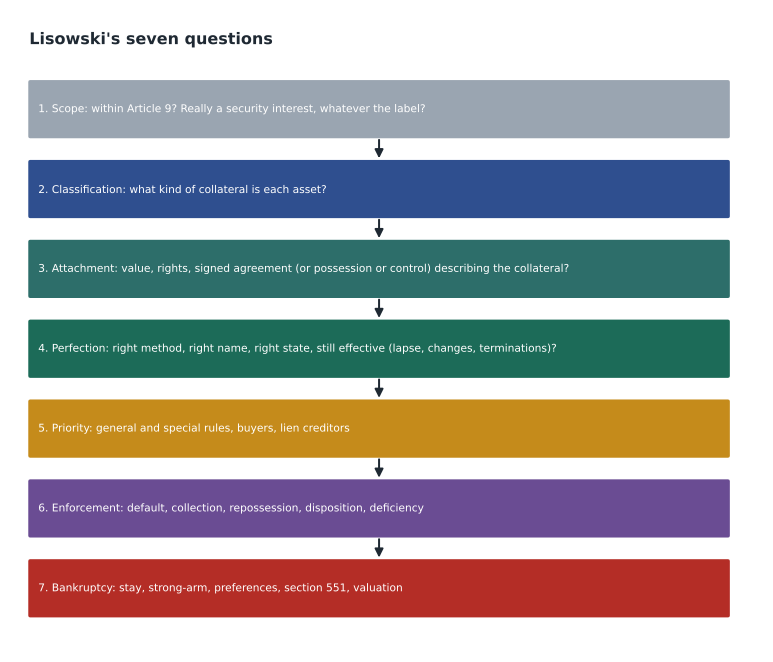
Lisowski writes the method on the board. First, scope: is the transaction within Article 9, and is any claimant's interest really a security interest whatever it is called? Second, classification: what kind of collateral is each asset? Third, attachment: does each claimant have an enforceable security interest in each asset, considering value, rights and the description in a signed security agreement or a substitute? Fourth, perfection: is each interest perfected, by the right method, under the right name, in the right state, and is it still effective, given lapse, changes and terminations? Fifth, priority: who ranks first in each asset, under the general rules and the special ones, including buyers and lien creditors? Sixth, enforcement: what may each secured party do on default, and what must it avoid? Seventh, bankruptcy: what survives the stay, the strong-arm power and the preference rules, and what is each claim worth?
The Thistledown file
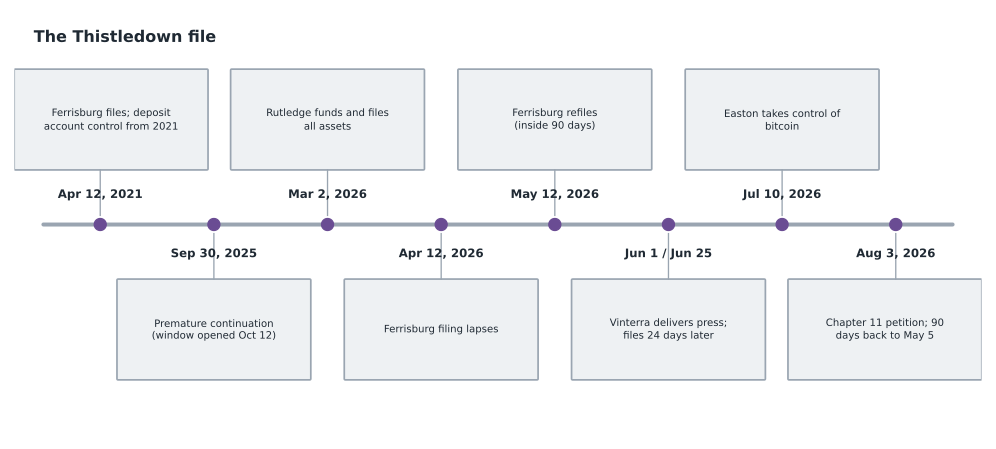
Ferrisburg Savings Bank has financed Thistledown since April 2021, under a 900,000-dollar line of credit and term loan secured by a security agreement covering "all inventory, equipment, accounts, deposit accounts and general intangibles, now owned or hereafter acquired, and proceeds." Ferrisburg filed a financing statement with the Westmarch Secretary of State on April 12, 2021, naming the debtor "Thistledown Cider Works, LLC," and Thistledown keeps its operating account at Ferrisburg. Ferrisburg's loan servicer, trying to be diligent, filed a continuation statement on September 30, 2025. On March 2, 2026, Thistledown signed an agreement with Rutledge Funding, a merchant cash advance company, under which Rutledge paid Thistledown 120,000 dollars for "the purchase of 180,000 dollars of Thistledown's future receivables," to be collected through daily debits of a fixed amount from the operating account, with no reconciliation if sales fell. Rutledge filed an all-assets financing statement against Thistledown that day. Ferrisburg discovered a problem with its own filing in May and filed a new financing statement on May 12, 2026.
On May 20, 2026, Thistledown signed a security agreement with Vinterra Press Co. for a new pneumatic bladder press priced at 150,000 dollars, with 30,000 dollars down and 120,000 dollars on credit, secured by the press. Vinterra delivered and installed the press on June 1; it sits on the barn floor and is bolted down but can be unbolted and moved by forklift. Vinterra filed a financing statement on June 25. Thistledown also holds 1.5 bitcoin, received from members of its online cider club, and on July 10, 2026, it borrowed 40,000 dollars from Easton Digital Lending, which took the coins into a wallet whose private key Easton alone holds. In July, Pennock's Fine Foods, a regional specialty grocer, bought 600 cases of cider from Thistledown on thirty-day terms. On August 3, 2026, Thistledown filed a Chapter 11 petition. Its landlord claims a statutory landlord's lien for three months of unpaid rent.
Lisowski gives values as of the petition date: accounts 60,000 dollars, cider inventory 210,000 dollars, equipment other than the press 180,000 dollars, the press 110,000 dollars, the bitcoin 130,000 dollars on his assumed numbers, and the operating account at Ferrisburg 25,000 dollars. Claims are Ferrisburg 900,000 dollars, Rutledge 150,000 dollars remaining to be collected, Vinterra 120,000 dollars and Easton 40,000 dollars. He divides Section B into teams. Priya and Jordan represent Ferrisburg; Daniel and Marcus represent the debtor in possession, standing in the trustee's shoes; Hannah represents Vinterra and, because Lisowski runs out of students, also Rutledge.
Question one: scope and characterization
Rutledge's agreement calls itself a purchase of future receivables, not a loan, and the merchant cash advance industry has litigated that label for years in usury cases, where courts ask whether the funder bears real risk of nonpayment, whether there is a reconciliation provision adjusting the daily debits to actual sales, whether the term is finite and whether the funder has recourse if the business fails. Hannah argues that the label does not matter for this problem, and Lisowski agrees. If the deal is a sale of accounts, section 9-109(a)(3) brings it within Article 9 and Rutledge's interest is a security interest perfected by filing. If it is a disguised loan, Rutledge is a secured lender with an all-assets filing. Either way, Rutledge's March 2 filing is the relevant event. The characterization would matter for usury, for whether Thistledown has any interest left in collected receivables and, in bankruptcy, for whether receivables arising after the petition belong to Rutledge at all. Lisowski asks the class to treat Rutledge as a secured lender with a 150,000-dollar claim.
The landlord's lien is outside Article 9 entirely: section 9-109(d)(1) excludes landlord's liens other than agricultural liens. Its validity and priority are governed by Westmarch's landlord-tenant statute. And in bankruptcy, section 545(3) and (4) of the Bankruptcy Code let the trustee avoid a statutory lien for rent, or of distress for rent, whether or not the lien is statutory. Daniel concludes, to Lisowski's approval, that the landlord is an unsecured creditor in the case, with an administrative claim for postpetition rent if Thistledown stays in the building.
Questions two and three: classification and attachment
Classification is straightforward. The receivables from Pennock's and other customers are accounts; the cider in tanks and cases is inventory; the tasting room furniture, tanks, bottling line and the press are equipment, unless the press has become a fixture; the operating account is a deposit account; and the self-hosted bitcoin is a controllable electronic record, a kind of general intangible. Marcus argues that the press is not a fixture: it is bolted down for stability but movable by forklift, and Thistledown leases the barn, which makes it unlikely that anyone intended the press to become part of the real estate. The class accepts the point, which also keeps the landlord and any mortgagee of the barn out of the press.
Attachment is satisfied for every secured creditor. Ferrisburg's 2021 security agreement covers every category except the bitcoin by name, and the bitcoin is covered by "general intangibles," since a CER is a general intangible. Rutledge's agreement grants a security interest in all assets, which is fine for a financing statement but would be a supergeneric description insufficient in a security agreement under section 9-108(c); Lisowski tells the class to assume that Rutledge's agreement also lists Article 9 types, as most funders' forms do. Vinterra's agreement describes the press specifically. Easton's agreement describes the coins, and Easton also has control, which can satisfy the evidentiary requirement under section 9-203(b)(3)(D). Value and rights are present in each case.
Question four: perfection
Perfection is where the file breaks open. Ferrisburg's April 12, 2021 filing would lapse on April 12, 2026, unless continued in the six months before lapse, which began October 12, 2025. The September 30, 2025 continuation came twelve days early. Under section 9-510(c) it was ineffective, and the filing lapsed on April 12, 2026. For one month Ferrisburg had no effective filing. Its new filing of May 12, 2026 perfected again from that date, but section 9-515(c) treats the lapsed interest as never perfected as against a purchaser of the collateral for value, and a secured party like Rutledge is a purchaser for value. Ferrisburg's deposit account interest is different. Ferrisburg has been the depositary bank since 2021, so it has had control of the operating account the whole time under section 9-104(a)(1), and lapse of a financing statement does not affect perfection by control.
The other filings check out with one exception. Ferrisburg's comma before "LLC" does not matter, because filing office search logic ordinarily disregards punctuation and entity endings, and Ferrisburg's new filing uses the exact name in the certificate of organization. Thistledown is a registered organization organized in Westmarch, so Westmarch is the right state for everyone. Rutledge filed the day it gave value and is perfected from March 2, 2026. Vinterra filed on June 25, twenty-four days after delivery: it is perfected, but it missed the twenty-day window for purchase-money priority in section 9-324(a). Easton's interest in the bitcoin is perfected by control under sections 9-314(a) and 12-105 from July 10, because it alone holds the private key.
Question five: priority outside bankruptcy
Lisowski asks the teams to rank the claims as if there were no bankruptcy, asset by asset. In accounts, inventory and equipment other than the press, Rutledge is first, because its March 2 filing now precedes Ferrisburg's effective date of May 12; the lapse cost Ferrisburg its 2021 priority as against Rutledge under section 9-515(c). Ferrisburg is second. In the press, Vinterra's missed twenty-day deadline means it is an ordinary secured party ranked by filing date: Rutledge (March 2) first, Ferrisburg (May 12) second and Vinterra (June 25) third. Had Vinterra filed by June 21, it would have been first in the press under section 9-324(a), ahead of both earlier filers. In the bitcoin, Easton is first, because a secured party with control has priority over those who perfected by filing (section 9-326A), then Rutledge and then Ferrisburg. In the operating account, Ferrisburg is first, because it has control and Rutledge's claim to the account is only as proceeds perfected by filing (section 9-327(1) and (3)).
The cider sold to Pennock's in July is gone from everyone's collateral. Pennock's is a buyer in ordinary course from a seller in the business of selling cider, and it takes free of security interests created by Thistledown, even perfected ones it knew about (section 9-320(a)). The secured parties' interests continue in the proceeds, the account owed by Pennock's, which is among the 60,000 dollars of accounts. Jordan asks whether Rutledge's daily debits from the operating account before the petition can be clawed back by Ferrisburg as the controlling party. Lisowski answers that Rutledge received funds from a deposit account and, under section 9-332(b), takes free of Ferrisburg's interest unless it colluded with Thistledown to violate Ferrisburg's rights, and nothing suggests collusion.
Question six: enforcement
Before the petition, each secured party could have enforced on default under Part 6, Ferrisburg by applying the operating account, which it controls (section 9-607(a)(4)), and the others by notifying account debtors, repossessing without breach of the peace and disposing of collateral in a commercially reasonable manner after notice to the debtor and the other secured parties of record. Easton, with the private key, could have sold the bitcoin itself on an exchange, a disposition on a recognized market for which notice may not be required (section 9-611(d)) and at which, under section 9-610(c)(2), Easton could even buy. The petition stopped all of it. From August 3, every secured party needs relief from the automatic stay, and Thistledown may use cash collateral, including the cider proceeds and the operating account, only with consent or court authorization and adequate protection under section 363(c)(2) and (e).
Question seven: bankruptcy
Daniel and Marcus, for the debtor in possession, attack Ferrisburg first. Its May 12, 2026 refiling perfected a security interest that had attached in 2021, so under section 547(e)(2)(B) the transfer is deemed made on May 12, the date of perfection, for an antecedent debt. May 12 is within ninety days before the August 3 petition, because the ninety days began May 5. Insolvency is presumed (section 547(f)). The transfer lets Ferrisburg receive more than it would as an unsecured creditor in Chapter 7. No exception fits: there was no new value, and the floating lien exception in section 547(c)(5) does not help, because on May 5, the ninetieth day before the petition, Ferrisburg was unperfected and its whole claim was effectively unsecured, so all the value it gained by refiling is an improvement in position. The debtor in possession can avoid Ferrisburg's interest in everything perfected only by the May 12 filing.
Priya and Jordan defend what they can. The deposit account is safe: Ferrisburg has had control since 2021, long before the ninety days, so there was no transfer in the preference period as to that collateral, and section 553 preserves Ferrisburg's setoff right as well. Ferrisburg therefore has a secured claim of 25,000 dollars and an unsecured claim for the rest. They also concede the point that makes the case hard for Vinterra. Under section 551, an avoided transfer is preserved for the benefit of the estate. The estate steps into Ferrisburg's May 12 priority position, ahead of Vinterra in the press, rather than letting Vinterra move up. Hannah protests that this is a windfall for unsecured creditors. Lisowski replies that it is exactly what section 551 is for: the avoidance belongs to the estate and its creditors as a whole, not to the next lienholder in line.
The other liens survive. Rutledge perfected on March 2, when it gave value, which is more than ninety days before the petition, so neither section 544 nor section 547 reaches it; its 150,000-dollar claim is fully secured by accounts and inventory worth 270,000 dollars. Vinterra perfected on June 25, before the petition, so the strong-arm power does not reach it; and although the filing came within the ninety days, section 547(c)(3) protects it, because the security interest secured new value that enabled Thistledown to acquire the press and was perfected within thirty days after Thistledown received possession on June 1. Vinterra keeps a valid lien, but it is junior to Rutledge and to the estate's preserved Ferrisburg position. Easton gave new value contemporaneously with obtaining control on July 10, so section 547(c)(1) protects it, and it is fully secured in bitcoin worth far more than its 40,000-dollar claim.
Worked problem
Valuing the claims on the petition date
Using Lisowski's values (accounts 60,000; inventory 210,000; other equipment 180,000; press 110,000; bitcoin 130,000; operating account 25,000) and claims (Ferrisburg 900,000; Rutledge 150,000; Vinterra 120,000; Easton 40,000), determine each creditor's secured claim under section 506(a) after the debtor in possession avoids Ferrisburg's May 12 perfection. Assume that Rutledge, which has the first lien on several assets, is satisfied first from accounts and inventory, as a court applying the equitable doctrine of marshaling might require so that Vinterra is not prejudiced.
Show solution
- Easton: first in the bitcoin by control. Secured claim 40,000 dollars, fully secured. The remaining 90,000 dollars of bitcoin value falls to the next interests: Rutledge (if needed), then the estate's preserved Ferrisburg position.
- Rutledge: first in accounts, inventory and equipment. Satisfied from accounts (60,000) and 90,000 of inventory. Secured claim 150,000 dollars, fully secured. Remaining inventory 120,000 dollars.
- Ferrisburg: secured only in the operating account by control. Secured claim 25,000 dollars; unsecured claim 875,000 dollars. Its avoided lien on the other assets is preserved for the estate under section 551.
- Vinterra: third in the press behind Rutledge (paid elsewhere) and the estate's preserved Ferrisburg position, which secures a 900,000-dollar claim and so absorbs the press's full 110,000-dollar value. Secured claim zero; unsecured claim 120,000 dollars. Filing four days sooner would have given it a fully secured 110,000-dollar claim under section 9-324(a).
- Estate: the preserved Ferrisburg position captures remaining inventory 120,000, other equipment 180,000, the press 110,000 and remaining bitcoin 90,000, a total of 500,000 dollars of value for the estate and its unsecured creditors, including Ferrisburg's 875,000-dollar and Vinterra's 120,000-dollar unsecured claims and the landlord.
- Check: 40,000 (Easton) + 150,000 (Rutledge) + 25,000 (Ferrisburg) + 500,000 (estate) = 715,000 dollars, which equals the total asset value of 60,000 + 210,000 + 180,000 + 110,000 + 130,000 + 25,000.
What the file teaches
Lisowski ends the semester by listing the mistakes in the Thistledown file and the steps that would have prevented each. Ferrisburg's servicer calendared the continuation from the wrong date; a tickler that opens the window six months before lapse and closes it on the lapse date, checked by a second person, would have saved a 900,000-dollar loan. Vinterra's credit department filed when the paperwork caught up with the delivery; filing on May 20, when the security agreement was signed, as section 9-502(d) allows, would have made it first in the press. Rutledge was the only creditor that did everything right, by filing the day it funded. Easton understood that, for digital assets after 2022, control is worth more than any filing. And the landlord learned that a statutory lien can look like security until a trustee reads section 545.
"You will forget most of the section numbers," Lisowski tells Section B. "Keep the seven questions. When a client calls at two in the morning before a closing, or a trustee calls the morning after a petition, ask them in order: is it Article 9, what is it, did it attach, is it perfected here and now, who is ahead, what can they do, and what survives bankruptcy? The answer to the last question depends on all the others, and the others depend on somebody's calendar." He puts the one-page financing statement from the first day back on the document camera and leaves it there while the class packs up.
Summary and key terms
- Work every problem through seven questions in order: scope, classification, attachment, perfection, priority, enforcement and bankruptcy.
- Labels such as 'purchase of future receivables' do not take a transaction out of Article 9; landlord's liens are outside it and are avoidable in bankruptcy under section 545.
- A premature continuation is ineffective; lapse makes a security interest unperfected and retroactively unperfected against purchasers for value, including later secured parties.
- Perfection by control of a deposit account survives a lapsed filing and predates the preference period.
- Refiling for an old debt within ninety days of bankruptcy is a preference under section 547(e)(2)(B), and section 547(c)(5) does not save an interest that was unperfected on the ninetieth day.
- An avoided lien is preserved for the estate under section 551, so juniors do not move up.
- A purchase-money creditor who misses the twenty-day Article 9 window may still survive bankruptcy under the thirty-day enabling-loan exception, but only with the priority of an ordinary filer.
- Control beats filing for controllable electronic records, and a contemporaneous exchange for new value is not a preference.
Practice problems
Work each problem on paper first, then reveal the answer to check.
Suppose Ferrisburg's continuation had been filed on October 20, 2025. How would the analysis change?
Show answer
The continuation would have been timely (the window opened October 12, 2025), Ferrisburg's 2021 filing would have remained effective, and Ferrisburg would rank first in everything its filing covers, ahead of Rutledge and, absent a timely PMSI, Vinterra. The May 12 refiling and the preference problem would disappear.
Suppose Vinterra had filed on June 18, 2026. Who ranks first in the press outside bankruptcy and in bankruptcy?
Show answer
Vinterra, under section 9-324(a), because it perfected its PMSI within twenty days after Thistledown received possession. Its interest would also be protected in bankruptcy by section 547(c)(3), giving it a secured claim of 110,000 dollars.
Suppose Easton had merely filed a financing statement covering the bitcoin on July 10 rather than taking control. Who would rank first in the bitcoin?
Show answer
Rutledge, which filed first (March 2), then the estate's preserved Ferrisburg position (May 12), then Easton (July 10). Without control, Easton would lose the priority section 9-326A gives to a secured party with control.
Why is the landlord unsecured in Thistledown's bankruptcy?
Show answer
A landlord's lien is outside Article 9 (section 9-109(d)(1)), and section 545(3) and (4) let the trustee avoid statutory liens for rent and liens of distress for rent. The landlord is left with an unsecured claim for prepetition rent.
Lesson quiz · 5 questions
Score 60% or more to complete this lesson.
Create a free account to save your progress, take quizzes and earn a certificate.