
LAWU-214 · Lesson 5 of 12 · 23 min
Possession, control and automatic perfection
▶ Video coming soon A video version of this lesson is on the way.
Lisowski begins with a problem that the Merrin Valley Bank file did not solve. The bank's all-assets financing statement, he reminds Section B, is a good filing in the right office under the right name. Yet when the bank's examiner visited the creamery in the spring of 2026, she found four kinds of collateral the filing did not perfect, or did not perfect well. The refrigerated delivery truck is covered by a Westmarch certificate of title. The operating account at the bank itself and the payroll account at another bank are deposit accounts. Some 6,000 pounds of cheddar sit in a third-party aging warehouse. And the 0.4 bitcoin in Owen's self-hosted wallet is a controllable electronic record. "Filing is the default," Lisowski says. "Today is about the exceptions, where filing is not allowed, not enough, or not needed."
Possession
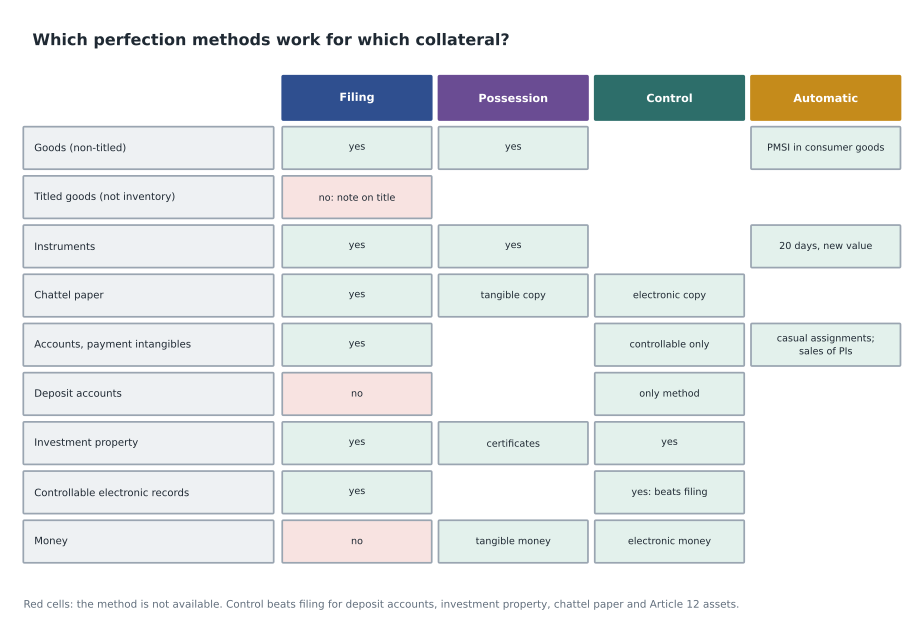
Possession is the oldest method of perfection. The common law pledge, in which a pawnbroker holds a ring until the loan is repaid, needed no public record because the creditor's possession was itself notice: anyone dealing with the debtor could see that the debtor did not have the ring. Section 9-313(a) continues the idea. A secured party may perfect a security interest in tangible negotiable documents, goods, instruments, tangible money and tangible chattel paper by taking possession. For money, possession is the only method other than control of electronic money; a lender cannot perfect in cash by filing (section 9-312(b)(3)). Possession also substitutes for a signed security agreement under section 9-203(b)(3)(B), so a pledge can be made by handing over the collateral under an oral agreement.
Possession must be real. The secured party, or an agent who is not the debtor, must have control over the goods in a practical sense, and the debtor must not have continued access and use. Possession by the debtor's employee or by the debtor itself on the secured party's behalf does not count. When collateral is held by a third person, section 9-313(c) says the secured party takes possession when the person in possession signs a record acknowledging that it holds the collateral for the secured party's benefit, or takes possession after having acknowledged that it will hold for the secured party. A bailee that issued a document of title is governed instead by section 9-312(c) and (d), described below. Possession perfects only while it continues; a secured party that returns the goods to the debtor loses perfection unless it has also filed or a temporary perfection rule applies.
The cheese in the aging warehouse illustrates the bailee rules. Juniper Hill stores 6,000 pounds of cheddar with Ambler Cold Storage, a commercial warehouse in Merrin County, while it ages for nine to twelve months. If Ambler has issued a negotiable warehouse receipt, the receipt is the collateral that matters. Section 9-312(c) says that while goods are in the possession of a bailee that has issued a negotiable document covering them, a security interest in the goods is perfected by perfecting in the document, and an interest perfected in the document has priority over one perfected in the goods by another method. If the receipt is nonnegotiable, or there is none, section 9-312(d) says the bank perfects in the goods by filing as to the goods, by the bailee's receipt of notification of the bank's interest, or by issuance of a document in the bank's name. The bank's all-assets filing covers the cheese as inventory, so the bank is perfected; but a lender that takes the negotiable receipt itself would beat the bank.
Certificate-of-title goods
For goods covered by a certificate-of-title statute, Article 9 steps aside. Section 9-311(a)(2) says that filing a financing statement is not necessary or effective to perfect a security interest in property subject to a state certificate-of-title statute that provides for a security interest to be indicated on the certificate as a condition or result of perfection. Compliance with the statute is the equivalent of filing (section 9-311(b)). The creamery's refrigerated delivery truck is titled in Westmarch in the partnership's name. The bank's all-assets financing statement, though it indicates "equipment," does not perfect the bank's interest in the truck. Unless the bank's lien is noted on the certificate, a trustee in bankruptcy will take the truck free of it.
Jordan Kimura, who managed motor pools in the Army, asks about inventory. A car dealer's showroom is full of titled vehicles, and lenders who finance dealer inventory do not note their liens on hundreds of certificates. Section 9-311(d) solves the problem: while goods are inventory held for sale or lease by a person in the business of selling goods of that kind, the certificate-of-title rule does not apply, and filing perfects. When the dealer sells a car to a consumer on credit, the dealer or its finance company perfects the new purchase-money interest by notation on the buyer's title. Section 9-303 governs choice of law: once a certificate is issued, the law of the issuing state governs perfection until the goods are covered by another state's certificate or the certificate lapses.
Control of deposit accounts
A deposit account can be original collateral only by control. Section 9-312(b)(1) says a security interest in a deposit account may be perfected only by control under section 9-314, except when the account is proceeds of other collateral, in which case perfection may continue under the proceeds rules. Control is defined in section 9-104. A secured party has control if it is the bank with which the account is maintained; if the debtor, the secured party and the bank have agreed in a signed record that the bank will comply with the secured party's instructions directing disposition of the funds without further consent by the debtor; if the secured party becomes the bank's customer on the account; or, under the 2022 text, if another person has control on the secured party's behalf. The debtor may keep the right to write checks, so long as the secured party can cut off that right when it chooses.
Merrin Valley Bank has automatic control of the operating account because it is the depositary bank (section 9-104(a)(1)). The payroll account is at Kittredge Savings Bank. The bank's security agreement covers "deposit accounts," so the interest has attached to the payroll account, but the bank's filing does not perfect it. To perfect, the bank needs a deposit account control agreement signed by Juniper Hill, Kittredge Savings and itself, or the bank must become Kittredge's customer on the account. Without one, a lien creditor or trustee takes priority. Many commercial lenders insist that borrowers move all accounts to the lending bank for exactly this reason.
Control also appears for other intangibles. A secured party perfects in investment property by filing or by control under section 8-106, which for a securities account usually means an agreement in which the securities intermediary agrees to follow the secured party's entitlement orders without the debtor's further consent (section 8-106(d)(2)). A security interest in a letter-of-credit right, other than as supporting obligation, is perfected only by control, which requires the issuer's consent to an assignment of proceeds (section 9-107). Electronic chattel paper and, under the 2022 amendments, electronic copies of records evidencing chattel paper, are controlled through a system that reliably establishes the secured party as the person to which the authoritative electronic copy was assigned (section 9-105). In each case control beats filing in a priority contest, as Lesson 7 shows, so a lender that can get control usually does.
Control under Article 12
The 2022 amendments carried the control idea into digital assets. A security interest in a controllable electronic record, a controllable account or a controllable payment intangible may be perfected by filing or by control (sections 9-312(a) and 9-314(a)), and control is defined by section 12-105. A person has control of a CER if the electronic record, a record attached to or logically associated with it, or a system in which it is recorded gives the person three powers: the power to avail itself of substantially all the benefit from the record; the exclusive power, subject to some exceptions, to prevent others from availing themselves of substantially all the benefit and to transfer control of the record to another person; and the ability to readily identify itself as the person having those powers (section 12-105(a)). For bitcoin, control in practice means exclusive possession of the private key, or an arrangement with a custodian or multisignature system that gives the secured party the exclusive power to move the coins.
Marcus Webb asks how the bank could get control of the bitcoin in Owen's phone. One way is for Juniper Hill to transfer the coins to a wallet whose private key the bank holds. Another is a multisignature wallet, but the details matter. Section 12-105(b) says a power can be exclusive even though it is shared with another person, yet section 12-105(c) adds that a shared power is not exclusive if the secured party can act only together with the other person and that other person is the one who transferred the interest to it. A two-key wallet in which the bank can move the coins only with Juniper Hill's key therefore does not give the bank control. A wallet in which the bank, alone or with an independent custodian, can move the coins without Juniper Hill does. If the bank merely files, it is perfected, but a later lender that obtains control will have priority (section 9-326A), and a qualifying purchaser that buys the coins for value, in good faith and without notice takes them free of the bank's interest (section 12-104(e)). For electronic money, such as a central bank digital currency, control under section 9-105A is the only method of perfection.
Automatic perfection
Some security interests are perfected the moment they attach, with no filing, possession or control. Section 9-309 lists them. The most important is a purchase-money security interest in consumer goods (section 9-309(1)). When Clement Quarles, a Brennan Falls schoolteacher in Lisowski's side hypothetical, buys a 2,400-dollar refrigerator for his kitchen from Wexford Appliance on an installment plan, and Wexford keeps a security interest in it to secure the price, Wexford's interest is perfected automatically. The drafters thought it impractical and pointless to require filings for the millions of small credit sales of household goods each year. The exception does not apply to consumer goods covered by a certificate-of-title statute, such as cars and boats in most states (sections 9-309(1) and 9-311(b)), and automatic perfection does not give the seller priority over a later real estate interest when the goods become fixtures.
Automatic perfection has a gap. Under section 9-320(b), a buyer of consumer goods takes free of a security interest, even a perfected one, if the buyer buys without knowledge of the security interest, for value, primarily for the buyer's own personal, family or household purposes, and before the filing of a financing statement covering the goods. If Clement sells the refrigerator to his neighbor at a yard sale, the neighbor takes it free of Wexford's automatically perfected interest. Wexford could have prevented that result only by filing. This is the consumer-to-consumer or garage-sale rule, and it explains why sellers of expensive consumer goods sometimes file anyway.
The list in section 9-309 includes several commercial interests too. An assignment of accounts or payment intangibles that does not, by itself or with other assignments, transfer a significant part of the assignor's outstanding accounts or payment intangibles is perfected automatically (section 9-309(2)). A sale of payment intangibles or of promissory notes is perfected automatically (sections 9-309(3) and (4)), which keeps the loan-participation and note-sale markets free of filing. A security interest created by the assignment of a health-care-insurance receivable to the provider of the health-care goods or services is automatically perfected (section 9-309(5)). And section 9-308(d) and (e) say that perfection of a security interest in a right to payment also perfects in a supporting obligation, such as a guaranty, and in a security interest or lien securing it.
Temporary perfection
A few rules perfect for a short time to let commerce move. Section 9-312(e) makes a security interest in certificated securities, negotiable documents or instruments perfected without filing or possession for twenty days from the time it attaches, to the extent it arises for new value given under a signed security agreement. Section 9-312(f) and (g) keep a possessory interest perfected for twenty days when the secured party releases a negotiable document or goods in a bailee's possession, or an instrument or certificated security, to the debtor for a limited purpose such as sale, loading or presentation for collection. And section 9-315(c) and (d) perfect a security interest in proceeds for twenty days after attachment, and longer if the conditions in subsection (d) are met. Each grace period is a bridge, not a destination.
Worked problem
Closing the bank's perfection gaps
The bank's examiner reports four gaps: the titled delivery truck, the payroll account at Kittredge Savings, 6,000 pounds of cheddar at Ambler Cold Storage under a negotiable warehouse receipt held by Juniper Hill, and 0.4 bitcoin in Owen's self-hosted wallet, which belongs to the partnership. For each, is the bank now perfected, and what should it do?
Show solution
- Truck: not perfected. Filing is not effective for titled goods that are not inventory (section 9-311(a)(2)). The bank must have its lien noted on the Westmarch certificate of title.
- Payroll account: attached but not perfected. A deposit account can be original collateral only by control (section 9-312(b)(1)). The bank needs a three-party control agreement with Kittredge Savings under section 9-104(a)(2), or must have the account moved to the bank, which has automatic control.
- Cheese at Ambler: perfected by the bank's inventory filing for now, but the negotiable receipt controls. Under section 9-312(c), a lender who perfects in the receipt itself, for example by taking possession of it, has priority. The bank should take possession of the receipt, with any necessary indorsement.
- Bitcoin: the bank's 'general intangibles' filing perfects its interest in the CER (sections 9-312(a) and 9-314(a)), but a later secured party with control would have priority (section 9-326A) and a qualifying purchaser would take free (section 12-104). The bank should obtain control under section 12-105, for example by moving the coins to a wallet whose key it holds, or to a multisignature wallet in which it can act without Juniper Hill's key.
- General lesson: an all-assets filing is necessary but not sufficient. A lender's closing checklist must match each category of collateral to its method of perfection.
Summary and key terms
- Filing is the default, but some collateral requires or rewards another method.
- Possession perfects in goods, instruments, tangible money, tangible negotiable documents and tangible chattel paper; money can be perfected only by possession (or, if electronic, control).
- For goods held by a bailee, a negotiable document controls; otherwise filing, bailee notification or a document in the secured party's name perfects.
- Titled goods are perfected by notation on the certificate, not by filing, except inventory held for sale.
- Deposit accounts as original collateral are perfected only by control; the depositary bank has control automatically.
- CERs, controllable accounts and controllable payment intangibles may be perfected by filing or control under section 12-105, and control beats filing.
- A purchase-money security interest in non-titled consumer goods is automatically perfected, but a consumer buyer without knowledge takes free unless the seller filed (section 9-320(b)).
- Short temporary perfection periods bridge transfers of documents, instruments and proceeds.
Practice problems
Work each problem on paper first, then reveal the answer to check.
A lender files an all-assets financing statement against a trucking company. Is it perfected in the company's tractor-trailers?
Show answer
Not in tractor-trailers covered by certificates of title and used as equipment. Section 9-311(a)(2) requires notation on the certificates. Filing would perfect only if the trucks were inventory held for sale by a dealer.
A consumer buys a sofa on credit from a furniture store, which keeps a security interest. The store does not file. Is the store perfected?
Show answer
Yes, automatically, because the security interest is a purchase-money security interest in consumer goods (section 9-309(1)). The store would lose to a consumer buyer from the consumer under section 9-320(b).
A lender has a signed security agreement covering the debtor's checking account at another bank and has filed a financing statement. Is it perfected?
Show answer
No. A security interest in a deposit account as original collateral may be perfected only by control (section 9-312(b)(1)). The lender needs a control agreement or must become the bank's customer.
What three powers does section 12-105 require for control of a CER?
Show answer
The power to avail itself of substantially all the benefit from the record; the exclusive power to prevent others from doing so and to transfer control to another person; and the ability to readily identify itself as having those powers.
Lesson quiz · 5 questions
Score 60% or more to complete this lesson.
Create a free account to save your progress, take quizzes and earn a certificate.