
LAWU-214 · Lesson 2 of 12 · 24 min
Classifying collateral
▶ Video coming soon A video version of this lesson is on the way.
Lisowski starts the second class with a walk through the creamery. He projects a list that Owen Marsh prepared for Merrin Valley Bank when the loan closed in September 2025: sixty-two Holstein and Jersey cows and fourteen heifers; feed, bedding and veterinary supplies; raw milk in the bulk tank; about 21,000 pounds of cheddar and gouda aging on wooden shelves; packaging and labels; the Harrowgate wrapping machine; two cheese vats and a press; a refrigerated delivery truck; office computers; a farm pickup that Owen uses on weekends to tow his bass boat; receivables from Northgate Grocers and some thirty restaurants and shops; a promissory note signed by a neighbor who bought the creamery's old vat; an operating account and a payroll account; the "Juniper Hill" name and its blue-label trademark; and a claim against Calloway Refrigeration for the cheese that spoiled in July 2026. "Every item on this list," Lisowski says, "belongs in exactly one Article 9 box. Find the box and you know how to describe it, how to perfect in it and what priority rules govern it."
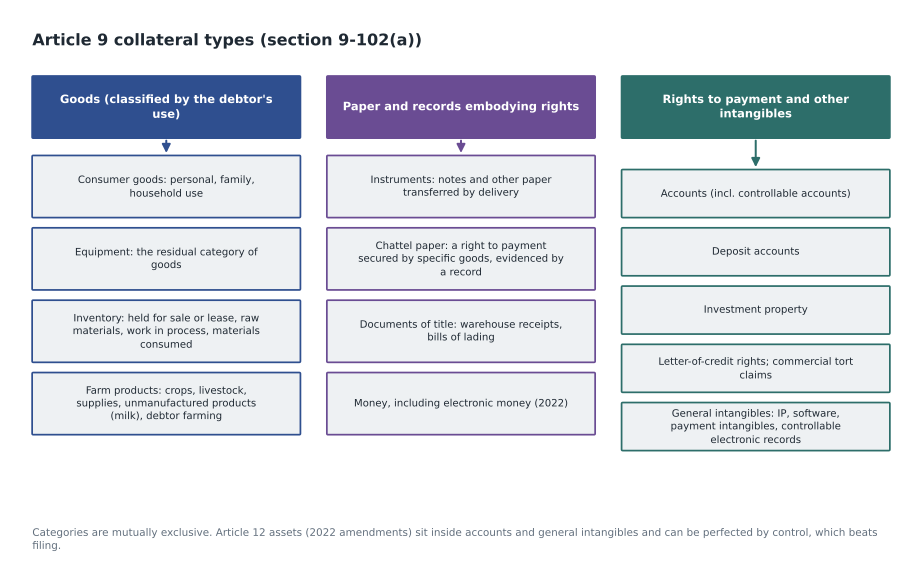
The boxes are defined in section 9-102(a). They are mutually exclusive, and the definitions are written so that a residual category catches whatever the specific ones miss. The first division is between goods, which are things movable when the security interest attaches (section 9-102(a)(44)), and everything else: rights to payment, documents and other intangibles. Within goods the Code divides by the debtor's use, not by the nature of the thing. Within intangibles it divides mostly by the form in which the right is embodied, whether in a piece of paper, an electronic record or nothing at all. Lisowski's rule of thumb is to ask two questions in order: is it a thing or a right, and, if a thing, what is the debtor doing with it?
The four kinds of goods
Consumer goods are goods used or bought for use primarily for personal, family or household purposes (section 9-102(a)(23)). Equipment is the residual category: goods other than inventory, farm products or consumer goods (section 9-102(a)(33)). Inventory is goods, other than farm products, that are held for sale or lease, furnished under a contract of service, or are raw materials, work in process or materials used or consumed in a business (section 9-102(a)(48)). Farm products are crops, livestock, supplies used or produced in a farming operation, and products of crops or livestock in their unmanufactured states, such as milk, eggs or wool, but only if the debtor is engaged in a farming operation (section 9-102(a)(34)).
Use governs, so the same object can fall into different boxes. A refrigerator in Owen's kitchen is consumer goods; the same model in the creamery's break room is equipment; on the floor of an appliance dealer it is inventory. Where goods are used for more than one purpose, the Code looks to the primary use. Owen's pickup hauls feed and milk cans on weekdays and a bass boat on weekends. If the business use predominates it is equipment, and if Owen bought and financed it in his own name for mostly personal use it is consumer goods. The answer changes how the lender perfects, what happens if Owen sells it and what notices are required on default. Courts generally classify goods by the debtor's use when the security interest attaches, and a careful lender asks the debtor to state the intended use in the security agreement. A debtor's false statement may estop the debtor, but it does not bind a third party who knows the truth.
Inventory is defined generously. It includes not only cheese on the shelf waiting to be sold but also raw materials and work in process, and "materials used or consumed in a business": packaging, labels, rennet and cultures. The test for these is short life. Goods that are consumed in a single use or used up quickly are inventory even though they are never sold; goods with a longer useful life, like the cheese vats, are equipment. Goods leased to others are inventory of the lessor. When the bank's security agreement grants an interest in "inventory," it reaches all of these, including goods acquired after the agreement if the after-acquired property clause covers them.
Farm products and the creamery's mixed operation
Juniper Hill is both a farm and a manufacturer, and Lisowski uses it to show why the farm products definition is the trickiest of the four. The cows are livestock used in a farming operation, so they are farm products. Feed and veterinary supplies used in that operation are farm products. Raw milk is a product of livestock in its unmanufactured state, and because Juniper Hill is engaged in a farming operation, the milk in the bulk tank is also a farm product. But once the milk becomes cheese, it has been manufactured, and cheese is no longer in an "unmanufactured state." The aging wheels on the shelves are inventory. The line between processing that leaves a product unmanufactured, such as washing and grading eggs or pasteurizing milk, and processing that manufactures something new is a question of degree, and courts have drawn it case by case.
Marcus Webb, the engineer in the group, asks why the distinction should matter. Lisowski gives three reasons. First, farm products are never inventory, even when the farmer holds them for sale, so a security agreement covering "inventory" does not reach a dairy farmer's herd or milk. Second, a buyer of farm products from a person engaged in farming operations is excluded from the buyer-in-ordinary-course rule of section 9-320(a) and is instead governed by the federal Food Security Act of 1985, 7 U.S.C. section 1631, which Lesson 7 examines. Third, agricultural liens attach only to farm products. The creamery's neighbor, Ezra Pullman, sells raw milk to Juniper Hill when the creamery's own herd falls short. In Pullman's hands the milk is a farm product; in Juniper Hill's hands, if it is destined for cheese, many lenders would call it inventory, and a careful one describes it both ways.
Paper and records that embody rights
Some rights to payment are so tied to a piece of paper or an electronic record that the paper is treated almost like the right itself. An instrument is a negotiable instrument or any other writing that evidences a right to payment, is not itself a security agreement or lease, and is of a type that in the ordinary course is transferred by delivery with any necessary indorsement (section 9-102(a)(47)). The neighbor's signed promissory note for the old cheese vat is an instrument. A document of title, such as a warehouse receipt or bill of lading, embodies the right to goods held by a bailee. Money is defined in section 1-201(b)(24) and, as revised in 2022, is a medium of exchange currently authorized or adopted by a government. Coins and bills in the creamery's cash drawer are money; so, since the 2022 amendments, is electronic money such as a central bank digital currency.
Chattel paper is a right to payment that is secured by specific goods or owed under a lease of specific goods, where the right is evidenced by a record (section 9-102(a)(11), as revised in 2022). Suppose that, instead of taking a promissory note, Juniper Hill had sold the old vat to its neighbor on an installment contract that kept a security interest in the vat. That contract would be chattel paper: a payment obligation plus a security interest in specific goods. Lenders and finance companies buy chattel paper in bulk from car and equipment dealers, and Article 9 gives such purchasers special priority rules. The 2022 amendments shifted the focus from the paper itself to the right to payment and allow perfection in electronic chattel paper by control of the authoritative electronic copy (section 9-105).
Rights to payment and other intangibles
The receivables owed by Northgate and the restaurants are accounts, and so are credit card receivables and many health-care receivables. A deposit account is a demand, time, savings, passbook or similar account maintained with a bank (section 9-102(a)(29)); the creamery's operating and payroll accounts qualify. A deposit account is not the money in it. It is the bank's obligation to pay the depositor, and that is why a security interest in it is perfected in its own special way. Investment property includes securities, securities entitlements and securities accounts (section 9-102(a)(49)); Lena's brokerage account at a firm in Brennan Falls is investment property. A letter-of-credit right is a right to payment under a letter of credit. A commercial tort claim is a tort claim held by an organization, or held by an individual if it arose in the course of the individual's business and does not include damages for personal injury or death (section 9-102(a)(13)).
General intangible is the residual category for personal property not otherwise defined, including things in action, intellectual property and software (section 9-102(a)(42)). The Juniper Hill name and trademark are general intangibles. So is a license, a contract right that is not yet a right to payment for goods or services, and the right to the county agricultural board's promised grant if it were enforceable. Within general intangibles is a subcategory, payment intangibles, in which the account debtor's principal obligation is monetary (section 9-102(a)(61)). A loan that is not evidenced by an instrument is a payment intangible in the hands of the lender. The rule that sales of payment intangibles are automatically perfected (section 9-309(3)) lets banks sell participations in their loans without filing.
The claim against Calloway Refrigeration shows why classification can be a matter of pleading. To the extent Juniper Hill sues for breach of warranty and contract damages, the claim is a contract right, a general intangible. To the extent it sues in negligence for the spoiled cheese, the claim is a commercial tort claim, because Juniper Hill is an organization. The distinction matters at attachment. Section 9-108(e)(1) says a description only by type of collateral is not sufficient for a commercial tort claim, and section 9-204(b)(2) says an after-acquired property clause does not reach commercial tort claims. The bank's security agreement, signed in September 2025, could not have covered a tort claim that arose in July 2026 unless the parties signed a supplement describing that specific claim.
The 2022 categories: controllable electronic records
Digital assets fit uneasily into the old categories. Before 2022 a bitcoin was, by default, a general intangible, perfected by filing, and a buyer of one could not be sure it was taking free of a lender's filed interest. Article 12 created a new kind of property, the controllable electronic record (CER): a record stored in an electronic medium that can be subjected to control under section 12-105 (section 12-102(a)(1)). Many cryptocurrencies and nonfungible tokens are CERs. Article 9 treats a CER as a kind of general intangible, but it gives a secured party who obtains control a better position than one who merely files, and Article 12 protects a qualifying purchaser, one who obtains control for value, in good faith and without notice of a claim, by letting it take the CER free of property claims (section 12-104).
Article 12 also lets ordinary rights to payment be tied to a CER. A controllable account is an account evidenced by a CER that provides that the account debtor undertakes to pay the person that has control of the CER; a controllable payment intangible is the same thing for a payment intangible (section 9-102(a)(27A) and (27B)). Imagine a tokenized invoice issued on a platform where whoever controls the token is the person Northgate must pay. Such rights can be transferred as quickly as the token, and a secured party with control has priority over one that filed (section 9-326A).
Lisowski poses a question that Priya Natarajan likes. A food-cooperative customer paid Juniper Hill for a holiday order with 0.4 bitcoin, which Owen moved to a self-hosted wallet on his phone; the creamery also holds some bitcoin in an account at a large crypto exchange. The bitcoin in the self-hosted wallet is a CER that the creamery controls. The bitcoin at the exchange may be something else: if the exchange's customer agreement treats it as a financial asset credited to a securities account, the creamery holds a securities entitlement, which is investment property governed by Article 8. "Read the customer agreement," Lisowski says. "The same coin can be a general intangible in one wallet and investment property in another." Electronic money, by contrast, is money: it cannot be a CER, and a security interest in it is perfected only by control (section 9-312(b)(4)).
Worked problem
Sorting the creamery's property into boxes
Using Owen's list, classify each item for Merrin Valley Bank's security agreement: the cows, raw milk, aging cheese, rennet and labels, the cheese vats, Owen's pickup, the Northgate receivables, the neighbor's promissory note, the operating account, the trademark and the claim against Calloway.
Show solution
- Cows: farm products (livestock used in a farming operation). Raw milk: farm products (a product of livestock in its unmanufactured state, held by a debtor engaged in farming).
- Aging cheese: inventory. Making cheese is manufacturing, so it is no longer a product in an unmanufactured state, and it is held for sale.
- Rennet, cultures and labels: inventory, as materials used or consumed in the business. Cheese vats and the press: equipment, because they are used in the business over a long life and are not held for sale.
- Owen's pickup: equipment if the partnership owns it and uses it mainly in the business; consumer goods if Owen owns it individually and uses it mainly for personal purposes. Because it is a titled vehicle, perfection runs through the certificate of title in either case (Lesson 5).
- Northgate and restaurant receivables: accounts. The neighbor's signed note: an instrument. Had the vat been sold on an installment contract retaining a security interest, the contract would be chattel paper.
- Operating account: a deposit account. Trademark: a general intangible. Calloway claim: a general intangible insofar as it sounds in contract, a commercial tort claim insofar as it sounds in negligence, which must be described specifically and cannot be reached by an after-acquired property clause.
Why the boxes matter
Lisowski ends by tying each category to the rules students will meet later. Description of collateral in a security agreement may be by Article 9 type (section 9-108(b)(3)), so a lender that writes "inventory and equipment" has covered the vats and the cheese but not the cows. The method of perfection depends on type: filing works for most collateral, but a deposit account can be perfected only by control, money only by possession or, for electronic money, by control, and a security interest in consumer goods bought on credit from the seller is often perfected automatically. Priority rules also depend on type: buyers of inventory take free of the lender's interest, purchase-money lenders in inventory must send notice to earlier filers, and purchasers of chattel paper and instruments may defeat even a perfected lender.
"The commonest drafting mistake in practice," Lisowski says, "is a description written for a manufacturer used for a farm, or one written for a farm used for a software company. The second commonest is forgetting that Owen uses his truck for fishing." He assigns a short exercise. Each student must draft a collateral description for Juniper Hill that reaches every item on the list that can be reached by a description by type, and must flag the items that need something more.
Summary and key terms
- Every item of collateral fits one Article 9 category; goods are classified by the debtor's use and intangibles mostly by the form in which they are embodied.
- Consumer goods, equipment, inventory and farm products are mutually exclusive; equipment is the residual category for goods.
- Farm products require a debtor engaged in a farming operation; manufacturing (milk into cheese) turns them into inventory.
- Instruments, chattel paper, documents and money embody rights in paper or records; accounts, deposit accounts, investment property, letter-of-credit rights and commercial tort claims are defined intangibles.
- General intangible is the residual category; payment intangibles and CERs sit inside it.
- Commercial tort claims must be described specifically and are not reached by after-acquired property clauses.
- Under the 2022 amendments, CERs, controllable accounts and controllable payment intangibles can be perfected by control, which beats filing; electronic money is money and is perfected only by control.
Practice problems
Work each problem on paper first, then reveal the answer to check.
An appliance dealer finances its showroom stock with a bank. A customer buys one refrigerator for her home on credit from the dealer. Classify the refrigerator before and after the sale.
Show answer
Before the sale it is inventory of the dealer. After the sale, in the customer's hands, it is consumer goods, because she uses it primarily for household purposes.
Juniper Hill's security agreement covers "all inventory, equipment and accounts, now owned or hereafter acquired." Does it reach the dairy herd?
Show answer
No. Livestock held by a debtor engaged in a farming operation are farm products, which by definition are not inventory or equipment. The agreement should also list farm products or livestock.
A restaurant customer signs a negotiable promissory note to pay an overdue invoice. What was the collateral before, and what is it now?
Show answer
Before, the right to payment for cheese sold was an account. Once evidenced by a negotiable note, the right is an instrument.
Why does it matter whether bitcoin held at an exchange is a CER or a securities entitlement?
Show answer
Different law governs transfer and perfection. A CER is governed by Article 12 and perfected by filing or by control under section 12-105; a securities entitlement is investment property under Article 8, perfected by filing or by control under section 8-106. The exchange's customer agreement often decides which it is.
Lesson quiz · 5 questions
Score 60% or more to complete this lesson.
Create a free account to save your progress, take quizzes and earn a certificate.