
LAWU-214 · Lesson 8 of 12 · 25 min
Special priority contests: fixtures, accessions, commingled goods and deposit accounts
▶ Video coming soon A video version of this lesson is on the way.
Lisowski begins by asking Marcus Webb to describe, as an engineer would, what Calloway actually built in the barn. Marcus has read the Contracts file closely. The aging room is a box of insulated panels bolted to a new concrete curb poured into the barn floor, with a door, shelving, two evaporator coils hung from the ceiling, condensing units on a steel pad outside the barn wall, refrigerant lines run through holes cut in the wall and a control panel wired into the barn's upgraded three-phase service. "Could you take it out?" Lisowski asks. Marcus says yes, in a week, with a crew, a crane for the condensing units and a mason to patch the wall and floor. "Then you have just described a fixture problem," Lisowski says, "and a fixture problem means a fight between personal property law and real property law."
The general rules of Lesson 7 rank competing claims to the same collateral when everyone's interest arises under Article 9 or from a judicial lien. This lesson covers four situations in which collateral is joined to something else: goods that become part of land (fixtures), goods that become part of other goods (accessions), goods that lose their identity in a product or mass (commingled goods), and money that sits in a bank account the bank itself has claims against (deposit accounts). In each, Article 9 supplies a special rule because the general rule would either ignore a non-Article 9 claimant, such as a mortgagee, or produce arbitrary results.
Fixtures
Fixtures are goods that have become so related to particular real property that an interest in them arises under real property law (section 9-102(a)(41)). Article 9 does not say when that happens. The answer comes from Westmarch real property law, which, like that of most states, asks about the degree of physical annexation, the adaptation of the goods to the use of the land and, most importantly, the objective intention of the person who attached them, judged from the circumstances. A walk-in aging room built on a poured curb in a dairy barn, wired into the building's electrical service, is very likely a fixture. A freestanding cheese vat plugged into an outlet is not. Section 9-334(a) adds that a security interest does not exist under Article 9 in ordinary building materials incorporated into an improvement on land, such as bricks, lumber or the concrete in the curb. Those simply become part of the real estate.
The fixture problem matters because the barn and land are mortgaged. Lisowski adds a fact: in 2019 Lena and Owen refinanced the farm with Ambler Farm Credit, which holds a recorded mortgage on the land and buildings in the Merrin County land records, covering, as mortgages usually do, all fixtures now or later attached. Under real property law the mortgage reaches the aging room once it becomes a fixture. Calloway, meanwhile, claims a purchase-money security interest in the equipment it sold. Section 9-334 decides between them. The starting point is section 9-334(c): a security interest in fixtures is subordinate to a conflicting interest of an encumbrancer or owner of the related real property other than the debtor. Real estate interests win unless an exception applies.
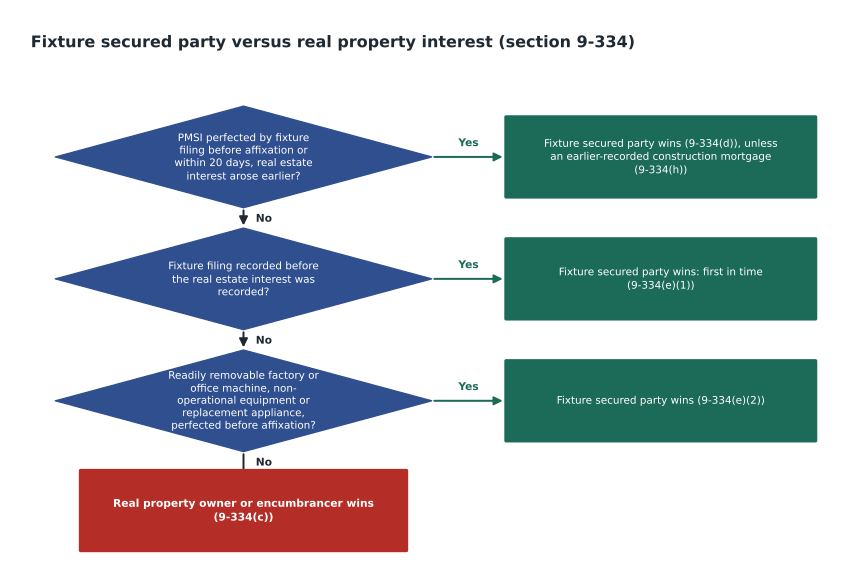
The exceptions are in section 9-334(d) and (e). The purchase-money exception, subsection (d), gives a PMSI in fixtures priority over an earlier real estate interest if the debtor has an interest of record in or is in possession of the real property, the security interest is a purchase-money security interest, the real estate interest arose before the goods became fixtures, and the security interest is perfected by a fixture filing before the goods become fixtures or within twenty days afterward. A fixture filing is a financing statement filed in the real property records with a description of the land and the other contents required by section 9-502(b). Subsection (e)(1) is a first-in-time rule: a fixture secured party that records a fixture filing before the real estate interest is recorded wins. Subsection (e)(2) protects security interests, perfected by any method before the goods become fixtures, in readily removable factory or office machines, readily removable equipment not primarily used or leased for use in the operation of the real property, and readily removable replacements of domestic appliances that are consumer goods. Subsection (e)(3) protects a perfected fixture security interest against a later judicial lien on the land.
Calloway filed only with the Westmarch Secretary of State on August 4, 2026. That central filing is not a fixture filing, so the purchase-money exception in section 9-334(d) is unavailable, however the twenty-day question in Lesson 6 comes out. The first-in-time exception fails too, because Ambler's mortgage was recorded in 2019. Calloway's best argument is subsection (e)(2): the equipment is not primarily used in the operation of the real property, since it serves the cheese business rather than the barn itself. But the exception covers only readily removable equipment, and a room built on a poured curb, removable only with a crew, a crane and a mason, is not readily removable on any natural reading. The probable result is that Ambler's mortgage has priority in the aging room, and Calloway's security interest in it, though valid, ranks behind the mortgage. The condensing units on their outdoor pad and the control panel may be a different story, which is why Calloway's lawyer will argue item by item.
Priority is not the only question. Section 9-604(c) lets a secured party with priority over the real estate claimants remove the fixtures on default, and section 9-604(d) requires it to reimburse an encumbrancer or owner, other than the debtor, for the cost of repairing any physical injury caused by the removal, but not for any diminution in value of the real property caused by the absence of the goods or the need to replace them. The secured party may have to post security for that obligation. The construction mortgage rule in section 9-334(h) gives a mortgage that secures an obligation incurred for the construction of an improvement priority over a later purchase-money fixture interest if the mortgage was recorded before the goods became fixtures and the goods became fixtures before the construction was completed. A purchase-money seller of fixtures for a building under construction must therefore negotiate with the construction lender.
Hannah Lindqvist asks what a careful equipment seller in Calloway's position should have done. Lisowski lists three steps: file a fixture filing in the Merrin County land records describing the farm, as well as a central filing, at the time of contract; obtain a signed disclaimer or subordination from Ambler Farm Credit, which lenders often give for equipment they never valued as part of their collateral; and, in the contract, describe the components that remain personal property and are intended to be removable. "Fixture law punishes sellers who think of themselves as selling machines when they are really changing a building," he says.
Accessions
Accessions are goods that are physically united with other goods in such a manner that the identity of the original goods is not lost (section 9-102(a)(1)). The reefer unit on the creamery's delivery truck is the standard example. In March 2026 Juniper Hill bought a new transport refrigeration unit for the truck from Osgood Transport Refrigeration for 14,000 dollars, on credit, and Osgood kept a security interest in the unit and filed a financing statement the same day. The unit can be unbolted and moved to another truck; its identity is not lost. By then Merrin Valley Bank had corrected the gap the examiner found and had its lien noted on the truck's certificate of title.
Section 9-335(a) says a security interest may be created in an accession and continues in collateral that becomes an accession. Section 9-335(c) says that, as a general matter, the other priority rules of Article 9 govern a contest between a security interest in an accession and a security interest in the whole. Osgood's PMSI in the unit, filed when Juniper Hill received possession, would therefore normally beat the bank's earlier interest in the unit, which attached as after-acquired equipment, under the purchase-money rule of section 9-324(a). But section 9-335(d) adds a special rule for titled goods: a security interest in an accession is subordinate to a security interest in the whole that is perfected by compliance with a certificate-of-title statute. Because the bank's interest in the truck is noted on the title, the bank has priority even in the reefer unit. The policy is that a buyer or lender relying on a clean title should be able to trust it for the whole vehicle.
When a secured party with priority in an accession removes it after default, section 9-335(e) and (f) require it to reimburse any holder of an interest in the whole, other than the debtor, for the cost of repairing physical injury caused by the removal, but not for diminution in value of the whole caused by the absence of the accession. The rule mirrors the fixture rule. It also explains why accession lenders seldom fight over small parts: the cost of removal and repair often exceeds the value of what they would recover.
Commingled goods
Commingled goods are goods that are physically united with other goods in such a manner that their identity is lost in a product or mass (section 9-336(a)). Milk made into cheese is the classic case, along with flour in bread, grain in an elevator and crude oil in a tank. Section 9-336(b) says a security interest does not exist in commingled goods as such, because they no longer exist as such. Instead, section 9-336(c) says a security interest may attach to the product or mass resulting when goods become commingled goods. If the security interest in the original goods was perfected, the security interest in the product or mass is perfected (section 9-336(d)).
Return to Ezra Pullman's milk. From Lesson 7, Juniper Hill bought three months of Pullman's milk subject to Corrigan State Bank's perfected security interest, because Corrigan gave direct notice under the Food Security Act and Juniper Hill ignored its payment instruction. The milk went into cheese along with milk from Juniper Hill's own herd, cultures and salt. Corrigan's security interest in Pullman's milk continues in the cheese, perfected. Merrin Valley Bank also claims the cheese, as Juniper Hill's inventory. Section 9-336(f) supplies the priority rule: a perfected security interest in the product or mass has priority over an unperfected one, and if more than one security interest is perfected under subsection (d), they rank equally in proportion to the value of the collateral at the time it became commingled goods. The bank will argue that its security interest attaches directly to the cheese as inventory, so that the first-to-file rule, rather than section 9-336, should govern its contest with Corrigan. Lisowski tells the class to assume that the proportional rule applies, as it would between two lenders whose interests in component goods both continue into the product.
Lisowski puts numbers on it. The milk from Pullman that went into one batch was worth 18,000 dollars when it entered the vat. Juniper Hill's own milk and other inputs subject to the bank's security interest were worth 42,000 dollars. The resulting cheese, after aging, is worth 90,000 dollars. Under the proportional rule, Corrigan's share is 18,000 divided by 60,000, or three-tenths, of the cheese's value, which is 27,000 dollars, and the bank's share is seven-tenths, or 63,000 dollars. Corrigan's claim is capped at the debt secured; if Pullman owes Corrigan only 20,000 dollars, Corrigan takes 20,000 and the remaining 7,000 dollars of its share falls to the bank. The rule shares the value added by Juniper Hill's labor and aging in proportion to inputs, rather than giving either lender the whole increase.
Deposit accounts
Deposit accounts have their own priority rules because the bank where the account is kept has claims of its own. Section 9-327 gives four rules. A security interest held by a secured party having control of the deposit account has priority over a conflicting interest held by a secured party that does not have control (section 9-327(1)). Among secured parties with control under the control-agreement or customer methods, priority goes by the time of obtaining control (section 9-327(2)). A security interest held by the bank with which the account is maintained has priority over a conflicting security interest held by another secured party (section 9-327(3)), unless the other secured party has become the bank's customer on the account, in which case the customer-secured party wins (section 9-327(4)). Section 9-340 adds that the bank may exercise any right of recoupment or setoff against a secured party that holds a security interest in the account, except one that has become the bank's customer.
The rules make control agreements matter. Merrin Valley Bank has automatic control of the operating account it maintains, so its security interest there beats any other lender's. At Kittredge Savings Bank, where Juniper Hill keeps its payroll account, Merrin Valley signed a three-party control agreement with Juniper Hill and Kittredge in the spring of 2026. That gives Merrin Valley priority over any later lender, but under section 9-327(3), if Kittredge itself took a security interest in the account to secure an equipment loan, Kittredge would win, and under section 9-340 Kittredge could set off fees and overdrafts. Control agreements therefore usually include the depositary bank's agreement to subordinate its own security interest and setoff rights, except for routine fees and returned items. Priya asks whether this is a trap for lenders. Lisowski answers that it is a trap only for lenders that do not read the control agreement.
Purchasers of chattel paper and instruments
One more set of special rules deserves mention because it can defeat a perfected secured party outright. Under section 9-330(a) and (b), a purchaser of chattel paper that gives new value and takes possession of the paper or obtains control of the authoritative electronic copy in good faith and in the ordinary course of its business has priority over a security interest in the chattel paper claimed merely as proceeds of inventory, unless the paper indicates that it has been assigned to someone else, and has priority over other security interests if it acts without knowledge that the purchase violates the secured party's rights. Under section 9-330(d), a purchaser of an instrument that gives value and takes possession in good faith and without knowledge that the purchase violates the secured party's rights has priority over a security interest perfected by another method. And section 9-331 preserves the rights of holders in due course of negotiable instruments. These rules protect the market for chattel paper and negotiable paper in the same way that section 9-320(a) protects buyers of goods.
Worked problem
Ranking claims to the cold storage system, the reefer unit and a batch of cheese
Use the facts in this lesson. (1) Ambler Farm Credit's 2019 recorded mortgage covering fixtures against Calloway's PMSI perfected by central filing on August 4, 2026 in a walk-in aging room built on a poured curb. (2) The bank's lien noted on the truck title against Osgood's PMSI in a 14,000-dollar reefer unit, filed when installed. (3) Corrigan's and the bank's interests in a batch of cheese worth 90,000 dollars made from 18,000 dollars of Pullman's milk and 42,000 dollars of the bank's collateral, with Pullman owing Corrigan 50,000 dollars.
Show solution
- Aging room: a fixture under Westmarch law. Calloway did not make a fixture filing, so section 9-334(d) and (e)(1) do not help. The room is probably not 'readily removable' equipment under section 9-334(e)(2). Under section 9-334(c), Ambler's mortgage has priority. Calloway should argue separately about readily removable components such as the outdoor condensing units.
- Reefer unit: an accession. Under the general rules Osgood's PMSI would beat the bank (section 9-324(a)), but section 9-335(d) subordinates an accession security interest to a security interest in the whole perfected by notation on a certificate of title. The bank wins.
- Cheese: commingled goods. Both interests are perfected and continue in the product (section 9-336(c) and (d)). Assuming the proportional rule of section 9-336(f)(2) governs, Corrigan takes 18/60 of 90,000 dollars, or 27,000, and the bank 42/60, or 63,000.
- Cap check: Pullman owes Corrigan 50,000 dollars, more than 27,000, so Corrigan's share is not capped and Corrigan keeps the full 27,000; its remaining 23,000 claim is against Pullman, and possibly against Juniper Hill in conversion.
- Practice lesson: in each contest the losing party could have protected itself in advance, by a fixture filing and a mortgagee disclaimer, by a title notation or subordination, or by paying the farmer jointly with his lender.
Summary and key terms
- Whether goods are fixtures is a question of real property law; ordinary building materials are not subject to Article 9 at all.
- A real estate interest generally beats a fixture security interest (section 9-334(c)), unless the secured party qualifies under subsection (d) or (e).
- Purchase-money fixture priority requires a fixture filing within twenty days after affixation; a central filing is not enough.
- Readily removable machines and non-operational equipment are protected if perfected by any method before affixation.
- Secured parties removing fixtures or accessions must pay for physical injury caused by removal, but not for lost value.
- Accession security interests follow the general rules, except that a security interest in the whole perfected through a certificate of title wins (section 9-335(d)).
- Perfected interests in commingled goods continue in the product and share proportionally to input values (section 9-336(f)).
- In deposit accounts, control beats non-control, the depositary bank beats others unless the secured party becomes its customer, and setoff is preserved (sections 9-327 and 9-340).
Practice problems
Work each problem on paper first, then reveal the answer to check.
A lender with a purchase-money security interest in a new furnace installed in an office building files a fixture filing ten days after installation. The building's mortgage was recorded three years earlier. Who has priority in the furnace?
Show answer
The lender, under section 9-334(d): it is a PMSI, the mortgage arose before the goods became fixtures, and the fixture filing came within twenty days after affixation, assuming the debtor had an interest of record or possession.
Same furnace, but the lender filed only centrally with the Secretary of State before installation. Who wins?
Show answer
Probably the mortgagee. A central filing is not a fixture filing, so subsection (d) is unavailable. A furnace is equipment used in the operation of the building and is not readily removable, so subsection (e)(2) does not apply either.
A lender with a filed security interest in a new engine installed in a titled truck competes with the truck lender whose lien is noted on the title. Who wins in the engine?
Show answer
The truck lender, under section 9-335(d), because its security interest in the whole is perfected by compliance with a certificate-of-title statute.
A secured party has a control agreement over a deposit account, and the depositary bank later takes its own security interest in the account. Who has priority?
Show answer
The depositary bank, under section 9-327(3), unless the secured party became the bank's customer on the account or the bank agreed to subordinate in the control agreement.
Lesson quiz · 5 questions
Score 60% or more to complete this lesson.
Create a free account to save your progress, take quizzes and earn a certificate.