
LAWU-214 · Lesson 4 of 12 · 24 min
Perfection
▶ Video coming soon A video version of this lesson is on the way.
Lisowski returns to the one-page form from the first day. It is Merrin Valley Bank's financing statement against Juniper Hill, filed electronically with the Westmarch Secretary of State on September 10, 2025, two days before the loan closed. Box 1 gives the debtor's name as "Juniper Hill Creamery." Box 3 names the bank. Box 4 describes the collateral as "all assets of the debtor, now owned or hereafter acquired, and all proceeds." "This," he says, "is how the bank tells the world. The world is not obliged to come looking for the bank, but anyone who lends to Juniper Hill without searching has only itself to blame."
Perfection is the step that makes a security interest effective against third parties. Section 9-308(a) says a security interest is perfected when it has attached and all applicable requirements for perfection have been satisfied. Section 9-310(a) supplies the general rule: a financing statement must be filed to perfect all security interests, except where the Code provides otherwise, as it does for possession, control, automatic perfection and goods covered by certificate-of-title statutes. Filing can happen before attachment. Section 9-502(d) allows a financing statement to be filed before a security agreement is made or a security interest otherwise attaches, and the bank's early filing is standard practice. It starts the clock for priority under the first-to-file-or-perfect rule even before the bank has lent anything.
How notice filing works
Article 9 uses what the drafters called notice filing. The financing statement does not describe the deal; it tells a searcher that a particular secured party may have a security interest in particular kinds of the debtor's property, so that the searcher can ask. Section 9-210 gives the debtor a right to demand that the secured party provide an accounting or confirm a list of collateral, and in practice the debtor passes the request along to the lender who is considering a new loan. The system works because it is cheap and simple, and it is simple because a financing statement needs only three things. Under section 9-502(a), it is sufficient if it provides the name of the debtor, provides the name of the secured party or a representative of the secured party, and indicates the collateral covered.
The collateral indication can be broad. Section 9-504 says it is sufficient if it provides a description under section 9-108 or an indication that the financing statement covers all assets or all personal property. Some filers say more than they need, and a filing that indicates "equipment" will not perfect an interest in inventory, so the indication must at least cover the collateral in which the secured party claims an interest. The filing office has some reasons it may reject a record under section 9-516(b), such as the absence of a mailing address for the debtor or an indication whether the debtor is an individual or an organization, but a filing that the office wrongly accepts is effective despite those omissions, and a record that the office wrongly rejects is effective except against a purchaser who reasonably relied on its absence (section 9-516(d)).
Filing must be authorized. Under section 9-509(a) and (b), a person may file a financing statement only if the debtor authorizes it in a signed record, and by signing a security agreement the debtor authorizes a filing covering the collateral described in it and identifiable proceeds. The bank's security agreement includes, as almost all do, an express authorization to file an all-assets financing statement. An unauthorized filing is ineffective, and section 9-625(b) and (e) expose the filer to damages and a statutory penalty. Authorization also matters for amendments and terminations, as the General Motors case below shows.
The debtor's name
Because searchers search by name, the debtor's name is the most important item on the form, and section 9-503 tells the filer what name to use. For a registered organization, an entity formed by filing a public organic record with a state, such as a corporation, a limited liability company or a limited partnership, the correct name is the name stated in the public organic record most recently filed with or issued by the state (section 9-503(a)(1)). For a decedent's estate, a trust and some other debtors there are special rules. For an individual, Article 9 offers states two alternatives. Under Alternative A, adopted by most states and assumed for Westmarch, if the individual holds an unexpired driver's license issued by the state where the financing statement is filed, the correct name is the name indicated on the license (section 9-503(a)(4)). Under Alternative B, the individual name, the surname and first personal name or the name on the license are all sufficient.
Other organizations, including a general partnership like Juniper Hill, which exists without filing anything with the state, are named by their organizational name (section 9-503(a)(6)(A)). If the organization has no name, the filer gives the names of the partners, members or associates (section 9-503(a)(6)(B)). Section 9-503(c) adds that a trade name is neither required nor sufficient. Juniper Hill sells its cheese under the blue-label brand "Juniper Hill Farm Cheese," and a financing statement in that name alone would not perfect. Because a general partnership's legal name can be uncertain when there is no written agreement, careful lenders also file against the partners by their individual names, which also helps if a court later decides that particular assets belong to the partners.
What if the filer gets the name wrong? Section 9-506(a) says a financing statement substantially satisfying the requirements is effective even if it has minor errors or omissions, unless the errors make it seriously misleading. Section 9-506(b) says a financing statement that fails to provide the debtor's correct name is seriously misleading, and then section 9-506(c) creates a safe harbor: if a search of the filing office's records under the debtor's correct name, using the office's standard search logic, would disclose the financing statement, the error is not seriously misleading. The test is mechanical. It does not ask whether a reasonable searcher would have found the filing by trying variations. It asks what the official search returns.
Two cases show how unforgiving the test can be. In In re Kinderknecht, 308 B.R. 71 (B.A.P. 10th Cir. 2004), a lender filed against "Terry J. Kinderknecht," the nickname the debtor used, when his legal name was Terrance Joseph Kinderknecht. A search under the legal name did not disclose the filing, so it was seriously misleading and the trustee avoided the lien. In Pankratz Implement Co. v. Citizens National Bank, 130 P.3d 57 (Kan. 2006), a filing against "Roger House" for a debtor named Rodger House was held seriously misleading because the filing office's search under the correct name did not find it. The 2010 amendments that adopted the driver's license rule were a response to cases like these: they gave filers an objective, checkable source for an individual's name.
Lisowski runs the bank's filing through the test. The partnership's name is Juniper Hill Creamery, the name Lena and Owen have used on contracts, tax returns and the partnership's bank accounts since 2015, so Box 1 is correct. The bank also filed, the same day, against "Marsh, Owen" and "Marsh, Lena" as additional debtors. Owen's Westmarch driver's license reads "Owen Thomas Marsh," and the bank's filing says "Owen Marsh." Under Alternative A, the correct name is the name on the license, so the filing does not give the correct name. Whether it is nonetheless effective depends on whether a search under "Owen Thomas Marsh" using the Secretary of State's standard search logic would disclose it. Lisowski tells the class to assume that Westmarch's office, like many, searches by surname and first name and disregards middle names; on that assumption the search finds the filing and section 9-506(c) saves it. "Never assume that in practice," he adds. "Run the search."
Where to file
Filing in the wrong state is the same as not filing. Section 9-301(1) says that, while a debtor is located in a jurisdiction, the local law of that jurisdiction governs perfection of a nonpossessory security interest. Section 9-307 says where debtors are located. A registered organization organized under a state's law is located in that state, wherever it does business (section 9-307(e)). An individual is located at the individual's principal residence (section 9-307(b)(1)). Any other organization is located at its place of business if it has only one, and at its chief executive office if it has more than one (section 9-307(b)(2) and (3)). Juniper Hill, an unregistered general partnership with one place of business in Westmarch, is located in Westmarch. If it became Juniper Hill Foods, Inc., a Delaware corporation, as in Thackeray's hypothetical, it would be located in Delaware even if every cow stayed in Westmarch, and the bank would have to file in Delaware.
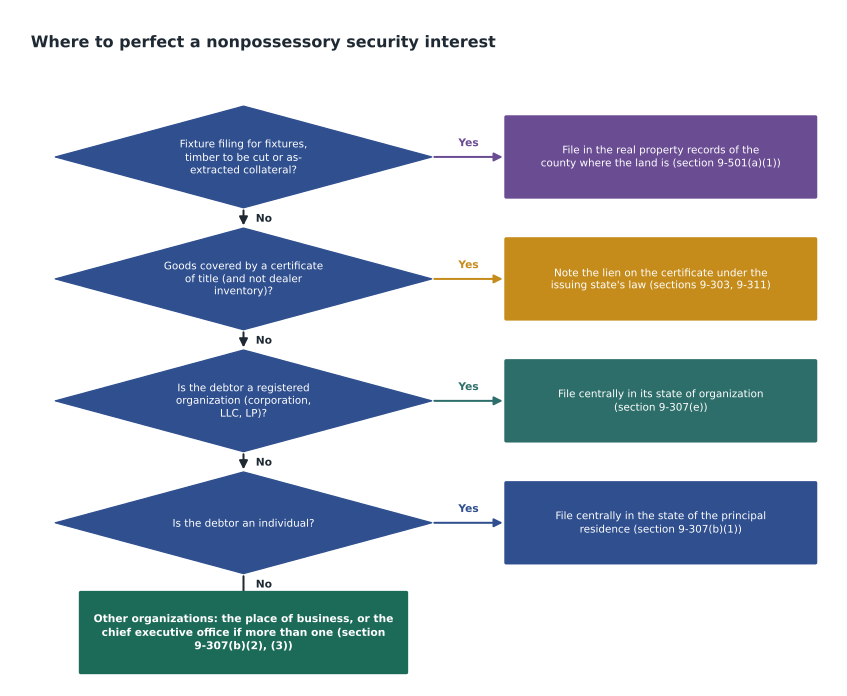
Within the state, section 9-501 sends most filings to a central office, usually the Secretary of State. The exceptions are filings for as-extracted collateral, timber to be cut and fixture filings, which go in the office where a mortgage on the related real property would be recorded, typically the county recorder (section 9-501(a)(1)). A fixture filing must also contain a description of the real property and, if the debtor has no interest of record in it, the name of a record owner (section 9-502(b)). Goods covered by certificate-of-title statutes, such as cars and trucks, are perfected by notation on the certificate rather than by filing (sections 9-303 and 9-311(a)(2)), a subject for Lesson 5.
Changes after filing
Debtors move, change their names and sell collateral, and Article 9 gives the secured party a grace period to catch up. If the debtor changes its location to another jurisdiction, a security interest perfected under the first state's law remains perfected until the earliest of the time it would have lapsed and four months after the change (section 9-316(a)(2)). If collateral is transferred to a person located in another jurisdiction, the period is one year (section 9-316(a)(3)). If the debtor changes its name so that the filing becomes seriously misleading, the financing statement remains effective for collateral acquired before the change and within four months after it, but not for collateral acquired more than four months after, unless the secured party amends the filing within the four months (section 9-507(c)). If collateral is sold to a buyer who takes subject to the security interest, the filing remains effective against the transferred collateral even though the buyer's name never appears in it (section 9-507(a)).
New debtors get similar treatment. When a new debtor becomes bound by the original debtor's security agreement under section 9-203(d), the original financing statement is effective against the new debtor's property to the extent it would have been against the original debtor (section 9-508(a)), but if the difference in names makes the filing seriously misleading, the filing is effective only for collateral the new debtor acquires within four months after it becomes bound (section 9-508(b)). The common thread is a four-month window for the secured party to discover the change and file anew. Lenders police that window through covenants requiring advance notice of any change in name, form or location and by searching periodically.
Lapse, continuation and termination
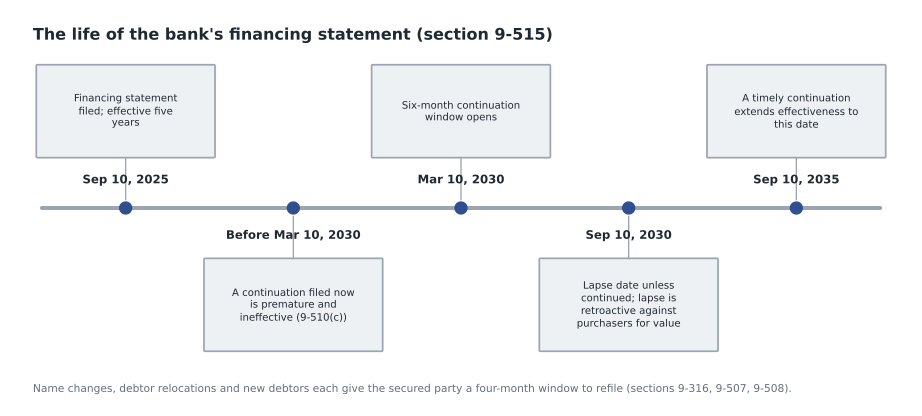
A financing statement is effective for five years after filing (section 9-515(a)). It lapses at the end of that period unless a continuation statement is filed within six months before lapse (section 9-515(d)). A continuation filed too early, outside that six-month window, is ineffective (section 9-510(c)), a trap that has cost lenders millions. A timely continuation extends effectiveness for another five years from the date the filing would have lapsed (section 9-515(e)). Upon lapse, the security interest becomes unperfected unless it is perfected by some other means, and section 9-515(c) adds a sting: it is deemed never to have been perfected as against a purchaser of the collateral for value, which includes a competing secured party. A lender that was first in line by years can drop to last because a calendar entry was missed.
Termination ends a financing statement's effectiveness. When the debt is paid and there is no commitment to lend, the secured party must file or send a termination statement within the periods in section 9-513, and it is liable for damages if it does not. The power to terminate is also a power to destroy. In Official Committee of Unsecured Creditors of Motors Liquidation Co. v. JPMorgan Chase Bank, N.A., 777 F.3d 100 (2d Cir. 2015), lawyers preparing the payoff of a small synthetic lease for General Motors included, by mistake, a termination statement for the financing statement securing a separate term loan of about 1.5 billion dollars. JPMorgan's lawyers reviewed and approved the closing documents. After answering a certified question, the Delaware Supreme Court held that a termination statement is effective if the secured party reviewed and knowingly approved its filing, even if it did not intend to terminate the security interest. The Second Circuit then held that JPMorgan had authorized the filing, leaving the term lenders unperfected in the GM bankruptcy.
Worked problem
Auditing the bank's filing
Lisowski asks Section B to audit the bank's financing statement as of today, with the following facts. Filed September 10, 2025 with the Westmarch Secretary of State, debtor "Juniper Hill Creamery," collateral "all assets." Additional debtors "Marsh, Owen" and "Marsh, Lena"; Owen's license reads "Owen Thomas Marsh" and Lena's reads "Lena Marsh." Assume Juniper Hill sells cheese under the name "Juniper Hill Farm Cheese" and has a single place of business in Merrin County, Westmarch. Is the bank perfected, and what should it calendar?
Show solution
- Attachment occurred on September 12, 2025 (Lesson 3), and filing two days earlier was permitted by section 9-502(d) and authorized by the security agreement under section 9-509. Perfection occurred on attachment.
- Content: the filing gives the debtor's name, the secured party's name and a collateral indication; 'all assets' is sufficient in a financing statement under section 9-504(2).
- Name: 'Juniper Hill Creamery' is the partnership's organizational name. The trade name 'Juniper Hill Farm Cheese' would not have been sufficient (section 9-503(c)), and need not appear.
- Place: an unregistered partnership with one place of business is located there (section 9-307(b)(2)), so Westmarch's central filing office is correct.
- Owen's filing: under Alternative A the correct name is the license name, 'Owen Thomas Marsh.' The filing is effective only if Westmarch's standard search logic would disclose 'Owen Marsh' on a search under the correct name (section 9-506(c)). The bank should run the official search and, to be safe, amend.
- Calendar: the filing lapses September 10, 2030. A continuation must be filed between March 10, 2030 and September 10, 2030. The bank should also require advance notice of any change in Juniper Hill's name, structure or location, because each triggers a four-month window under sections 9-316, 9-507 and 9-508.
Summary and key terms
- Filing perfects most security interests (section 9-310); a financing statement may be filed before attachment, and perfection occurs once both have happened.
- A financing statement needs the debtor's name, the secured party's name and an indication of collateral (section 9-502(a)); 'all assets' is enough.
- The debtor's name controls searching: the public organic record for registered organizations, the driver's license name for individuals under Alternative A, and the organizational name for others; trade names are insufficient.
- A wrong name is seriously misleading unless the filing office's standard search under the correct name discloses the filing (section 9-506(c)); see Kinderknecht and Pankratz.
- File in the state where the debtor is located (sections 9-301 and 9-307), usually centrally; fixture filings go in the real property records.
- Changes in location, name or debtor generally give the secured party four months to refile; transfers of collateral to a debtor in another state give one year.
- Financing statements lapse after five years unless continued within the six-month window; lapse is retroactive against purchasers for value.
- An authorized termination statement is effective even if filed by mistake (Motors Liquidation).
Practice problems
Work each problem on paper first, then reveal the answer to check.
A lender files against "Thistledown Cider" for a debtor whose certificate of organization reads "Thistledown Cider Works LLC." Is the filing effective?
Show answer
Only if a search under 'Thistledown Cider Works LLC' using the filing office's standard search logic would disclose it (section 9-506(c)). Many offices disregard entity endings like 'LLC,' but not missing words, so the filing is probably seriously misleading.
Juniper Hill converts into a Delaware corporation on March 1. When must the bank file in Delaware?
Show answer
The new corporation is located in Delaware (section 9-307(e)). As a new debtor bound by the security agreement, its property is covered, but the bank must file in Delaware within the grace periods (four months under sections 9-316 and 9-508) to remain perfected, and should file at once.
A financing statement filed January 15, 2021 is continued on May 1, 2025. Is the continuation effective?
Show answer
No. The filing lapses January 15, 2026, and the continuation window ran from July 15, 2025 to January 15, 2026. A continuation filed May 1, 2025 is premature and ineffective (section 9-510(c)).
Who decides whether a debtor's name error is seriously misleading: a reasonable searcher or the filing office's search logic?
Show answer
The filing office's standard search logic. Section 9-506(c) asks only whether a search under the correct name using that logic would disclose the filing.
Lesson quiz · 5 questions
Score 60% or more to complete this lesson.
Create a free account to save your progress, take quizzes and earn a certificate.