
LAWU-214 · Lesson 3 of 12 · 23 min
Attachment
▶ Video coming soon A video version of this lesson is on the way.
Lisowski opens the third class with the Merrin Valley Bank security agreement, a nine-page document that Owen Marsh signed on September 12, 2025, on behalf of "Juniper Hill Creamery, a Westmarch general partnership." He reads the granting clause slowly: "Debtor hereby grants to Bank a security interest in all of Debtor's inventory, equipment, farm products, accounts, deposit accounts, general intangibles, instruments and chattel paper, whether now owned or hereafter acquired, and all proceeds and products of the foregoing, to secure all obligations of Debtor to Bank, now existing or hereafter arising." Then he asks Jordan Kimura, the Army logistics officer who runs Section B's study group, a question that sounds simple. "On September 12, did the bank have a security interest in the cheese that Juniper Hill will make next spring?"
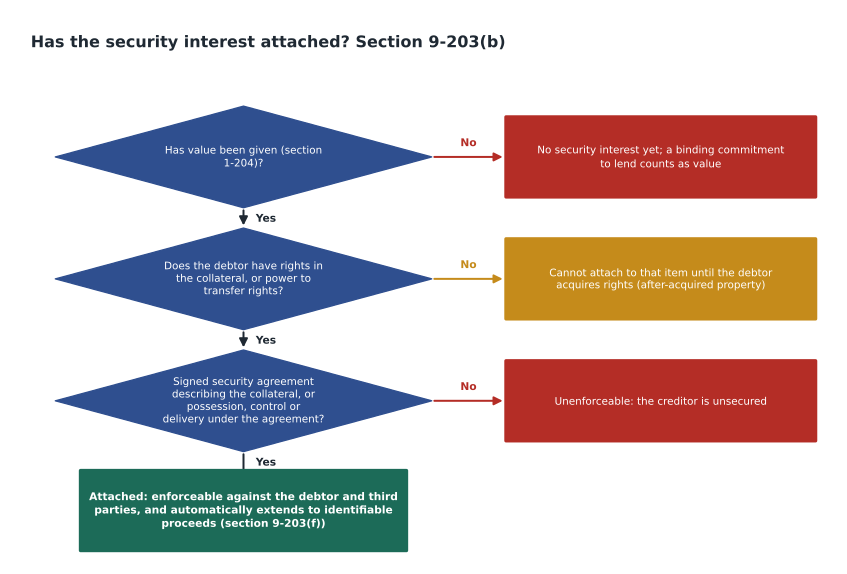
Jordan's answer, after some prompting, is no, and the reason is the subject of the lesson. A security interest attaches to collateral, and becomes enforceable against the debtor, only when three things are true at once. Section 9-203(b) requires that value has been given, that the debtor has rights in the collateral or the power to transfer rights in it, and that one of four evidentiary conditions is met: the debtor has signed a security agreement that describes the collateral, the secured party has possession of the collateral under the agreement, the secured party has control of certain kinds of collateral under the agreement, or, for certificated securities, delivery has occurred. Section 9-203(a) says the interest attaches when it becomes enforceable, unless the agreement expressly postpones attachment. Next spring's cheese does not yet exist, so Juniper Hill has no rights in it. The bank's interest will attach to each wheel the moment Juniper Hill acquires rights in it.
Value
Value is the easiest requirement. Section 1-204 says a person gives value for rights if the person acquires them in return for a binding commitment to extend credit, whether or not drawn upon; as security for, or in total or partial satisfaction of, a preexisting claim; by accepting delivery under a preexisting contract for purchase; or in return for any consideration sufficient to support a simple contract. Merrin Valley Bank gave value when it committed to the 600,000-dollar line of credit, before Owen drew a single dollar. A lender that takes collateral for a debt already owed also gives value, which is why a creditor who is worried about a customer can ask for collateral for an existing balance. That second rule has a bankruptcy cost, however. A security interest given for an old debt within ninety days before bankruptcy is a classic preference, as Lesson 11 shows.
Rights in the collateral
The debtor must have rights in the collateral, or the power to transfer rights in it to the secured party (section 9-203(b)(2)). Full ownership is not required. A debtor can grant a security interest in whatever rights it has: a lessee in its leasehold interest, a buyer in goods it has contracted for once they are identified to the contract under section 2-501, a consignee in consigned goods under section 9-319. But a debtor generally cannot encumber what it does not own. If Lena brings her own grandmother's cheese press to the creamery and lets the partnership use it, the bank's security interest in the partnership's equipment does not reach the press, because the partnership has no rights in it beyond a license to use it.
Hannah Lindqvist asks who the debtor is when the business is a partnership. Under the Revised Uniform Partnership Act, which Westmarch has adopted, property acquired by a partnership is property of the partnership and not of the partners individually (RUPA section 204). The debtor is therefore Juniper Hill Creamery, the partnership. Owen's signature binds it because a partner is an agent of the partnership for apparently carrying on in the ordinary course the partnership business (RUPA section 301), and borrowing money and granting collateral is ordinary for a dairy. The farm pickup, if titled to Owen personally, is not partnership property, and the partnership's security agreement does not reach it. If the bank wanted it, Owen would have to sign a security agreement in his own name.
Rights in collateral also has a timing dimension. A security interest in after-acquired property attaches to each new item only when the debtor acquires rights in it. For goods bought from a supplier, the buyer acquires rights no later than when the goods are delivered, and often earlier, once they are identified to the contract. For cheese made from the creamery's own milk, rights exist as each batch comes into being. For accounts, rights arise when the account is earned. These moments matter because they set the time of attachment, which can in turn determine priority against competing interests and, in bankruptcy, the date of the transfer for preference purposes under section 547(e)(3) of the Bankruptcy Code.
The signed security agreement
For collateral that the secured party does not possess or control, which is most collateral in commercial lending, the debtor must sign a security agreement that provides a description of the collateral (section 9-203(b)(3)(A)). This is Article 9's statute of frauds. It serves an evidentiary function, showing that the debtor really did agree to give collateral, and a cautionary one, impressing on the debtor the seriousness of the grant. Since the 2022 amendments the Code speaks of a record that is "signed," and section 1-201(b)(37) defines sign to include executing or adopting a tangible symbol or attaching or logically associating an electronic symbol, sound or process with a record, with present intent to adopt or accept it. An electronic signature on a loan platform suffices, as it did under the older word "authenticate."
No magic words are required, but the agreement must show an intent to create a security interest. Courts once divided on whether a financing statement and a promissory note could together satisfy the requirement when no document said "grants a security interest." Most now follow the composite document approach of In re Bollinger Corp., 614 F.2d 924 (3d Cir. 1980), in which the Third Circuit held that a promissory note, a financing statement and a course of correspondence, read together, showed that the parties intended a security interest, even though no formal security agreement had been signed. The approach is forgiving but not limitless: a financing statement alone, which merely gives notice that a security interest may exist, is usually not enough, because it does not show a grant.
Describing the collateral
Section 9-108(a) says a description is sufficient if it reasonably identifies what is described. It may do so by specific listing, by category, by a type of collateral defined in the UCC, by quantity, by a computational or allocational formula, or by any other method if the identity of the collateral is objectively determinable (section 9-108(b)). The bank's description by UCC type, "inventory, equipment, farm products, accounts" and so on, is standard and sufficient. But section 9-108(c) says a supergeneric description such as "all the debtor's assets" or "all the debtor's personal property" does not reasonably identify the collateral in a security agreement. The rule surprises students, because the same phrase is perfectly acceptable in a financing statement (section 9-504(2)). The difference reflects the two documents' jobs. The financing statement only warns searchers to inquire; the security agreement defines the deal.
Some descriptions need more. A commercial tort claim must be described more specifically than by type (section 9-108(e)(1)); "all commercial tort claims" fails, while "Debtor's claim against Calloway Refrigeration Systems, Inc. arising from the spoilage of cheese at Debtor's premises in July 2026" works. In a consumer transaction, a description only by type of collateral is insufficient for consumer goods, a security entitlement, a securities account or a commodity account (section 9-108(e)(2)). And courts read descriptions against the drafter. A security agreement that covers "equipment" does not cover the cows, and one that covers "inventory" at a dairy may not cover the raw milk, because farm products are not inventory. Lisowski points out that the bank's form lists farm products expressly, a sign that its lawyer had represented agricultural lenders before.
After-acquired property and future advances
A security agreement may create or provide for a security interest in after-acquired collateral (section 9-204(a)). That provision is what makes the floating lien possible. A lender to a business with inventory and receivables that turn over constantly does not want a security interest in this month's cheese and this month's invoices only. It wants an interest that floats over whatever inventory and accounts the debtor has at any moment. The clause "now owned or hereafter acquired" accomplishes that: each new wheel of cheese and each new account becomes collateral as soon as the creamery has rights in it, without any new document. Courts have sometimes inferred after-acquired coverage for inventory and accounts from the nature of the collateral even without the words, but a drafter who relies on that inference is taking a needless risk.
Two limits apply. An after-acquired property clause does not attach to consumer goods, other than accessions given as additional security, unless the debtor acquires rights in them within ten days after the secured party gives value (section 9-204(b)(1)). That rule prevents a consumer lender from taking a lien on everything a household will ever buy. And, as already noted, a clause does not reach commercial tort claims (section 9-204(b)(2)). On the other side of the deal, section 9-204(c) allows the security agreement to secure future advances and other value, whether or not the advances are given pursuant to commitment. The bank's clause securing "all obligations of Debtor to Bank, now existing or hereafter arising" is a dragnet clause; it makes the same collateral secure later loans, overdrafts and even a credit card account, although some courts have read such clauses narrowly when the later debt is unrelated to the original transaction.
Proceeds
Attachment of a security interest in collateral gives the secured party, automatically, a security interest in identifiable proceeds (sections 9-203(f) and 9-315(a)(2)). Proceeds are defined broadly in section 9-102(a)(64): whatever is acquired upon the sale, lease, license, exchange or other disposition of collateral; whatever is collected on or distributed on account of collateral; rights arising out of collateral; claims arising from loss of, defects in or damage to the collateral; and insurance payable by reason of such loss. When Juniper Hill sells cheese to Northgate on credit, the resulting account is proceeds of the inventory. When Northgate pays by electronic transfer into the operating account, the funds credited are proceeds of the account. If a fire destroys the aging room, the insurance payment is proceeds. The bank does not need to list proceeds in its agreement to get them, though careful drafters do, and the bank's form does.
Proceeds must be identifiable. When proceeds are commingled with other property, the secured party must trace them, and section 9-315(b) lets it use any method of tracing permitted under other law, including equitable principles, for proceeds that are not goods. The method courts use most for commingled bank accounts is the lowest intermediate balance rule, which presumes that the debtor spends its own money first and limits the secured party's claim to the lowest balance in the account between deposit and the time of claim. Lesson 7 returns to proceeds when it asks whether perfection and priority carry over to them.
Worked problem
When did the bank's security interest attach to each item?
The security agreement was signed on September 12, 2025; the bank committed to the line of credit the same day and first advanced 180,000 dollars on September 20. Juniper Hill bought a new cheese press, delivered October 3, 2025. On February 14, 2026, Juniper Hill shipped cheese to Northgate on thirty-day terms. In July 2026 cheese spoiled because the Calloway system was late. When did the bank's security interest attach to the existing equipment, the new press, the Northgate account, the tort claim and Owen's personal pickup?
Show solution
- Existing equipment and inventory: September 12, 2025. All three requirements were met that day: the commitment to lend was value under section 1-204, the partnership owned the property, and Owen signed an agreement describing it by type.
- New press: no later than October 3, 2025, when the partnership acquired rights in it by delivery (or earlier, if it was identified to the contract). The after-acquired property clause made a new document unnecessary.
- Northgate account: February 14, 2026, when the account came into existence. It is both original collateral (accounts) and proceeds of inventory under section 9-102(a)(64).
- Tort claim against Calloway: not at all, unless the parties signed a supplement describing that specific claim. Section 9-204(b)(2) excludes commercial tort claims from after-acquired property clauses, and section 9-108(e)(1) requires a specific description. The contract and warranty claim, a general intangible, is covered.
- Owen's pickup: not at all, if titled to Owen personally. The partnership is the debtor and has no rights in Owen's individual property. Owen would have to sign a security agreement as an individual debtor.
Attachment against new debtors
Businesses change form, and Article 9 follows the collateral. Suppose the specialty food investor in Professor Thackeray's hypothetical persuaded the Marshes to convert Juniper Hill into a corporation, Juniper Hill Foods, Inc., which then took over all the partnership's assets and business. Under section 9-203(d) the new corporation becomes bound by the security agreement as a new debtor if, by contract or operation of law, it becomes generally obligated for the old debtor's obligations, including the obligation secured. Section 9-203(e) then makes the old agreement effective to create a security interest in property the new debtor owns or later acquires, to the extent it is described in the agreement. The bank's financing statement, filed against the old name, then has to be dealt with under the rules on new debtors in section 9-508, which Lesson 4 covers.
Lisowski closes with a list he calls the closing checklist. Before money moves, confirm the debtor's exact legal identity and who may sign for it; confirm what the debtor owns and how title is held; get a signed security agreement with a granting clause and a description by type, with farm products, commercial tort claims and anything unusual described specifically; include after-acquired property, proceeds and future-advance language; and confirm that value has been or is being given. "Attachment is the part of the deal the debtor can't complain about later," he says. "Everything else in this course is about the people who weren't at the closing."
Summary and key terms
- A security interest attaches when value has been given, the debtor has rights in the collateral and an evidentiary condition is met (section 9-203(b)).
- The evidentiary condition is usually a security agreement signed by the debtor that describes the collateral; possession, control or delivery can substitute.
- Value includes a binding commitment to lend and security for a preexisting debt.
- A debtor can encumber only the rights it has; partnership property belongs to the partnership, not the partners.
- Descriptions by UCC type are sufficient, but 'all assets' is not sufficient in a security agreement, and commercial tort claims need a specific description.
- After-acquired property clauses create floating liens, subject to the consumer goods ten-day rule and the commercial tort claim exclusion.
- Attachment to collateral carries a security interest in identifiable proceeds automatically.
- A new debtor that becomes generally obligated for the original debtor's obligations is bound by the original security agreement (section 9-203(d) and (e)).
Practice problems
Work each problem on paper first, then reveal the answer to check.
A lender and a borrower orally agree that the lender will have a security interest in the borrower's equipment, and the lender advances 50,000 dollars. Nothing is signed. Is the lender secured?
Show answer
No, unless the lender takes possession of the equipment. Without possession, control or delivery, section 9-203(b)(3) requires a security agreement signed by the debtor that describes the collateral.
A security agreement describes the collateral as "all of Debtor's personal property." The financing statement says the same. Which is effective?
Show answer
The financing statement is effective (section 9-504(2)), but the security agreement's supergeneric description is insufficient under section 9-108(c), so no security interest attaches on the strength of that description.
A consumer signs a security agreement with a furniture store covering "all household goods now owned or hereafter acquired." Three months later the consumer buys a television elsewhere. Does the store's security interest attach to it?
Show answer
No. Under section 9-204(b)(1), an after-acquired property clause does not attach to consumer goods unless the debtor acquires rights in them within ten days after the secured party gives value.
Juniper Hill's insurer pays 40,000 dollars for cheese destroyed in a barn fire. Does the bank's security interest reach the payment, though the agreement never mentions insurance?
Show answer
Yes. Insurance payable by reason of loss of or damage to collateral is proceeds under section 9-102(a)(64)(E), and section 9-203(f) gives the secured party a security interest in identifiable proceeds automatically.
Lesson quiz · 5 questions
Score 60% or more to complete this lesson.
Create a free account to save your progress, take quizzes and earn a certificate.