
LAWU-214 · Lesson 1 of 12 · 29 min
The scope of Article 9
▶ Video coming soon A video version of this lesson is on the way.
Professor Thaddeus Lisowski begins Secured Transactions by putting a single sheet of paper on the document camera. It is a one-page form with boxes for a name, an address and a short description of property, and it is stamped with a filing number from the Westmarch Secretary of State. "This form," he tells Section B, now in the winter of their second year, "is worth more than most contracts you will ever read. When a business fails, the creditors who filed one of these get paid first and the creditors who did not get paid last, if at all. Almost everything in this course is about who gets the thing when there is not enough to go around."
Lisowski spent twelve years at a Brennan Falls firm representing banks and equipment lenders in asset-based loans, drafting security agreements and searching filing records at two in the morning before closings. He then spent eight years as a Chapter 7 panel trustee, the official who takes over a failed debtor's property and tries to set aside every lien that was not done right. "For twelve years I taught lenders how to get it right," he says, "and for eight years I made a living from the ones who got it wrong." He frames the whole subject as three questions he will write at the top of the board every day: does the creditor have rights in the thing, can it beat everyone else who wants the thing, and what can it do when the debtor stops paying?
His running file for the semester is the Juniper Hill loan file. Students who took Contracts know Juniper Hill Creamery, the family dairy and cheese maker run by Lena Marsh and her brother Owen, and those who took Business Associations know that Professor Thackeray placed it in the fictional State of Westmarch and treated it as a general partnership, because Lena and Owen never signed a partnership agreement. Lisowski keeps both premises. In September 2025, he explains, the creamery borrowed from Merrin Valley Bank in Brennan Falls: a revolving line of credit of up to 600,000 dollars to carry cheese while it ages and to cover receivables, and a 250,000-dollar term loan for the barn and herd. Owen signed the loan papers. The aging room and cold storage system that Calloway Refrigeration Systems installed in the summer of 2026, the subject of so much litigation in Contracts, enter the file later in the course. The people and businesses are fictional; the Uniform Commercial Code, the Bankruptcy Code and the cases are real.
Lisowski tells the class to assume that Westmarch has enacted the current official text of Article 9, including the 2022 amendments to the Uniform Commercial Code that added a new Article 12 for controllable electronic records and revised Article 9 to fit it. That assumption is realistic. By the end of 2026 roughly three dozen jurisdictions had enacted the 2022 amendments, including Delaware, California and New York, whose version took effect on June 3, 2026, and Ohio, whose version took effect in October 2026. A minority of states still had not. "Always check which version your state has," Lisowski says. "For most of what we do the two versions are identical. Where the 2022 text changed the words, I will tell you, and you will see the word 'sign' where older opinions say 'authenticate.'"
Why a creditor wants a security interest
Start with a creditor who has no security interest. If the creamery stops paying a supplier, the supplier can sue, win a judgment and then ask the sheriff to levy on the creamery's property. Only at the moment of levy, or under some state statutes when a judgment is recorded, does the supplier acquire a judicial lien, a property right in particular assets. Until then the supplier is a general or unsecured creditor with nothing but a claim against the debtor's person. The process takes months, other creditors can race ahead, and if the debtor files for bankruptcy the race stops entirely: the automatic stay freezes collection and unsecured creditors share pro rata in whatever is left after secured and priority claims are paid. In many business bankruptcies that share is a few cents on the dollar.
A security interest changes the creditor's position in three ways. It gives the creditor a property right in specific assets from the moment the deal is made, without a lawsuit. It lets the creditor take those assets on default, often without going to court, and sell them to pay the debt. And, if the creditor has perfected the interest, it survives the debtor's bankruptcy: the secured creditor is entitled to the value of its collateral ahead of unsecured creditors. That is why lenders insist on collateral, why the cost of secured credit is lower, and why Article 9 matters even to lawyers who never draft a loan. A tort plaintiff who wins a judgment against a bankrupt company, a landlord who is owed rent, an employee owed wages: each of them is affected by how much of the debtor's property is already spoken for.
The Code's vocabulary is precise and you should use it from the first day. A security interest is "an interest in personal property or fixtures which secures payment or performance of an obligation" (section 1-201(b)(35)). The secured party holds it; the debtor is the person who has an interest in the collateral; the obligor is the person who owes the debt. Usually the debtor and obligor are the same, but not always: if Lena personally pledged her own investment account to secure the partnership's loan, she would be a debtor as to that collateral without being the primary obligor. The security agreement is the agreement that creates or provides for the security interest (section 9-102(a)(74)); the collateral is the property subject to it. A financing statement, the one-page form on the document camera, is not a security agreement at all. It gives public notice that a security interest may exist.
The architecture of Article 9
Lisowski draws the course as a sequence of gates. First comes scope: is this a transaction Article 9 governs at all? Second comes attachment: has the security interest become enforceable against the debtor? Attachment requires value, the debtor's rights in the collateral and a signed security agreement or a substitute such as possession or control (section 9-203). Third comes perfection: has the secured party done what the Code requires to make its interest good against third parties, usually by filing a financing statement, sometimes by possession or control and occasionally automatically? Fourth comes priority: when two people claim the same collateral, which wins? Fifth comes enforcement on default. Running underneath all of them is the bankruptcy question, because the trustee in bankruptcy is the most dangerous third party a secured creditor will ever meet.
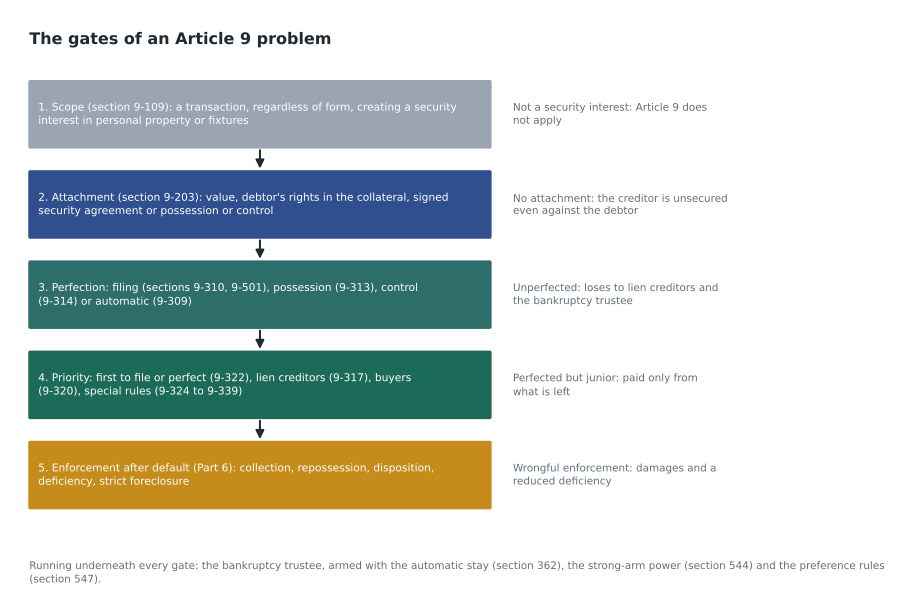
The gates matter because a failure at each one has a different consequence. A security interest that never attached is no security interest; the creditor is unsecured even against the debtor. An interest that attached but was never perfected is good against the debtor but loses to a lien creditor and, in bankruptcy, to the trustee, which in practice usually means it is worthless. A perfected interest can still lose a priority contest to a competing secured party or to a buyer. And a secured party that wins every contest can still lose money, or owe damages, if it repossesses or sells badly. "Students lose points on exams by jumping straight to priority," Lisowski says. "Lenders lose money the same way."
Section 9-109: what Article 9 covers
Section 9-109(a)(1) sets out the core scope: Article 9 applies to "a transaction, regardless of its form, that creates a security interest in personal property or fixtures by contract." Two parts of that sentence do most of the work. The phrase "regardless of its form" means that labels do not control. Before the Code, American law had a crowd of separate devices: the chattel mortgage, the conditional sale, the trust receipt, the factor's lien, the assignment of accounts. Each had its own filing rules and its own traps. Article 9 replaced them all with a single concept. A seller who keeps "title" until the price is paid has, under section 1-201(b)(35) and section 2-401, only a security interest. A transaction called a lease or a consignment may also be a security interest if that is what it does in substance.
The second phrase, "personal property or fixtures," excludes real estate. A mortgage on the creamery's land and barn is governed by Westmarch real property law and recorded in the Merrin County land records, not filed under Article 9. Fixtures, goods that become so related to real property that an interest in them arises under real property law, sit on the border, and Article 9 governs a security interest in them, with special priority rules we will study in Lesson 8. A security interest also does not depend on the debtor's being a business. Article 9 governs a car loan or a store credit card secured by a refrigerator as much as it governs a bank's lien on a factory, though it adds consumer protections in several places.
Section 9-109(a) also sweeps in transactions that are not loans at all. Agricultural liens, statutory liens in favor of suppliers of farm goods and services, are covered for filing and priority purposes. Consignments, in which a business delivers goods to a merchant to sell on the owner's behalf, are covered when they meet the definition in section 9-102(a)(20), largely to protect the merchant's creditors from secret ownership claims. And section 9-109(a)(3) covers outright sales of accounts, chattel paper, payment intangibles and promissory notes. A business that sells its receivables to a factor has not borrowed anything, but the buyer's interest is still called a security interest and must ordinarily be perfected by filing. The reason is notice: a creditor deciding whether to lend against a company's receivables needs to know whether the company has already sold them.
Section 9-109(c) and (d) take things out. Federal law preempts Article 9 to the extent federal law governs, so security interests in aircraft are recorded with the Federal Aviation Administration and, under the leading line of cases beginning with In re Peregrine Entertainment, Ltd., 116 B.R. 194 (C.D. Cal. 1990), interests in registered copyrights are perfected by recording in the Copyright Office. Section 9-109(d) excludes landlord's liens, wage assignments, most transfers of insurance policies (other than health-care-insurance receivables), the creation of interests in real property and leases of real property, judgments other than those taken as collateral for a right to payment, and, in consumer transactions, assignments of deposit accounts. Each exclusion exists because some other body of law already governs the interest or because the drafters chose to protect consumers. When a fact pattern involves one of these, the first step is to say that Article 9 does not apply and to identify what law does.
True leases and disguised security interests
The most litigated scope question is whether a lease is really a lease. In June 2025 Juniper Hill signed a "Lease Agreement" with Harrowgate Equipment Finance for a cheese-wrapping and labeling machine. The term is forty-eight months, at 1,950 dollars a month, and Juniper Hill cannot cancel. At the end of the term Juniper Hill may buy the machine for one dollar. Harrowgate did not file a financing statement, because, its loan officer said, "we own it and they lease it." Lisowski asks Hannah Lindqvist to read section 1-203 aloud and then asks whether Harrowgate owns the machine.
Section 1-203 answers the question by economics, not labels. Whether a transaction in the form of a lease creates a security interest "is determined by the facts of each case." But section 1-203(b) sets out a bright-line test: a transaction creates a security interest if the lessee's obligation to pay continues for the full term and is not subject to termination by the lessee, and one of four further conditions is met. The original term equals or exceeds the remaining economic life of the goods; the lessee is bound to renew for the remaining economic life or to become the owner; the lessee has an option to renew for the remaining economic life for no or nominal additional consideration; or the lessee has an option to become the owner for no or nominal additional consideration. The idea is that a true lessor keeps a meaningful residual interest, the value of the goods when they come back. A "lessor" who will get back nothing of value, or who will get back only what the lessee chooses to pay nothing for, has sold the goods on credit and kept a security interest.
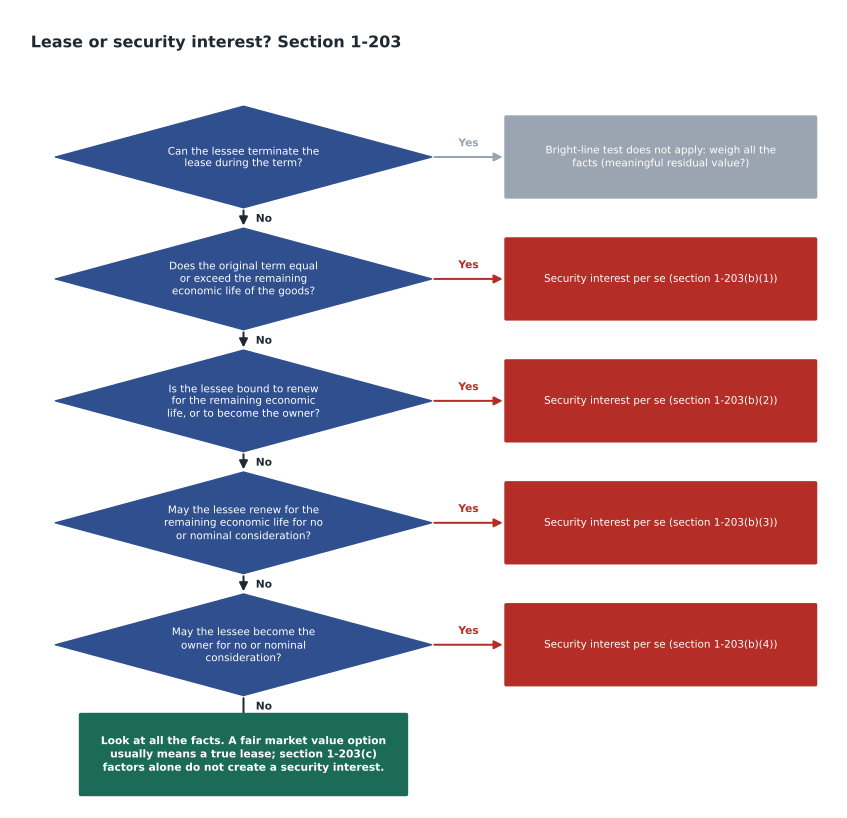
Juniper Hill's lease fails the true-lease test in the most common way: it is noncancellable and the purchase option is one dollar. Section 1-203(d) says additional consideration is nominal if it is less than the lessee's reasonably predictable cost of performing under the lease agreement if the option is not exercised, and no one will hand back a working machine rather than pay one dollar. The "lease" is a security interest per se, Harrowgate is a secured party, Juniper Hill owns the machine, and Harrowgate's interest is unperfected because no financing statement was filed. Hannah asks what would have happened if the option price were the machine's fair market value at the end of the term. Then the bright-line test would not be met, and the court would look at all the facts. A fair market value option ordinarily signals a true lease, because the lessor keeps the residual value.
Courts applying the facts-of-the-case inquiry ask whether the lessor retained a meaningful reversionary interest, measured as of the time the deal was made. In In re Pillowtex, Inc., 349 F.3d 711 (3d Cir. 2003), Duke Energy installed energy-saving lighting and equipment in a textile company's plants under agreements styled as leases. The Third Circuit held that the agreements created security interests: the payments were calculated to return Duke's costs plus a profit, and the equipment, once installed, would have little or no value to Duke at the end of the term, so the purchase option was effectively nominal. Section 1-203(c) adds a list of features that do not by themselves create a security interest, such as a present value of rent that equals or exceeds the fair market value of the goods, or the lessee's assumption of risk of loss, taxes and insurance. Those features are common in true leases too.
The classification matters most in bankruptcy. If the Harrowgate deal is a true lease, Harrowgate owns the machine, Juniper Hill's estate has only a leasehold, and in a reorganization the debtor must either assume the lease and cure defaults or reject it and return the machine. If the deal is a disguised security interest and Harrowgate never filed, the trustee can avoid the unperfected interest and keep the machine for the estate, leaving Harrowgate with an unsecured claim. Careful lessors therefore file a precautionary financing statement. Section 9-505 says that filing one, using the terms lessor and lessee, is not itself evidence that the transaction is a security interest, and if a court later recharacterizes the deal, the filing perfects. "Filing costs a few dollars," Lisowski says. "Not filing cost Harrowgate a machine."
Worked problem
Lease or security interest? Three versions of the Harrowgate deal
Lisowski gives the class three versions of the Harrowgate agreement for the wrapping machine, which cost 92,000 dollars new and has an expected useful life of eight years. In each, the monthly payment is 1,950 dollars and Juniper Hill cannot terminate. Version A: forty-eight months, option to buy for one dollar. Version B: forty-eight months, option to buy for the machine's fair market value at the end of the term, then expected to be about 38,000 dollars. Version C: ninety-six months, no purchase option, machine returned at the end. Which versions create a security interest?
Show solution
- Start with section 1-203(b). The lessee cannot terminate in any version, so the first condition of the bright-line test is met in all three, and the question is whether one of the four further conditions is met.
- Version A: the option price of one dollar is nominal under section 1-203(d), because it is far less than the cost of returning a machine still worth tens of thousands of dollars. A security interest per se.
- Version B: the option price is fair market value, determined at the time of exercise, which section 1-203(d) says is not nominal. None of the four conditions is met. Harrowgate expects a meaningful residual worth about 38,000 dollars, so the deal is very likely a true lease, and the court looks to all the facts.
- Version C: the ninety-six-month term equals the eight-year economic life of the machine, so the first of the four conditions is met. Harrowgate will get back a machine with no remaining economic life. A security interest per se, even though no purchase option appears anywhere.
- Consequences: in A and C, Harrowgate has an unperfected security interest unless it filed, and Juniper Hill is the owner. In B, Harrowgate owns the machine and a filing is merely prudent. In all three, a precautionary filing under section 9-505 would have cost Harrowgate nothing and protected it against recharacterization.
Sales of accounts and the Northgate receivables
The bank's loan file also contains an "Assignment of Accounts" covering Juniper Hill's receivables from Northgate Grocers and its other wholesale customers. Daniel Reyes, who spent three years at a personal-injury firm, asks whether the bank now owns the receivables or merely has a lien on them. Lisowski's answer is that it usually does not matter for perfection and priority, and that is the point of section 9-109(a)(3). Whether Juniper Hill borrowed against its accounts or sold them, the bank's interest is a security interest and is perfected by filing a financing statement. The distinction matters elsewhere. Section 9-318(a) provides that a debtor that has sold an account retains no legal or equitable interest in it, and a buyer of accounts, unlike a lender, keeps any surplus when it collects and is not liable for a deficiency unless the agreement says so (section 9-608(b)).
The definition of account is broad. Under section 9-102(a)(2) an account is a right to payment of a monetary obligation, whether or not earned by performance, for goods sold or services rendered, among other things. Juniper Hill's right to be paid for cheese delivered to Northgate is an account. Article 9 also governs the account debtor's position. Under section 9-406, once Northgate receives a signed notification that the account has been assigned and that payment is to be made to the bank, Northgate can discharge its debt only by paying the bank. If Northgate pays the creamery after receiving notice, it may have to pay twice. Some sales are perfected automatically, without filing: a sale of payment intangibles or promissory notes (section 9-309(3) and (4)) and an assignment of accounts that does not transfer a significant part of the assignor's outstanding accounts (section 9-309(2)), which protects casual and isolated assignments.
A note on the 2022 amendments
The 2022 amendments responded to digital assets and to electronic commerce. They added Article 12, which governs the transfer of controllable electronic records, a new kind of intangible property that includes many cryptocurrencies and other records that can be subjected to control. They revised the definition of money so that a cryptocurrency adopted by a government as legal tender after the fact does not become money for UCC purposes, and they created a category of electronic money, such as a central bank digital currency. They rewrote the rules for chattel paper, replaced the word "authenticate" throughout with "sign," and replaced many references to a "writing" with a "record." Lesson 2 shows where these new kinds of collateral fit. Lesson 5 explains control, which is how a secured party perfects in them and gets priority over a party that merely filed.
Lisowski closes the first class by putting the three questions back on the board. "You now know the first gate," he says. "The Harrowgate machine and the Northgate accounts are both inside Article 9 whatever the paperwork calls them. Next time we ask what kind of property each item in the creamery's barn is, because almost every rule after that depends on the answer."
Summary and key terms
- Article 9 governs any transaction, regardless of its form, that creates a security interest in personal property or fixtures by contract (section 9-109(a)(1)).
- It also governs agricultural liens, many consignments and outright sales of accounts, chattel paper, payment intangibles and promissory notes.
- Federal law preempts it for aircraft and registered copyrights, and section 9-109(d) excludes real property interests, landlord's liens, wage assignments, most insurance and consumer deposit accounts.
- Security problems run through gates: scope, attachment, perfection, priority and enforcement, with bankruptcy testing each one.
- A lease that the lessee cannot terminate is a security interest per se if the term equals the economic life or the lessee can buy or renew for nominal consideration (section 1-203(b)).
- Otherwise courts ask whether the lessor kept a meaningful residual interest, as in In re Pillowtex.
- Assume Westmarch has adopted the 2022 amendments, which added Article 12 and replaced 'authenticate' with 'sign'.
Practice problems
Work each problem on paper first, then reveal the answer to check.
Juniper Hill "leases" a used delivery van for thirty-six months, cancellable by Juniper Hill on thirty days' notice, with no purchase option. Is this a security interest per se?
Show answer
No. The bright-line test in section 1-203(b) applies only when the lessee cannot terminate. Because Juniper Hill can cancel, the court looks at all the facts, and a cancellable lease with no purchase option is very likely a true lease.
Merrin Valley Bank buys outright, for cash, all of Juniper Hill's accounts from Northgate. Must the bank file a financing statement to protect itself against Juniper Hill's creditors?
Show answer
Yes, ordinarily. A sale of accounts is within Article 9 (section 9-109(a)(3)), and the buyer's interest is a security interest perfected by filing, unless the sale is a casual assignment of an insignificant part of the accounts under section 9-309(2).
Lena pledges her personal brokerage account to secure the partnership's loan. Who is the debtor and who is the obligor?
Show answer
Lena is a debtor as to the brokerage account, because she has an interest in the collateral. The partnership is the obligor on the loan. Lena may also be a secondary obligor if she guaranteed the debt.
Is a mortgage on the creamery's barn governed by Article 9?
Show answer
No. Section 9-109(d)(11) excludes the creation or transfer of an interest in or lien on real property. The mortgage is governed by Westmarch real property law and recorded in the county land records. Goods attached to the barn may be fixtures, which Article 9 does govern.
Lesson quiz · 5 questions
Score 60% or more to complete this lesson.
Create a free account to save your progress, take quizzes and earn a certificate.