
LAWU-214 · Lesson 11 of 12 · 26 min
Bankruptcy interface
▶ Video coming soon A video version of this lesson is on the way.
Lisowski introduces the bankruptcy unit as an alternate history, in the style Professor Thackeray used in Business Associations. "Suppose," he says, "that instead of letting the bank sell the cheese, Lena and Owen had gone to a bankruptcy lawyer the day after the loan officer called. Suppose Juniper Hill had filed a Chapter 11 petition in the United States Bankruptcy Court for the District of Westmarch on Friday, October 30, 2026." This is Lisowski's hypothetical, not an event in the file. He uses it because bankruptcy is where every weakness in a secured creditor's position is tested at once, by a trustee or debtor in possession whose job is to find them. "When I was a trustee," he says, "my first week in every case was spent with the filing records and a calendar."
The estate and the automatic stay
The filing of a petition creates an estate consisting of all legal and equitable interests of the debtor in property as of the commencement of the case (section 541(a)(1) of the Bankruptcy Code, 11 U.S.C.). Juniper Hill's cows, cheese, equipment, accounts and bank balances all become property of the estate, subject to whatever valid liens encumber them. In Chapter 11, the debtor ordinarily remains in possession and operates the business as a debtor in possession, with the powers and duties of a trustee (section 1107). A general partnership that files does not by that filing put its partners into bankruptcy, but the partners remain liable for partnership debts and section 723 lets a Chapter 7 trustee pursue them for any deficiency.
The filing also triggers the automatic stay. Section 362(a) stays, among other things, the commencement or continuation of actions against the debtor, the enforcement of prepetition judgments, any act to obtain possession of property of the estate or to exercise control over it, any act to create, perfect or enforce any lien against property of the estate, and the setoff of prepetition debts. On October 30, the bank must stop. It may not repossess the cheese, notify Northgate to pay it, apply the operating account to the loan or file anything to improve its position, except in narrow cases such as the relation-back perfection protected by section 362(b)(3). Acts in violation of the stay are generally void, and an individual injured by a willful violation may recover actual damages, costs, attorney's fees and, in appropriate circumstances, punitive damages (section 362(k)).
A secured creditor can ask the court to lift the stay. Section 362(d)(1) requires relief for cause, including lack of adequate protection of the creditor's interest in property. Section 362(d)(2) requires relief from a stay against property if the debtor does not have equity in the property and the property is not necessary to an effective reorganization. Section 361 describes adequate protection: periodic cash payments, a replacement lien or additional lien, or other relief that gives the creditor the indubitable equivalent of its interest, to compensate for any decrease in the value of the creditor's interest in the collateral during the case. The Supreme Court held in United Savings Ass'n of Texas v. Timbers of Inwood Forest Associates, Ltd., 484 U.S. 365 (1988), that an undersecured creditor is not entitled to compensation for the delay in foreclosing caused by the stay, that is, for the lost opportunity to reinvest the value of its collateral. What adequate protection protects is the value of the collateral itself.
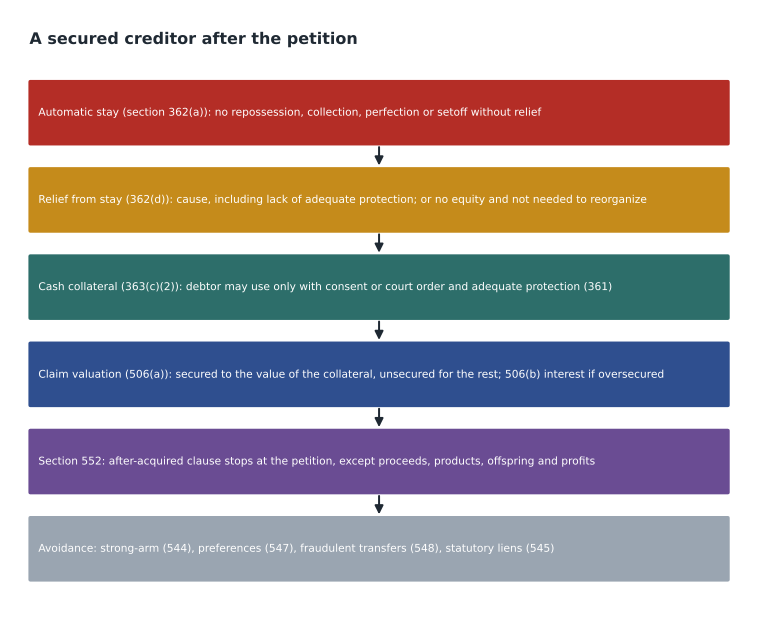
Juniper Hill's cheese and receivables are the bank's cash collateral in the making. Section 363(a) defines cash collateral to include cash, deposit accounts and other cash equivalents in which the estate and another entity have an interest, including proceeds of collateral. Section 363(c)(2) forbids the debtor in possession to use cash collateral unless each entity with an interest consents or the court, after notice and a hearing, authorizes the use, and section 363(e) conditions authorization on adequate protection. In practice the first days of a Chapter 11 case are spent negotiating a cash collateral order or a debtor-in-possession financing order. Juniper Hill needs to pay for feed, payroll and propane with money that is the bank's collateral; the bank needs assurance that the value of its collateral will not shrink. A typical order grants the bank replacement liens on postpetition inventory and receivables, monthly reporting and a budget.
Secured claims: section 506
Section 506(a) bifurcates an undersecured creditor's claim. An allowed claim secured by a lien on property is a secured claim to the extent of the value of the creditor's interest in the property and an unsecured claim for the rest. Suppose the bank's claim on the petition date is 780,000 dollars and its collateral, valued under section 506(a) in light of the purpose of the valuation and the proposed use of the property, is worth 640,000 dollars. The bank holds a 640,000-dollar secured claim and a 140,000-dollar unsecured claim, and its unsecured claim shares pro rata with Juniper Hill's other unsecured creditors. If the collateral were worth more than the debt, the bank would be oversecured, and section 506(b) would entitle it to postpetition interest and reasonable fees, costs and charges provided for in the agreement, up to the value of the collateral.
Valuation is contested. In Associates Commercial Corp. v. Rash, 520 U.S. 953 (1997), the Court held that when a Chapter 13 debtor proposes to keep collateral over the creditor's objection, the collateral is valued at its replacement value, the price a willing buyer in the debtor's trade, business or situation would pay to obtain like property from a willing seller, rather than at foreclosure value. Congress later codified a replacement-value standard for individual debtors in Chapters 7 and 13 (section 506(a)(2)). In Till v. SCS Credit Corp., 541 U.S. 465 (2004), a plurality held that the interest rate a Chapter 13 plan must pay a secured creditor to give it the present value of its claim is the prime rate adjusted upward for risk. The 2005 amendments also added the so-called hanging paragraph after section 1325(a)(9), which bars bifurcation in Chapter 13 of a purchase-money claim secured by a motor vehicle bought for personal use within 910 days before the petition.
The floating lien after the petition: section 552
Section 552(a) says that property acquired by the estate or the debtor after the commencement of the case is not subject to any lien resulting from a security agreement entered into before the commencement of the case. The bank's after-acquired property clause therefore stops working on October 30. Section 552(b)(1) creates the essential exception: if the prepetition security agreement extends to property acquired before the case and to proceeds, products, offspring or profits of that property, the security interest extends to such proceeds, products, offspring and profits acquired by the estate after the commencement of the case, except to the extent the court orders otherwise based on the equities of the case. Cheese made after the petition from milk produced before it, calves born after the petition to cows that were collateral, and accounts arising from the sale of prepetition cheese all remain the bank's collateral. Milk produced after the petition from cows the bank already had a security interest in is likely a product or offspring of prepetition collateral, a point lenders and debtors litigate. New inventory bought with unencumbered postpetition money is not covered, which is why the bank needs replacement liens in the cash collateral order.
The strong-arm power: section 544
Section 544(a)(1) gives the trustee, and a debtor in possession, the rights and powers of a creditor that extends credit to the debtor at the time of the commencement of the case and obtains, at that time, a judicial lien on all property on which a creditor on a simple contract could have obtained one, whether or not such a creditor exists. The trustee is a hypothetical lien creditor, without knowledge, as of the petition date. Under section 9-317(a)(2), a lien creditor defeats a security interest that was unperfected when the lien arose. So the strong-arm power lets the estate avoid every security interest unperfected on the petition date, and section 551 preserves the avoided lien for the benefit of the estate.
Harrowgate is the casualty. Its "lease" of the wrapping machine was a disguised security interest (Lesson 1), and, as the November search in Lesson 10 showed, Harrowgate finally filed a financing statement in September 2026, after its credit manager heard a talk on recharacterization at a trade conference. That filing perfected its interest about six weeks before the petition, so the strong-arm power does not reach it. But the late filing creates a different problem, a preference, because perfection of a security interest for an old debt within ninety days before bankruptcy is a transfer for an antecedent debt. The trustee's tools work together: an interest unperfected at the petition date falls to section 544, and one perfected too late falls to section 547.
Section 546(b) limits the strong-arm power where state law lets a creditor perfect with retroactive effect. It makes the trustee's rights subject to any generally applicable law that permits perfection of an interest in property to be effective against an entity that acquires rights before the date of perfection. Section 9-317(e), the twenty-day purchase-money relation-back rule, is such a law. If a purchase-money seller delivers goods, the debtor files a petition the next day, and the seller files a financing statement within twenty days after delivery, the seller's interest is perfected as against the trustee, and section 362(b)(3) excepts the filing from the automatic stay.
Preferences: section 547
Section 547(b) lets the trustee avoid any transfer of an interest of the debtor in property to or for the benefit of a creditor, for or on account of an antecedent debt owed before the transfer was made, made while the debtor was insolvent, made on or within ninety days before the petition (or one year for insiders), that enables the creditor to receive more than it would receive in a Chapter 7 liquidation if the transfer had not been made. Insolvency is presumed during the ninety days (section 547(f)). The granting or perfecting of a security interest is a transfer. The policy is equality among creditors: a creditor who grabs collateral or payment on the eve of bankruptcy should not jump the line ahead of creditors in the same position.
Timing of a security interest transfer is set by section 547(e). A transfer of a security interest is made at the time it takes effect between the parties, if it is perfected at or within thirty days after that time; otherwise it is made when it is perfected (section 547(e)(2)). And it is not made until the debtor has acquired rights in the property (section 547(e)(3)). A secured party that attaches and perfects at the same time, or within thirty days, gives value contemporaneously and has no preference problem. A secured party that waits more than thirty days to perfect is treated as having received its security interest on the day it perfected, for whatever debt then existed, which is antecedent.
Section 547(c) supplies exceptions that protect ordinary secured lending. Section 547(c)(1) protects a contemporaneous exchange for new value. Section 547(c)(2) protects payments of debts incurred in the ordinary course of business, made in the ordinary course or according to ordinary business terms; the Supreme Court held in Union Bank v. Wolas, 502 U.S. 151 (1991), that the exception applies to payments on long-term debt as well as short-term trade credit. Section 547(c)(3), the enabling-loan exception, protects a security interest that secures new value given at or after the signing of a security agreement describing the property, given to enable the debtor to acquire the property and in fact so used, and perfected on or before thirty days after the debtor receives possession of the property. In Fidelity Financial Services, Inc. v. Fink, 522 U.S. 211 (1998), the Court held that a creditor that perfected after the federal period, then twenty days, could not rely on a longer state relation-back period. Congress lengthened the federal period to thirty days in 2005.
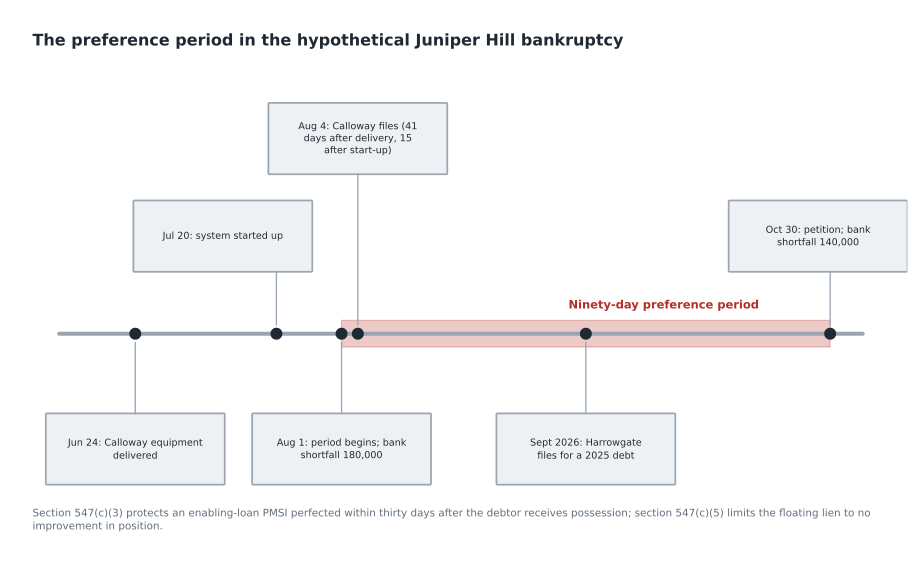
Calloway is the hard case. Its security agreement was signed March 6, 2026; it gave new value by delivering equipment on credit; the value enabled Juniper Hill to acquire the equipment; and it perfected on August 4, 2026, which is inside the ninety-day period that began August 1. If Juniper Hill received possession on June 24, Calloway perfected forty-one days later, outside the thirty-day window in both section 547(c)(3) and section 547(e)(2). The transfer would then be deemed made on August 4, for an antecedent debt, within ninety days, while Juniper Hill was presumed insolvent, and it would let Calloway receive more than it would as an unsecured creditor in Chapter 7. The trustee could avoid it. If possession dates from July 20, when the system was assembled and running, Calloway perfected within fifteen days and is protected. Lisowski points out that the twenty-day question from Lesson 6 has become a thirty-day question in bankruptcy, and that courts have not agreed whether the phrase "receives possession" in section 547(c)(3) takes the same meaning as in Article 9.
The bank's floating lien is protected by section 547(c)(5), which shelters a perfected security interest in inventory or receivables or their proceeds except to the extent that the aggregate of all such transfers caused a reduction, as of the petition date and to the prejudice of unsecured creditors, of any amount by which the debt exceeded the value of the collateral ninety days before the petition. This is the improvement-in-position test. On August 1, 2026, the bank was owed 700,000 dollars and its inventory and receivables were worth 520,000 dollars, a shortfall of 180,000. On October 30 it was owed 780,000 dollars and the same kinds of collateral were worth 640,000, a shortfall of 140,000. The bank improved its position by 40,000 dollars, and the trustee may recover that amount if the improvement came from transfers that prejudiced unsecured creditors, such as new receivables generated with labor and feed bought on unsecured credit. If the improvement came instead from cheese aging and rising in price on its own, the bank will argue that no transfer caused it.
Other avoidance powers and the end of the case
Two other powers deserve mention. Section 548 lets the trustee avoid fraudulent transfers made within two years before the petition, including transfers for less than reasonably equivalent value while the debtor was insolvent, and section 544(b) lets the trustee use state fraudulent transfer law, often with longer look-back periods. A security interest given by the partnership to secure a loan made to Lena personally, for example, could be attacked on that ground. And section 553 preserves but limits setoff: a bank that improves its setoff position within ninety days before the petition can be made to give back the improvement (section 553(b)).
A Chapter 11 case ends with a plan. Under section 1129(b)(2)(A), a plan can be confirmed over a secured creditor's objection if the creditor retains its lien and receives deferred cash payments with a present value equal to the value of its collateral, if the collateral is sold free of the lien with the lien attaching to proceeds, or if the creditor receives the indubitable equivalent of its claim. Because of section 1111(b), an undersecured creditor in Chapter 11 may in some cases elect to have its entire claim treated as secured, giving up its unsecured deficiency claim. Lisowski does not ask the class to master Chapter 11. He asks them to see that every Article 9 rule they have learned, from the debtor's name in Box 1 to the twenty-day window, decides a creditor's fate when the case begins.
Worked problem
The trustee's review of the Juniper Hill liens
As of the hypothetical October 30, 2026 petition, review: (1) the bank's all-assets filing of September 10, 2025, its title notation on the truck and its control of the deposit accounts; (2) Harrowgate's September 2026 filing for a June 2025 'lease' that was a security interest; (3) Calloway's August 4 filing for equipment delivered June 24 and started up July 20; (4) the bank's floating lien in inventory and receivables, with a shortfall of 180,000 dollars on August 1 and 140,000 dollars on October 30.
Show solution
- Bank: perfected well before the ninety-day period and properly named and located; the strong-arm power does not reach it. The truck notation and control agreements were obtained in spring 2026, outside the ninety days, so they are not preferences either. The bank's claim is bifurcated under section 506(a) into a secured claim equal to the collateral's value and an unsecured deficiency.
- Harrowgate: perfected about six weeks before the petition for a debt incurred in June 2025. Under section 547(e)(2)(B), the transfer occurred when perfected, for an antecedent debt, within ninety days, while insolvency is presumed. No exception applies, so the trustee can avoid it, and Harrowgate becomes unsecured.
- Calloway: depends on when Juniper Hill received possession. From June 24, perfection came forty-one days later, outside section 547(c)(3), and the security interest is avoidable as a preference. From July 20, perfection came within fifteen days, and the enabling-loan exception protects it.
- Bank floating lien: under section 547(c)(5), the shortfall fell from 180,000 to 140,000 dollars, an improvement of 40,000. The trustee may recover up to 40,000 dollars to the extent the improvement resulted from transfers prejudicing unsecured creditors.
- Stay and cash collateral: the bank cannot enforce without relief from the stay, and Juniper Hill cannot spend the bank's cash collateral without consent or court authorization and adequate protection (sections 362 and 363(c)(2)). Postpetition milk and cheese remain collateral only as proceeds, products or offspring of prepetition collateral (section 552(b)).
Summary and key terms
- The petition creates an estate and an automatic stay that halts repossession, collection, perfection and setoff (sections 541 and 362).
- Relief from the stay requires cause, such as lack of adequate protection, or no equity plus no need for reorganization; Timbers denies compensation for delay itself.
- Cash collateral can be used only with consent or court approval and adequate protection.
- Section 506(a) bifurcates undersecured claims; oversecured creditors earn postpetition interest and fees; Rash and Till govern valuation and interest in Chapter 13.
- Section 552 cuts off after-acquired property clauses at the petition, except for proceeds, products, offspring and profits of prepetition collateral.
- The strong-arm power avoids security interests unperfected on the petition date, subject to state relation-back rules preserved by section 546(b).
- Perfection more than thirty days after attachment is a transfer when perfected, often a preference for an antecedent debt (section 547(e)).
- The enabling-loan exception protects PMSIs perfected within thirty days after the debtor receives possession (Fink), and floating liens are protected except for improvement in position.
Practice problems
Work each problem on paper first, then reveal the answer to check.
A lender's security interest attached in March for a loan made in March, but the lender did not file until August 20. The petition is filed October 1. Is the security interest avoidable?
Show answer
Very likely. Because perfection came more than thirty days after attachment, the transfer is deemed made on August 20 (section 547(e)(2)(B)), for the March debt, which is antecedent, within ninety days. Unless an exception applies, the trustee can avoid it as a preference.
An equipment seller delivers equipment on credit with a PMSI on May 1 and files on May 18. The debtor filed a bankruptcy petition on May 10. Can the trustee avoid the interest under section 544?
Show answer
No. Section 9-317(e) gives the PMSI priority over a lien creditor arising between attachment and filing if the seller files within twenty days after delivery, and section 546(b) makes the trustee's strong-arm power subject to that relation back; section 362(b)(3) excepts the filing from the stay.
A bank's inventory lender was owed 1,000,000 dollars ninety days before bankruptcy, secured by inventory worth 600,000. At the petition it is owed 900,000 dollars, secured by inventory worth 700,000. How much can the trustee recover under section 547(c)(5)?
Show answer
The shortfall fell from 400,000 to 200,000 dollars, an improvement of 200,000. The trustee may recover up to 200,000 dollars, to the extent the improvement prejudiced unsecured creditors.
Does an undersecured creditor get compensation for the time value of money it cannot collect because of the stay?
Show answer
No. Under Timbers of Inwood Forest, adequate protection protects only the value of the collateral, not the creditor's lost opportunity to foreclose and reinvest.
Lesson quiz · 5 questions
Score 60% or more to complete this lesson.
Create a free account to save your progress, take quizzes and earn a certificate.