
LAWU-214 · Lesson 6 of 12 · 24 min
Purchase-money security interests
▶ Video coming soon A video version of this lesson is on the way.
The aging room and cold storage system arrive in the Juniper Hill file in Lesson 6, and Lisowski brings them in with a question. "Merrin Valley Bank filed against all of the creamery's equipment, now owned or hereafter acquired, in September 2025," he says. "In 2026 Calloway Refrigeration sold the creamery a cold storage system on credit and kept a security interest in it. The bank filed first. Why would any equipment seller ever extend credit to a business whose lender has an after-acquired property clause?" The answer is the purchase-money security interest, the most important exception to the rule that the first to file wins.
Lisowski fills in the financing facts, which he invented for this course and which sit alongside the contract facts students learned in Contracts. Calloway's order acknowledgment of March 6, 2026 provided for a deposit and for the balance to be paid in twenty-four monthly installments, secured by "a security interest in all equipment sold hereunder," and Owen signed a separate one-page security agreement on the same terms. After the deposit and the price increases, Juniper Hill owed Calloway 140,000 dollars when the equipment arrived: 112,000 dollars for equipment and 28,000 dollars for design, installation and start-up services. The compressors, coils, panels and controls were delivered to the barn on June 24, 2026, but the system could not run until the barn's power was upgraded, and it was started up on July 20. Calloway's credit manager filed a financing statement with the Westmarch Secretary of State on August 4, 2026.
What makes a security interest purchase-money
Section 9-103 defines the purchase-money security interest. For goods, a security interest is purchase-money to the extent that the goods are purchase-money collateral with respect to that security interest (section 9-103(b)(1)). Purchase-money collateral means goods that secure a purchase-money obligation incurred with respect to that collateral, and a purchase-money obligation is an obligation incurred as all or part of the price of the collateral or for value given to enable the debtor to acquire rights in or the use of the collateral if the value is in fact so used (section 9-103(a)). There are therefore two kinds of purchase-money creditors. A seller who sells on credit and keeps a security interest in the goods sold holds a seller's PMSI. A lender who advances money that the debtor uses to buy the goods, such as a bank that pays the seller directly, holds an enabling-loan PMSI.
The definition polices two links. The obligation must be for the price or for value that enabled the purchase, and the value must in fact be so used. A lender who advances money for "working capital," which the debtor happens to spend on a press, has no PMSI; the safest practice for an enabling lender is to pay the seller directly or issue a check payable jointly to the debtor and the seller. And the collateral must be the very goods bought with the value. A seller who sells a cold storage system on credit and takes a security interest in the creamery's existing cheese vats does not have a PMSI in the vats, because the vats are not collateral "with respect to" which the obligation was incurred. The official comments read price and value generously to include sales tax, freight, finance charges, interest and costs of collection, but not unrelated obligations.
Dual status and the services problem
The Calloway debt raises a recurring problem: part of the obligation is for goods and part is for services. Hannah Lindqvist reads section 9-103(f), which applies in a transaction other than a consumer-goods transaction. A purchase-money security interest does not lose its status even if the purchase-money collateral also secures an obligation that is not a purchase-money obligation, or the purchase-money obligation is also secured by other collateral, or the purchase-money obligation has been renewed, refinanced, consolidated or restructured. This is the dual-status rule. It rejects the older transformation rule, under which a few courts held that any mixing of purchase-money and non-purchase-money debt destroyed purchase-money status entirely. Section 9-103(g) places on the secured party claiming PMSI status the burden of establishing the extent to which the interest is purchase-money.
Applied to Calloway, the rule means that its security interest in the equipment is a PMSI at least to the extent of the 112,000 dollars of equipment price. Whether the 28,000 dollars of design, installation and start-up services is part of the "price" of the equipment is less clear. Calloway will argue that installation and start-up were costs necessary to acquire a working system, much like freight; the bank will argue that services are a separate purchase and that Article 9 rewards purchase-money creditors only for adding new goods to the debtor's estate. Marcus Webb points out that a refrigeration system delivered in crates is not usable until it is installed and charged. Lisowski calls the argument respectable and the outcome uncertain, and notes that a careful seller would have separately priced the services and allocated payments to them last. Section 9-103(e) supplies the allocation rule in a non-consumer transaction: payments are applied as the parties agree, otherwise as the obligor directs, and otherwise to unsecured obligations first and then to purchase-money obligations in the order incurred.
Consumer transactions and cross-collateralization
In consumer-goods transactions the drafters took no position. Section 9-103(h) says the limitation of the dual-status rule to non-consumer transactions is intended to leave to the court the determination of the proper rules in consumer-goods transactions, and that the court may not infer from that limitation the nature of the proper rule. Some courts have applied the transformation rule to consumer refinancings and add-on sales. The background is a famous case. In Williams v. Walker-Thomas Furniture Co., 350 F.2d 445 (D.C. Cir. 1965), a store sold household goods to a customer over several years under contracts that kept a balance due on every item until everything was paid, so that the store could repossess a whole apartment of furniture over a small balance on a stereo. The D.C. Circuit held that such a clause could be unenforceable if unconscionable. Federal Trade Commission rules and many state consumer credit codes now restrict such cross-collateralization and add-on clauses, and Article 9 leaves the purchase-money question in those transactions to the courts.
Why PMSI priority exists
Priya Natarajan, the economist, offers the standard justification before Lisowski can. A purchase-money creditor adds a new asset to the debtor's estate. Giving that creditor first claim to the asset it financed does not hurt the earlier lender, who never relied on an asset the debtor did not yet own. Without the rule, a debtor with a floating lien would be locked into its first lender for all future credit, because no seller or new lender would extend credit secured by goods the first lender's after-acquired clause would capture. With it, the earlier lender keeps everything it bargained for and the debtor keeps access to competitive purchase-money credit. Lisowski adds that the rule is also a limit on the first lender's monopoly power and that sophisticated lenders often negotiate their own exceptions to it by covenant.
Priority for equipment and other non-inventory goods
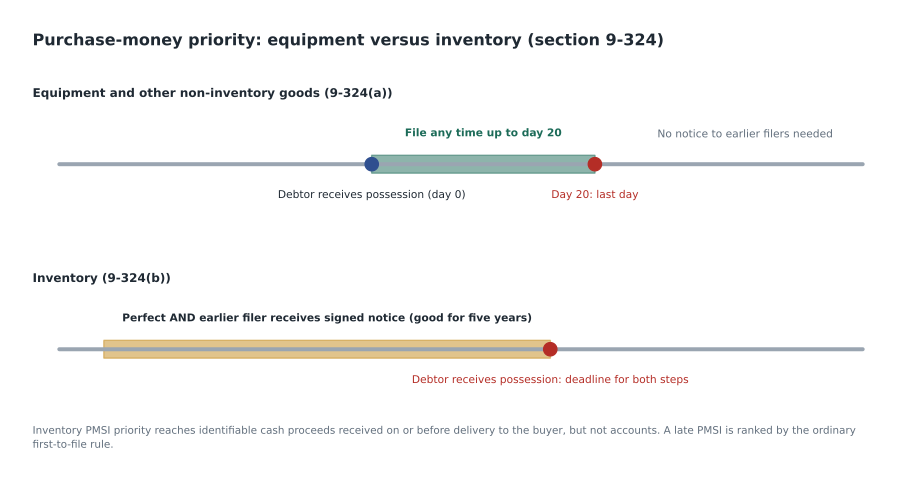
Section 9-324(a) gives the basic rule. Subject to the inventory and livestock rules, a perfected purchase-money security interest in goods other than inventory or livestock has priority over a conflicting security interest in the same goods, and in identifiable proceeds, if the purchase-money security interest is perfected when the debtor receives possession of the collateral or within twenty days thereafter. Two features matter in practice. First, the earlier secured party need not be told anything; the purchase-money creditor simply has to perfect on time. Second, the clock starts when the debtor receives possession, not when the contract is signed or the goods are paid for. A twenty-day relation-back rule in section 9-317(e) gives the same grace period against lien creditors and buyers who intervene between attachment and filing.
When did Juniper Hill receive possession of the Calloway system? If on June 24, when the crates came off the trucks, the twenty days ran out on July 14 and Calloway's filing on August 4 was three weeks late. If on July 20, when the system was assembled and running, the filing was timely. The official comment to section 9-324 addresses goods delivered in stages and assembled at the debtor's site: the buyer takes possession when, after an inspection of the portion of the goods in the debtor's possession, it would be apparent to a potential lender that the debtor has acquired an interest in the goods taken as a whole. The comment also says that possession must be as debtor, not merely as a bailee or on approval. On those terms Calloway has a real argument. A lender walking through the barn on June 30 would have seen stacked panels, uninstalled compressors and coils, and might or might not have recognized a cold storage system. Lisowski calls it the kind of fact question that settles cases.
If Calloway's PMSI is timely, it beats the bank in the cold storage equipment, at least to the extent of the purchase-money obligation, even though the bank filed first. If it is not timely, Calloway still has a perfected security interest from August 4, but it is an ordinary one, and the first-to-file rule of section 9-322(a)(1) gives the bank priority, because the bank filed on September 10, 2025. The system then serves first to secure the bank's line of credit, and Calloway is paid only from whatever value remains. "Twenty days," Lisowski says, "is the difference between first and second in line. A seller's credit department should file the day the contract is signed." Filing before delivery is permitted (section 9-502(d)) and is the standard practice for exactly this reason.
Priority for inventory
Inventory is different, because an inventory lender advances against a constantly changing pool and checks it regularly. Section 9-324(b) gives a purchase-money security interest in inventory priority over a conflicting security interest in the same inventory only if four conditions are met: the PMSI is perfected when the debtor receives possession of the inventory; the purchase-money secured party sends a signed notification to the holder of the conflicting security interest; the holder receives the notification within five years before the debtor receives possession; and the notification states that the person sending it has or expects to acquire a purchase-money security interest in inventory of the debtor and describes the inventory (section 9-324(b)(1) to (4)). Section 9-324(c) says the notice requirement applies to a holder who filed a financing statement covering the same types of inventory before the PMSI was perfected. There is no twenty-day grace period, and the notice must be received before the goods arrive.
The reason for the notice is that an inventory lender typically advances against each new delivery. If a new supplier could slip in ahead without warning, the lender might advance against goods that already belonged first to someone else. With notice, the lender knows to exclude that supplier's goods from its borrowing base. Lisowski gives an example. In the fall of 2026 Juniper Hill bought 30,000 dollars of wax, film, printed labels and gift boxes for the holiday season from Beaumont Packaging Supply on sixty-day credit, with a security interest in the goods sold. These are inventory, as materials used or consumed in the business. For Beaumont to beat the bank, it must have filed before delivery and the bank must have received Beaumont's notification before delivery. A notice sent on the delivery date and received two days later is too late.
PMSI priority in inventory also reaches proceeds only narrowly. Under section 9-324(b), the priority extends to identifiable cash proceeds received on or before the delivery of the inventory to a buyer, and, under conditions in section 9-330, to chattel paper and instruments. It does not extend to accounts. When wrapped cheese in Beaumont's boxes is sold on thirty-day terms to Northgate, the resulting account is governed by the ordinary first-to-file rule, and the bank, as an earlier filer against accounts, wins. That result protects receivables financing, which lenders consider the core of a working-capital loan. A purchase-money inventory seller that wants the accounts must negotiate with the bank, usually by an intercreditor agreement.
Livestock, software and competing PMSIs
Livestock gets a rule close to the inventory rule. Under section 9-324(d), a perfected PMSI in livestock that are farm products has priority if it is perfected when the debtor receives possession and the earlier filer receives notification within six months before then; the priority extends to identifiable proceeds and to products of the livestock in their unmanufactured states, such as milk. If Ezra Pullman sold Juniper Hill ten heifers on credit with a security interest, he would need to file and notify the bank in advance. Software gets the same priority as the goods in which it is embedded, if it is bought in an integrated transaction (sections 9-103(c) and 9-324(f)). And when two purchase-money creditors claim the same goods, section 9-324(g) gives a seller's PMSI priority over an enabling lender's, and otherwise applies the first-to-file-or-perfect rule. The drafters thought the seller, who parted with goods, had the stronger equity.
The consumer side
For consumer goods, a PMSI matters chiefly because it is automatically perfected (section 9-309(1)), as Lesson 5 showed, and because a consumer's after-acquired goods are protected from a nonpurchase-money lender by the ten-day rule in section 9-204(b)(1). It also matters in bankruptcy. A consumer debtor may avoid a nonpossessory, nonpurchase-money lien on household furnishings, appliances, tools of the trade and similar exempt property under section 522(f)(1)(B) of the Bankruptcy Code, but cannot avoid a purchase-money lien. That is one reason consumer lenders care so much whether a refinanced or consolidated debt kept its purchase-money character.
Worked problem
Does Calloway beat the bank in the cold storage system?
Facts: the bank filed against all equipment, now owned or hereafter acquired, on September 10, 2025 and its security agreement was signed September 12. Calloway's security agreement was signed March 6, 2026. The equipment was delivered June 24, 2026, assembled, and started up July 20. Calloway filed August 4. Juniper Hill owes Calloway 140,000 dollars (112,000 equipment, 28,000 services) and the bank 780,000 dollars. The system is worth 120,000 dollars. Assume it is not a fixture. Who gets what if Juniper Hill defaults on both?
Show solution
- Both interests attached to the system no later than delivery on June 24, 2026, when Juniper Hill acquired rights in the delivered goods: the bank's under its after-acquired equipment clause, Calloway's under its own agreement.
- Calloway's interest is a PMSI to the extent of the equipment price, 112,000 dollars, and arguably to the extent of the services; under section 9-103(f) and (g), it keeps PMSI status despite the mixed obligation, and Calloway bears the burden of proving the extent.
- Timing: the PMSI has priority under section 9-324(a) only if perfected within twenty days after Juniper Hill received possession. From June 24, the deadline was July 14 and Calloway missed it. From July 20, the deadline was August 9 and Calloway met it.
- If possession dates from July 20 (the comment's 'goods taken as a whole' test): Calloway takes the first 112,000 dollars of value, and the bank takes the remaining 8,000. Whether Calloway can also claim priority for the 28,000 dollars for services does not matter here, because the system is worth only 120,000 dollars.
- If possession dates from June 24: the first-to-file rule gives the bank priority (filed September 10, 2025, before Calloway's August 4, 2026 filing). The bank takes the full 120,000 dollars, which does not come close to covering its 780,000-dollar debt, and Calloway gets nothing from the system.
- Lesson for practice: Calloway could have avoided the dispute by filing on March 6, 2026, when the contract was signed, as section 9-502(d) permits.
Summary and key terms
- A PMSI secures the price of the very goods sold or a loan in fact used to buy them (section 9-103).
- In commercial transactions the dual-status rule preserves PMSI status to the extent of the purchase-money obligation; in consumer transactions the courts decide.
- PMSI priority lets new credit finance new assets without harming the earlier lender, who never relied on them.
- Equipment and other non-inventory goods: priority if perfected when the debtor receives possession or within twenty days afterward; no notice needed.
- Possession for goods delivered in stages may run from the point at which a lender would recognize the goods as a whole; file before delivery to avoid the question.
- Inventory: perfect and give signed notice to earlier inventory filers before the debtor receives possession; priority in proceeds is limited and does not reach accounts.
- Livestock has a notice rule with a six-month window; a seller's PMSI beats an enabling lender's.
- A PMSI that misses its timing rule is an ordinary security interest, ranked by the first-to-file-or-perfect rule.
Practice problems
Work each problem on paper first, then reveal the answer to check.
A bank lends a manufacturer 80,000 dollars, deposited in its general account, and the manufacturer uses it a week later to buy a lathe. Does the bank have a PMSI in the lathe?
Show answer
Possibly, if the bank can prove the value was given to enable the purchase and was in fact so used; but a general deposit makes tracing difficult. Enabling lenders should pay the seller directly or by joint check.
An equipment seller files nineteen days after the buyer takes possession. An earlier all-assets lender filed two years before. Who has priority in the equipment?
Show answer
The seller, if its interest is a PMSI. Section 9-324(a) gives priority to a PMSI in non-inventory goods perfected within twenty days after the debtor receives possession, and no notice is needed.
A supplier sells inventory to a retailer with a PMSI, files a week before delivery and sends notice to the retailer's bank, which receives it the day after delivery. Who has priority in the inventory?
Show answer
The bank, if it filed first. Section 9-324(b)(3) requires the holder of the conflicting interest to receive the notification before the debtor receives possession.
Does a timely inventory PMSI give the supplier priority over the bank in accounts arising when the inventory is sold?
Show answer
No. Section 9-324(b) limits the priority to identifiable cash proceeds received on or before delivery to the buyer (and, in some cases, chattel paper and instruments). Accounts go to the first to file or perfect.
Lesson quiz · 5 questions
Score 60% or more to complete this lesson.
Create a free account to save your progress, take quizzes and earn a certificate.