
LAWU-214 · Lesson 7 of 12 · 23 min
Priority
▶ Video coming soon A video version of this lesson is on the way.
Lisowski starts the priority unit by drawing a line across the board and writing, at intervals along it, the names of everyone who might want something of Juniper Hill's: Merrin Valley Bank, Calloway Refrigeration, Harrowgate Equipment Finance, Beaumont Packaging Supply, a supplier who wins a judgment, Northgate Grocers as a buyer of cheese, a restaurant that buys a used vat, and a trustee in bankruptcy. "Priority is a ranking," he says. "Most of the time the debtor is solvent and nobody cares about the order. When it is insolvent the order is everything, because the people at the end of the line get nothing." Priya Natarajan says it looks like a capital structure, and Lisowski agrees: secured credit is the part of a firm's capital structure that is ranked by statute.
The basic rules among secured parties
Section 9-322(a) supplies three rules for conflicting security interests in the same collateral, and the first is the most important rule in the course. Conflicting perfected security interests rank according to priority in time of filing or perfection, and priority dates from the earlier of the time a filing is first made covering the collateral or the time the security interest is first perfected, if there is no period thereafter when there is neither filing nor perfection (section 9-322(a)(1)). A perfected security interest has priority over a conflicting unperfected one (section 9-322(a)(2)). Among unperfected security interests, the first to attach has priority (section 9-322(a)(3)). The first rule is a pure race: knowledge does not matter. A lender who files first wins even if it knew of an earlier unfiled security agreement, and even if it lent last.
The rule rewards filing early, and that is deliberate. A lender can search, find nothing, file, and then take its time negotiating, knowing that any lender who files later will be behind it. It also explains why the bank's September 10, 2025 filing, made two days before the security agreement was signed, dates the bank's priority from September 10 for all collateral covered, including equipment and inventory acquired years later. The filing date governs even for later advances. Under section 9-323, a future advance generally takes the priority of the original filing, so the bank's draw of an extra 100,000 dollars in October 2026 ranks from September 10, 2025, ahead of any lender who filed in between.
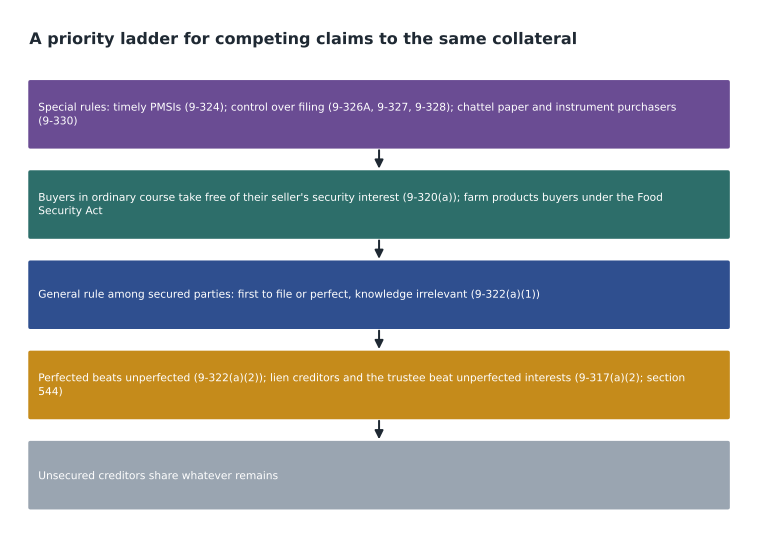
Apply the basic rules to the Harrowgate wrapping machine. Harrowgate's "lease" was a security interest (Lesson 1), it attached in June 2025 and it was never perfected. The bank's interest in the machine attached when Juniper Hill acquired rights in it, and it is perfected by the bank's filing. Under section 9-322(a)(2) the bank's perfected interest beats Harrowgate's unperfected one, though Harrowgate's attached first. If Harrowgate files now, its priority dates from the filing, more than a year after the bank's, and it still loses under section 9-322(a)(1). Harrowgate's one hope was the purchase-money rule, which required perfection within twenty days after Juniper Hill received possession. That deadline passed in the summer of 2025.
Lien creditors
A lien creditor is a creditor that has acquired a lien on the property involved by attachment, levy or the like, as well as an assignee for the benefit of creditors, a receiver and a trustee in bankruptcy from the time of filing the petition (section 9-102(a)(52)). Section 9-317(a)(2) says a security interest is subordinate to the rights of a person that becomes a lien creditor before the earlier of the time the security interest is perfected or the time a financing statement is filed and a security agreement signed or other attachment condition met. In plain terms, an unperfected security interest loses to a later judicial lien, and a perfected one wins. Suppose a feed supplier, Gantry Feed and Grain, obtains a judgment against Juniper Hill and has the sheriff levy on the wrapping machine. Gantry becomes a lien creditor at the levy. The bank, perfected long before, prevails over Gantry. Gantry prevails over Harrowgate, which is unperfected.
The lien creditor rule matters most because of bankruptcy. Section 544(a)(1) of the Bankruptcy Code gives the trustee the rights of a hypothetical judicial lien creditor as of the moment the petition is filed. Every security interest unperfected at that moment can be avoided, and the collateral is preserved for the estate. If Juniper Hill filed for bankruptcy tomorrow, Harrowgate would be an unsecured creditor. Section 9-317(e) gives purchase-money creditors their twenty-day grace period against lien creditors too: if a PMSI is perfected within twenty days after the debtor receives delivery, it takes priority over the rights of a lien creditor that arise between attachment and filing, and section 546(b) of the Bankruptcy Code respects that relation back.
Buyers of goods
Buyers are treated more generously than lien creditors, because commerce depends on them. Under section 9-317(b), a buyer of goods who gives value and receives delivery without knowledge of an unperfected security interest takes free of it. Under section 9-315(a)(1), a perfected security interest continues in collateral notwithstanding sale, unless the secured party authorized the disposition free of the security interest or a specific rule says otherwise. The most important specific rule is section 9-320(a): a buyer in ordinary course of business takes free of a security interest created by the buyer's seller, even if the security interest is perfected and the buyer knows of its existence. When Northgate buys cheese from Juniper Hill, Northgate takes free of the bank's security interest. If it did not, no grocery chain could buy inventory from a borrower without searching the filing records, and no secured inventory financing could work.
The definition of a buyer in ordinary course of business, in section 1-201(b)(9), does the screening. The buyer must buy in good faith, without knowledge that the sale violates the rights of another person in the goods, in the ordinary course from a person, other than a pawnbroker, in the business of selling goods of that kind. The sale must comport with the usual or customary practices in the seller's kind of business or with the seller's own usual practices. A buyer who takes goods in a bulk transaction or as security for or in total or partial satisfaction of a money debt is not a buyer in ordinary course. Knowledge that a security interest exists does not disqualify the buyer; knowledge that the sale violates the secured party's rights, for example because the security agreement forbids sales and the buyer knows the bank has not consented, does.
The phrase "created by the buyer's seller" limits the protection. If Juniper Hill sells its old cheese vat to a neighbor who is not in the business of selling vats, the neighbor is not a buyer in ordinary course, because Juniper Hill does not sell vats as part of its business, and the neighbor takes subject to the bank's perfected interest. And if a used equipment dealer buys the vat from Juniper Hill and resells it to a restaurant, the restaurant takes free of security interests created by the dealer, but not of the bank's interest, which Juniper Hill created. Courts have applied this limit strictly. In National Shawmut Bank of Boston v. Jones, 236 A.2d 484 (N.H. 1967), a consumer buyer of a car from a dealer took subject to a security interest created by an earlier owner who had sold the car to the dealer, because the dealer had not created it. Section 9-320(e) adds that a buyer does not take free of a possessory security interest.
Two narrower rules complete the picture. Section 9-320(b), the garage-sale rule from Lesson 5, protects consumer buyers from consumer sellers against automatically perfected PMSIs. And section 9-323(d) and (e) protect a buyer of goods that are not in ordinary course from future advances: the buyer takes free of a security interest to the extent it secures advances made after the earlier of the time the secured party acquires knowledge of the buyer's purchase and forty-five days after the purchase, unless the advance was made under a commitment entered into without knowledge of the purchase and before the forty-five days ran out. Lessees in ordinary course receive parallel protection under section 9-321.
Farm products and the Food Security Act
Section 9-320(a) has an exception that the creamery runs into from the other side: it does not protect a person buying farm products from a person engaged in farming operations. For years that exception meant buyers of grain and livestock took subject to the farmer's lender's security interest and sometimes paid twice. Congress responded in the Food Security Act of 1985, 7 U.S.C. section 1631, which preempts the exception. Under the federal rule, a buyer in the ordinary course of farm products from a seller engaged in farming takes free of a security interest created by the seller, even if perfected and known, unless the buyer had received the protections the Act gives the secured party. In a state without a certified central filing system, the secured party must send the buyer written direct notice, within one year before the sale, identifying the farm products and the payment obligations conditioned on the release of the interest. In a state with such a system, the buyer takes subject if it failed to register with the system or received notice from it.
Lisowski adds a fact for this lesson. Ezra Pullman, the neighbor who sells raw milk to the creamery, borrowed from Corrigan State Bank in 2024 and granted it a security interest in his herd and milk. In January 2026 Corrigan sent Juniper Hill a signed direct notice that complied with the Act, describing Pullman's milk and instructing that payments be made by check payable jointly to Pullman and Corrigan. Westmarch, Lisowski tells the class to assume, has no certified central filing system. Juniper Hill paid Pullman alone, by direct deposit, for three months of milk in the summer of 2026, and Pullman spent the money. Juniper Hill bought the milk subject to Corrigan's security interest and, having made the milk into cheese, may be liable to Corrigan in conversion for the value of the milk, effectively paying twice. Jordan Kimura says it is the kind of mistake an accounts-payable clerk makes on a Tuesday, and Lisowski agrees: the cure is a vendor file that flags every direct notice.
Proceeds and their priority
A security interest in collateral attaches to identifiable proceeds (Lesson 3), and section 9-315(c) says it is perfected in them if the security interest in the original collateral was perfected. That perfection lapses on the twenty-first day after attachment to the proceeds unless one of the conditions in section 9-315(d) is met. The first condition is the same-office rule: a filed financing statement covers the original collateral, the proceeds are collateral in which a security interest may be perfected by filing in the same office, and the proceeds are not acquired with cash proceeds. The second is that the proceeds are identifiable cash proceeds. The third is that the security interest in the proceeds is perfected, other than by the original filing, within the twenty days. For the bank, whose all-assets filing covers nearly everything, these rules mostly confirm that its perfection follows the cheese from inventory to accounts to the operating account.
Priority in proceeds generally follows priority in the original collateral. Section 9-322(b)(1) says the time of filing or perfection as to collateral is also the time of filing or perfection as to its proceeds. Section 9-322(c) to (e) add special rules for proceeds of collateral such as deposit accounts, investment property, chattel paper and letter-of-credit rights, where priority may have come from control or possession rather than filing; they are intricate, and the official comments work through examples. And section 9-332 protects people who receive money from the debtor: a transferee of money, or of funds from a deposit account, takes free of a security interest unless the transferee acts in collusion with the debtor in violating the secured party's rights. When Juniper Hill pays its employees, its propane supplier and its veterinarian from the operating account, they take the money free of the bank's interest, even though the bank's interest was perfected in the account as cash proceeds.
Commingled bank accounts raise the tracing problem. If Juniper Hill deposits 50,000 dollars of Northgate's payments into an account that already holds 20,000 dollars of unencumbered money from a state grant, and then spends 60,000 dollars before depositing anything else, how much of the remaining 10,000 dollars is the bank's? Under the lowest intermediate balance rule, the court presumes the debtor spent its own money first. The 20,000 dollars of grant money went first and 40,000 of the 50,000 dollars of proceeds followed, so the lowest balance of proceeds was 10,000 dollars, and that is the limit of the bank's identifiable cash proceeds even if the account is later replenished with other money. Section 9-315(b)(2) authorizes this kind of equitable tracing.
Worked problem
Three contests in the creamery's file
Resolve three contests. (1) Gantry Feed and Grain levies on the Harrowgate machine; Harrowgate has an unperfected security interest and the bank a perfected one. (2) Northgate buys 4,000 pounds of cheddar from Juniper Hill in the ordinary course; the bank's security agreement prohibits sales outside the ordinary course but permits ordinary sales. (3) Corrigan State Bank demands payment from Juniper Hill for milk bought from Pullman after Corrigan's direct notice.
Show solution
- Contest 1: the bank's perfected interest beats both Gantry and Harrowgate (section 9-322(a)(2) as to Harrowgate; section 9-317(a)(2) as to Gantry, because the bank perfected before Gantry's levy). Gantry, a lien creditor, beats Harrowgate's unperfected interest under section 9-317(a)(2). Order: bank, Gantry, Harrowgate.
- Contest 2: Northgate is a buyer in ordinary course from a seller in the business of selling cheese, buying in good faith without knowledge that the sale violates the bank's rights (it does not: ordinary sales are permitted). Under section 9-320(a) Northgate takes free of the bank's perfected security interest. The bank's interest continues in the proceeds, the account owed by Northgate.
- Contest 3: the milk is a farm product sold by a person engaged in farming, so section 9-320(a) does not protect Juniper Hill. The Food Security Act does, unless the secured party gave written direct notice in a state without a central filing system. Corrigan gave complying notice, and Juniper Hill ignored its payment instruction, so Juniper Hill took the milk subject to Corrigan's security interest.
- Remedy in contest 3: because the milk has been made into cheese, Corrigan's practical claim is for conversion or under section 9-336 (commingled goods), discussed in Lesson 8; Juniper Hill may have to pay for the milk twice and seek reimbursement from Pullman.
Summary and key terms
- Among secured parties, the first to file or perfect wins, without regard to knowledge (section 9-322(a)(1)); perfected beats unperfected, and among unperfected interests the first to attach wins.
- Priority dates from the original filing even for later advances.
- A lien creditor, including a bankruptcy trustee under section 544(a)(1), defeats an unperfected security interest (section 9-317(a)(2)).
- A buyer in ordinary course takes free of a security interest created by its seller, even if perfected and known (section 9-320(a)); it does not take free of one created by an earlier owner.
- Buyers of farm products are governed by the Food Security Act: direct notice or a central filing system preserves the lender's interest.
- Perfection and priority carry over to identifiable proceeds, subject to the twenty-day rule and its exceptions (sections 9-315 and 9-322(b)).
- Recipients of money and of funds from a deposit account take free unless they collude (section 9-332).
- Commingled cash proceeds are traced by equitable methods such as the lowest intermediate balance rule.
Practice problems
Work each problem on paper first, then reveal the answer to check.
Lender A signs a security agreement with a debtor in January but files in March. Lender B files in February, signs a security agreement and lends in April. Both claim equipment. Who wins?
Show answer
Lender B. B filed first (February), and under section 9-322(a)(1) priority dates from the earlier of filing or perfection. A's attachment in January does not matter once both are perfected.
A car dealer's inventory lender has a perfected security interest. A consumer buys a car from the dealer's lot. Does the consumer take free?
Show answer
Yes. The consumer is a buyer in ordinary course from a person in the business of selling cars, and the inventory lender's security interest was created by the buyer's seller (section 9-320(a)).
A grain elevator buys corn from a farmer. The farmer's lender sent the elevator a complying direct notice eight months before. The elevator pays the farmer alone. Does the elevator take free of the lender's interest?
Show answer
No. Under the Food Security Act, in a state without a central filing system, a buyer that received written direct notice within one year before the sale takes subject to the security interest unless it complies with the payment instructions.
An account holds 30,000 dollars of proceeds. The debtor withdraws 25,000 dollars, then deposits 40,000 dollars of non-proceeds. How much is identifiable cash proceeds?
Show answer
5,000 dollars, under the lowest intermediate balance rule. The later deposit of other money does not restore the proceeds.
Lesson quiz · 5 questions
Score 60% or more to complete this lesson.
Create a free account to save your progress, take quizzes and earn a certificate.