
LAWU-213 · Lesson 9 of 12 · 23 min
Discretionary, spendthrift and charitable trusts
▶ Video coming soon A video version of this lesson is on the way.
Arthur Wexley did not leave Julian's share to him outright. Arthur's 2021 lawyer's notes, now in the file, explain why: Julian's restaurant was failing, he had debts, and he and his former wife were fighting over support for their daughter, Tilly. Arthur wanted Julian to be cared for without the money going to his creditors. So Julian's third of the trust is held in a separate trust, with Philippa as trustee, who may distribute "such amounts of income and principal as the trustee, in her sole and absolute discretion, considers advisable for Julian's health, education, maintenance and support." At Julian's death the remainder passes to his descendants. A spendthrift clause bars Julian from transferring his interest and bars his creditors from reaching it.
Two creditors have already written. The landlord of Julian's former restaurant in Portland holds a judgment for 85,000 dollars in unpaid rent. Julian's former wife holds a support order for Tilly, on which Julian owes 14,000 dollars in arrears. "This lesson," Stavely tells Section B, "is about when a trust's terms bind the outside world. A settlor can tell a trustee what to do. Can the settlor also tell the beneficiary's creditors what they may not do?"
Mandatory, discretionary and support trusts
A trust interest is mandatory if the trustee must distribute, for example "all the income to Julian at least quarterly." It is discretionary if the trustee decides whether and how much to distribute. Discretion may be unlimited in form, "in the trustee's sole and absolute discretion," or limited by a standard, such as health, education, maintenance and support, the familiar ascertainable standard that also has tax significance. Older cases distinguished support trusts, in which the trustee must pay what is needed for the beneficiary's support, from pure discretionary trusts; the Restatement (Third) of Trusts and the UTC treat both as discretionary trusts with different standards.
Even the broadest grant of discretion is subject to judicial review. Under UTC section 814(a), a trustee must exercise a discretionary power in good faith and in accordance with the terms and purposes of the trust and the interests of the beneficiaries, notwithstanding words such as absolute, sole or uncontrolled. A court will not substitute its judgment for the trustee's, but it will intervene if the trustee acts dishonestly, with an improper motive or without considering the beneficiary's circumstances. In Marsman v. Nasca (Mass. App. Ct. 1991), a trust allowed the trustee to pay principal to the settlor's widower for his "comfortable support and maintenance," in the trustee's discretion. The widower ran short of money and ended up giving up ownership of his house to make ends meet, while the trustee, a lawyer, never asked about his needs. The court held that the trustee had a duty to inquire into the beneficiary's needs and had breached it, though the trust's exculpation clause limited the relief.
The trustee may also consider the beneficiary's other resources unless the trust says otherwise. Stavely tells Philippa, through the class, that she must make reasoned decisions about Julian's requests, document them, and neither rubber-stamp them nor ignore them.
Creditors of a beneficiary
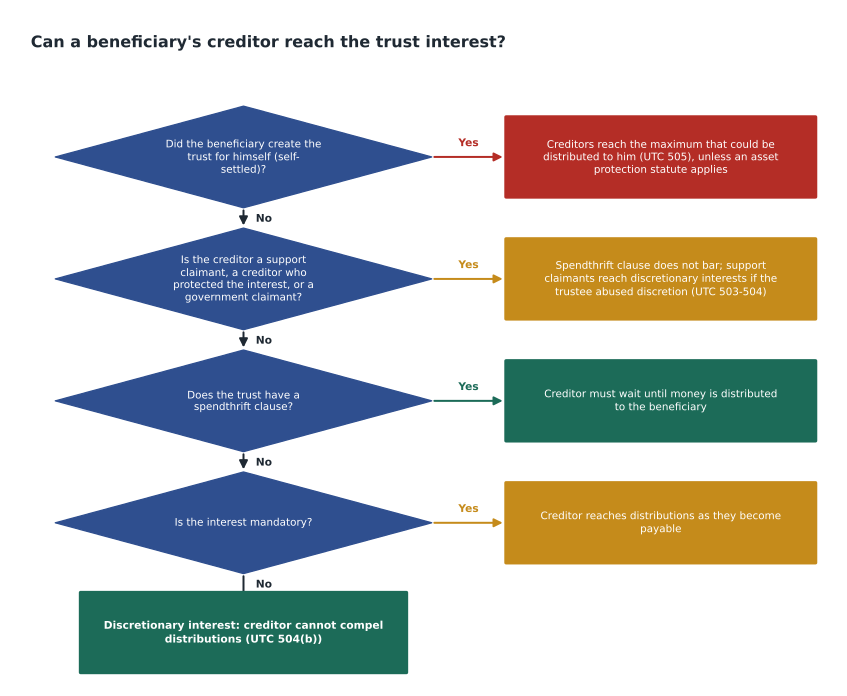
What can a beneficiary's creditors reach? For a mandatory interest without a spendthrift clause, a creditor can generally reach the distributions as they become payable, and may be able to have the interest sold. For a discretionary interest, a creditor cannot compel the trustee to distribute. Under UTC section 504(b), whether or not there is a spendthrift clause, a creditor of a beneficiary may not compel a discretionary distribution, even if the trustee has abused its discretion or failed to comply with a standard. Some states, under the older Restatement (Second) view, let a creditor obtain an order requiring the trustee to pay the creditor any amount the trustee decides to distribute, so that the beneficiary receives nothing until the creditor is paid; that is often enough to make the trustee stop distributing to the beneficiary and instead pay third parties for his benefit, such as a landlord or a hospital.
There is an important exception for family support. Under UTC section 504(c), to the extent the trustee has not complied with a standard of distribution or has abused its discretion, a court may order a distribution to satisfy a judgment for the support of the beneficiary's child, spouse or former spouse, up to the amount the trustee would have been required to distribute had it complied. A child or former spouse can therefore reach a support trust's distributions if the trustee is withholding them to defeat the claim.
Spendthrift trusts
A spendthrift clause restrains both voluntary and involuntary transfers of a beneficiary's interest: the beneficiary may not assign it, and creditors may not reach it before it is distributed. English law refused to enforce such clauses on the ground that a person's property should be available to creditors. American courts, beginning with Broadway National Bank v. Adams (Mass. 1882), enforced them, reasoning that a settlor may give property on whatever conditions the settlor likes and that creditors can find out about the restraint before they lend. Nearly every state now enforces spendthrift clauses, and UTC section 502 validates them if they restrain both voluntary and involuntary transfer. A clause stating that the interest is "held subject to a spendthrift trust" is sufficient.
Once money is distributed, the protection ends; a creditor can reach it in the beneficiary's hands. The clause also protects only third-party trusts, not interests the beneficiary created for himself. And it yields to certain claimants. Under UTC section 503(b), a spendthrift provision is unenforceable against a beneficiary's child, spouse or former spouse who has a judgment or court order for support or maintenance, a judgment creditor who has provided services for the protection of the beneficiary's interest in the trust, and a claim of the state or the United States to the extent a statute so provides. Federal tax liens reach spendthrift interests regardless of state law.
Courts have disagreed about tort victims. In Scheffel v. Krueger (N.H. 2001), a mother obtained a tort judgment against a man who had sexually assaulted her minor son, and sought to reach the defendant's interest in a spendthrift trust created by his grandmother. The New Hampshire Supreme Court held that the state's statute enforcing spendthrift clauses contained no exception for tort creditors and that it was for the legislature to create one. A few courts have suggested a public policy exception for intentional torts, and the Restatement (Third) of Trusts favors exceptions for tort claims, but the UTC does not adopt one. In Shelley v. Shelley (Or. 1960), by contrast, the Oregon Supreme Court allowed a beneficiary's former wives and children to reach his interest in a spendthrift trust for alimony and child support, because the policy of family support outweighed the settlor's intent.
Worked problem
Julian's creditors
Apply the UTC, as adopted in Westmarch, to the claims of the Portland landlord (an 85,000 dollar judgment for unpaid rent) and Julian's former wife (14,000 dollars of child support arrears for Tilly) against Julian's interest in the discretionary spendthrift trust.
Show solution
- The landlord: Julian's interest is discretionary and protected by a spendthrift clause. The landlord is an ordinary contract creditor, not within any section 503(b) exception. It cannot reach the interest, cannot compel distributions, and under section 504(b) cannot complain even if Philippa abuses her discretion.
- Once Philippa distributes money to Julian, the landlord can reach it in his bank account. Philippa may therefore pay Julian's rent or medical bills directly, which the trust's support standard permits.
- The former wife: she holds a court order for the support of the beneficiary's child, a claimant listed in section 503(b), so the spendthrift clause does not bar her.
- Because the interest is discretionary, section 504(c) governs. She can obtain a court order for a distribution only to the extent Philippa has failed to comply with the support standard or abused her discretion, and only up to what Philippa would have had to distribute had she complied.
- If Philippa refuses all distributions so that Julian cannot pay support while he is in need, a court could find an abuse of discretion and order payment of the arrears directly to Tilly's mother.
Answer: The landlord gets nothing from the trust until money is distributed to Julian, and Philippa can largely avoid that by paying third parties for his benefit. Tilly's mother can reach the trust for the 14,000 dollars if Philippa has withheld distributions the support standard requires. Stavely adds that Philippa should consider making support payments for Tilly directly, since a payment for Julian's child arguably serves his support and the trust's purposes.
Self-settled trusts and asset protection
A person cannot ordinarily put property into a trust for his or her own benefit and keep it from creditors. Under UTC section 505(a)(2), a creditor of the settlor of an irrevocable trust may reach the maximum amount that can be distributed to or for the settlor's benefit, and spendthrift clauses do not protect self-settled interests. Beginning with Alaska and Delaware in 1997, however, about twenty states have enacted domestic asset protection trust statutes that allow a settlor to create an irrevocable self-settled spendthrift trust, usually with an independent in-state trustee, and protect it from most creditors after a waiting period. Offshore jurisdictions, such as the Cook Islands, go further.
Asset protection trusts face limits. Transfers made to defraud existing creditors can be set aside under fraudulent transfer law. In FTC v. Affordable Media, LLC (9th Cir. 1999), a couple who ran a telemarketing scheme had put the proceeds into a Cook Islands trust and claimed they could not bring the money back because the foreign trustee would not cooperate; the Ninth Circuit affirmed their civil contempt, holding that their inability to comply was self-created and that they remained protectors with power over the trust. Federal bankruptcy law also reaches such trusts: section 548(e) of the Bankruptcy Code lets a trustee avoid a transfer to a self-settled trust made within ten years of bankruptcy with actual intent to hinder, delay or defraud creditors, and in Battley v. Mortensen (Bankr. D. Alaska 2011), the court applied it to an Alaska trust. Conflict of laws is unsettled when a settlor in a state that rejects such trusts uses another state's law.
A related device serves people with disabilities. A supplemental needs trust holds property for a beneficiary who receives Medicaid or Supplemental Security Income, with distributions limited to needs those programs do not cover, so that the trust does not count as the beneficiary's resource. A third-party trust created by a parent may leave the remainder to anyone. A self-settled trust funded with the disabled person's own money, for example a personal injury settlement, must satisfy federal Medicaid law and repay the state from any remainder at the beneficiary's death.
Modification and termination
Can the beneficiaries change or end a trust? Under the American rule of Claflin v. Claflin (Mass. 1889), all beneficiaries together may not terminate a trust if termination would defeat a material purpose of the settlor; a son whose father's will held his share in trust until he reached 30 could not compel early payment at 21, because postponing enjoyment was a material purpose. The English rule of Saunders v. Vautier (1841) lets competent adult beneficiaries end a trust whenever they all agree. UTC section 411 follows Claflin: a noncharitable irrevocable trust may be terminated or modified with the consent of the settlor and all beneficiaries, or, if the settlor is dead or does not consent, with the consent of all beneficiaries if the court concludes that continuance is not necessary to achieve a material purpose. In the UTC's bracketed text, which states may adopt, a spendthrift clause is not presumed to be a material purpose. Unborn and minor beneficiaries complicate consent, and courts may use guardians ad litem or virtual representation.
Courts may also modify a trust because of circumstances the settlor did not anticipate, under the doctrine of equitable deviation, codified in UTC section 412, if modification will further the trust's purposes. They may reform a trust for mistake under section 415, and modify it to achieve the settlor's tax objectives under section 416. Many states now permit decanting, the trustee's distribution of trust property to a new trust with different terms, under the Uniform Trust Decanting Act (2015) or similar statutes, when the trustee has discretion to distribute principal. Maisie, now 19, has asked whether she can end her share of the trust and receive it at 21 rather than 25. Under section 411, the answer depends on whether postponing enjoyment to 25 is a material purpose, and a court will likely say it is, because that is the only apparent reason for the age.
Charitable trusts
Charitable trusts differ from private trusts in three ways. They need no definite beneficiaries, because the public is the beneficiary; they may last forever, because the rule against perpetuities does not apply to them; and they are enforced by the state attorney general rather than, or in addition to, the beneficiaries. A purpose is charitable under UTC section 405 if it is for the relief of poverty, the advancement of education or religion, the promotion of health, governmental or municipal purposes, or other purposes beneficial to the community. A trust for the benefit of a few named individuals is not charitable, however worthy. UTC section 405(c) gives the settlor standing to enforce a charitable trust, and some courts have also given standing to others with a special interest. In Smithers v. St. Luke's-Roosevelt Hospital Center (N.Y. App. Div. 2001), the court let the widow of a donor, as administrator of his estate, sue to enforce restrictions on his gift to a hospital for an alcoholism treatment center.
When a charitable purpose becomes impossible, impracticable or wasteful, the doctrine of cy pres allows a court to direct the property to another charitable purpose as near as possible to the settlor's. Traditional law required a general charitable intent; otherwise the trust failed and the property reverted to the settlor's heirs. In In re Neher (N.Y. 1939), a testator left her home to a village for a hospital in memory of her husband; when the village could not support a hospital, the court allowed it to use the property as an administration building bearing the husband's name. In Evans v. Abney (1970), a senator's will left land to the city of Macon, Georgia, for a park for white people only; after the Court held that the city could not operate a segregated park, the Georgia courts refused to apply cy pres, finding that the testator would have preferred that the trust fail, and the land reverted to his heirs. The Supreme Court held that the reversion did not violate equal protection. In the Buck Trust case (Cal. Super. Ct. 1986), the court refused to let a foundation spend income from a bequest restricted to Marin County, one of the wealthiest counties in the country, elsewhere in the San Francisco Bay Area, because the restriction was not impracticable merely because the money could do more good elsewhere.
UTC section 413 presumes a general charitable intent and lets a court apply cy pres if a purpose becomes unlawful, impracticable, impossible to achieve or wasteful. Arthur's 100,000 dollar gift to the Brennan Falls Public Library for a reading room named for Edith now faces a problem: the library merged into the Merrin County Library District in 2026, and the district plans to close the downtown building. Cy pres would likely let the district create the Edith Wexley Reading Room in the new central library rather than return the gift to the trust.
Summary and key terms
- Discretionary powers, even "absolute" ones, must be exercised in good faith and with inquiry into the beneficiary's needs (Marsman v. Nasca).
- Creditors cannot compel discretionary distributions; spendthrift clauses bar creditors until distribution, with exceptions for child and spousal support and some government claims.
- Self-settled trusts are reachable by creditors except under domestic asset protection statutes, which are limited by fraudulent transfer law and bankruptcy section 548(e).
- Beneficiaries may terminate or modify only if no material purpose is defeated (Claflin, UTC section 411); courts may deviate, reform and allow decanting.
- Charitable trusts need no definite beneficiaries, may be perpetual and are enforced by the attorney general; cy pres redirects failed purposes (Neher, Evans v. Abney).
Practice problems
Work each problem on paper first, then reveal the answer to check.
A trust directs the trustee to pay all income to a beneficiary for life and contains no spendthrift clause. Can the beneficiary's judgment creditor reach the income?
Show answer
Yes. A mandatory income interest without a spendthrift clause can be reached as distributions become payable.
A settlor funds an irrevocable trust in Westmarch, which has no asset protection statute, naming herself as discretionary beneficiary. Can her creditors reach the trust?
Show answer
Yes, up to the maximum amount the trustee could distribute to her, under UTC section 505(a)(2).
Why did the court in Evans v. Abney refuse to apply cy pres?
Show answer
It found that the testator had no general charitable intent apart from the racial restriction and would have preferred that the trust fail.
Can Julian assign his interest in the trust to a friend in exchange for a loan?
Show answer
No. A valid spendthrift clause restrains voluntary as well as involuntary transfers, so the assignment is unenforceable against the trustee.
Lesson quiz · 5 questions
Score 60% or more to complete this lesson.
Create a free account to save your progress, take quizzes and earn a certificate.