
LAWU-213 · Lesson 11 of 12 · 24 min
Estate planning
▶ Video coming soon A video version of this lesson is on the way.
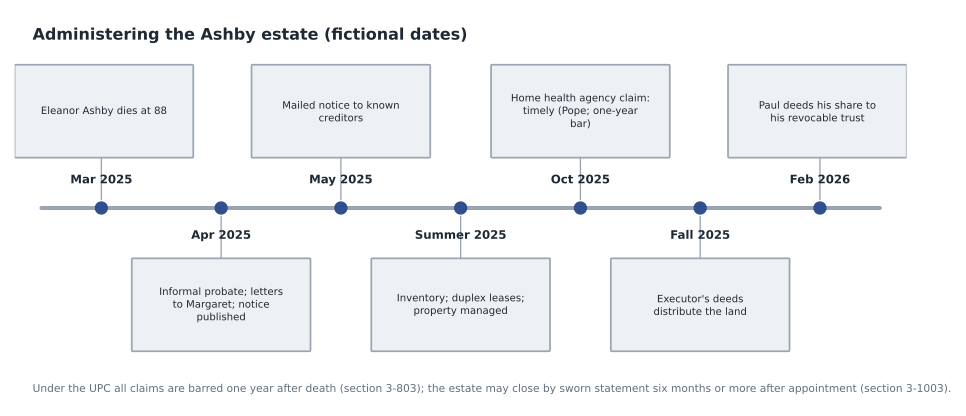
Stavely opens the eleventh session with a file the class has seen before. In Property, Professor Vandermolen taught from the Ashby files: Eleanor Ashby, a widow, died in March 2025 at 88, leaving Ashby Point on Lake Callowhill, a duplex in Brennan Falls, a cabin lot and a 2019 will. Section B studied the will's property problems: the joint tenancy, the land trust's defeasible fee, Margaret's life estate in the duplex. "Nobody asked," Stavely says, "how the property got from Eleanor to her children. Someone had to collect it, pay her bills, file her tax returns and sign the deeds. That someone was Margaret, and this is what she did." The administration details are Stavely's additions to the Ashby story, and they are fictional, like the rest of it.
Estate planning, Stavely tells the class, is planning for what happens after death: the administration that will follow and the taxes it may bring. A plan that ignores either is not finished. The second half of the lesson turns to taxes, using the Wexley estate. Neither estate owes any federal estate tax. Both illustrate why the tax system still shapes estate planning, through income tax basis, portability and the gift and generation-skipping transfer taxes.
Opening the estate
Probate jurisdiction lies in the county of the decedent's domicile, with ancillary proceedings wherever the decedent owned real property in another state. Eleanor lived in Brennan Falls and owned property only in Westmarch, so one proceeding in the Merrin County probate court sufficed. The 2019 will named Margaret as executor. Under the UPC, a will may be probated informally, by an application to the court's registrar, who reviews the will and the application without notice or a hearing, or formally, in a court proceeding with notice to interested persons. Informal probate is fast and inexpensive; formal probate binds everyone who receives notice and is chosen when a contest is expected. In April 2025 Margaret applied for informal probate, the registrar admitted the will, and Margaret received letters testamentary, the document that proves her authority to banks, title companies and buyers. Because the will waived bond, she did not have to post one.
A personal representative is a fiduciary with the same core duties as a trustee: loyalty, prudence, impartiality and the duty to account. Under UPC section 3-703, she must settle and distribute the estate in accordance with the will and applicable law, as expeditiously and efficiently as is consistent with the best interests of the estate. Under the UPC's system of unsupervised administration, she may act without court orders, including selling property, unless an interested person asks for supervised administration. Many non-UPC states still require court approval for sales and distributions.
Notice to creditors and claims
One of the personal representative's first tasks is to give notice to creditors. UPC section 3-801 requires publication of a notice once a week for three successive weeks, telling creditors to present claims within four months after the first publication. The personal representative may also mail notice to creditors, and a creditor who receives it must present a claim within the later of the four-month period or 60 days after the mailing. Claims not presented within those periods are barred. Under section 3-803, all claims are in any event barred one year after the decedent's death if not presented earlier, whether or not notice was given.
Publication alone is not enough for creditors the estate knows about. In Tulsa Professional Collection Services, Inc. v. Pope (1988), a hospital that had treated the decedent before his death did not file a claim within the two-month period that ran from published notice under Oklahoma's statute. The Supreme Court held that the short nonclaim period, triggered by the probate court's involvement, was state action, and that due process required actual notice, by mail or other means, to creditors whose identity was known or reasonably ascertainable. The UPC's one-year self-executing bar is designed to avoid the problem, because it runs from death without any court action.
Margaret published notice in April and May 2025 and mailed notice to the creditors she knew of: the hospital, a credit card company and the propane supplier. She did not mail notice to the home health agency that sent aides to Eleanor in her last winter, because its bills were in a drawer she had not opened. The agency presented a claim for 9,400 dollars in October 2025. Under Pope, the agency was reasonably ascertainable and entitled to actual notice, so the four-month publication period does not bar it; and under the UPC's one-year limit, the claim was timely because it came within a year of Eleanor's death. Margaret paid it. If an estate cannot pay all claims, UPC section 3-805 sets the priority: administration costs, funeral expenses, federal debts and taxes, medical expenses of the last illness, state debts and taxes, and then all other claims.
Inventory, management and distribution
Within three months after appointment, a UPC personal representative must prepare an inventory of the probate property, with its fair market value at the date of death, and send it to interested persons who request it (section 3-706). Margaret's inventory listed Ashby Point, including the farmhouse, boathouse, north meadow and the orchard lot; the point lot; Lot 14 in Callowhill Shores; the duplex at 412 Sycamore Street; and Eleanor's bank accounts and personal property. Two items raised questions. The watercolor over the fireplace had been given to Chloe in 2015, with Eleanor keeping it for life, so Chloe owned it and it was not part of the probate estate. The orchard lot had been deeded to Simon Pryor in 2017 by a deed he did not record; Margaret listed it as estate property, which is how the recording-act dispute studied in Property began.
During administration the personal representative manages the property: insuring it, collecting rents, paying taxes, and deciding what to sell to raise cash for debts and expenses. Margaret signed the duplex leases in 2025 both as executor and as the future life tenant, a dual role that was proper but would have required care if her interests and the remainder beneficiaries' had diverged. She also had to decide whether to sell anything. She did not need to: Eleanor's bank accounts covered the debts and expenses.
Distribution follows the will. In the fall of 2025, Margaret signed executor's deeds conveying the house parcel to Paul and Margaret as joint tenants with right of survivorship, the north meadow to the Merrin County Land Trust, the duplex to herself for life with the remainder to her surviving children, and the residuary real estate to Paul and herself equally. Each deed was recorded. Paul's February 2026 deed of his interest in the house parcel to his own revocable trust, the severance problem from Property, followed. Before distributing, a careful personal representative obtains receipts and refunding agreements from the beneficiaries, so that if a late claim appears the beneficiaries return what is needed; under UPC section 3-909, a distributee is liable to return property improperly distributed.
Closing the estate
An estate may be closed by a formal court order, after notice and an accounting, or, under UPC section 3-1003, by the personal representative's sworn closing statement filed no earlier than six months after appointment, stating that notice to creditors was given, that claims have been paid and that the estate has been fully distributed, with a copy sent to all distributees. Small estates may skip administration entirely. Under UPC section 3-1201, a successor may collect personal property by affidavit if the estate's value, less liens, does not exceed a statutory amount, and many states provide summary procedures for modest estates.
Federal transfer taxes: the framework
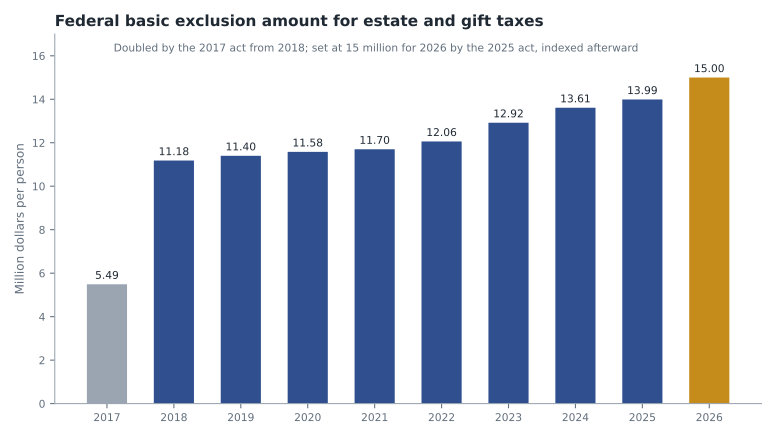
The federal government taxes gratuitous transfers through three linked taxes: the estate tax, the gift tax and the generation-skipping transfer (GST) tax. The estate and gift taxes are unified: one rate schedule, with a top rate of 40 percent, and one lifetime exemption, the basic exclusion amount, shared between gifts and the estate. The One Big Beautiful Bill Act of July 2025 set the basic exclusion at 15,000,000 dollars per person for 2026, to be indexed for inflation in later years, replacing the scheduled drop to about half that amount. The GST exemption is the same amount. As a result, only a very small fraction of estates, the largest few thousand each year, owe any federal estate tax. About a dozen states and the District of Columbia have their own estate taxes, often with much lower exemptions, and a handful of states impose inheritance taxes on recipients; Westmarch, Stavely says, has neither.
The estate tax
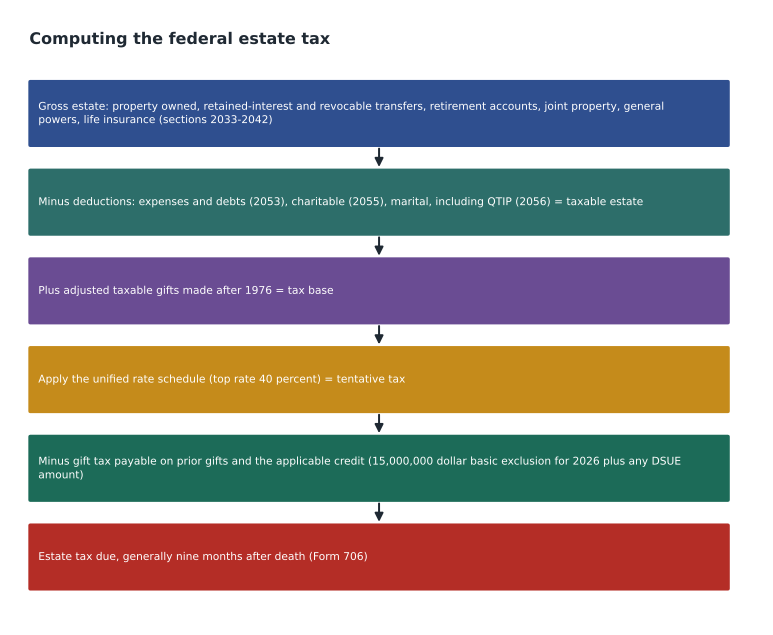
The estate tax begins with the gross estate, which is much broader than the probate estate. It includes all property the decedent owned (Internal Revenue Code section 2033); property transferred during life in which the decedent kept the income or use (section 2036) or a power to revoke or amend (section 2038), which brings in revocable trusts; annuities and retirement accounts (section 2039); joint tenancy property, in full except to the extent the survivor contributed, or one-half for spouses (section 2040); property subject to a general power of appointment (section 2041); and life insurance payable to the estate or over which the decedent held incidents of ownership (section 2042). Eleanor's watercolor, which she gave away but kept for life, is in her gross estate under section 2036, even though it was not in her probate estate.
From the gross estate the estate subtracts deductions: funeral and administration expenses and debts (section 2053), casualty losses, the unlimited charitable deduction (section 2055) and the unlimited marital deduction for property passing to a surviving spouse who is a United States citizen (section 2056). Property in which the spouse receives only a terminable interest, such as a life estate, qualifies only if it is qualified terminable interest property (QTIP), for which the executor elects to defer tax until the spouse's death. The result is the taxable estate. The tax is computed on the taxable estate plus adjusted taxable gifts (lifetime taxable gifts made after 1976), and then reduced by gift tax payable on those gifts and by the applicable credit, which shelters the basic exclusion amount. With a 40 percent rate above the exemption, a 20,000,000 dollar taxable estate with no prior taxable gifts would owe about 2,000,000 dollars.
Two further rules make the marital deduction especially powerful. Portability, added in 2010, lets the executor of a married decedent elect to transfer the decedent's unused exclusion, the deceased spousal unused exclusion amount (DSUE), to the surviving spouse, who can use it for later gifts or at death (section 2010(c)). The election is made on a timely filed estate tax return, Form 706, due nine months after death with a six-month extension available, even if no tax is owed; under Rev. Proc. 2022-32, an estate not otherwise required to file may make the election up to five years after death. And the income tax rule of section 1014 gives property included in a decedent's gross estate a basis equal to its fair market value at death, the stepped-up basis, while property received by lifetime gift keeps the donor's basis under section 1015. Every inherited Ashby parcel took a new basis at its March 2025 value, which will matter when Paul's partition forces a sale.
Worked problem
Does the Wexley estate owe estate tax, and should it file anyway?
Using the figures in the file, compute Arthur's taxable estate and decide whether Philippa, as executor, should file Form 706. The gross estate includes the probate assets (1,010,000 dollars), the trust (2,400,000 dollars, under section 2038), the IRA (500,000 dollars), the life insurance he owned (300,000 dollars) and the joint account he funded (60,000 dollars). Expenses and debts are 110,000 dollars. Odette receives the IRA, the 200,000 dollar trust gift and the 250,400 dollar elective share balance outright. The library receives 100,000 dollars. In 2023 Arthur gave Julian 40,000 dollars, when the annual exclusion was 17,000 dollars.
Show solution
- Gross estate: 1,010,000 plus 2,400,000 plus 500,000 plus 300,000 plus 60,000 dollars equals 4,270,000 dollars.
- Deductions: expenses and debts of 110,000 dollars; a marital deduction of 950,400 dollars (500,000 plus 200,000 plus 250,400 dollars, all passing outright); a charitable deduction of 100,000 dollars. Odette's one-year right to occupy the house is a nondeductible terminable interest.
- Taxable estate: 4,270,000 minus 1,160,400 dollars equals 3,109,600 dollars.
- Adjusted taxable gifts: the 2023 gift exceeded the annual exclusion by 23,000 dollars, which should have been reported on a gift tax return and used part of Arthur's exclusion. The tax base is 3,132,600 dollars.
- Tax: the base is far below the 15,000,000 dollar basic exclusion, so no estate tax is due, and no return is required.
- Portability: if Philippa files a Form 706 and elects portability, Odette receives a DSUE amount of 15,000,000 minus 3,132,600 dollars, or 11,867,400 dollars, which she can add to her own exclusion.
Answer: The Wexley estate owes no federal estate tax. Philippa should nevertheless consider filing to elect portability for Odette's benefit, though Odette's own modest estate may never need it. Because Philippa's duties run to the estate's beneficiaries, not to Odette, the cost of filing is a point for negotiation with Odette's lawyer, who may ask the estate to file at Odette's expense, and Rev. Proc. 2022-32 gives them up to five years to decide.
The gift tax and the GST tax
The gift tax applies to lifetime transfers for less than full consideration. Each donor may give up to the annual exclusion amount, 19,000 dollars per donee in 2026, free of gift tax and without using any exemption, if the gift is of a present interest (section 2503(b)). Spouses may elect to split gifts, so a couple can give 38,000 dollars per donee. Payments made directly to a school for tuition or to a medical provider for someone's care are excluded without limit (section 2503(e)). Gifts to a spouse qualify for the marital deduction, and gifts to charity for the charitable deduction. Gifts above those amounts are taxable gifts that must be reported on Form 709 and use up the donor's exclusion; tax is owed only after the exclusion is exhausted. Gifts in trust can qualify for the annual exclusion if the beneficiary has a temporary right to withdraw each contribution, a Crummey power, named for Crummey v. Commissioner (9th Cir. 1968).
The GST tax applies, at the top estate tax rate, to transfers that skip a generation, such as gifts to grandchildren or trusts for grandchildren, beyond the GST exemption. Without it, wealthy families could avoid one round of estate tax by giving directly to grandchildren. The tax has an important exception: under section 2651(e), if the grandchild's parent who is the transferor's descendant is dead at the time of the transfer, the grandchild moves up a generation and is not a skip person. Silas died in 2018, before Arthur's death, so the trust for Maisie and Rhys is not a generation-skipping transfer. The remainder of Julian's trust to Tilly, by contrast, will be a taxable termination at Julian's death unless the executor allocates GST exemption to that trust, which costs nothing here and should be done on the return.
Planning tools
With the exemption at 15,000,000 dollars, most clients' estate planning is now driven less by estate tax than by income tax basis, incapacity, family dynamics and probate avoidance. Lifetime gifts of appreciated property, for example, give up the step-up in basis at death, so many families hold appreciated assets until death and give cash instead. For the minority of clients with taxable estates, the classic techniques remain: annual exclusion gifts and direct payments of tuition and medical expenses; contributions to section 529 education savings plans, which may be front-loaded with five years of annual exclusions; irrevocable life insurance trusts that keep insurance proceeds out of the gross estate (with a three-year rule under section 2035 for transferred policies); credit shelter trusts, which use the first spouse's exclusion and may also protect assets for children of an earlier marriage, though portability reduces the tax need for them; QTIP trusts, which defer tax while letting the first spouse to die choose the remainder beneficiaries; charitable remainder and lead trusts; grantor retained annuity trusts, which shift future appreciation to children with little gift tax cost; sales to intentionally defective grantor trusts; and family limited partnerships, whose interests may be valued at a discount, though section 2036 litigation has limited their use. Many states have also repealed or extended the rule against perpetuities, allowing dynasty trusts that use the GST exemption to shelter wealth for generations.
Stavely's own priorities for a typical family are different. "Make sure every asset has a plan, that the plan matches the will, that someone can act if the client is incapacitated, and that the person who will be in charge knows where the papers are," she says. "For ninety-nine families out of a hundred, the estate tax is the least of their problems."
Summary and key terms
- Administration opens with probate in the domicile, often informally under the UPC, and appointment of a personal representative with fiduciary duties.
- Creditors receive published notice and, if known or reasonably ascertainable, actual notice (Tulsa v. Pope); the UPC bars all claims one year after death.
- The personal representative inventories, manages, pays claims by priority and distributes by deed and receipt, then closes by court order or sworn statement.
- For 2026 the estate, gift and GST exemptions are 15,000,000 dollars and the top rate is 40 percent; the gross estate includes nonprobate assets; marital and charitable deductions are unlimited.
- Portability, basis step-up, annual exclusion gifts, the GST predeceased parent rule and trust-based techniques shape planning even for estates that owe no tax.
Practice problems
Work each problem on paper first, then reveal the answer to check.
Margaret forgot to mail notice to a known plumber who repaired the duplex's furnace in February 2025. He presents his claim in June 2026. Is it timely under the UPC?
Show answer
No. Even though he was entitled to actual notice, UPC section 3-803 bars all claims not presented within one year of death, and Eleanor died in March 2025.
Why is Eleanor's watercolor in her gross estate but not her probate estate?
Show answer
She gave the painting to Chloe in 2015 but kept possession for life; the gift removed it from probate, but section 2036 includes property in which the decedent retained possession or enjoyment.
A grandmother pays her grandson's college 60,000 dollars of tuition directly and gives him 19,000 dollars in cash in 2026. Does she make a taxable gift?
Show answer
No. The tuition paid directly to the school is excluded under section 2503(e), and the cash is within the 19,000 dollar annual exclusion.
What does portability give a surviving spouse?
Show answer
The deceased spouse's unused exclusion amount, if the executor elects it on a Form 706, which the survivor can use for gifts or at death in addition to his or her own exclusion.
Lesson quiz · 5 questions
Score 60% or more to complete this lesson.
Create a free account to save your progress, take quizzes and earn a certificate.