
LAWU-213 · Lesson 1 of 12 · 27 min
Intestate succession
▶ Video coming soon A video version of this lesson is on the way.
Professor Lorraine Stavely begins Wills, Trusts and Estates by setting a manila folder on the lectern and announcing that its owner is dead. "Every estate file I ever opened," she tells Section B, now in the winter of their second year, "started with two lists. The first is what the person owned. The second is how the person held it. The law of wills only decides what happens to part of the first list, and you cannot know which part until you have made the second." She writes both headings on the board and leaves them there for the rest of the semester.
Stavely practiced for eleven years at a Brennan Falls firm, first drafting wills and trusts for families and small business owners and then litigating the estates that went wrong. She then served six years as a probate commissioner, the judicial officer who hears uncontested probate matters and the first round of most disputes in a busy county court. "I have seen the same mistakes from both sides of the bench," she says. "Most of them were made by people who meant well, at kitchen tables, with a pen and no lawyer." She tells the class that the dead hand gets a great deal of respect in American law, but not unlimited respect, and that the course is largely about where the respect runs out.
Her running file for the semester is the estate of Arthur Wexley. Arthur, a fictional client, ran Wexley Hardware on Mill Street in Brennan Falls for forty years, sold the business in 2022 and kept the building. He died in August 2026, at 79, after a stroke. His first wife, Edith, died in 2009. They had three children: Philippa Wexley Dunn, 52, a pharmacist in Brennan Falls; Julian Wexley, 48, who lives in Portland, Oregon, and whose restaurant closed in 2023; and Silas Wexley, who died in a car accident in 2018 and left two children, Maisie, 19, a college student, and Rhys, 16. In June 2017 Arthur married Odette, a retired school librarian, who has a son of her own, Declan Shea, 44. Arthur's sister, Hester Gray, died in 2024, survived by two children. In his last two years Arthur relied on a paid caregiver, Bettina Kroll.
Arthur left papers: a 2021 will and a revocable trust prepared by a Brennan Falls lawyer, a typed and signed document from January 2026, and a will with handwriting on it. Each lesson opens another part of the file. Stavely tells the class to assume that the fictional State of Westmarch has adopted the Uniform Probate Code (UPC) and the Uniform Trust Code (UTC) in their current official forms, except where she says otherwise. The people are fictional; the statutes, uniform acts and cases are real. "Before we read his will," she says, "we will pretend he never made one. Intestacy is the default plan the state writes for everyone who does not write their own, and every will is drafted against that background."
Probate property and the intestacy statute
When a person dies, the property that passes under a will, or by intestacy if there is no valid will, is the probate estate. It typically includes property titled in the decedent's sole name: a house deeded to the decedent alone, a bank account with no survivor or pay-on-death feature, cars, household goods and claims owed to the decedent. Property that passes by its own terms at death is nonprobate property: assets of a revocable trust, life insurance and retirement accounts payable to a named beneficiary, joint tenancy property and accounts with a survivorship or pay-on-death designation. Lesson 7 deals with those. In the Wexley file, most of the wealth sits in the revocable trust, but intestacy still matters for whatever is outside it and as the baseline against which a court measures what Arthur would have wanted.
A person who dies without a valid will dies intestate, and the property passes to heirs under the state's statute of descent and distribution. A person can also die partially intestate, if the will fails to dispose of some property, for example because the residuary clause lapses. The word heirs has a technical meaning: the people who take by intestacy. A living person has no heirs, only heirs apparent, and an heir apparent has only an expectancy, not a property interest. People who take under a will are devisees or beneficiaries; older usage called a gift of land a devise and a gift of personal property a bequest or legacy, but the UPC uses devise for all of them.
Intestacy statutes try to carry out the plan that most people would choose, while staying simple enough to administer without a hearing on every family's dynamics. Studies of wills and surveys of public attitudes consistently show that married people want most or all of their property to go to their surviving spouse, and that people want their children to share equally. The modern statutes reflect that evidence, and the UPC reflects it most fully.
The surviving spouse
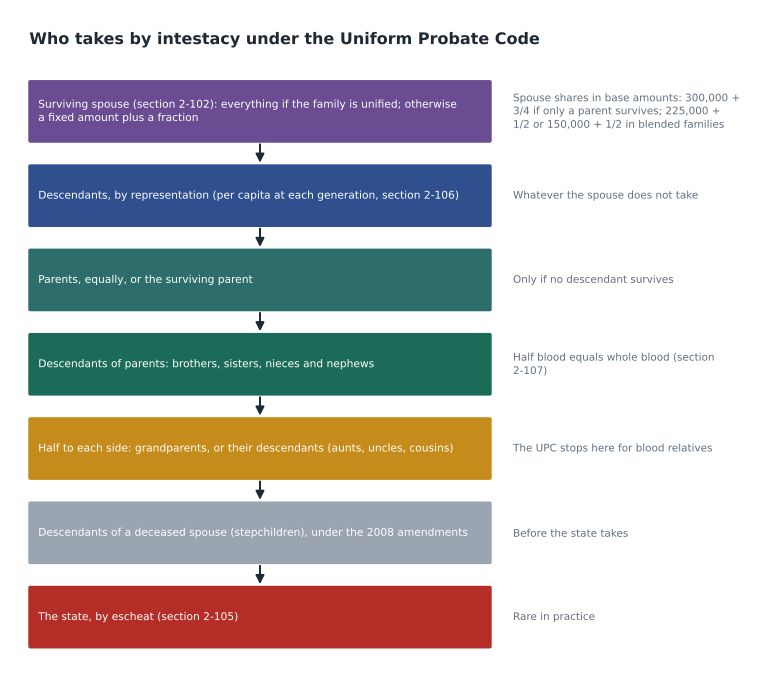
Under UPC section 2-102, the surviving spouse takes the entire intestate estate if no descendant or parent of the decedent survives, or if all of the decedent's surviving descendants are also descendants of the surviving spouse and the spouse has no other descendant. The idea is that the spouse will take care of the couple's children, who will eventually inherit from the spouse. When that assumption weakens, the spouse's share shrinks. If the decedent has no surviving descendant but a parent survives, the spouse takes the first 300,000 dollars plus three-fourths of the balance. If all of the decedent's descendants are also the spouse's, but the spouse has other descendants, the spouse takes the first 225,000 dollars plus one-half of the balance. If one or more of the decedent's descendants are not descendants of the spouse, as in a second marriage with children from the first, the spouse takes the first 150,000 dollars plus one-half of the balance.
The dollar figures are the Code's base amounts. UPC section 1-109 adjusts them for inflation, and states that adopt the Code may choose different numbers or freeze them. Stavely tells the class to use the base figures for Westmarch. Many states do not follow the UPC at all on this point. A common non-UPC pattern gives the spouse one-third or one-half of the estate when the decedent leaves descendants, with the rest divided among the descendants. In community property states, discussed in Lesson 6, the surviving spouse already owns half of the community property, and the intestacy rules govern the decedent's half and the decedent's separate property.
Who counts as a spouse is a question for family law. Divorce ends spousal status, and UPC section 2-802 also treats as no longer a spouse a person whose marriage was annulled, or who obtained an invalid divorce or then married someone else. A legal separation does not necessarily end inheritance rights. Unmarried partners, however long the relationship, generally take nothing by intestacy, although a few states give rights to registered domestic partners or reciprocal beneficiaries. Since Obergefell v. Hodges (2015), same-sex spouses have the same intestacy rights as any other spouse.
Descendants, ancestors and collaterals
Whatever the spouse does not take passes under UPC section 2-103 in a fixed order. First come the decedent's descendants, by representation. If there are none, the parents take equally, or the survivor of them takes all. If no parent survives, the descendants of the parents take: brothers and sisters, and the descendants of deceased brothers and sisters. If there are none, the estate is split in half between the paternal and maternal sides, and on each side passes to the grandparents or their descendants (aunts, uncles and cousins). The 2008 version of the Code adds a further step: if no one in those groups survives, the estate passes to the descendants of a deceased spouse, so that stepchildren take before the state. Only after that does the property escheat to the state under section 2-105.
States differ greatly on how far the line extends. Some follow a parentelic system, which looks to the nearest line of ancestors with surviving descendants; others use degrees of kinship, counting steps up to the common ancestor and down to the relative. The UPC deliberately stops with descendants of grandparents, on the theory that "laughing heirs", distant relatives who never knew the decedent, have no strong claim. Under UPC section 2-107, relatives of the half blood inherit the same share as relatives of the whole blood, so Arthur's half-siblings, if he had any, would share equally with full siblings.
Representation among descendants
When some children have died before the decedent leaving children of their own, the statute must decide how to divide the estate among the generations. Three systems exist, and they give different answers when family branches are uneven.
Under English per stirpes, sometimes called strict per stirpes, the estate is divided into equal shares at the children's generation, whether or not any child survives, and each deceased child's share passes down that child's line in the same way. Under modern per stirpes, also called per capita with representation, the first division is made at the nearest generation that has a living member, and the shares of deceased members of that generation pass down their lines. Under per capita at each generation, the system adopted by UPC section 2-106, the first division is also made at the nearest generation with a living member, but the shares of deceased members of that generation are pooled and divided equally among the members of the next generation. The UPC's justification is that people at the same generation, standing in the same relationship to the decedent, should be treated alike.
In many families the three systems give the same result. They diverge when the children's generation is entirely dead but the grandchildren are spread unevenly across lines, or when two or more children have died leaving different numbers of children. A will can choose any system, and drafters should choose expressly, because terms like "per stirpes" and "by representation" have been read differently from state to state.
Worked problem
Dividing the Wexley estate as if Arthur had died intestate
Stavely asks the class to pretend that Arthur left no will and no trust, and that his net probate estate, after debts, funeral and administration expenses, is 1,350,000 dollars. He is survived by Odette, by his children Philippa and Julian, and by Silas's children Maisie and Rhys. How is the estate divided under the UPC? Then she changes one fact: suppose Julian also died before Arthur, leaving one child.
Show solution
- The spouse's share: Arthur has descendants who are not Odette's descendants (all of them, in fact), so section 2-102(4) applies. Odette takes the first 150,000 dollars plus one-half of the remaining 1,200,000 dollars, a total of 750,000 dollars.
- The descendants' share: the remaining 600,000 dollars passes to Arthur's descendants by representation under section 2-106.
- The children's generation has living members (Philippa and Julian), so the first division is made there into three shares: one for each living child and one for Silas, who left descendants. Each share is 200,000 dollars.
- Philippa and Julian each take 200,000 dollars. Silas's 200,000 dollar share is divided between Maisie and Rhys, 100,000 dollars each. Here every system gives the same answer.
- The changed facts: if Julian also predeceased leaving one child, the first division is still at the children's generation, because Philippa survives. Philippa takes one-third, or 200,000 dollars.
- Under per capita at each generation, the shares of Julian and Silas (400,000 dollars together) are pooled and divided equally among the three grandchildren in those lines: 133,333.33 dollars each to Maisie, Rhys and Julian's child.
- Under per stirpes, Julian's child would take Julian's whole 200,000 dollar share, and Maisie and Rhys would split Silas's share, 100,000 dollars each.
Answer: On the actual facts Odette takes 750,000 dollars, Philippa and Julian 200,000 dollars each, and Maisie and Rhys 100,000 dollars each. If Julian had also died, the UPC would give each grandchild 133,333.33 dollars, while per stirpes would give Julian's only child 200,000 dollars and Silas's children 100,000 dollars each. Rhys is a minor, so his share would be paid to a conservator or under the Uniform Transfers to Minors Act, not to him directly.
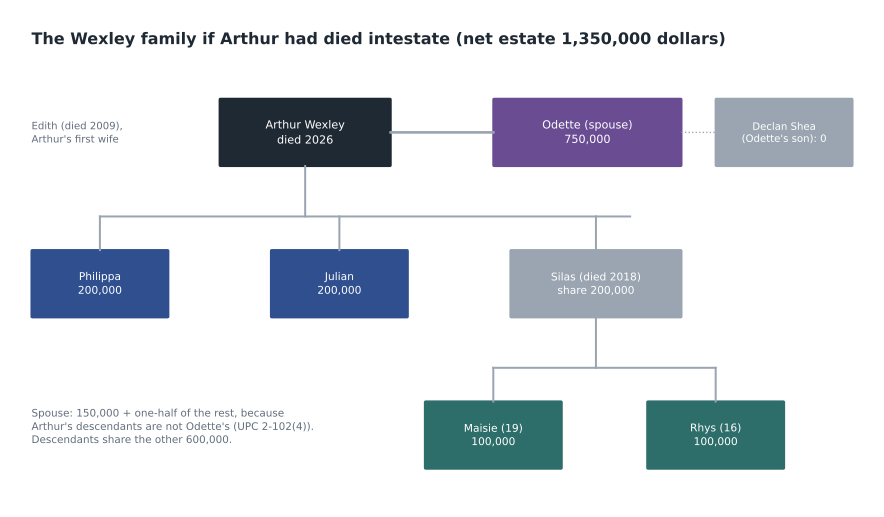
Hannah Lindqvist asks why Declan, Odette's son, gets nothing. Stavely answers that stepchildren are not heirs of a stepparent under the UPC unless the stepparent adopted them, or unless no closer relative survives. Declan's route to Arthur's property runs through his mother: whatever Odette inherits may eventually pass to him. That is exactly why the UPC reduces Odette's share when Arthur has children who are not hers, since her property will likely go to Declan rather than to Arthur's children.
Survival and simultaneous death
An heir must survive the decedent to inherit. At common law, surviving by an instant was enough, which made the order of deaths in a common accident decisive and invited grim litigation. The Uniform Simultaneous Death Act, in its original form, provided that when there was no sufficient evidence of the order of deaths, each person was treated as having survived the other for purposes of his or her own property. In Janus v. Tarasewicz (Ill. App. 1985), victims of the Chicago Tylenol poisonings, a husband and wife, were both taken to the hospital, and the court found sufficient evidence that the wife had survived her husband because she retained some signs of life longer, so his life insurance passed through her estate to her family rather than his.
The UPC and the revised Uniform Simultaneous Death Act now require survival by 120 hours. Under UPC section 2-104, an individual who fails to survive the decedent by 120 hours is treated as having predeceased, and survival must be established by clear and convincing evidence. The rule avoids double administration of property that would pass through one estate for a day and then into another, and it sends property to the decedent's own family. Wills commonly impose longer survival periods, such as thirty days, and the Code respects them.
Children: adoption, parentage and new families
Inheritance between parent and child depends on the legal parent-child relationship, which modern statutes define more broadly than biology. Under UPC sections 2-116 through 2-122, a child inherits from and through a parent who is the child's genetic parent, adoptive parent, or a parent by assisted reproduction or gestational agreement, and the parent inherits from the child, subject to bars discussed below. Children born to unmarried parents inherit from both parents once parentage is established; the Uniform Parentage Act supplies the methods, and the Supreme Court's equal protection decisions, beginning with Levy v. Louisiana (1968) and Trimble v. Gordon (1977), limit the state's power to burden nonmarital children.
Adoption generally severs the relationship between the child and the genetic parents and creates a full relationship with the adoptive parents. Under UPC section 2-119, an adopted child is the child of the adopting parents and not of the genetic parents, with an important exception for stepparent adoption: a child adopted by a stepparent still inherits from and through the genetic parent who is married to the stepparent, and from and through the other genetic parent's family. Adoption of adults is permitted in most states and occasionally has been used to make the adoptee an heir or a member of a class in someone else's trust, which courts sometimes refuse to recognize when the adoption looks like a device to defeat a class gift.
Posthumously conceived children present a newer problem. In Woodward v. Commissioner of Social Security (Mass. 2002), the Massachusetts court held that children conceived after a father's death by in vitro fertilization could inherit if the mother showed a genetic relationship, that the father consented to posthumous conception and to support the resulting child, and that notice was given to interested parties. In Astrue v. Capato (2012), the Supreme Court held that eligibility for Social Security survivors' benefits for such children depends on whether they could inherit under the state's intestacy law. UPC section 2-120(k) treats a posthumously conceived child as in gestation at the parent's death if the child is in utero within 36 months, or born within 45 months, after the death, provided the parent consented.
Advancements, disclaimers and bars to inheritance
At common law, a lifetime gift by a parent to a child was presumed to be an advancement, an early payment of the child's inheritance, and was charged against the child's intestate share. The doctrine invited disputes over every birthday check. UPC section 2-109 reverses the presumption: a lifetime gift counts against an heir's share only if the decedent declared in a contemporaneous writing, or the heir acknowledged in writing, that it is to be treated as an advancement or taken into account. When an advancement counts, it is added to the estate on paper (hotchpot) and then subtracted from the recipient's share.
An heir or devisee may disclaim, or refuse, an inheritance. Under the Uniform Disclaimer of Property Interests Act, incorporated in the UPC, a disclaimed interest passes as if the disclaimant had died immediately before the decedent. Disclaimers are often used for tax planning: a disclaimer that meets section 2518 of the Internal Revenue Code, generally made in writing within nine months, is not a taxable gift by the disclaimant. Most states hold that a disclaimer defeats the claims of the disclaimant's creditors, although Drye v. United States (1999) held that a disclaimer does not defeat a federal tax lien, and a disclaimer may be ineffective against Medicaid eligibility rules.
Some heirs are barred. Under the slayer rule, codified in UPC section 2-803, a person who feloniously and intentionally kills the decedent forfeits all benefits from the decedent's estate, including intestate shares, gifts by will and nonprobate benefits, and is treated as having disclaimed them. The rule traces to Riggs v. Palmer (N.Y. 1889), in which a grandson who poisoned his grandfather could not take under the grandfather's will, and it applies by civil standard of proof even without a criminal conviction. UPC section 2-114 bars a parent from inheriting from a child if the parent's rights were terminated, or if the parent could have had them terminated for abandonment, neglect or nonsupport. Many states have also enacted statutes barring people who abused or financially exploited an elderly or vulnerable decedent.
Why intestacy still matters
Despite decades of encouragement, a large share of American adults, by most surveys around half or more, have no will, and many who do still own property that falls into intestacy. Intestacy also matters for constitutional reasons. In Hodel v. Irving (1987), the Supreme Court held that a federal statute abolishing both descent and devise of small fractional interests in allotted Indian lands, without compensation, was a taking. The right to pass property at death is not absolute, but a total abolition went too far. The case is often cited for the proposition that the power to transmit property at death is a stick in the bundle of property rights.
Stavely ends with a practical point. When an estate is small, the UPC and most states let successors collect personal property by affidavit, without any probate at all, and many families never see a court. But when a family has a blended structure like the Wexleys', intestacy can produce results no one wanted: a spouse who has to share the family home with stepchildren, a minor who receives money at 18, distant relatives with claims to a business. "A will," she says, "is a request to depart from the state's plan. Most of the rest of this course is about how to make that request, how to read it and when the law refuses it."
Summary and key terms
- Make two lists: what the decedent owned and how each asset was held. Only probate property passes by will or intestacy.
- Under UPC section 2-102 the spouse takes everything when the family is unified, and a fixed amount plus a fraction (300,000, 225,000 or 150,000 dollars in base amounts) when it is not.
- The rest passes to descendants, then parents, then descendants of parents, then grandparents' lines, then stepchildren, then the state.
- Representation systems differ when branches are uneven; the UPC uses per capita at each generation.
- Heirs must survive by 120 hours; adopted, nonmarital and some posthumously conceived children inherit; advancements require a writing; slayers and abandoning parents are barred.
Practice problems
Work each problem on paper first, then reveal the answer to check.
Arthur's net probate estate is 900,000 dollars. He is survived only by Odette and by Philippa. What does Odette take under the UPC?
Show answer
Philippa is not Odette's descendant, so section 2-102(4) applies: 150,000 dollars plus half of the remaining 750,000 dollars, a total of 525,000 dollars. Philippa takes 375,000 dollars.
Why does the UPC give a surviving spouse less when the spouse has children from another relationship?
Show answer
The spouse's own estate will likely pass to the spouse's children, not the decedent's, so the Code gives part of the estate directly to the decedent's descendants.
A testator's only son and the son's daughter die in a car crash; the son dies at the scene and the daughter two days later. Does the daughter's estate share in her father's property?
Show answer
Under the 120-hour rule, the daughter is treated as having predeceased her father, so his property passes as if she had died first and does not pass through her estate.
Arthur gave Julian 40,000 dollars in 2023 to keep the restaurant open. Is it an advancement if Arthur dies intestate?
Show answer
Under UPC section 2-109, only if Arthur declared in a contemporaneous writing, or Julian acknowledged in writing, that it was an advancement. Otherwise Julian's share is not reduced.
Lesson quiz · 5 questions
Score 60% or more to complete this lesson.
Create a free account to save your progress, take quizzes and earn a certificate.