
LAWU-213 · Lesson 8 of 12 · 22 min
Trusts
▶ Video coming soon A video version of this lesson is on the way.
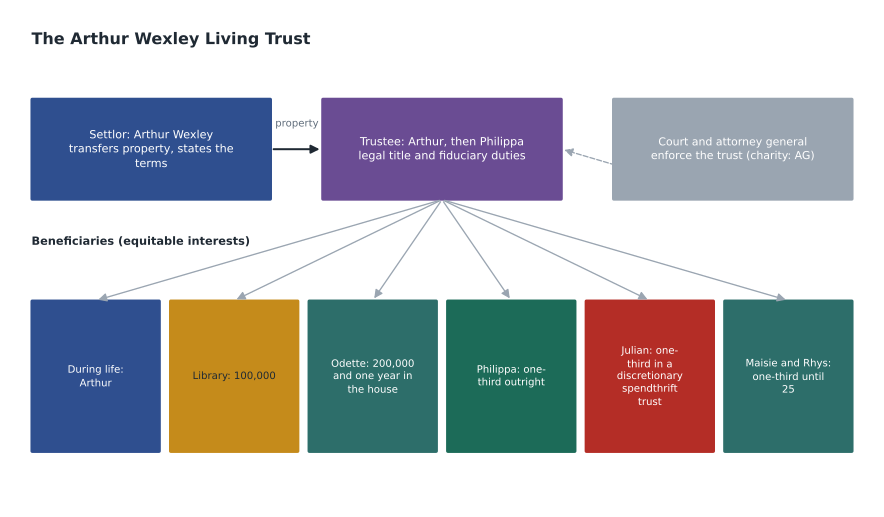
A trust is a fiduciary relationship in which one person, the trustee, holds legal title to property for the benefit of others, the beneficiaries. The person who creates it is the settlor, also called the grantor or trustor. The trust splits ownership in a way the common law of property could not: the trustee has the power to manage and dispose of the property, and the beneficiaries have the right to its benefits, protected by the trustee's duties and enforceable in court. "The trust is the most flexible tool in the lawyer's kit," Stavely tells Section B. "It lets a client say not only who gets the property but when, how and on what conditions, and it lets someone else make the decisions the client cannot make from the grave."
The Arthur Wexley Living Trust, signed in 2021, is typical of a modern revocable trust. Arthur is the settlor and initial trustee, and Philippa is the successor trustee. During his life Arthur may revoke or amend the trust and receives all the income and as much principal as he wants. At his death the trustee must pay 100,000 dollars to the Brennan Falls Public Library for a reading room named for Edith, pay 200,000 dollars to Odette and let her live in the Linden Avenue house for one year, and then divide what remains into three equal shares: one for Philippa outright; one held in a discretionary trust for Julian for life, with the remainder to his descendants; and one held for Silas's children until each reaches 25. A spendthrift clause applies to every share.
The elements of a trust
Trust law in most states is now codified in the Uniform Trust Code, adopted in about three dozen states and the District of Columbia, and restated in the Restatement (Third) of Trusts. Under UTC section 402, a trust is created only if the settlor has capacity; the settlor indicates an intention to create the trust; the trust has a definite beneficiary, or is a charitable trust or a valid trust for a noncharitable purpose or for the care of an animal; the trustee has duties to perform; and the same person is not the sole trustee and sole beneficiary. In addition, the trust must have property, often called the res or corpus. A trust may be created by a transfer of property to a trustee during life, by will, or by a declaration by the owner that he or she holds property as trustee, and, under UTC section 401, by the exercise of a power of appointment.
No particular words are needed, and the word trust is neither necessary nor conclusive. A trust may be oral, except that the statute of frauds generally requires a writing for a trust of land, and UTC section 407 permits oral trusts of other property to be proved by clear and convincing evidence. A trust need not be supported by consideration. A trust does not fail for want of a trustee: if the named trustee dies, declines or cannot serve, the court will appoint one, unless the settlor made the identity of the trustee essential.
Intent to create a trust
The settlor must manifest an intention to create a trust, meaning an intention to impose enforceable duties on someone to hold property for another. The question often arises when a transfer is accompanied by words of hope or wish. A will that leaves property "to my wife, in the hope that she will provide for our children" uses precatory words, which traditionally create no trust; the wife takes outright, and the hope is a moral obligation only. Courts read precatory language in context and will find a trust if the instrument as a whole shows that the transferor meant to impose a duty, but the modern presumption is that precatory words do not create a trust.
Intent can also be found where the parties did not use the word trust at all. In Jimenez v. Lee (Or. 1976), a father received a 1,000 dollar savings bond and a cash gift for his infant daughter's education, from her godmother and others, and later used the money for himself. The Oregon Supreme Court held that he received the gifts as trustee, because the donors' intent that the property be used for the child's education imposed a fiduciary duty, and he had to account for the money. Conversely, a promise to make a gift in the future creates no trust. In Unthank v. Rippstein (Tex. 1964), a man wrote to a woman, three days before his death, that he would pay her 200 dollars a month for five years, and that his estate would be bound for it; the court held that the letter was an unenforceable gratuitous promise, not a declaration of trust, because he had not set apart any property to hold for her.
Courts must also distinguish a trust from other relationships. A debt is not a trust: a bank that takes a deposit owes money, but does not hold specific property for the depositor. An agency is not a trust, because an agent acts under the principal's control. And a gift is not a trust, though a failed gift raises a recurring problem. If an owner intends an outright gift but fails to deliver the property, equity will not rescue the gift by calling it a trust; the owner intended to give the property away, not to hold it as trustee. A declaration of trust requires no delivery, but it requires intent to hold the property for another.
Trust property
A trust must have property, but almost any property interest will do: land, cash, securities, a contract right, an interest in another trust, a copyright, even a remainder. What will not do is an expectancy or a mere hope of future property. In Brainard v. Commissioner (7th Cir. 1937), a stock trader declared in 1927 that he held his stock trading profits for the coming year in trust for his family. The court held, for federal income tax purposes, that no trust could exist until profits existed, because future profits were not property; when profits arose, the trader was treated as having received them and then transferred them to the trust, so they were taxable to him. In Speelman v. Pascal (N.Y. 1961), by contrast, the holder of rights to produce a musical based on Shaw's Pygmalion assigned to his secretary a percentage of his future profits from the show, and the court upheld the gift, because the rights already existed as property even though the profits did not.
The settlor must also identify the property. A declaration that "I hold 50,000 dollars of my savings in trust for my niece" may fail if the settlor has several accounts and never sets apart any particular funds, though courts are generous where the amount and source are clear.
Ascertainable beneficiaries
A private trust must have one or more beneficiaries who are definite or definitely ascertainable, now or within the period of the rule against perpetuities, so that someone can enforce the trustee's duties. In Clark v. Campbell (N.H. 1926), a will left the testator's personal belongings to trustees to distribute "to such of my friends as they shall select." The court held that the trust failed, because "friends" has no fixed meaning that would allow a court to identify the beneficiaries and enforce the trust, and the property passed as part of the residue. A gift to "my relatives," by contrast, can be enforced by reading relatives to mean heirs. Today, Clark v. Campbell would probably come out differently: Restatement (Third) of Trusts section 46 and UTC section 402(c) treat a power to select among an indefinite class as a valid power of appointment, so the trustees may choose, and only if they fail to do so does the property pass as if the power had not been given.
Some purposes have no human beneficiary at all. At common law, a trust for a noncharitable purpose, such as maintaining a grave or caring for a pet, was not enforceable, though courts sometimes allowed it as an honorary trust that the trustee could carry out if willing. In In re Searight's Estate (Ohio Ct. App. 1950), a gift of 1,000 dollars for the care of the testator's dog, at 75 cents a day, was upheld as an honorary trust. UTC section 408 now authorizes trusts for the care of an animal alive during the settlor's life, which end at the animal's death, and section 409 authorizes trusts for other noncharitable purposes for up to 21 years. In both cases a person named in the trust or appointed by the court may enforce it, and a court may reduce the property if it exceeds what the purpose requires.
The trustee and the merger rule
The trustee holds legal title and must have duties, which distinguishes an active trust from a passive one. If the trustee has no duties at all, a passive trust, the Statute of Uses traditionally executed the trust and gave the beneficiaries legal title. Arthur, like most settlors of revocable trusts, named himself trustee and sole lifetime beneficiary. That might seem to violate the merger rule, under which a trust fails when the same person is sole trustee and sole beneficiary, because no one can owe a duty to himself. But Arthur was not the sole beneficiary: the trust named remainder beneficiaries who took at his death, and their interests, though revocable, kept the trust alive. UTC section 402(a)(5) codifies the rule while treating such trusts as valid.
Revocation and amendment
At common law, a trust was irrevocable unless the settlor reserved a power to revoke. Most American states, and UTC section 602(a), now reverse that presumption for trusts created after the Code's effective date: a trust is revocable unless its terms expressly provide that it is irrevocable. Under section 602(c), the settlor may revoke or amend by complying with a method stated in the trust; if the terms do not make that method exclusive, the settlor may also revoke or amend by a later will or codicil that expressly refers to the trust or specifically devises property that would otherwise have passed under it, or by any other method manifesting clear and convincing evidence of the settlor's intent. Under section 604, a person may contest the validity of a revocable trust within three years after the settlor's death, or within 120 days after the trustee sends notice of the trust's existence, whichever is earlier.
Capacity to create, amend or revoke a revocable trust is the same as capacity to make a will, under UTC section 601. Capacity for an irrevocable lifetime trust is generally the capacity to make a lifetime gift, a somewhat higher standard.
Worked problem
Arthur's 2019 letter to Maisie
In 2019, when Maisie was twelve, Arthur wrote her a birthday letter: "The 400 shares of Merrin Valley Bancorp in my account at Callowhill Securities are yours for college. I'm keeping them for you until you start." He signed it "Grandpa." The shares stayed in his individual brokerage account, the one that never went into the trust, and he kept the dividends. In August 2026 they are worth 24,000 dollars. Maisie started college in 2025, and the shares were never transferred. Do the shares belong to Arthur's probate estate or to Maisie?
Show solution
- Outright gift: a gift of shares requires delivery, by transfer of the shares or a written assignment. Arthur's letter describes the shares as hers but he never transferred them; as an outright gift, it fails for lack of delivery.
- Declaration of trust: no delivery is needed if Arthur declared himself trustee. The words "I'm keeping them for you until you start" suggest he meant to hold specific, identified property for her benefit, like the father in Jimenez v. Lee.
- Property: the shares are identified by number, company and account, so the trust property is definite, unlike the general promise in Unthank v. Rippstein.
- Against a trust: Arthur kept the dividends and never told the broker. Equity does not convert a failed gift into a trust, and the letter's language ("are yours") reads like a gift.
- Formalities: a trust of personal property need not be in writing, but the letter supplies writing anyway, and a declaration of trust is a lifetime transfer, not a will, so it need not be witnessed.
Answer: The question is close, but the best reading is that Arthur declared a trust of the specific shares for Maisie's education and that he, and now his personal representative, holds them for her. Philippa, as executor, should treat the shares as Maisie's, with the dividends Arthur kept possibly charged against them as a breach or forgiven as consistent with his intent, rather than include them in the probate estate, which would then be 24,000 dollars smaller than the table in Lesson 7 shows. Julian could argue the contrary, which shows why Stavely calls handwritten family gifts "lawsuits waiting for a funeral."
Secret and semi-secret trusts
When a will gives property to someone who orally agreed to hold it for another, the arrangement is a secret trust if the will makes an absolute gift and a semi-secret trust if the will states that the property is held in trust but does not name the beneficiary. Courts impose a constructive trust in favor of the intended beneficiary in the secret trust case, to prevent unjust enrichment, if the promise can be proved. In the semi-secret case, the traditional American rule, from Olliffe v. Wells (Mass. 1881), was that the trust failed and the property returned to the testator's estate, because the beneficiary was not identified in the will and the will showed the legatee was not meant to keep it. The Restatement (Third) of Trusts rejects that distinction and treats both alike, enforcing the promise. Oral promises to convey land, similarly, may be enforced by constructive trust when the transferee obtained the land by fraud or in a confidential relationship.
Resulting and constructive trusts
Two kinds of trusts arise by operation of law. A resulting trust arises when an express trust fails or does not dispose of all the property, so the trustee holds the remaining interest for the settlor or the settlor's estate, and in the older purchase money situation, where one person pays for property titled in another's name. A constructive trust is not really a trust at all but an equitable remedy imposed to prevent unjust enrichment, used for property obtained by fraud, undue influence, breach of fiduciary duty or homicide. Stavely tells the class to treat both as remedies to remember whenever an express trust fails.
Summary and key terms
- A trust requires capacity, intent, property, a definite beneficiary or valid purpose, and a trustee with duties; no special words or consideration are needed.
- Precatory words usually create no trust, but intent can be found without the word trust (Jimenez v. Lee); a promise to give in the future is not a trust (Unthank).
- Trust property must exist; future profits are not property (Brainard), but existing rights to future income are (Speelman).
- Private trusts need ascertainable beneficiaries (Clark v. Campbell), though modern law treats a power to select among friends as valid; pet and purpose trusts are authorized by statute.
- Under UTC section 602 trusts are revocable unless they say otherwise, and revocation may be by any method showing clear and convincing intent unless the trust's method is exclusive.
Practice problems
Work each problem on paper first, then reveal the answer to check.
A will leaves 100,000 dollars "to my brother, trusting that he will use it to help my grandchildren with their schooling." Is there a trust?
Show answer
Probably not. "Trusting that" is precatory language, and the modern presumption is that the brother takes outright with a moral obligation only, unless the will as a whole shows an intent to impose a duty.
Why did the trust in Brainard v. Commissioner not exist when declared?
Show answer
Because its only property was future trading profits, which were an expectancy and not existing property.
A settlor's trust allows revocation "by a writing delivered to the trustee." She later leaves a will stating that the trust is revoked. Is it revoked under the UTC?
Show answer
Only if the trust's method was not exclusive; then a later will expressly referring to the trust can revoke it under section 602(c). If the trust said the method was exclusive, the will is ineffective.
What happens to Philippa's role if she declines to serve as successor trustee?
Show answer
The trust does not fail. The trust's terms or the court will supply a successor, and under UTC section 704 the qualified beneficiaries may in some cases agree on a successor.
Lesson quiz · 5 questions
Score 60% or more to complete this lesson.
Create a free account to save your progress, take quizzes and earn a certificate.