
LAWU-213 · Lesson 6 of 12 · 22 min
Protecting the family: spouses and children
▶ Video coming soon A video version of this lesson is on the way.
American law gives testators wide freedom to disinherit. A parent may leave nothing to an adult child, for good reasons, bad reasons or no reason, and the child has no claim unless the will is invalid. The surviving spouse is different. Every state except Georgia gives a surviving spouse some protection against disinheritance, either through community property or through an elective share, and most states add small allowances for the family's immediate needs. The law also protects spouses and children who were left out by accident, because the will was written before the marriage or the birth. "The question in this lesson," Stavely says, "is not what Arthur wanted. It is what Arthur owed."
The Wexley file now includes a letter. Odette Wexley's lawyer writes that Odette will claim her elective share. Under the 2021 will and trust, Odette receives the household goods not on Arthur's list, the IRA of which she is the named beneficiary, 200,000 dollars from the trust and the right to live in the trust's house for one year. Everything else goes to Arthur's descendants. Odette, who is 70, has her own savings and a small pension worth about 640,000 dollars together. "Nine years of marriage," her lawyer writes, "and she is being asked to move out of her home."
Two systems of marital property
Nine states are community property states: Arizona, California, Idaho, Louisiana, Nevada, New Mexico, Texas, Washington and Wisconsin. In those states, earnings of either spouse during the marriage and property acquired with those earnings are community property, owned one-half by each spouse from the moment of acquisition. Property owned before marriage or received by gift or inheritance is separate property. At death, the decedent may dispose of his or her half of the community and all separate property; the survivor already owns the other half of the community. Because the survivor's half is protected from the start, community property states generally have no elective share. Alaska, Kentucky, Tennessee, Florida and South Dakota allow couples to opt into community property by agreement or trust.
The other states follow the common law system of separate property, in which each spouse owns what he or she earns or acquires in his or her own name. A spouse who stayed home or earned less could be left with nothing if the other spouse's will gave it all away. The elective share answers that risk. Moving between systems creates problems: a couple who move from California to Westmarch bring community property with them, and the Uniform Disposition of Community Property Rights at Death Act, adopted in about sixteen states, preserves its character at death.
The traditional elective share
The traditional elective share, still used in some separate property states, gives the surviving spouse the right to take a fraction of the decedent's probate estate, usually one-third, in place of what the will provides. The spouse must elect within a short period after death. The obvious weakness is that the share applies only to the probate estate. A spouse could be disinherited through nonprobate transfers: a revocable trust, joint accounts, life insurance or pay-on-death accounts.
Courts responded with doctrines that brought some nonprobate transfers back into the computation. Some asked whether the transfer was illusory, meaning that the decedent kept so much control that nothing really passed during life. Others asked about the decedent's intent to defraud the spouse, or whether the transfer was real. In Sullivan v. Burkin (Mass. 1984), a husband had put his house into a revocable trust for himself and then his friends; his widow claimed the house should count toward her statutory share. The Supreme Judicial Court held, prospectively, that for trusts created or amended after the decision, the assets of a revocable trust created by the decedent during the marriage would be treated as part of the estate for purposes of the spouse's share. Statutes in New York and elsewhere took the same idea further by listing nonprobate transfers that count.
The UPC augmented estate
The UPC adopted a comprehensive solution in 1990 and refined it in 2008. Its premise is the partnership theory of marriage: spouses contribute to each other's wealth during the marriage, and the longer the marriage, the more of each spouse's property is properly treated as joint. The elective share is calculated not on the probate estate but on the augmented estate, which, under UPC sections 2-203 through 2-208, includes four components: the decedent's net probate estate (after funeral and administration expenses, statutory allowances and claims); the decedent's nonprobate transfers to others, including revocable trusts, joint accounts, pay-on-death accounts, life insurance the decedent owned, and property transferred within two years of death beyond the gift tax annual exclusion; the decedent's nonprobate transfers to the surviving spouse; and the surviving spouse's own property and nonprobate transfers to others. Including the survivor's own property keeps a wealthy survivor from claiming a share of a less wealthy decedent's estate.
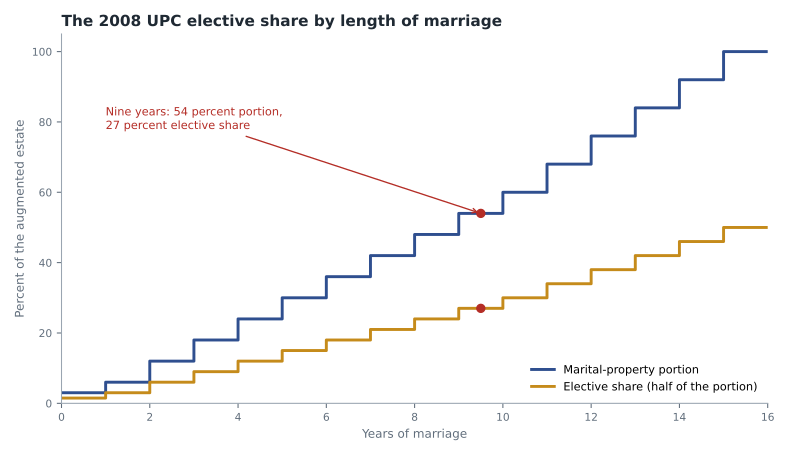
Under the 2008 version, the elective-share amount is 50 percent of the marital-property portion of the augmented estate. The marital-property portion is a percentage of the augmented estate that rises with the length of the marriage, from 3 percent for a marriage of less than one year to 6 percent per year through ten years (60 percent), then by 8 percent per year until it reaches 100 percent at fifteen years. A spouse married for fifteen years or more is entitled, in effect, to half of the couple's combined wealth. The 1990 version reached similar results through a sliding percentage applied directly to the augmented estate, rising to 50 percent after fifteen years. If the survivor's own assets and the elective share together fall below 75,000 dollars, the survivor may claim a supplemental elective-share amount to bring the total to that figure.
Once the elective-share amount is known, UPC section 2-209 determines who pays for it. The amount is first satisfied from property that already passes to the spouse, by will, intestacy or nonprobate transfer, and from the marital-property portion of the spouse's own property. Only the unsatisfied balance comes from others, and then pro rata from the recipients of the decedent's probate estate and nonprobate transfers. The spouse must elect within nine months after the decedent's death or six months after probate of the will, whichever is later, under section 2-211. The right is personal to the spouse: if the spouse dies before electing, it ends, and a conservator or agent may elect only with court approval in some states.
Worked problem
Odette's elective share
Arthur and Odette married in June 2017; he died in August 2026, after nine years and about two months of marriage. Using the file's figures, compute Odette's elective share under the 2008 UPC. Arthur's net probate estate is 900,000 dollars. His nonprobate transfers to others are the trust assets passing to others (2,200,000 dollars), a life insurance policy he owned payable to his children (300,000 dollars) and a joint account with Philippa that he funded (60,000 dollars). His nonprobate transfers to Odette are the IRA (500,000 dollars) and the trust's 200,000 dollar gift. Odette's own property is worth 640,000 dollars. The household goods she receives are claimed as exempt property and left out of the computation.
Show solution
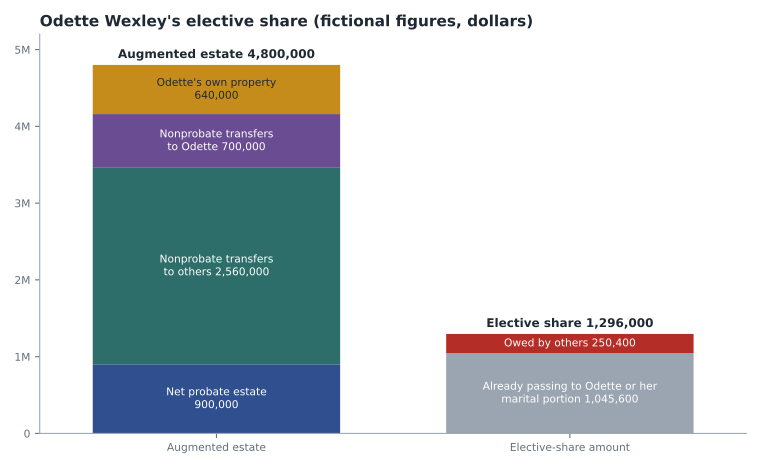
- Augmented estate: 900,000 plus 2,200,000 plus 300,000 plus 60,000 plus 500,000 plus 200,000 plus 640,000 dollars equals 4,800,000 dollars.
- Marital-property portion: for nine years but less than ten, 54 percent of 4,800,000 dollars, which is 2,592,000 dollars.
- Elective-share amount: 50 percent of the marital-property portion, which is 1,296,000 dollars.
- Credits under section 2-209: the IRA (500,000 dollars), the trust gift (200,000 dollars) and 54 percent of Odette's own property (345,600 dollars), a total of 1,045,600 dollars.
- Unsatisfied balance: 1,296,000 minus 1,045,600 dollars equals 250,400 dollars, payable by the recipients of the probate estate and of nonprobate transfers to others, in proportion to the value of what they receive (3,460,000 dollars in total, so about 7.24 percent of each gift).
- Allocation: about 159,214 dollars from the trust gifts to others, 65,133 dollars from the probate estate, 21,711 dollars from the life insurance beneficiaries and 4,342 dollars from Philippa's share of the joint account.
Answer: Odette is entitled to 250,400 dollars more than she receives under Arthur's plan, together with the statutory allowances. Her lawyer must file the election by the later of nine months after August 2026 or six months after the will is probated. Stavely notes that the right to occupy the house for one year is hard to value, and that the parties may well negotiate a settlement letting Odette stay longer instead of taking cash.
Statutory allowances
Apart from the elective share, a surviving spouse, and in some cases minor or dependent children, may claim allowances that protect the family in the months after death. Under the UPC, the spouse receives a homestead allowance of 22,500 dollars (section 2-402), exempt property up to 15,000 dollars in household furniture, cars, appliances and personal effects (section 2-403), and a reasonable family allowance for maintenance during administration, which may not continue more than one year if the estate is insufficient to pay claims (section 2-404). The homestead allowance and exempt property have priority over most creditors, and all three are in addition to whatever passes to the spouse by will, intestacy or elective share. Many non-UPC states protect a homestead itself, as Florida does with its constitutional homestead protections that restrict a married owner's power to devise the residence.
Waiver by agreement
Spouses may waive their rights to an elective share, homestead, exempt property and family allowance by a written agreement before or during marriage. Under UPC section 2-213, a waiver is unenforceable if the surviving spouse proves that it was not executed voluntarily, or that it was unconscionable when executed and, before execution, the spouse was not given fair and reasonable disclosure of the decedent's property and obligations, did not waive disclosure in writing and did not have adequate knowledge of the property. The Uniform Premarital and Marital Agreements Act (2012) adds a requirement of access to independent counsel. Premarital agreements are standard in second marriages, where both spouses often want their property to go to their own children. Arthur and Odette did not sign one. Stavely says that if Arthur's lawyer had advised him properly in 2017, they would have.
Omitted spouses
A spouse who marries a testator after the will was executed may be omitted not by choice but by inattention. UPC section 2-301 protects such a spouse. If a testator's surviving spouse married the testator after the testator executed the will, the spouse receives at least the share he or she would have taken by intestacy, but only out of that part of the estate that is not devised to the testator's children born before the marriage who are not the spouse's children, or to their descendants. The omitted-spouse share does not apply if the will was made in contemplation of the marriage, if it expresses an intent to be effective notwithstanding a later marriage, or if the testator provided for the spouse outside the will intending it to be in lieu of a testamentary provision.
The provision's carve-out matters. Suppose Arthur had never made the 2021 will, so that his 2012 will, which left everything to his children, governed at his death. Odette would be an omitted spouse, but her share would come only from property not devised to Arthur's children from his first marriage, which is none of it. She would take nothing under section 2-301 and would have to rely on the elective share. The UPC drafters chose that result because the elective share already protects spouses, and the omitted-spouse rule is aimed at the testator who simply forgot to update a will that left property to someone other than his children.
Omitted children
Children born or adopted after a will is executed may also be omitted by accident. Pretermitted child statutes vary widely. Under UPC section 2-302, if the testator had no child living when the will was executed, an omitted after-born or after-adopted child receives an intestate share, unless the will devised all or substantially all of the estate to the other parent of the child and that parent survives. If the testator had one or more children living when the will was executed and the will gave them something, the after-born child shares in the gifts to the other children, as if the child had been named. The statute does not apply if the omission appears intentional from the will, or if the testator provided for the child outside the will intending that to be in lieu of a testamentary gift, as with a life insurance policy.
Courts have struggled with republication. In Azcunce v. Estate of Azcunce (Fla. Dist. Ct. App. 1991), a father executed a will and then, after his daughter's birth, a codicil that did not mention her; because the codicil republished the will after her birth, she was not a pretermitted child and took nothing. Her malpractice claim against the lawyer failed for lack of privity under Florida law. Most states also protect children whom the testator omitted because the testator mistakenly believed they were dead. Apart from these statutes, children have no right to inherit anything from a parent who dies with a will. Louisiana is the exception: its forced heirship rules reserve a share for children under 24 or permanently incapable of caring for themselves.
Policy debates
The elective share raises hard questions. Should a spouse of six months take anything from a long-widowed decedent's estate? The UPC's schedule says only a little. Should the share be tied to need, as in England, where courts may award family provision based on the survivor's circumstances, rather than to a fixed fraction? American law has mostly preferred fixed rules to judicial discretion. And should unmarried partners have any rights? No American state gives them an elective share, though some states extend rights to registered domestic partners. Stavely ends by asking the class whether Odette's claim seems fair. Marcus Webb says it does: she gave up her own home to move into Arthur's, and the partnership theory fits. Priya Natarajan disagrees: most of the wealth came from Arthur's forty years in the store with Edith, long before Odette arrived. "Both of you have just described the 2008 amendments," Stavely says. "The marital-property portion is the Code's way of splitting that difference."
Summary and key terms
- Community property states protect spouses by giving each half of marital earnings; separate property states use an elective share.
- The traditional share is a fraction of the probate estate and can be evaded with nonprobate transfers; Sullivan v. Burkin brought revocable trusts back in.
- The UPC elective share is 50 percent of the marital-property portion of the augmented estate, which includes nonprobate transfers and the spouse's own property and grows with the marriage's length.
- The spouse also takes homestead, exempt property and family allowances; rights can be waived by a fair agreement.
- Omitted spouses and children receive protection against accidental disinheritance, but children may otherwise be disinherited everywhere except Louisiana.
Practice problems
Work each problem on paper first, then reveal the answer to check.
A decedent married for twenty years has an augmented estate of 2,000,000 dollars. The surviving spouse's own property is 400,000 dollars and she receives nothing else. What is her elective-share amount under the 2008 UPC, and how much is still owed after the credit for her own property?
Show answer
The marital-property portion is 100 percent, so the elective-share amount is 1,000,000 dollars. Her own property counts in full (100 percent of 400,000 dollars), leaving 600,000 dollars to be paid by the recipients of the decedent's property.
Why does the UPC include the surviving spouse's own property in the augmented estate?
Show answer
So that the share reflects the couple's combined wealth; a wealthy survivor should not claim half of a less wealthy decedent's property.
A testator with two children executes a will leaving 50,000 dollars to each of them, and later adopts a third child without changing the will. What does the third child take under UPC section 2-302?
Show answer
An equal share of the gifts to the other children, so the 100,000 dollars is divided three ways, about 33,333 dollars each, unless the omission was intentional or the testator provided for the child outside the will.
When must Odette file her election?
Show answer
Within nine months after Arthur's death or six months after the probate of his will, whichever is later (UPC section 2-211).
Lesson quiz · 5 questions
Score 60% or more to complete this lesson.
Create a free account to save your progress, take quizzes and earn a certificate.