
LAWU-213 · Lesson 2 of 12 · 23 min
Executing wills
▶ Video coming soon A video version of this lesson is on the way.
Stavely opens the second session by holding up two documents from the Wexley file. The first is Arthur's 2021 will: eleven typed pages, signed at the end in blue ink, with the signatures of two witnesses from his lawyer's office and a notarized affidavit stapled behind them. The second is a single sheet from January 2026, typed on Arthur's laptop and headed "Changes to my will." It leaves 40,000 dollars to Bettina Kroll, his caregiver, "for everything she has done for me," and it is signed "Arthur Wexley" in a shaky hand. One other signature appears below his: that of Bettina's friend, who drove her to work that morning.
"Under the law of 1950," Stavely says, "the second document is not a will, and that is the end of the matter. Under the law of Westmarch today, it might be. This lesson is about why the formalities exist, what they are, and how far modern law will go to save a document that does not meet them."
Why wills require formalities
A will is unlike most legal documents in one respect: it takes effect when its author is dead and cannot explain it. A court must decide whether the document is genuine, whether the decedent meant it to be a will rather than a draft or a letter, and whether the decedent made it freely. Formalities supply the evidence. In a famous 1941 article, Ashbel Gulliver and Catherine Tilson identified their functions: a ritual function, which impresses the testator with the seriousness of the act and separates final intentions from casual talk; an evidentiary function, which provides reliable proof of what the testator wanted; and a protective function, which guards against fraud, forgery and undue influence. Later scholars added a channeling function: standard forms make wills easy to recognize and to administer, much as a standard check form simplifies banking.
The traditional American approach demanded strict compliance. If a statutory requirement was missed, the will failed, even when no one doubted that it expressed the testator's wishes. The approach has the virtue of predictability and the vice of defeating intent over trivial lapses, and much of the modern law is an effort to recover intent without abandoning the functions the formalities serve.
The attested will
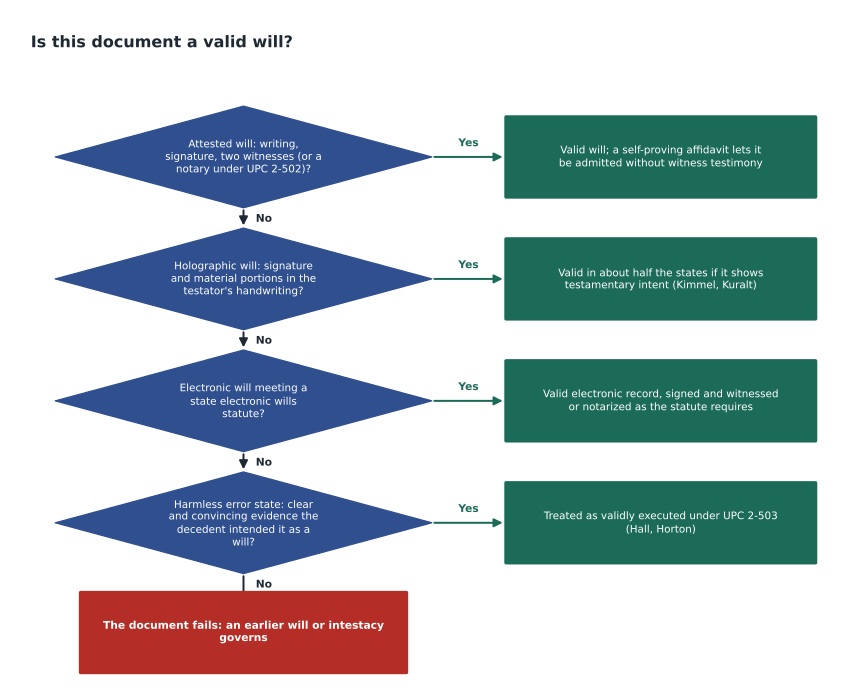
Every state recognizes a will that is in writing, signed by the testator and attested by witnesses. The details vary. Under UPC section 2-502(a), a will must be in writing; signed by the testator, or in the testator's name by another person in the testator's conscious presence and by the testator's direction; and either signed by at least two individuals, each of whom signed within a reasonable time after witnessing the testator's signing or the testator's acknowledgment of the signature or of the will, or acknowledged by the testator before a notary public or other authorized official. The notarization alternative, added in 2008, has been adopted by only some UPC states.
Many non-UPC states impose further requirements. Some require that the testator sign at the end of the will, so that anything below the signature is disregarded or, in a few states, invalidates the will. Some require publication, a declaration to the witnesses that the document is the testator's will; New York is the familiar example. Most require that the witnesses sign in the testator's presence, and some that they sign in each other's presence. Courts read presence in two ways. The line-of-sight test asks whether the testator could have seen the witnesses sign had the testator looked. The conscious-presence test, used by the UPC, asks whether the testator, through any of the senses, was aware that the witnesses were signing. A witness who signs in the next room while the testator listens through an open door satisfies the second test but may fail the first.
A signature can be anything the testator intends as a signature: a full name, initials, a nickname, an X by someone who cannot write. Signing must be done with the intent to authenticate the document. The witnesses need not read the will or know its contents; they attest the act of signing or acknowledgment. Witnesses must be competent, meaning they could testify in court, and age limits are rare.
Interested witnesses
At common law, a witness who took a gift under the will was not competent, and the will failed. Purging statutes softened that result: the will stands, but the interested witness loses the gift, or loses whatever the gift exceeds the witness's intestate share. A gift is not purged if there were enough other disinterested witnesses; the interested witness is then called a supernumerary. The UPC goes further. Under section 2-505, the signing of a will by an interested witness does not invalidate the will or any provision of it. The drafters reasoned that innocent family members often witness homemade wills, while wrongdoers rarely sign as witnesses, and that undue influence doctrine, discussed in Lesson 5, is a better tool for policing self-interested participation.
The self-proving affidavit
When a will is offered for probate, the proponent must prove that it was duly executed. Traditionally that meant producing the witnesses or proving their handwriting. A self-proving affidavit, permitted by UPC section 2-504 and the law of almost every state, avoids that step. The testator and witnesses sign an affidavit before a notary reciting that the formalities were met, and the will can then be admitted without testimony unless someone contests it. Arthur's 2021 will has one. The affidavit creates a presumption of due execution; in most states it can also supply a missing signature if the testator or witnesses signed only the affidavit and not the will itself, a mistake that once defeated wills and that UPC section 2-504(c) now forgives.
Holographic wills
About half the states, including most western and southern states, recognize holographic wills: wills written by hand and signed by the testator, with no witnesses at all. The handwriting itself is the evidence of genuineness, and the testator's effort is a ritual of its own. States differ on how much must be handwritten. Older statutes required the entire will to be in the testator's hand, with a date. UPC section 2-502(b) requires only that the signature and the material portions of the document be in the testator's handwriting, and section 2-502(c) allows extrinsic evidence, as well as portions of the document not in the testator's hand, to establish testamentary intent. Under that approach a preprinted will form completed by hand can be a valid holograph.
The hardest holographic cases turn on testamentary intent: did the writer mean this paper to dispose of property at death? In Kimmel's Estate (Pa. 1924), a father's rambling, misspelled letter to two of his children, which said that if anything happened to him certain property should go to them and was signed "Father", was held a valid holographic will, because the conditional language showed that he meant the letter itself to operate at his death. In Estate of Kuralt (Mont. 2000), the television journalist Charles Kuralt had a long secret relationship with Patricia Shannon and had deeded her part of his Montana property. Two weeks before his death, from a hospital bed, he wrote to her that he would have the lawyer visit "to be sure you inherit the rest of the place in Montana." The Montana Supreme Court held that the letter was a valid holographic codicil, because the surrounding evidence showed that he intended it to transfer the property if he did not survive to complete the deed.
Substantial compliance and harmless error
Strict compliance produced results that even its defenders found hard to accept. In In re Pavlinko's Estate (Pa. 1959), a husband and wife executed reciprocal wills prepared by a lawyer but each mistakenly signed the other's will; the court refused to probate either. In In re Snide (N.Y. 1981), on nearly identical facts, the New York Court of Appeals reformed the will and admitted it, emphasizing that the error was obvious and that no one could have been defrauded.
Two doctrines generalize the impulse. Substantial compliance, proposed by John Langbein in 1975, asks whether a defective document nonetheless serves the purposes of the formalities so well that the defect should be excused. In In re Will of Ranney (N.J. 1991), the witnesses signed only a self-proving affidavit and not the will itself; the New Jersey Supreme Court held that the will could be admitted if it substantially complied with the statute. Courts applying substantial compliance have been cautious, and many refused to excuse the complete absence of a formality, such as a missing witness.
The harmless error rule, or dispensing power, goes further. UPC section 2-503, adopted in 1990, provides that a document not executed in compliance with section 2-502 is treated as if it had been executed in compliance if the proponent establishes by clear and convincing evidence that the decedent intended the document to be the decedent's will, a partial or complete revocation, an addition to or alteration of the will, or a partial or complete revival. The rule shifts the question from form to intent, while the heightened standard of proof preserves the evidentiary function. About a dozen states have adopted the rule, by statute or by judicial decision, and others have adopted narrower versions.
Courts applying harmless error have probated documents with one witness, documents witnessed by a notary but not by attesting witnesses, and even unsigned documents in some states. In In re Estate of Hall (Mont. 2002), a husband and wife reviewed a draft joint will in their lawyer's office and signed it before the lawyer, who notarized it, without attesting witnesses; the husband said the draft would serve as the will until a final version was prepared, and at his direction his wife then tore up the original of his earlier will. The Montana court admitted the draft. Courts have been far more reluctant when the testator never signed, because the signature is the clearest evidence that the document was final rather than a draft. The Restatement (Third) of Property endorses harmless error and observes that a missing signature is the hardest defect to excuse.
Electronic wills
A growing number of people write their wishes on screens rather than paper. Two legal routes can make such a document a will. The first is harmless error. In In re Estate of Horton (Mich. Ct. App. 2018), a 21-year-old who died by suicide left a handwritten journal note directing readers to a "final note" on his phone. The note, typed in a notes app and ending with his typed name, said how his property should pass and excluded his mother. The court affirmed its admission under Michigan's harmless error statute, holding that clear and convincing evidence showed he intended it as his will.
The second route is legislation. The Uniform Electronic Wills Act, approved by the Uniform Law Commission in 2019, lets a will be an electronic record, signed electronically, and witnessed or notarized under the state's usual requirements. States may choose to allow remote witnessing by audio-video communication, a practice that spread during the COVID-19 pandemic through emergency orders. The Act also lets a paper copy of an electronic will be certified for probate, and it lets an electronic will be revoked by a later will or by a physical act that shows intent to revoke. By the spring of 2026 roughly fifteen states had enacted electronic will statutes of some kind, including Arizona, Colorado, Florida, Illinois, Indiana, Maryland, Minnesota, Nevada, New York, North Dakota, Utah and Washington, and the details differ widely.
Stavely tells the class to assume that Westmarch has adopted both UPC section 2-503 and the Uniform Electronic Wills Act. Arthur's January 2026 document is not an electronic will: he printed it and signed the paper, and in any case it has only one witness. It is not a holographic will, because it is typed. Its fate depends on harmless error.
Worked problem
Arthur's January 2026 "Changes to my will"
The typed sheet leaves 40,000 dollars to Bettina Kroll and is signed by Arthur and by one witness. Philippa, as executor of the 2021 will, asks whether it must be offered for probate as a codicil and whether it will be admitted. The file shows that Arthur printed it at home, that Bettina's friend signed as a witness in his presence, that he told his neighbor in February that he had "put Bettina in the will," and that he kept the sheet in the envelope holding the 2021 will.
Show solution
- Attested-will formalities: the document is in writing and signed by Arthur, but it has one witness, not two, and was not acknowledged before a notary. It fails section 2-502(a).
- Holographic will: the material portions are typed, not handwritten, so it cannot be a holograph under section 2-502(b).
- Electronic will: Arthur created the text on a laptop but executed a paper document. The Electronic Wills Act does not help, and in any case the witnessing would fall short.
- Harmless error: the question is whether clear and convincing evidence shows Arthur intended this paper to be an addition to his will. Favorable evidence: the heading, his signature, the attempt to have it witnessed, his statement to his neighbor and its storage with the 2021 will.
- Contrary evidence: Arthur had a lawyer and had used formal execution before, which may suggest he knew this was not a finished will; and Bettina's involvement raises questions that belong to undue influence, not to execution.
Answer: Philippa must offer the document, because the executor's duty runs to every instrument that may be a testamentary writing. On these facts a court applying section 2-503 could well find clear and convincing evidence that Arthur intended it as a codicil, so it would be admitted unless the contest on capacity and undue influence in Lesson 5 succeeds. In a strict-compliance state it would fail for lack of a second witness.
Choice of law and statutory wills
A will is generally valid if it complies with the law of the place of execution, the testator's domicile at execution or at death, or, under UPC section 2-506, the place where the testator was a national. A will executed properly in California by a person who later moves to Westmarch remains valid. A few states also offer statutory wills, fill-in-the-blank forms enacted by the legislature, such as those in California, Maine, Michigan and Wisconsin, which give simple families a cheap and reliable way to make a will.
The lawyer's role
Most will execution failures happen in kitchens, not law offices, but lawyers make mistakes too, and the beneficiaries of a botched will may sue. Lucas v. Hamm (Cal. 1961) abandoned the requirement of privity and held that intended beneficiaries could sue the drafting lawyer for negligence, and most states now agree, though some, such as Texas, still limit such suits. Stavely gives the class her own execution checklist: the testator reads the will; the lawyer asks questions that establish capacity and intent in the witnesses' hearing; the testator declares the document to be the will and signs each page and the end; the witnesses, disinterested adults who are not family members, watch and sign; the self-proving affidavit is completed; and no one leaves the room until all of it is done. "The ceremony is cheap," she says. "The lawsuit is not."
Summary and key terms
- Formalities serve ritual, evidentiary, protective and channeling functions.
- An attested will needs a writing, the testator's signature and two witnesses (or, under the 2008 UPC, a notary); some states add signing at the end and publication.
- The UPC lets interested witnesses attest without loss of their gifts; purging statutes elsewhere may strip the gift.
- Holographic wills, recognized in about half the states, need the signature and material portions in the testator's hand and testamentary intent.
- Harmless error excuses defects on clear and convincing evidence of intent; electronic will statutes and cases like Horton bring the same questions to screens.
Practice problems
Work each problem on paper first, then reveal the answer to check.
Arthur's witnesses signed the 2021 will in the lawyer's conference room while Arthur, who had just signed, stepped into the hall to take a phone call but could hear them talking. Is the will valid in Westmarch?
Show answer
Probably yes. The UPC requires only that each witness signed within a reasonable time after witnessing the signing or acknowledgment, and does not require signing in the testator's presence. Even under a presence requirement, a conscious-presence state might find it satisfied.
A testator writes "I leave my lake cabin to my nephew" in her own hand on a card, signs it, and leaves it in her desk. Is it a will?
Show answer
In a state recognizing holographs, yes, if it shows testamentary intent; the material portions and signature are handwritten. In a state without holographs, it fails unless harmless error applies.
Why do courts applying harmless error treat a missing signature more harshly than a missing witness?
Show answer
The signature is the best evidence that the testator adopted the document as final; without it, the paper often looks like a draft or note.
Under a traditional purging statute, a witness who is also a devisee takes what?
Show answer
The will stands, but the witness loses the gift, or the amount by which it exceeds the witness's intestate share, unless there were enough other witnesses.
Lesson quiz · 5 questions
Score 60% or more to complete this lesson.
Create a free account to save your progress, take quizzes and earn a certificate.