
LAWU-213 · Lesson 12 of 12 · 23 min
Capstone: solving a wills, trusts and estates problem
▶ Video coming soon A video version of this lesson is on the way.
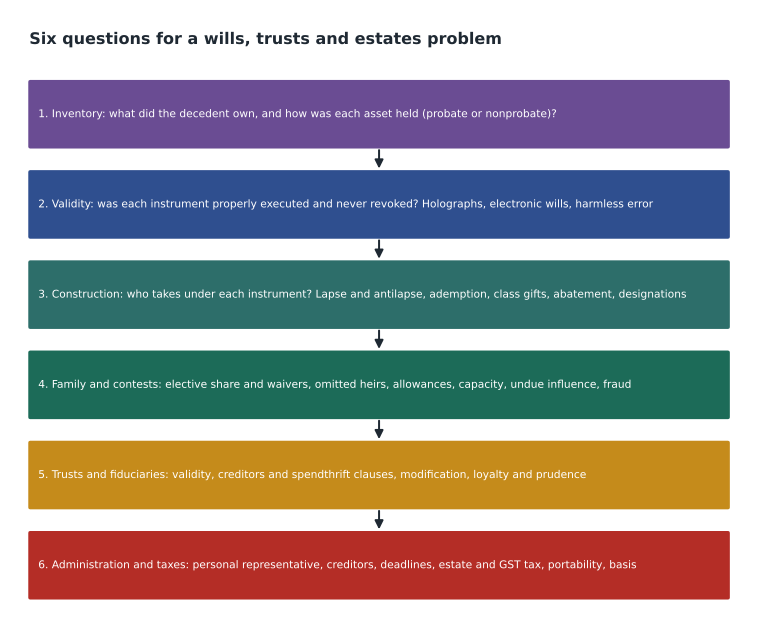
For the last session, Stavely sets the Wexley file aside and hands out a new one. "An exam problem in this course," she says, "is an estate file with the boring parts removed. It will have more issues than you have time for, some of them buried in a date or a phrase on a bank form. The students who do well are not the ones who know the most rules. They are the ones who have a method and follow it in order, so that nothing important gets skipped." Her method has six questions, and she writes them on the board under the two lists from the first day.
The problem: the estate of Estelle Penhallow
Estelle Penhallow, a retired principal violinist of a regional orchestra, died in Brennan Falls on September 14, 2026, at 81. All of the people are fictional. Her first husband, Conrad Penhallow, died in 2016; his executor filed an estate tax return electing portability, reporting a deceased spousal unused exclusion amount of 4,250,000 dollars. Estelle and Conrad had two children: Lucien Penhallow, 55, a building contractor in Brennan Falls, and Margery Penhallow Hargreave, who died in 2024, survived by her daughter, Saskia Hargreave, 22, a graduate student with 60,000 dollars of student loans.
In May 2022 Estelle married Anselm Grieve, 74, a retired piano teacher. Three days before the wedding, at Estelle's lawyer's office, Anselm signed a premarital agreement waiving "all rights in Estelle's estate, including any elective share." He had no lawyer. Attached was a one-page summary listing Estelle's assets at "approximately 9,000,000 dollars"; her assets were then worth about 15,000,000 dollars, and the summary omitted her art collection. Anselm's own property is worth about 800,000 dollars.
Estelle's documents are these. A 2014 will, executed with two witnesses and a self-proving affidavit, leaves "my eighteenth-century Italian violin to the Brennan Falls Youth Orchestra" and the residue "to my children, Lucien and Margery, in equal shares, if they survive me," and names Lucien executor. A 2014 revocable trust, the Penhallow Family Trust, of which Estelle was trustee and her nephew Barnaby Penhallow is successor trustee, holds a brokerage account worth 10,500,000 dollars. At her death it is to be divided into equal shares for her children; the share of a child who does not survive her passes to that child's descendants, held in trust until each reaches 30, with a spendthrift clause. The trust does not mention Anselm. In 2023 Estelle recorded a transfer-on-death deed of her house on Ridgeview Road, worth 1,100,000 dollars, to Lucien. A 400,000 dollar life insurance policy she owned names "Margery Hargreave" as sole beneficiary, with no contingent beneficiary. Her probate assets are her art collection (3,000,000 dollars), bank accounts (1,300,000 dollars), a modern violin (60,000 dollars) and a grand piano (90,000 dollars). Administration expenses and debts will be about 250,000 dollars.
Three events complicate matters. In 2025 Estelle sold the Italian violin for 1,200,000 dollars, deposited the money in her bank account, and bought the modern violin, which she played until her death. In July 2026 she typed a note on her tablet, signed it with a stylus and saved it to her cloud account: "I want Anselm to have my piano and to stay in the house as long as he wants. Estelle." No one witnessed it. And in October 2026, Barnaby invested 1,000,000 dollars of trust money in Fernhollow Analytics, a startup he co-founded.
Step 1: inventory and title
Begin with the two lists. The probate estate is the art, the bank accounts, the modern violin and the piano, 4,450,000 dollars in all, which pass under the will (and the tablet note, if it is valid). The trust's 10,500,000 dollars passes under the trust. The house passes to Lucien under the TOD deed. The life insurance passes under its designation. A will, or a tablet note, cannot change the TOD deed or the insurance designation; a TOD deed can be revoked only by a recorded instrument, and the insurance only by the insurer's procedure. That disposes of half of the tablet note at once: whatever its validity, it cannot give Anselm a right to stay in a house that passed to Lucien at Estelle's death.
| Asset | Value (dollars) | Passes by | Likely taker |
|---|---|---|---|
| Art collection | 3,000,000 | Will (residue) | Lucien and Saskia |
| Bank accounts | 1,300,000 | Will (residue) | Lucien and Saskia |
| Modern violin | 60,000 | Will (replacement for the specific gift) | Youth orchestra, if replacement rule applies |
| Grand piano | 90,000 | Tablet note if valid, otherwise residue | Anselm, if harmless error applies |
| Trust brokerage account | 10,500,000 | Trust terms | Lucien; Saskia in trust until 30 |
| Ridgeview Road house | 1,100,000 | TOD deed | Lucien |
| Life insurance | 400,000 | Designation, with UPC section 2-706 | Saskia |
Step 2: validity and revocation of each instrument
The 2014 will is properly executed and self-proved, and nothing in the facts suggests revocation; Estelle's marriage in 2022 did not revoke it. Anselm is not an omitted spouse entitled to protection under UPC section 2-301 in any practical sense, because the will leaves everything to Estelle's children from her first marriage, and the omitted-spouse share comes only from property not devised to such children. His protection, if any, is the elective share.
The tablet note is the instrument in doubt. It is not an attested will: no witnesses. It is not a holographic will: it is typed, and a stylus signature does not make the material portions handwritten. Under the Uniform Electronic Wills Act, as Westmarch adopted it, an electronic will still needs witnesses, so the note fails as an electronic will. That leaves harmless error. Under UPC section 2-503, which the Electronic Wills Act carries over to electronic records in states that have it, the question is whether clear and convincing evidence shows Estelle intended the note to operate as an addition to her will. The note uses the language of gift ("I want Anselm to have"), is signed, and was saved deliberately. Against it, its language is precatory in form and it mixes a gift she could make (the piano) with one she could not (the house), which may suggest she thought of it as a statement of wishes rather than a will. Horton shows that a court may admit such a note. A reasonable answer is that the piano gift is likely, though not certainly, effective.
Step 3: construing the instruments
The violin gift is a specific gift of an item Estelle sold. Under the identity theory, it is adeemed. Under UPC section 2-606(a)(5), however, the specific devisee takes property the testator acquired as a replacement for specifically devised tangible personal property. Estelle bought the modern violin with part of the proceeds and played it as her own instrument, so the youth orchestra takes the modern violin. It does not take the 1,200,000 dollars of proceeds, which were paid in full and mixed into her accounts; the catchall in section 2-606(a)(6) would require proof that ademption is inconsistent with her plan, and the replacement already carries out her evident purpose of giving the orchestra her violin.
The residuary gift to "my children, Lucien and Margery, in equal shares, if they survive me" raises the antilapse problem. Margery predeceased; she is Estelle's descendant, so UPC section 2-603 creates a substitute gift in her descendant, Saskia, unless the will shows a contrary intent. Lucien will argue that "if they survive me" is exactly such an intent, and in most non-UPC states he would win: the gift to Margery would lapse and Lucien would take the whole residue. Under UPC section 2-603(b)(3), however, words of survivorship alone are not enough, so in Westmarch Saskia takes Margery's half of the residue.
The life insurance names Margery alone. Because she did not survive, the designation fails, and without more the proceeds would typically be paid to Estelle's estate under the policy terms and pass under the residuary clause. UPC section 2-706 applies antilapse to beneficiary designations, substituting Margery's descendant, Saskia, so Saskia takes the 400,000 dollars directly. The trust itself provides expressly for the share of a child who does not survive, so Saskia's half of the trust is held for her until she reaches 30.
Step 4: family protection and contests
Anselm's main claim is the elective share, and its threshold question is the premarital waiver. Under UPC section 2-213, the waiver is unenforceable if Anselm proves either that he did not sign voluntarily, or that the agreement was unconscionable when signed and, before signing, he was not given fair and reasonable disclosure of Estelle's property, did not waive disclosure in writing and did not have adequate knowledge of it. Signing three days before the wedding without a lawyer supports an argument of involuntariness, though courts often enforce agreements signed close to a wedding if the party had time to read and understand them. The disclosure argument is stronger: the summary understated Estelle's wealth by about 6,000,000 dollars and omitted the art. Whether the agreement was also unconscionable, a waiver of everything by a man with a modest estate, is a closer call. The Uniform Premarital and Marital Agreements Act, where adopted, adds that a party who lacked access to independent counsel may avoid the agreement in some circumstances.
Worked problem
Anselm's elective share if the waiver fails
Compute Anselm's elective share under the 2008 UPC, assuming the waiver is unenforceable and the piano gift is valid. They married in May 2022, so the marriage lasted four years and about four months.
Show solution
- Net probate estate: 4,450,000 minus 250,000 dollars of expenses and debts equals 4,200,000 dollars.
- Nonprobate transfers to others: the trust (10,500,000 dollars), the house (1,100,000 dollars) and the life insurance Estelle owned (400,000 dollars), a total of 12,000,000 dollars.
- Anselm's own property: 800,000 dollars. Augmented estate: 4,200,000 plus 12,000,000 plus 800,000 dollars equals 17,000,000 dollars.
- Marital-property portion: for four years but less than five, 24 percent, or 4,080,000 dollars. The elective-share amount is half of that, 2,040,000 dollars.
- Credits: the piano (90,000 dollars) and 24 percent of Anselm's own property (192,000 dollars), a total of 282,000 dollars.
- Unsatisfied balance: 2,040,000 minus 282,000 dollars equals 1,758,000 dollars, contributed pro rata by the recipients of the probate estate and the nonprobate transfers to others, including the trust, Lucien as TOD beneficiary and Saskia as insurance beneficiary.
Answer: If the waiver fails, Anselm can claim about 1,758,000 dollars beyond the piano, which makes the enforceability of the premarital agreement the single most valuable issue in the file. He must elect within nine months after Estelle's death or six months after probate of the will, whichever is later. A settlement is likely.
Other contest grounds are weak. Nothing suggests Estelle lacked capacity in 2014, and the tablet note, if attacked, would be attacked mainly on whether it was intended as a will at all. If Lucien contests the note and the will contains a no-contest clause, the UPC's probable cause standard would protect him.
Step 5: trusts and fiduciaries
Saskia's share of the trust is held until she reaches 30 under a spendthrift clause. Her student loan creditors, ordinary contract creditors, cannot reach her interest before distribution under UTC section 502, though federal student loans can be collected from her own assets and any distributions she receives. If Saskia, at 22, asks to end the trust early, UTC section 411 will likely block her, because postponing enjoyment to 30 is a material purpose. The insurance proceeds, by contrast, pass to her outright, a reminder that coordinating designations with trusts would have served Estelle's apparent purpose better.
Barnaby's investment in his own startup is a textbook loyalty problem. It is a transaction affected by a conflict between his fiduciary and personal interests, so under UTC section 802(b) it is voidable by the beneficiaries without inquiry into its fairness, unless the trust authorized it or the beneficiaries consented after full disclosure. It is also very likely imprudent under the Uniform Prudent Investor Act: about a tenth of the trust in one illiquid early-stage company is a concentration that diversification principles disfavor, and it was made within a month of Estelle's death, while the trust was about to be divided. The beneficiaries can ask the court to void the investment, surcharge Barnaby for any loss, require him to account for any profit, and remove him under section 706. He also owes the 60-day notice of the trust's existence to the qualified beneficiaries under section 813, and if the elective share claim is pursued, the trust will have to contribute its share.
Step 6: administration and taxes
Lucien, as executor, applies for probate in Merrin County, offering the 2014 will and, because a personal representative must present every document that may be testamentary, the tablet note, preferably in a formal proceeding given the disputes. He publishes notice to creditors, mails notice to known creditors, inventories the probate estate within three months, and coordinates with Barnaby on claims and the elective share. Because Lucien takes under both the will and the TOD deed and is a likely defendant in the elective share and antilapse disputes, he faces conflicts of his own and should act transparently or consider whether a neutral administrator is wiser.
The estate tax analysis begins with the gross estate: the probate assets (4,450,000 dollars), the trust (10,500,000 dollars under section 2038), the house (1,100,000 dollars, included because the TOD deed left Estelle full ownership), and the life insurance she owned (400,000 dollars under section 2042), for a total of 16,450,000 dollars. Deductions include 250,000 dollars of expenses and debts, a 60,000 dollar charitable deduction for the violin and a 90,000 dollar marital deduction for the piano if the note is valid, leaving a taxable estate of about 16,050,000 dollars, which exceeds Estelle's own 15,000,000 dollar basic exclusion by 1,050,000 dollars. Without more, the tax would be about 420,000 dollars. But Conrad's executor elected portability in 2016, so Estelle's applicable exclusion amount is 15,000,000 plus 4,250,000 dollars, or 19,250,000 dollars, and no estate tax is due. If Anselm's elective share is paid, it qualifies for the marital deduction and reduces the taxable estate further. Lucien must still file Form 706, because the gross estate exceeds the basic exclusion; the return is due nine months after death, by mid-June 2027, with a six-month extension available.
The GST tax does not apply to the trust for Saskia, because her parent, Margery, was dead when the transfer occurred, so under section 2651(e) she moves up a generation. Every asset in the gross estate receives a stepped-up basis under section 1014, which matters most for the art collection.
Writing the answer
Stavely's advice on exam technique is short. Start with the inventory, because it tells you which instruments govern which assets and eliminates false issues, such as the tablet note's attempt to dispose of the house. Take each instrument in turn and ask the same questions: is it valid, is it revoked, what does it say, and who is protected against it? State the majority rule and the UPC rule when they differ, and say which one the facts' jurisdiction follows. Do the arithmetic when it changes the answer, as the elective share does here, and show the steps. Flag what you would need to know, such as the circumstances of the premarital agreement's signing or Estelle's statements about the tablet note. And end with the practical recommendations a client would need: who should do what, by when.
She closes the semester where she began. "The dead hand gets a great deal of respect in American law," she says. "It gets less when it forgets the spouse, ignores the creditors, picks a careless fiduciary or tries to change a beneficiary form with a tablet. Most of what you will do in practice is help living clients make plans that will deserve that respect, and then help their families when the plans meet the facts."
Summary and key terms
- Step 1: inventory assets and title; nonprobate assets pass by their own terms and cannot be changed by a will or note.
- Step 2: test each instrument's execution and revocation, using holographic, electronic and harmless error rules for informal documents.
- Step 3: construe each instrument: ademption and replacement property, antilapse (including survivorship words under the UPC) and antilapse for designations.
- Step 4: apply family protections, starting with the enforceability of any waiver, and compute the elective share when it changes the outcome.
- Steps 5 and 6: analyze trusts, creditors and fiduciary duties, then plan administration, deadlines and taxes, including portability and the GST tax.
Practice problems
Work each problem on paper first, then reveal the answer to check.
Why can't Estelle's tablet note give Anselm the right to stay in the house?
Show answer
The house passed to Lucien at her death under a recorded TOD deed, which can be revoked only by a recorded instrument during life; a will or testamentary note cannot change it.
In a state that follows the majority rule on survivorship language, who takes the Penhallow residue?
Show answer
Lucien alone. Most courts treat "if they survive me" as a contrary intent that defeats antilapse, so Margery's gift lapses and the surviving residuary taker takes it.
What would Estelle's estate tax have been if Conrad's executor had not elected portability, assuming the piano gift is valid and no elective share is paid?
Show answer
About 420,000 dollars: 40 percent of the 1,050,000 dollars by which the 16,050,000 dollar taxable estate exceeds the 15,000,000 dollar basic exclusion.
Name two remedies available against Barnaby for the startup investment.
Show answer
Voiding the transaction under UTC section 802(b) and surcharging him for any loss or requiring him to disgorge any profit under section 1002; the court may also remove him under section 706.
Lesson quiz · 5 questions
Score 60% or more to complete this lesson.
Create a free account to save your progress, take quizzes and earn a certificate.