
LAWU-213 · Lesson 3 of 12 · 23 min
Revocation, revival and electronic records
▶ Video coming soon A video version of this lesson is on the way.
A will is ambulatory: it speaks only at death, and until then the testator may change or revoke it at any time, for any reason or none. That freedom creates its own evidence problems. A will found in a drawer with lines through it, a will that cannot be found at all, an old will that was supposedly torn up years ago: each requires a court to decide what the testator did and what the testator meant by it. Stavely opens the third session by projecting page 4 of Arthur Wexley's 2021 will. Paragraph 4 originally read, in type, "I give the building and land at 220 Mill Street, Brennan Falls, to my daughter Philippa." A pen line runs through the word "Philippa." Above it, in Arthur's handwriting, are the words "Philippa and Julian equally," followed by "A.W. 3/2026."
"Three questions," she says. "Did Arthur revoke the gift to Philippa? Did he make a new gift to Philippa and Julian? And if he did the first but failed at the second, what happens to the building?" Answering them takes most of the law of revocation.
Revocation by a later writing
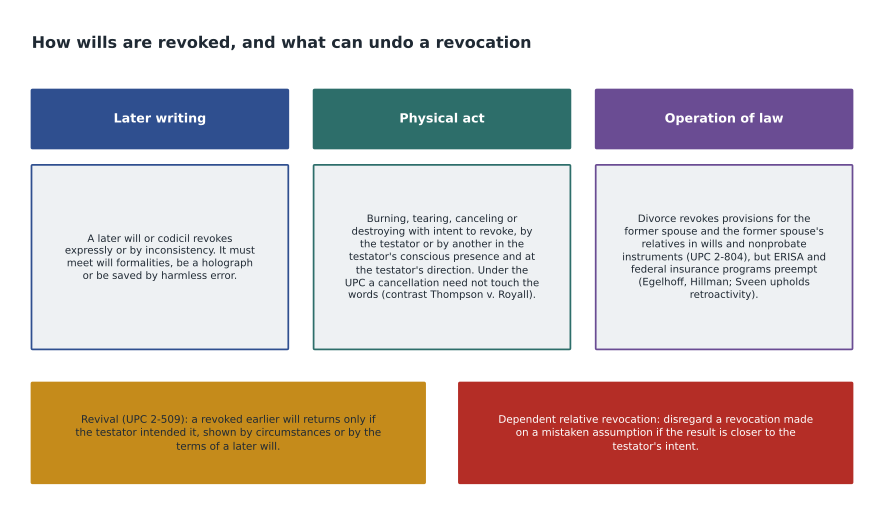
Under UPC section 2-507, a will or any part of it is revoked by executing a subsequent will that revokes it expressly or by inconsistency, or by performing a revocatory act on the will with the intent and for the purpose of revoking it. Every state recognizes both methods, though the details vary.
A later will revokes an earlier one expressly when it says so; most professionally drafted wills begin "I revoke all prior wills and codicils." Arthur's 2021 will contains such a clause, which is why his 2012 will, still in his desk with "OLD" written across the first page, has no effect. A later will can also revoke by inconsistency. Under section 2-507(c), if the later will makes a complete disposition of the estate, it is presumed to replace the earlier one entirely; if it does not, it is presumed to supplement the earlier will, which is revoked only to the extent of the inconsistency. A later instrument that only adds to or changes an earlier will is a codicil. A codicil must itself be executed with the formalities of a will, or qualify as a holograph, or be saved by harmless error.
Revocation by physical act
The traditional physical acts are burning, tearing, canceling, obliterating and destroying. The act must be done with the intent to revoke, by the testator or by another person in the testator's conscious presence and at the testator's direction. An accidental fire does not revoke a will, and a testator who tears up a will thinking it is a copy has not revoked it. Conversely, intent alone is not enough. A testator who says "burn my will" to a servant who leaves the room and burns it elsewhere has not revoked it in most states, because the act was not done in the testator's presence.
Cancellation raised a technical issue that the classic case illustrates. In Thompson v. Royall (Va. 1934), the testator, intending to revoke her will, had her lawyer write on the back of the will and on the back of a codicil a notation that they were "null and void" and were being kept only as a memorandum, and she signed the notation. No witnesses signed. The court held that the will was not revoked: the notation did not touch the words of the will, so it was not a cancellation, and it was not executed with the formalities of a will, so it could not revoke as a writing. UPC section 2-507(a)(2) changes the first rule: a burning, tearing or canceling is a revocatory act whether or not it touches any of the words. Today the Thompson notation would likely revoke under that provision or under harmless error.
States also differ on partial revocation by act. The UPC and most states allow a testator to revoke part of a will by striking out a clause. A minority of states refuse, on the ground that striking a gift increases other gifts and so amounts to a new testamentary disposition that must be executed with formalities. In those states, the cancellation of a single clause is ineffective, and the will is probated as originally written.
Presumptions when a will is missing or mutilated
If a will that was last in the testator's possession cannot be found after death, or is found mutilated, most states presume that the testator destroyed or mutilated it with intent to revoke. The presumption can be rebutted with evidence that the will was lost by accident, destroyed by someone else, or that the testator kept treating it as valid. In Harrison v. Bird (Ala. 1993), the testator's lawyer tore up the will at her telephone request but outside her presence, and sent her the pieces; when the pieces could not be found at her death, the presumption of revocation applied, and her estate passed by intestacy. If the presumption is rebutted, a lost will can be probated on proof of its contents, often through a copy or the drafting lawyer's file.
The modern solution is to keep originals where they will survive: in the lawyer's vault, a court registry where the state offers one, or, for electronic wills, with a qualified custodian. Stavely notes that the Wexley original was in Arthur's desk, which makes every mark on it a potential lawsuit.
Revocation by operation of law: divorce
Certain changes in family circumstances revoke wills, or parts of them, automatically. Every state now has a statute providing that divorce revokes gifts to the former spouse. UPC section 2-804 is broad. It revokes any revocable disposition or appointment of property to the former spouse, any nomination of the former spouse as executor, trustee or guardian, and the same provisions in favor of the former spouse's relatives, and it severs joint tenancies with the former spouse into tenancies in common. It applies to wills and to nonprobate transfers, including revocable trusts, life insurance and retirement beneficiary designations. The revoked provisions take effect as if the former spouse and the former spouse's relatives had disclaimed, which usually means as if they had predeceased.
Federal law limits how far these statutes reach. In Egelhoff v. Egelhoff (2001), the Supreme Court held that ERISA preempts a Washington revocation-on-divorce statute as applied to an employer-provided life insurance policy and pension plan, so the plan administrator must pay the beneficiary named in the plan documents, even an ex-spouse. In Hillman v. Maretta (2013), the Court held that the Federal Employees' Group Life Insurance Act preempted a Virginia statute that would have made a former spouse who received the proceeds liable to the person who would have taken under state law. But in Sveen v. Melin (2018), the Court held that applying Minnesota's revocation-on-divorce statute to a life insurance policy purchased before the statute was enacted did not violate the Contracts Clause, because the statute carried out the policyholder's likely intent, did not substantially impair the contract and could be undone by a simple redesignation. The practical lesson is that divorce clients must update every beneficiary designation, because federal plans will pay according to the form on file.
Marriage traditionally revoked a woman's will at common law, and the birth of children after marriage revoked a man's. Modern statutes do not revoke the will on marriage or birth. Instead they give omitted spouses and children a share, as Lesson 6 explains.
Revival
Suppose a testator executes Will 1, then Will 2, which expressly revokes Will 1, and then revokes Will 2. Does Will 1 come back to life? At English common law it did, on the theory that a will speaks only at death and Will 2 never took effect. Most American states reject automatic revival, and the UPC distinguishes by method. Under section 2-509, if Will 2 is revoked by a physical act, Will 1 is revived only if the testator intended the revival, as shown by the circumstances or the testator's statements; if Will 2 wholly revoked Will 1 and is then revoked by a later will, Will 1 is revived only to the extent the later will shows that intent. A few states take an anti-revival position and require Will 1 to be re-executed or republished by codicil.
In the Wexley file, if Arthur had torn up the 2021 will, the 2012 will would revive under the UPC only if the evidence showed he wanted it to. His "OLD" notation suggests the opposite, and the estate would then pass by intestacy, a result he probably did not foresee and certainly did not want.
Dependent relative revocation
Dependent relative revocation (DRR) is a doctrine of second-best intent. When a testator revokes a will or a gift on the basis of a mistaken assumption of law or fact, typically the assumption that a new disposition will be effective, the court may disregard the revocation if the testator would not have revoked had the truth been known. The court compares the result of giving effect to the revocation with the result of ignoring it, and chooses the one closer to what the testator was trying to do. DRR does not give effect to the failed new gift. It only decides whether the old one survives.
Classic cases involve a testator who tears up a will believing that a new, invalid will has replaced it, or who crosses out an amount and writes a new, unattested one. In Carter v. First United Methodist Church (Ga. 1980), the testator's will was found folded with a handwritten but unsigned draft of a new will, and with pencil lines through the dispositive provisions; the court applied DRR to probate the old will rather than let the estate pass by intestacy, since the draft showed she meant to change beneficiaries, not to die intestate. Courts also apply the doctrine when the testator's revocation rested on a mistaken recital of fact in the revoking instrument, for example "I revoke the gift to my nephew because he is dead," when the nephew is alive, if the mistake and what the testator would have done are clear from the instrument.
Under the UPC, harmless error often makes DRR unnecessary: if clear and convincing evidence shows that the testator intended a handwritten change to be an alteration of the will, section 2-503 gives it effect directly. DRR remains important in states without harmless error and in cases where the new disposition fails for a reason other than formalities.
Worked problem
The interlineation in paragraph 4
Arthur struck "Philippa" from the gift of the Mill Street building and wrote "Philippa and Julian equally. A.W. 3/2026" above it. No witnesses signed. The residue of the will pours over into Arthur's revocable trust, which divides its assets into three equal shares for Philippa, for Julian (in a discretionary trust) and for Silas's children. Analyze the building's fate under Westmarch law, which follows the UPC.
Show solution
- Partial revocation by act: striking a name is a cancellation. Westmarch, following the UPC, allows partial revocation by physical act if done with intent to revoke. Arthur's intent to remove Philippa as sole taker is clear from the substitution.
- The new gift as a holographic codicil: the words "Philippa and Julian equally" are in Arthur's hand, and "A.W." may be a signature if he intended initials to authenticate. Under UPC section 2-502(b) and (c), the typed words of paragraph 4 can be used to show what the handwritten words mean. A court could find a valid holographic codicil.
- The new gift under harmless error: even if "A.W." is not a signature, section 2-503 covers "an addition to or an alteration of the will." Clear and convincing evidence of intent includes the date, the initials and the obvious purpose.
- If both routes fail, apply DRR: would Arthur have wanted the revocation to stand if the new gift failed? If it stands, the building falls into the residue and is split three ways through the trust, giving Silas's children a share Arthur did not intend. If it is disregarded, Philippa takes all of it, cutting out Julian, whom Arthur meant to include.
- Neither result matches his plan. Courts applying DRR usually ask which outcome is closer; many would say Arthur's main purpose was to add Julian, not to remove Philippa, so ignoring the revocation keeps half his plan intact, while letting it stand gives Philippa a third and Julian a third in trust.
Answer: In Westmarch the most likely result is that the change is given effect, either as a holographic codicil or under harmless error, so the building passes to Philippa and Julian equally. Only if both fail does DRR matter, and the stronger argument is to disregard the revocation and give Philippa the building, though the question is close and depends on evidence of why Arthur made the change.
Contracts concerning wills
A person may contract to make a will, not to revoke one or to die intestate. The contract does not stop the promisor from making a different will, but the promisee can enforce the contract against the estate, usually by a constructive trust. Under UPC section 2-514, such a contract can be established only by provisions of a will stating its material terms, an express reference in a will to the contract plus extrinsic evidence of its terms, or a writing signed by the decedent evidencing the contract. Execution of a joint will or of mutual wills does not create a presumption of a contract not to revoke. Spouses who want a binding arrangement must say so in writing, and they often do so in second marriages to protect children of earlier marriages.
Revoking electronic wills and digital records
Electronic wills complicate revocation. A file can exist in many copies, and deleting one does not destroy the others. The Uniform Electronic Wills Act allows revocation of an electronic will by a later will or by a physical act, if it is established by a preponderance of the evidence that the testator, with intent to revoke, performed the act or directed another to perform it in the testator's physical presence. Deleting a file, therefore, can revoke, but the proponent of revocation must prove intent, and copies on other devices do not necessarily keep the will alive. Stavely predicts that the next generation of revocation litigation will be about phones and cloud accounts.
A related problem is access to digital assets: email, photographs, social media accounts and online financial records. The Revised Uniform Fiduciary Access to Digital Assets Act (2015), adopted in nearly every state, lets a user direct, through an online tool offered by the service provider or in a will, trust or power of attorney, whether a fiduciary may see the content of communications. Without direction, the personal representative gets a catalog of communications but not their content.
Summary and key terms
- A will may be revoked by a later writing, expressly or by inconsistency, or by a physical act done with intent to revoke.
- Under the UPC a cancellation need not touch the words, and partial revocation by act is allowed; Thompson v. Royall reflects the older rule.
- A will last in the testator's possession that cannot be found is presumed revoked, a presumption that can be rebutted.
- Divorce revokes provisions for a former spouse in wills and nonprobate instruments, but ERISA and federal insurance programs preempt state law (Egelhoff, Hillman); Sveen upheld retroactive application.
- Revival depends on intent under UPC section 2-509; DRR disregards a revocation based on a mistake when the result is closer to the testator's intent.
Practice problems
Work each problem on paper first, then reveal the answer to check.
A testator writes "revoked" across the margin of her will, without touching any words, and signs her initials. Is the will revoked under the UPC?
Show answer
Yes, if she intended to revoke. UPC section 2-507(a)(2) treats a canceling as a revocatory act whether or not it touches the words.
Arthur's 2021 will cannot be found after his death, though his lawyer kept a signed copy. What presumption arises if Arthur kept the original?
Show answer
That he destroyed it with intent to revoke. The proponents may rebut it, for example with evidence that he referred to the will as valid shortly before death or that someone else had access to it.
A divorced father still names his former wife on his employer's group life policy, governed by ERISA. He dies. Who gets the proceeds?
Show answer
Under Egelhoff, the plan pays the named beneficiary, the former wife, notwithstanding the state revocation-on-divorce statute. Whether she must then hand the money over depends on the scope of preemption, which Hillman suggests is broad for federal programs.
What does DRR require a court to compare?
Show answer
The result of giving effect to the revocation with the result of disregarding it, choosing the one closer to what the testator was trying to accomplish.
Lesson quiz · 5 questions
Score 60% or more to complete this lesson.
Create a free account to save your progress, take quizzes and earn a certificate.