
LAWU-213 · Lesson 5 of 12 · 23 min
Will contests
▶ Video coming soon A video version of this lesson is on the way.
A will contest is a lawsuit in which someone who would take more if a will were set aside argues that it is not the testator's will at all. The grounds are few: defective execution, revocation, lack of capacity, insane delusion, undue influence, fraud and duress. Most contests, Stavely tells Section B, are not really about legal doctrine. "They are about a family's story of the last two years of someone's life," she says. "Who was there, who was not, who drove her to the lawyer, who stopped calling. The doctrines are the vocabulary the court uses to decide whose story to believe."
In the Wexley file, Philippa has asked whether to contest the January 2026 document leaving 40,000 dollars to Bettina Kroll. The file adds facts. In October 2025 a neurologist diagnosed Arthur with mild cognitive impairment and noted that he sometimes forgot recent conversations but managed his own finances with help. In December 2025 he spent a week in the hospital after a fall. Bettina, whom Arthur had hired in 2024, drove him to appointments, managed his calendar and his mail, and was present most days. Bettina says Arthur asked her to help him type the January document because of the tremor in his hands, and that her friend, who was in the house that morning, signed as a witness. Philippa learned of the document only after Arthur's death.
Who may contest, and when
Only an interested person, someone who would take a larger share if the will or provision were invalid, has standing to contest. An heir has standing to attack a will that disinherits him; a beneficiary under an earlier will has standing to attack a later one. Philippa has standing because, if the January document fails, the 40,000 dollars stays in the residue, which pours into the trust of which she is a beneficiary.
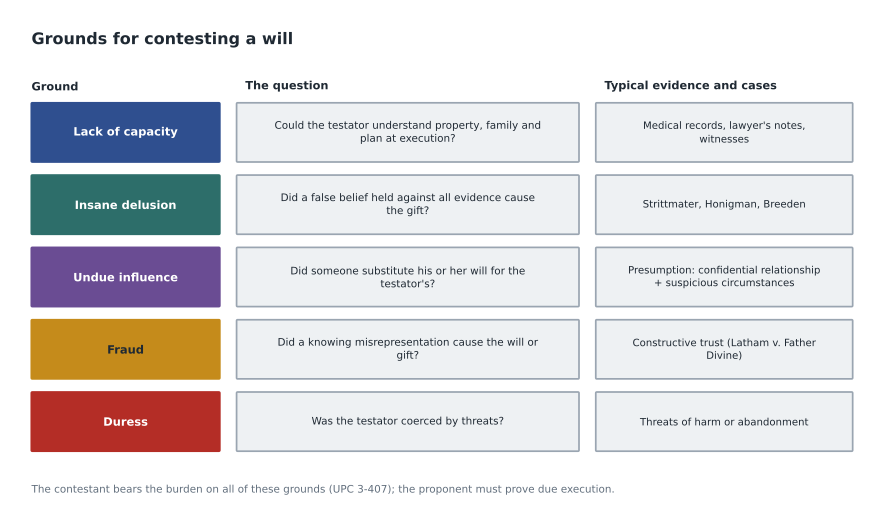
Contests are brought in the probate proceeding. Under the UPC, a will may be probated informally, by application to a registrar without notice, or formally, in a court proceeding with notice to interested persons. A formal testacy order binds those who received notice. An informal probate can be challenged in a formal proceeding, generally within the later of twelve months after the informal probate or three years after death, under UPC section 3-108. Non-UPC states set their own deadlines, often short, and a lawyer who misses one has lost the contest regardless of its merits. The burden of proving due execution is on the proponent; the burden of proving incapacity, undue influence, fraud, duress or revocation is on the contestant, under UPC section 3-407.
Testamentary capacity
A testator must be at least eighteen, in nearly every state, and must have testamentary capacity when the will is executed. The traditional test, restated in the Restatement (Third) of Property section 8.1, requires that the testator be capable of knowing and understanding in a general way the nature and extent of his or her property, the natural objects of his or her bounty, and the disposition being made, and of relating these elements to one another to form an orderly plan. The test is about capacity, not performance: a testator who could have known her property but forgot one bank account still has capacity.
The standard is lower than the capacity required to make a contract or a lifetime gift, on the theory that a will costs the testator nothing during life and that people near death, often ill and frail, should still be able to make one. A person under guardianship or conservatorship may still have testamentary capacity, and a will executed in a lucid interval is valid even if the testator lacked capacity before and after. Old age, physical weakness, eccentricity and even a diagnosis of dementia do not by themselves establish incapacity. The evidence that matters most is evidence about the moment of execution: the drafting lawyer's notes, the witnesses' observations, the testator's conversation that day.
Arthur's diagnosis of mild cognitive impairment is relevant but not decisive. People with mild impairment often meet the capacity test, especially for a simple instrument. A gift of 40,000 dollars to a caregiver, in a single sentence, is a simple plan. The best evidence will be Bettina's friend, the neighbor to whom Arthur later mentioned the gift, and Arthur's medical records from January.
Insane delusion
A will, or a part of it, is invalid if it was caused by an insane delusion: a false belief, to which the testator adheres against all evidence and reason, that affects the disposition. The doctrine is narrower than it sounds. The belief must be false, it must be held in the face of contrary evidence, and the will must be its product. Most courts ask whether a rational person in the testator's situation could have reached the same conclusion; some ask whether there was any factual basis at all.
In In re Strittmater (N.J. 1947), the testator, who had been treated for mental illness and whose writings expressed intense hostility to men, left her estate to the National Woman's Party. The court set aside the will, finding that her hatred of her parents and of men was a paranoid delusion that produced the gift. The case is widely criticized today, because it treated feminist political commitments as evidence of insanity. In In re Honigman (N.Y. 1960), a husband convinced, without basis, that his wife of forty years was unfaithful left her only the minimum required by law; a jury found an insane delusion and the court of appeals agreed. In Breeden v. Stone (Colo. 2000), on the other hand, the court upheld a holographic will written shortly before the testator's suicide, despite evidence of drug use and paranoid beliefs, because the beliefs did not affect the disposition.
Undue influence
Undue influence is the most common ground of contest and the hardest to define. The Restatement (Third) of Property section 8.3 describes it as influence that overcomes the donor's free will and causes the donor to make a transfer the donor would not otherwise have made. Courts traditionally require proof that the testator was susceptible to influence, that the influencer had the opportunity to exert it, that the influencer had a disposition to exert it, and that the result appears to be the effect of the influence. Influence is not undue merely because it exists. Persuasion, flattery, kindness and appeals to affection are permitted; what is forbidden is substituting the influencer's will for the testator's.
Because undue influence is usually exercised in private, courts allow it to be proved by circumstantial evidence and, in most states, by a presumption. A presumption of undue influence arises when the contestant shows a confidential relationship between the testator and a beneficiary, together with suspicious circumstances, such as the beneficiary's participation in procuring the will, the testator's weakened condition, secrecy or haste, the exclusion of the testator's family, an unnatural disposition and the absence of independent advice. Once the presumption arises, the burden shifts to the beneficiary to produce evidence, or in some states to prove, that the gift was not the product of undue influence.
Confidential relationships include fiduciary relationships, such as lawyer and client or trustee and beneficiary; reliant relationships, such as a frail parent who depends on a child or caregiver to manage affairs; and dominant-subservient relationships. Some states treat caregivers specially. California presumes that a gift to an unrelated care custodian of a dependent adult was the product of fraud or undue influence, and requires the custodian to rebut the presumption by clear and convincing evidence, unless the instrument was reviewed by an independent attorney who certifies that it was not the product of fraud or undue influence (Probate Code sections 21380 and 21384). Stavely tells the class to assume that Westmarch has no such statute but follows the common law presumption.
The leading cases show how the presumption works. In Lipper v. Weslow (Tex. Civ. App. 1963), a son who was a lawyer drafted his elderly mother's will, which excluded the children of her deceased son; the will recited her reasons, mainly that the excluded grandchildren had not visited. A jury found undue influence, but the appellate court reversed, holding that there was no evidence she had been dominated, that she had a strong personality and that her stated reasons, whether wise or not, were her own. In In re Will of Moses (Miss. 1969), a widow left most of her estate to a younger lawyer with whom she had a long intimate relationship; although she consulted an independent lawyer, the Mississippi Supreme Court held that the presumption arising from the confidential relationship was not rebutted, a result critics have attributed to disapproval of the relationship. In In re Kaufmann's Will (N.Y. App. Div. 1964), the court set aside a will leaving most of a wealthy man's estate to his male companion, in a decision now widely viewed as reflecting hostility to same-sex relationships. The lesson Stavely draws is that "unnatural disposition" can become a vehicle for a jury's moral views, and that lawyers drafting for clients with nontraditional families should build evidence of independent intent.
Worked problem
Undue influence and the caregiver's 40,000 dollars
Philippa contests the January 2026 document on the ground of undue influence. Apply the presumption and assess whether Bettina can rebut it.
Show solution
- Confidential relationship: Bettina managed Arthur's mail, calendar and transportation and saw him most days; he relied on her. A court is likely to find a reliant confidential relationship.
- Suspicious circumstances: Bettina helped type the document; her friend was the only witness; no lawyer was involved; Arthur had recently been hospitalized and had a cognitive diagnosis; his family did not know. These are classic indicia of procurement and secrecy.
- Unnaturalness: the gift is modest, about one percent of Arthur's total wealth, and a gift to a long-serving caregiver is common. This factor cuts in Bettina's favor.
- Rebuttal: Bettina can point to Arthur's later statement to his neighbor, made outside her presence, that he had "put Bettina in the will," to his tremor as a reason for her typing, and to evidence that he made his own decisions about money in early 2026.
- Capacity is a separate question; the diagnosis alone will not defeat the gift, so Philippa's case rises or falls mainly on undue influence and on the harmless error issue from Lesson 2.
Answer: The presumption almost certainly arises. Whether Bettina rebuts it depends on how the court weighs Arthur's statement to his neighbor and the modest size of the gift against her role in preparing the document. Stavely tells the class that a probate court would probably uphold the gift, but that a settlement paying Bettina part of the 40,000 dollars is the most likely outcome, because the litigation would cost more than the amount in dispute.
Fraud and duress
Fraud occurs when a person knowingly makes a false statement to the testator, intending to influence the disposition, and the statement does influence it. Fraud in the execution is deception about the nature or contents of the document, as when the testator is told she is signing a power of attorney. Fraud in the inducement is a lie that causes the testator to make or change a will, as when a nephew falsely tells his aunt that her son has been stealing from her. The remedy may be denying probate to the affected provision or, if probate is allowed, imposing a constructive trust on the wrongdoer's gift.
Fraud can also prevent a will. In Latham v. Father Divine (N.Y. 1949), the plaintiffs alleged that the religious leader known as Father Divine and his associates had used fraud and undue influence to prevent the testator from executing a new will leaving property to them, and even caused her death; the court held that if the allegations were proved a constructive trust could be imposed in favor of the intended beneficiaries. Duress is a stronger form of undue influence: coercion by threats of physical or other harm. A will made because a caregiver threatened to abandon a frail testator if she did not change it is the modern example.
Many states also recognize a tort of intentional interference with an expected inheritance or gift. The Supreme Court encountered it in the long litigation over the estate of the Texas oil executive J. Howard Marshall II, whose young widow, Vickie Lynn Marshall, known as Anna Nicole Smith, claimed that his son had interfered with an expected gift; Marshall v. Marshall (2006) and Stern v. Marshall (2011) addressed the jurisdiction of federal courts and bankruptcy courts rather than the merits. Most states that recognize the tort require the plaintiff to pursue probate remedies first if they are adequate.
No-contest clauses
A no-contest, or in terrorem, clause provides that a beneficiary who contests the will forfeits his or her gift. The clause deters contests only if the beneficiary has something to lose, so drafters who expect a challenge often leave the likely contestant a meaningful gift conditioned on not contesting. States differ on enforceability. UPC sections 2-517 and 3-905 make the clause unenforceable if probable cause existed for the contest, and the Restatement agrees. A few states enforce the clauses strictly, and a few refuse to enforce them at all. Most also exempt certain proceedings from the clause, such as actions to construe the will or to remove a fiduciary.
Arthur's 2021 will contains a no-contest clause applying to "any challenge to this will or any codicil to it." Philippa's contest of the January document is therefore at least arguably covered. Under the UPC, she keeps her gifts if she had probable cause, and the facts in the file, a caregiver's participation, a single interested witness and recent hospitalization, almost certainly supply it.
Preventing contests
Lawyers can do much to make a will contest unattractive. The most effective tools are evidentiary: a careful execution ceremony, the lawyer's contemporaneous notes on the client's reasons, a letter from the client explaining an unusual plan, and, where capacity may be questioned, an assessment by the client's physician near the time of execution. Some lawyers video-record executions, though a recording can backfire if the testator seems confused. Using a revocable trust, rather than a will, can also reduce the risk of a contest because a trust is usually administered without court involvement and because the settlor's years of managing it are evidence of capacity, though trusts can be contested on the same grounds. A growing minority of states, including Alaska, Arkansas, North Dakota and Ohio, allow ante-mortem probate, in which a testator obtains a judgment declaring the will valid while alive.
Lawyers must also watch their own role. Under Model Rule of Professional Conduct 1.8(c), a lawyer may not prepare an instrument giving the lawyer or a person related to the lawyer a substantial gift unless the client is related to the donee. A caregiver who asks a lawyer to draft a will for an elderly client, sits in on the meeting and pays the fee has created most of the circumstances that support a presumption of undue influence. The lawyer should meet the client alone and confirm that the plan is the client's own.
Summary and key terms
- Only interested persons may contest, and deadlines are short; the contestant bears the burden on capacity, undue influence, fraud and duress.
- Testamentary capacity is a low standard focused on the moment of execution; diagnoses and old age are evidence, not proof.
- Insane delusion requires a false belief held against reason that caused the gift; Strittmater and Kaufmann show the risk of moral judgment.
- Undue influence is usually proved by a presumption from a confidential relationship plus suspicious circumstances, which the beneficiary must rebut.
- Fraud and duress, constructive trusts and tortious interference supplement the doctrines; no-contest clauses are unenforceable under the UPC when probable cause exists.
Practice problems
Work each problem on paper first, then reveal the answer to check.
A testator with moderate dementia signs a will in a lawyer's office on a good day, answers questions about her property and family, and explains her plan. A week later she does not recognize her son. Is the will valid?
Show answer
Probably yes. Capacity is judged at execution, and the evidence suggests a lucid interval in which she met the test.
What is the difference between undue influence and fraud?
Show answer
Undue influence overcomes the testator's will by pressure or domination; fraud deceives the testator with a knowing falsehood that causes the gift.
A beneficiary contests a will on capacity grounds with a doctor's report supporting her claim, and loses. The will has a no-contest clause. Does she forfeit her gift under the UPC?
Show answer
No. Probable cause existed, so the clause is unenforceable against her.
Why might a revocable trust reduce the risk of a successful contest?
Show answer
It is administered privately, it often operates for years during the settlor's life, which is evidence of capacity and intent, and the settlor's management of it shows ratification.
Lesson quiz · 5 questions
Score 60% or more to complete this lesson.
Create a free account to save your progress, take quizzes and earn a certificate.