
LAWU-213 · Lesson 4 of 12 · 23 min
Components and construction of wills
▶ Video coming soon A video version of this lesson is on the way.
Once a court decides that a will is valid and unrevoked, two more questions follow. What documents and facts make up the will? And what do its words mean, applied to the family and property that exist at death rather than at signing? Arthur Wexley signed his will in 2021. By August 2026 his sister had died, his car had been sold, a grandchild had been added to the class of grandchildren, and he had left a list in his desk saying who should get his tools. "A will is written at one moment and read at another," Stavely tells Section B. "Construction rules are the law's guesses about what the testator would have said about the gap."
She hands out the dispositive provisions of the 2021 will. Article 2 gives tangible personal property "as I direct in any written list I leave," and the rest of it to Odette. Article 3 gives "my 1966 Ford Mustang to my grandson Rhys." Article 4 gives the Mill Street building to Philippa, the clause Arthur later altered. Article 5 gives "20,000 dollars to my sister, Hester Gray." Article 6 gives "10,000 dollars to each of my grandchildren." Article 7 gives the residue to the trustee of the Arthur Wexley Living Trust, to be added to the trust and administered under its terms. Philippa is named executor.
Integration, republication and incorporation by reference
Integration is the doctrine that the papers present at execution and intended to be part of the will make up the will. Problems arise when pages are not attached or are inconsistent, and lawyers avoid them by stapling the pages, numbering them and having the testator initial each one. Republication by codicil treats a will as re-executed on the date of a later codicil, which can change the meaning of words like "my grandchildren" or validate an earlier will that was defectively executed, if the codicil refers to it.
Incorporation by reference lets a will give effect to a writing that is not itself executed as a will. Under UPC section 2-510, a writing in existence when the will is executed may be incorporated if the will shows an intent to incorporate it and describes it sufficiently to permit its identification. In Clark v. Greenhalge (Mass. 1991), the testator's will left her tangible property to her cousin and executor, with a direction that he distribute items listed in a memorandum she might leave. She kept a notebook of wishes, including one that a painting of a farm scene go to a friend, Virginia Clark. The court held that the notebook, which existed when she later executed codicils that republished the will, was incorporated, so Clark took the painting. The usual limit, that the writing must already exist, prevents a testator from changing a will by unattested later papers.
UPC section 2-513 makes an exception for tangible personal property. A will may refer to a written statement or list, signed by the testator, disposing of items of tangible personal property not otherwise specifically disposed of, other than money. The list may be prepared before or after the will and may be changed at any time. Arthur's desk held a signed list dated 2023: his hand tools and workbench to Declan, who had helped him in the shop for years, and his father's watch to Julian. Article 2 refers to such a list, so the list controls those items, even though it was written after the will and never witnessed.
Acts of independent significance and pour-over gifts
A will may dispose of property by reference to acts or events that have significance apart from their effect on the will. Under UPC section 2-512, a gift of "the car I own at my death" or "to the people employed in my store when I die" is valid even though the testator can change the car or the employees without re-executing the will, because no one buys a car or hires a clerk merely to change a will. The doctrine extends to gifts measured by the terms of another person's will.
The most important application is the pour-over gift: a gift in a will to the trustee of a trust. If the trust exists at the testator's death, its later amendments might seem to be unattested changes to the will. The Uniform Testamentary Additions to Trusts Act, incorporated in UPC section 2-511, validates pour-over gifts to a trust identified in the will whose terms are set forth in a written instrument executed before, with or after the will, and the gift is administered under the trust's terms as amended, even amendments made after the testator's death if the trust so provides. The trust need not be funded during life. Article 7 of Arthur's will is a pour-over, and it carries the residue into the Wexley trust.
Mistake and ambiguity
The traditional rule is that a court will not reform a will to correct a mistake, and will not admit extrinsic evidence to vary its plain meaning. The reasons are the statute of wills and the testator's absence: a will must be in writing, and the person who knew the truth is dead. Within that rule, courts drew distinctions. A patent ambiguity, one apparent on the face of the will, traditionally could not be resolved by extrinsic evidence; a latent ambiguity, one that appears only when the will is applied to the facts, could be. Two people named "my cousin John" is a latent ambiguity, and evidence of which John the testator meant is admissible. In Mahoney v. Grainger (Mass. 1933), by contrast, a testator told her lawyer she wanted her cousins to share equally, but the will left the residue to her "heirs at law"; her only heir was an aunt, and the court refused to admit the evidence, because the words had a plain legal meaning.
Courts also developed the doctrine that a misdescription can be corrected by striking the false part (falsa demonstratio non nocet), so a gift of "my house at 220 Mill Street" when the testator owned only 222 Mill Street passes 222, and the personal usage exception, which admits evidence that the testator habitually used a word in a special sense.
The modern trend allows reformation. UPC section 2-805 and the Restatement (Third) of Property permit a court to reform even an unambiguous will to conform to the testator's intention if it is proved by clear and convincing evidence that the testator's intent and the terms of the will were affected by a mistake of fact or law, in expression or inducement. In Erickson v. Erickson (Conn. 1998), the Connecticut Supreme Court allowed extrinsic evidence that a will signed two days before the testator's marriage was meant to survive the marriage, and in Estate of Duke (Cal. 2015), the California Supreme Court held that an unambiguous will may be reformed if clear and convincing evidence establishes a mistake in expression and the testator's actual specific intent. The doctrine is spreading but remains a minority position for wills.
Lapse and antilapse
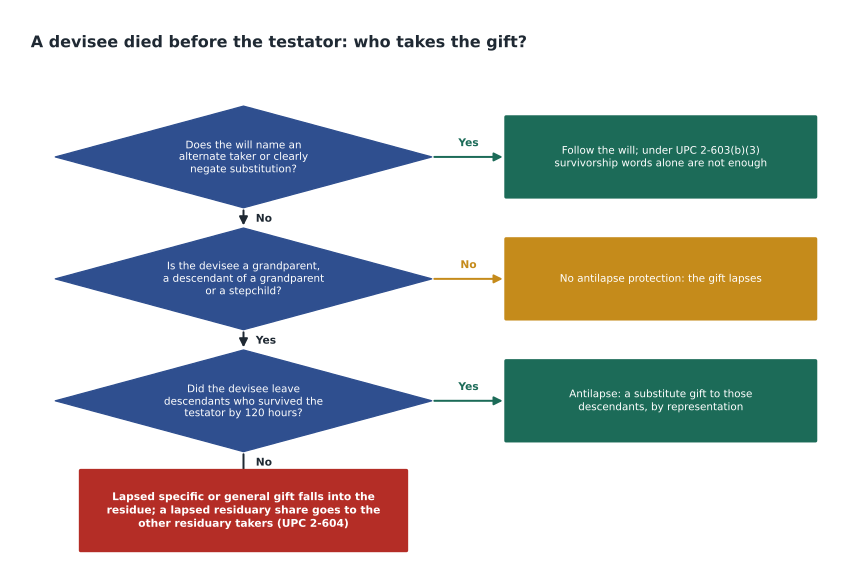
A gift by will is conditioned on the beneficiary's survival of the testator. If the beneficiary dies first, the gift lapses: it fails and, unless the will provides otherwise, a specific or general gift falls into the residue, and a residuary gift passes by intestacy under the old no-residue-of-a-residue rule. A gift to someone already dead when the will is signed is void, which has the same effect. Under UPC section 2-604, a lapsed share of the residue passes to the other residuary devisees, rejecting the no-residue-of-a-residue rule.
Every state except Louisiana has an antilapse statute that substitutes the predeceased beneficiary's descendants for certain beneficiaries. The statutes vary in whom they protect. Some cover only the testator's descendants; others cover all relatives. UPC section 2-603 covers a devisee who is a grandparent, a descendant of a grandparent or a stepchild of the testator. If such a devisee fails to survive, a substitute gift is created in the devisee's surviving descendants, who take by representation. The statute is a default rule; a testator can avoid it by a contrary intention, such as an express gift over.
The hardest question is whether words of survivorship, such as "to my sister if she survives me," show a contrary intention. Most courts say yes: the testator has addressed what happens if the sister dies first, and the gift fails. UPC section 2-603(b)(3) says no: words of survivorship alone are not a sufficient indication of an intent contrary to the antilapse statute. The drafters reasoned that such words are often boilerplate, and that a testator who truly wanted to cut off the sister's children would say so. The provision has been controversial, and several UPC states did not adopt it. Drafters now routinely add "and if she does not survive me, this gift shall lapse" or name alternate takers.
Antilapse statutes also apply to class gifts. A class gift is a gift to a group described collectively, such as "my grandchildren," whose membership may change. Members who die before the testator ordinarily drop out, and the surviving members share the gift. Under the UPC, antilapse applies to class members, so the descendants of a deceased class member, if that member is within the protected relationship, take the member's share. Class gifts also raise questions of class closing. Under the rule of convenience, a class closes when any member is entitled to possession, usually at the testator's death for an outright gift; members born later are excluded, except that children in gestation at the time count. A gift of "10,000 dollars to each of my grandchildren" is a per capita gift, and the rule of convenience closes it at the testator's death even if no grandchild is then alive, a special rule meant to let the estate be distributed.
Ademption, accessions and exoneration
Gifts are classified by type. A specific devise is a gift of a particular item, such as "my 1966 Ford Mustang." A general devise is a gift payable from the general assets, typically a sum of money. A demonstrative devise is a gift of money from a particular source, such as "5,000 dollars from my savings account at Merrin Valley Credit Union." A residuary devise is a gift of what remains after all other gifts.
If the subject of a specific devise is not in the estate at death, the gift is adeemed by extinction. The traditional identity theory asks only whether the item is in the estate; if not, the gift fails, regardless of the testator's intent. The intent theory, adopted in part by UPC section 2-606, asks whether the testator intended the gift to fail. The UPC gives the specific devisee any balance of the purchase price still owed, insurance proceeds, condemnation awards and property acquired as a replacement for specifically devised real or tangible personal property, and, as a catchall, the value of the item if the devisee shows that ademption would be inconsistent with the testator's manifested plan of distribution. In Wasserman v. Cohen (Mass. 1993), the court applied ademption to a specific gift of real estate in a revocable trust when the settlor had sold the property before death. In In re Estate of Anton (Iowa 2007), the Iowa Supreme Court moved away from a strict identity approach where a specifically devised duplex was sold by the testator's representative while she was incapacitated, asking instead what she would have intended for the proceeds.
Ademption by satisfaction is the testamentary counterpart of an advancement: a lifetime gift to a devisee may be treated as satisfying a gift in the will. Under UPC section 2-609, satisfaction requires a writing, by the testator or the devisee, similar to the advancement rule. Other construction rules address changes in securities. Under UPC section 2-605, a specific devisee of stock is entitled to additional shares produced by stock splits and stock dividends of the same company and to securities of another entity received in a merger. Under section 2-607, a specific devise passes subject to any mortgage, without exoneration, unless the will expressly requires the debt to be paid; a general direction to pay debts is not enough.
Worked problem
The Mustang, the sister and the grandchildren
Arthur sold the 1966 Mustang in 2024 for 38,000 dollars, paid in full, and deposited the money in his checking account, where it was mixed with other funds and spent on care. Hester Gray died in 2024, survived by two adult children. Julian has a daughter, Tilly, 9. Philippa has no children. Silas's children are Maisie and Rhys. Who takes the Article 3, 5 and 6 gifts?
Show solution
- Article 3, the Mustang: it is a specific devise of an item not in the estate at death. Under the identity theory the gift is adeemed. Under UPC section 2-606, Rhys gets the unpaid purchase price only if some is still owed; nothing is. Replacement property does not apply, because Arthur bought nothing to replace the car.
- Rhys can try the catchall in section 2-606(a)(6), arguing that ademption is inconsistent with Arthur's plan. The evidence is weak: Arthur sold the car himself, while competent, and spent the money. The gift is most likely adeemed.
- Article 5, the sister: Hester died before Arthur. She is a descendant of Arthur's grandparents, so the antilapse statute substitutes her surviving descendants. Her two children take the 20,000 dollars equally, 10,000 dollars each. No words of survivorship or alternate gift appear.
- Article 6, the grandchildren: it is a class gift of 10,000 dollars to each grandchild, which closes at Arthur's death. The members alive then are Maisie, Rhys and Tilly, so the gift totals 30,000 dollars. Declan's children are not Arthur's grandchildren.
Answer: Rhys takes nothing under Article 3, though he still takes 10,000 dollars under Article 6. Hester's two children take 10,000 dollars each under the antilapse statute. Maisie, Rhys and Tilly each take 10,000 dollars as members of the grandchildren class.
Abatement
When the estate is not large enough to pay debts, expenses and all the gifts, the gifts abate, or are reduced, in a statutory order. Under UPC section 3-902, absent a contrary provision in the will, property passing by intestacy abates first, then residuary devises, then general devises, then specific devises, and within each class gifts abate pro rata. Demonstrative gifts are treated as specific to the extent the named source is available. The order reflects a presumption that testators care most about gifts they described with particularity. Many wills include their own abatement and tax apportionment clauses, which control.
Arthur's probate estate is large enough to pay his debts and the general gifts in Articles 5 and 6, but the residue will be smaller than the 2021 numbers suggested, because the care costs of his last years consumed savings. The elective share, in Lesson 6, will also come partly from the residue.
Conditions and public policy
Testators may attach conditions to gifts. Most are valid, but courts refuse to enforce conditions that are illegal or contrary to public policy, such as conditions encouraging divorce or wholly restraining a first marriage. In Shapira v. Union National Bank (Ohio C.P. 1974), a father's will conditioned his son's inheritance on marrying a Jewish woman within seven years; the court upheld the condition, reasoning that it was a partial restraint on marriage and that the testator could have left the son nothing. The Restatement (Third) of Trusts takes a more skeptical view of conditions that interfere with fundamental personal choices, and modern courts are divided. Lesson 9 returns to the dead hand in trusts.
Summary and key terms
- A will may incorporate existing writings, refer to later lists of tangible property under section 2-513, and rely on acts of independent significance; pour-over gifts carry the residue into a trust.
- Traditional law barred reformation and extrinsic evidence of plain meaning; the UPC, the Restatement and courts like Duke now allow reformation on clear and convincing evidence of mistake.
- Gifts to beneficiaries who predecease lapse, but antilapse statutes substitute descendants of protected relatives; the UPC says survivorship words alone do not defeat antilapse.
- Specific gifts adeem if the item is gone, with UPC exceptions for proceeds, replacements and the testator's manifested plan; satisfaction requires a writing.
- Gifts abate in the order intestate, residuary, general, specific, unless the will says otherwise.
Practice problems
Work each problem on paper first, then reveal the answer to check.
A will leaves "my shares of Merrin Valley Bancorp" to a nephew. The company splits its stock two for one. How many shares does the nephew take?
Show answer
All of them, including the split shares, under UPC section 2-605.
A will leaves "my house on Orchard Road to my friend Lena if she survives me." Lena dies first, leaving a son. Who takes the house?
Show answer
A friend is not within UPC section 2-603's protected class, so antilapse does not apply. The house falls into the residue.
A will leaves a house to a daughter; the house has a 90,000 dollar mortgage. The will says "I direct that my debts be paid." Does the daughter take free of the mortgage?
Show answer
No. Under UPC section 2-607 a general direction to pay debts does not require exoneration of a specific devise.
What kind of ambiguity is shown when a will leaves property to "my niece Carol" and the testator has two nieces named Carol?
Show answer
A latent ambiguity, which arises only when the will is applied to the facts; extrinsic evidence is admissible to resolve it.
Lesson quiz · 5 questions
Score 60% or more to complete this lesson.
Create a free account to save your progress, take quizzes and earn a certificate.