
LAWU-213 · Lesson 7 of 12 · 21 min
Nonprobate transfers and will substitutes
▶ Video coming soon A video version of this lesson is on the way.
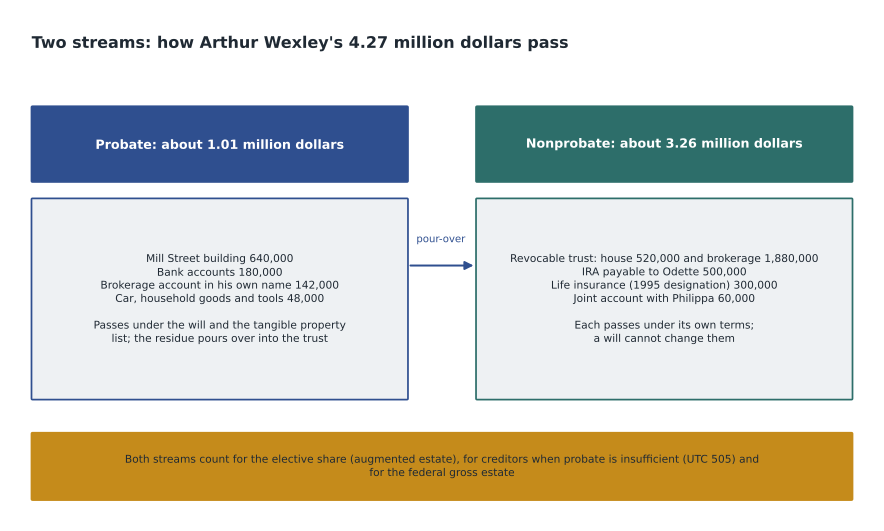
Stavely returns to the two lists from the first day. On the board she writes everything Arthur Wexley owned, and next to each item, how he held it. The result surprises the class. Of roughly 4.27 million dollars in assets, only about 1 million dollars will pass through probate under Arthur's will. The rest will pass by trust, beneficiary designation or survivorship, without a court's involvement and without regard to what the will says. "This is normal," she says. "For most American families today, the will is a backstop. The real estate plan is the paperwork at the bank, the brokerage firm and the insurance company, and almost nobody reads it."
| Asset | Value (dollars) | How held | Passes by |
|---|---|---|---|
| Building at 220 Mill Street | 640,000 | Arthur alone | Will (probate) |
| Checking and savings accounts | 180,000 | Arthur alone | Will (probate) |
| Brokerage account never moved into the trust | 142,000 | Arthur alone | Will (probate), then pour-over |
| Car, household goods and tools | 48,000 | Arthur alone | Will and list (probate) |
| House on Linden Avenue | 520,000 | Trustee of the Wexley Living Trust | Trust terms |
| Trust brokerage account | 1,880,000 | Trustee of the Wexley Living Trust | Trust terms |
| Individual retirement account | 500,000 | Beneficiary designation: Odette | Designation |
| Life insurance policy (owned by Arthur) | 300,000 | Beneficiary designation from 1995 | Designation |
| Joint account with Philippa | 60,000 | Joint with right of survivorship | Survivorship |
Why nonprobate transfers took over
Probate is the court-supervised process of proving a will, appointing a personal representative, paying debts and distributing property. It protects creditors and beneficiaries, but it can be slow, public and expensive, especially in states that require court approval for many steps or set lawyers' fees as a percentage of the estate. Over the twentieth century, banks, insurers and brokerage firms offered products that transfer property at death by contract, and lawyers promoted the revocable trust as a way to avoid probate altogether. John Langbein called this the nonprobate revolution. The UPC accepts it: section 6-101 declares that provisions for nonprobate transfers in insurance policies, contracts, accounts, trusts and similar instruments are nontestamentary, so they need not comply with the formalities for wills.
Will substitutes share three features with wills: they transfer property at death, they can be revoked or changed during life, and the owner keeps the use of the property until death. They differ in that they are created by a contract or deed with a third party, rather than a document executed with testamentary formalities, and they are administered by the third party, not the probate court.
Revocable trusts
The revocable trust is the most comprehensive will substitute. The settlor transfers property to a trustee, often the settlor himself, to hold for the settlor during life and then for others at death. Because the trustee holds legal title at death, the trust property does not pass through probate. The trust can also manage property if the settlor becomes incapacitated, since a successor trustee can take over without a guardianship proceeding. The trust document is private, while a probated will becomes a public record.
Courts once questioned whether such trusts were invalid testamentary transfers, since the settlor kept nearly complete control. In Farkas v. Williams (Ill. 1955), Albert Farkas bought stock and signed declarations that he held it as trustee for his employee, Richard Williams, keeping the income, the right to sell the stock and the right to revoke. The Illinois Supreme Court held that the trusts were valid: Williams received an equitable interest at once, even though it could be defeated by revocation, and Farkas, as trustee, owed duties in managing the stock. Courts today uniformly uphold revocable trusts. Under UTC section 603, while a trust is revocable, the trustee's duties are owed exclusively to the settlor, and the beneficiaries' rights are subject to the settlor's control.
A revocable trust avoids probate only for property actually transferred into it. Arthur's 2021 lawyer deeded the Linden Avenue house to the trustee and retitled one brokerage account, but Arthur later opened a second account in his own name, so that account will pass through probate and then into the trust through the pour-over clause. Creditors cannot be avoided this way. In State Street Bank and Trust Co. v. Reiser (Mass. App. Ct. 1979), the court held that a creditor of the deceased settlor could reach the assets of the settlor's revocable trust if the probate estate was insufficient, because the settlor had kept control equivalent to ownership. UTC section 505(a) codifies the point: during life the property of a revocable trust is subject to the settlor's creditors, and after death it is subject to claims against the estate, expenses and statutory allowances to the extent the probate estate is inadequate.
Life insurance and retirement accounts
Life insurance proceeds pass to the beneficiary named in the policy, under the contract with the insurer. Courts have consistently held that a will cannot change a beneficiary designation. In Wilhoit v. Peoples Life Insurance Co. (7th Cir. 1955), the insured's widow left the proceeds on deposit with the insurer under an agreement directing who would be paid at her death; a claimant under her later will lost, because the deposit agreement was a valid contract, not a testamentary disposition that had to meet will formalities, and the will could not override it. In Cook v. Equitable Life Assurance Society (Ind. Ct. App. 1981), a man named his first wife as beneficiary, divorced her, remarried and then wrote a holographic will leaving his life insurance to his second wife and son; the court held that the policy proceeds went to the first wife, because the policy required changes to be made on the insurer's form, and he never made one. Indiana had no revocation-on-divorce statute for insurance at the time. Washington's "superwill" statute is a rare exception: it allows a will that specifically refers to certain nonprobate assets to change their beneficiaries.
Retirement accounts add federal law. Employer plans governed by ERISA, such as 401(k) plans and pensions, must pay according to plan documents, and under the Retirement Equity Act of 1984 a married participant's spouse is entitled to a survivor annuity or to the account balance unless the spouse consents in writing, before a notary or plan representative, to a different beneficiary. Individual retirement accounts are not covered by those spousal rules, so Arthur was free to name Odette or anyone else. Retirement accounts also carry income tax consequences: distributions are taxable to the beneficiary, and after the SECURE Act of 2019 most beneficiaries other than a spouse, a minor child of the decedent, a disabled or chronically ill person or someone not more than ten years younger must withdraw the entire account within ten years.
Joint tenancy and joint accounts
Joint tenancy with right of survivorship passes property to the surviving tenant automatically at death; the decedent's interest simply ends. Joint bank accounts raise a further question: was the account a true joint account, intended to give the survivor the balance, or a convenience account, opened so that a relative could help pay bills, with no intent to make a gift? Courts traditionally looked for donative intent, and results varied. The UPC answers with clear rules. Under section 6-211, during the parties' lives a joint account belongs to them in proportion to their net contributions, so adding a child's name gives the child nothing until death. Under section 6-212, at death the balance belongs to the surviving party unless there is clear and convincing evidence of a different intention at the time the account was created. The Code also offers an agency, or convenience, designation that lets someone sign checks without any survivorship right, which is what most families mean when they add a child to an account.
Arthur and Philippa opened the joint account in 2024 when his eyesight was failing. Arthur funded it entirely. Under section 6-212, Philippa takes the 60,000 dollars unless Julian or the other beneficiaries prove by clear and convincing evidence that Arthur intended only a convenience account. The bank form is a standard joint account with survivorship. The account still counts in Odette's augmented estate, as Lesson 6 showed.
Pay-on-death and transfer-on-death designations
Bank accounts may carry a pay-on-death (POD) designation, and securities accounts a transfer-on-death (TOD) designation under the Uniform TOD Security Registration Act, adopted in nearly every state. The owner keeps full ownership during life, and at death the property passes to the named beneficiary. Real estate can pass the same way. The Uniform Real Property Transfer on Death Act (2009), and similar statutes, allow an owner to record a transfer-on-death deed naming a beneficiary; the deed has no effect during life, need not be delivered or supported by consideration, and can be revoked by a later recorded instrument. Roughly thirty states and the District of Columbia now permit TOD deeds. They are cheap and simple, but they can create problems when a beneficiary dies first, when the owner needs to sell or borrow, or when they conflict with the will.
Applying the law of wills to will substitutes
Because will substitutes do the work of wills, courts and legislatures increasingly apply the rules of wills to them. The Restatement (Third) of Property section 7.2 states that the rules of construction and other doctrines that apply to wills should apply to will substitutes. Specific statutes do so in several areas. UPC section 2-804 applies revocation on divorce to revocable trusts, insurance designations and other nonprobate transfers. Courts reached the same result for a revocable trust in Clymer v. Mayo (Mass. 1985), holding that a divorce revoked the trust provisions for the settlor's former husband, even though the Massachusetts statute then spoke only of wills. The slayer rule in UPC section 2-803 covers nonprobate transfers. UPC section 2-706 extends antilapse to beneficiary designations, so that if a beneficiary who is a grandparent, a descendant of a grandparent or a stepchild of the decedent fails to survive, the beneficiary's descendants are substituted. Section 2-707 goes further for future interests in trusts: it requires a remainder beneficiary to survive to the time of distribution and, if the beneficiary does not, substitutes the beneficiary's descendants.
Creditors' rights and the elective share also reach nonprobate property, as Lessons 6 and 11 explain. What generally does not apply to will substitutes are the formalities of execution; the third party's forms take their place.
Worked problem
Arthur's 1995 life insurance designation
In 1995 Arthur named "Edith Wexley, my wife, if she survives me, otherwise my children in equal shares" as beneficiaries of a policy he owned. Edith died in 2009 and Silas in 2018. Arthur never changed the designation. Who takes the 300,000 dollars in proceeds? The insurer's contract says nothing about deceased beneficiaries.
Show solution
- Edith did not survive Arthur, so the primary gift fails by its own terms and the contingent gift to "my children in equal shares" takes effect.
- The children are a class. At Arthur's death, the living members are Philippa and Julian. Without an antilapse rule, they would each take half, and Silas's children would take nothing.
- UPC section 2-706, as adopted in Westmarch, applies antilapse to beneficiary designations. Silas was Arthur's descendant, so his surviving descendants are substituted for him as a class member.
- The phrase "if she survives me" applied to Edith, not to the children, so there are no words of survivorship attached to the children's gift. Even if there were, the UPC treats such words alone as insufficient to defeat the substitute gift.
- Federal law does not displace the result, because the policy is an individual policy, not an employer plan governed by ERISA.
Answer: Philippa and Julian each take 100,000 dollars, and Maisie and Rhys share Silas's 100,000 dollars, 50,000 dollars each. Rhys's share must be paid to a conservator or custodian because he is a minor. In a state without section 2-706, Philippa and Julian would each take 150,000 dollars.
Planning for incapacity
Will substitutes also manage property during incapacity. A durable power of attorney, which remains effective if the principal becomes incapacitated, lets an agent manage the principal's property. The Uniform Power of Attorney Act (2006), adopted in about thirty states, makes powers of attorney durable by default, requires the agent to act in good faith and in the principal's best interest, and requires express authority for certain "hot powers" that could change the principal's estate plan, such as making gifts, creating or changing beneficiary designations and rights of survivorship, and amending a trust. Without a durable power or a funded revocable trust, the family of an incapacitated person must seek a guardianship or conservatorship, a court proceeding that the Uniform Guardianship, Conservatorship, and Other Protective Arrangements Act (2017) tries to make less restrictive.
Health care decisions are handled separately, by a health care power of attorney naming an agent and an advance directive or living will stating the person's wishes about treatment. Arthur signed both in 2021, naming Philippa. Stavely notes that many of the worst estate disputes she saw began as fights over care decisions in the last months of life.
The costs of a nonprobate world
The nonprobate revolution has costs. Each instrument is governed by its own form and its own default rules, and few clients coordinate them. A 1995 insurance designation, a 2021 trust and a 2024 bank form each reflect a different moment in Arthur's life. Beneficiary designations are often filled out without a lawyer, and they may name a dead person, a former spouse or a minor. Probate courts cannot easily see the whole picture, and creditors may have trouble finding assets. Stavely's advice to clients is simple. Every time a family changes, update the will, the trust and every designation together, and keep a list of every account and how it is titled.
Summary and key terms
- Most wealth now passes outside probate by revocable trust, beneficiary designation, survivorship or POD and TOD registration.
- Revocable trusts are valid (Farkas v. Williams) but avoid probate only for funded assets, and they remain subject to the settlor's creditors (Reiser, UTC section 505).
- A will cannot change a life insurance or account designation, except under statutes like Washington's superwill law; ERISA plans give spouses federal survivor rights.
- Joint accounts pass to the survivor under UPC section 6-212 unless clear and convincing evidence shows a different intent; convenience accounts are a common dispute.
- Courts and the UPC increasingly apply wills rules to will substitutes: revocation on divorce, the slayer rule and antilapse for beneficiary designations.
Practice problems
Work each problem on paper first, then reveal the answer to check.
A client wants her house to pass to her son without probate. Name two ways to do it.
Show answer
Deed it to a revocable trust with the son as remainder beneficiary, or, where permitted, record a transfer-on-death deed naming him. Joint tenancy also works but gives the son a present interest exposed to his creditors.
Arthur's will says, "I leave my life insurance to Philippa." Does the will change the 1995 designation?
Show answer
No. Absent a superwill statute, the policy passes under its own beneficiary designation.
Why does adding a child to a bank account as joint owner often produce disputes?
Show answer
The owner usually means only to let the child help pay bills, but the account form creates a right of survivorship, so the child takes the balance unless others prove a different intent.
A married participant in a 401(k) plan names his sister as beneficiary without his wife's consent. Who takes at his death?
Show answer
Under ERISA, as amended by the Retirement Equity Act, the spouse is entitled to the benefit unless she consented in writing before a notary or plan representative.
Lesson quiz · 5 questions
Score 60% or more to complete this lesson.
Create a free account to save your progress, take quizzes and earn a certificate.