
LAWU-213 · Lesson 10 of 12 · 24 min
Trustee duties and the prudent investor rule
▶ Video coming soon A video version of this lesson is on the way.
When Arthur Wexley died, his revocable trust became irrevocable and Philippa became its trustee. In September 2026 she signed the acceptance, took control of the trust brokerage account and changed the locks on the Mill Street building, which she also inherits under the will. By November she has three questions for her lawyer, and Stavely puts them on the screen. First: about 1.1 million dollars of the 1.88 million dollar trust account is invested in a single stock, Merrin Valley Bancorp, which Arthur bought over forty years and admired. In October the bank reported large loan losses and the stock fell 30 percent. Must she sell? Second: she would like to buy the Linden Avenue house from the trust after Odette's year of occupancy ends, at its appraised value. May she? Third: Julian has demanded a copy of the trust and a full accounting, and she would rather not give him one, since "he'll just use it to fight with me." Must she?
"Philippa is a pharmacist," Stavely says. "She is honest and careful and has never been a fiduciary in her life. She will be held to the same standard as a bank."
The fiduciary relationship
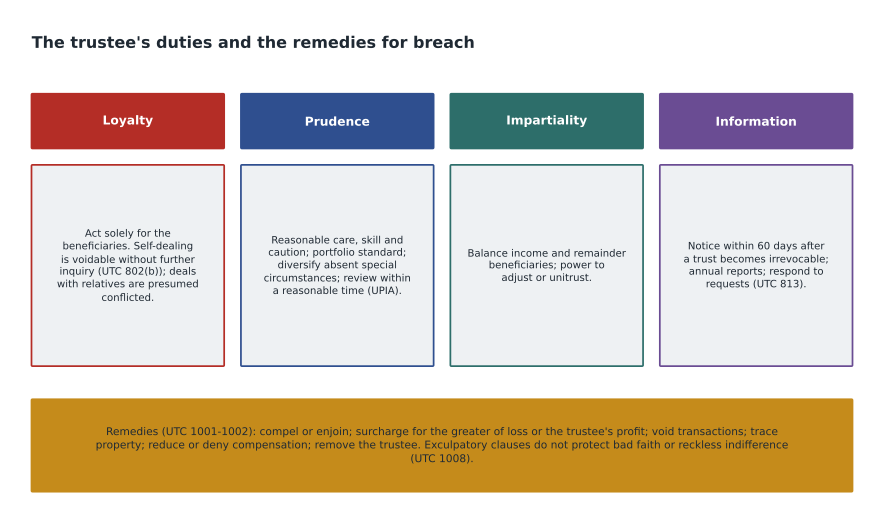
A trustee holds property for others, and trust law protects the beneficiaries by imposing duties enforceable in equity. The core duties are loyalty and prudence. Around them are subsidiary duties: to administer the trust in good faith according to its terms and purposes (UTC section 801), to be impartial among beneficiaries (section 803), to control and protect the property and keep it separate and identified (sections 809 and 810), to keep records and inform and report to beneficiaries (sections 810 and 813), and to enforce and defend claims (section 811). Most duties are default rules the settlor may modify, but UTC section 105 lists mandatory rules that the trust's terms cannot override, including the duty to act in good faith and in accordance with the trust's purposes and the interests of the beneficiaries, the court's power to modify or terminate, and, in part, the duty to inform qualified beneficiaries.
The duty of loyalty
A trustee must administer the trust solely in the interests of the beneficiaries. The duty of loyalty is the strictest rule in trust law. Under UTC section 802(b), a sale, encumbrance or other transaction involving trust property entered into by the trustee for the trustee's own personal account, or which is otherwise affected by a conflict between the trustee's fiduciary and personal interests, is voidable by an affected beneficiary unless the transaction was authorized by the terms of the trust, approved by the court, consented to by the beneficiary after full disclosure, or within a few narrow exceptions. This is the no-further-inquiry rule: in a self-dealing transaction, the court does not ask whether the price was fair or the trustee acted in good faith. The transaction can be undone regardless.
The rule is old and severe by design. In Hartman v. Hartle (N.J. Ch. 1923), executors with a power to sell the testator's farm sold it at public auction to the wife of one executor, who resold it a year later at a profit; the court set aside the sale, or required an accounting for the profit, without asking whether the auction price had been fair, because a fiduciary cannot buy indirectly what he could not buy directly. In In re Gleeson's Will (Ill. App. Ct. 1954), a trustee who had been leasing the testator's farm continued to farm it under the same lease after he became trustee; the court held that he must account for his profits, even though he acted in good faith and the arrangement was not unfair, because he stood on both sides of the transaction.
Conflicts short of self-dealing are judged more flexibly. Under section 802(c), a transaction between the trust and the trustee's spouse, descendants, siblings, parents, agents or attorneys, or a business in which the trustee has a significant interest, is presumed to be affected by a conflict of interest, a presumption the trustee may rebut by showing that the transaction was fair and that the trustee's judgment was not affected. If Philippa hires her husband's property management company to rent out the house, the presumption applies.
The most famous loyalty case involved an art estate. In In re Rothko (N.Y. 1977), the painter Mark Rothko left about 800 paintings to his estate; his three executors sold or consigned them, on terms very favorable to the buyer, to Marlborough Gallery, with which two of the executors had personal business relationships, one as a Marlborough director and the other as an artist it represented. The third executor knew of the conflicts and went along. The New York Court of Appeals held all three liable, removed them and approved appreciation damages: the executors had to pay the value of the paintings at the time of trial, which was much higher than the sale price, because restoring the estate to its position without the breach required it.
The duty of prudence and the Uniform Prudent Investor Act
A trustee must administer the trust as a prudent person would, considering its purposes, terms and distribution requirements and exercising reasonable care, skill and caution (UTC section 804). For investments, the old prudent man rule of Harvard College v. Amory (Mass. 1830) told trustees to observe how men of prudence manage their own affairs, and over time courts and legislatures turned it into lists of approved investments and judged each investment in isolation. Speculative assets were forbidden, and a trustee could be liable for a single losing stock even if the portfolio as a whole did well.
The Uniform Prudent Investor Act (1994), adopted in nearly every state, replaced that approach with modern portfolio theory. Under UPIA section 2, a trustee's investment decisions are evaluated not in isolation but in the context of the trust portfolio as a whole and as part of an overall investment strategy with risk and return objectives reasonably suited to the trust. No category of investment is inherently imprudent. The trustee must consider general economic conditions, inflation, taxes, the trust's other resources, the beneficiaries' needs for liquidity and income, and an asset's special relationship to the purposes of the trust or to a beneficiary. Under section 3, a trustee must diversify the investments unless the trustee reasonably determines that, because of special circumstances, the purposes of the trust are better served without diversifying. Under section 4, within a reasonable time after accepting a trusteeship, the trustee must review the assets and make decisions to bring the portfolio into compliance. Under section 9, a trustee may delegate investment functions to an agent, if prudent in selecting and monitoring the agent, which reverses the old rule that trustees could not delegate discretionary functions.
Prudence is judged by conduct, not results, and at the time of the decision, not with hindsight. A trustee who makes a reasonable decision after reasonable investigation is not liable merely because the investment lost money. A trustee who makes no decision at all, by contrast, may be liable for doing nothing. In In re Estate of Janes (N.Y. 1997), the bank serving as executor and trustee held Kodak stock that made up about 71 percent of the estate's portfolio, and kept it for years as the price fell. The court held that the bank was liable for failing to consider diversification, given the beneficiary's age and needs and the concentration, and measured damages by the value the stock would have had if it had been sold within a reasonable time, a lost-capital measure rather than lost profits.
Settlors often authorize retention of family assets. A trust provision permitting the trustee "to retain any property I own at my death" relieves the trustee of the duty to sell it immediately, but courts generally hold that a permissive retention clause does not excuse the trustee from considering whether retention remains prudent; a mandatory direction to retain, or an express waiver of the duty to diversify, is treated differently. Under UPIA section 1(b), the trust's terms can expand or restrict the prudent investor rule, and a trustee who reasonably relies on them is not liable.
Worked problem
The Merrin Valley Bancorp shares
The trust gives Philippa power "to retain any property I own at my death, including shares of Merrin Valley Bancorp, for so long as my trustee considers advisable." When she took over in early September 2026, the shares were worth 1,100,000 dollars, about 58 percent of the trust account. By late October they were worth 770,000 dollars. Philippa had not reviewed the portfolio or spoken to an adviser. Suppose an expert testifies that a prudent trustee would have begun selling by October 1 and that a diversified portfolio would have gained 1 percent in that period. Is Philippa liable, and for how much?
Show solution
- Duty to diversify: UPIA section 3 requires diversification unless special circumstances justify concentration. A 58 percent position in one regional bank is a large concentration for a trust that must provide for several beneficiaries over many years.
- The retention clause: it is permissive ("may retain ... for so long as my trustee considers advisable"). It shows Arthur's fondness for the stock and excuses immediate sale, but it does not relieve Philippa of the duty to consider whether retention is prudent. The clause requires her to exercise judgment, which she did not do.
- Reasonable time: under section 4 she must review the portfolio within a reasonable time after accepting. A few weeks to a few months is often reasonable; doing nothing for two months while the bank's problems were public weighs against her.
- Causation and damages: if the court finds a breach as of October 1, damages are measured by what the trust would have had with prudent investment, about 1,111,000 dollars (1,100,000 dollars plus 1 percent), minus what it has, 770,000 dollars, or about 341,000 dollars, adjusted for any shares a prudent trustee would have kept.
- Defenses: Philippa can argue that a reasonable time had not yet run, that Arthur's clause signaled a wish to keep the stock, and that losses from a sudden announcement were not foreseeable. She may also ask the court under UTC section 1009 or 1010 to excuse her, but good faith alone is not a defense.
Answer: Philippa has a serious exposure. A court might find that the reasonable period for review had not ended by October, but her failure to consider the concentration at all is the kind of inaction Janes punished. Stavely's practical advice is to hire an investment adviser at once, document a decision about the shares, and seek the beneficiaries' consent or court instructions if she wants to keep a large position for family reasons.
The duty of impartiality and principal and income
When a trust has successive beneficiaries, such as an income beneficiary for life and remainder beneficiaries afterward, the trustee must treat them impartially, giving due regard to their respective interests (UTC section 803). Investing entirely in high-yield bonds favors the income beneficiary; investing entirely in growth stocks that pay no dividends favors the remainder. Traditional principal and income rules allocated dividends and interest to income and capital gains to principal, which tied investment choices to the trust's distribution scheme. The Uniform Principal and Income Act (1997) and its successor, the Uniform Fiduciary Income and Principal Act (2018), give trustees who invest under the prudent investor rule a power to adjust between income and principal, and many states allow conversion to a unitrust, which pays the income beneficiary a fixed percentage of the trust's value each year regardless of how the return is earned. Julian's trust is discretionary as to both income and principal, so the problem is smaller, but Philippa must still consider Julian's needs alongside Tilly's interest as a remainder beneficiary.
The duty to inform and report
Beneficiaries cannot protect their interests without information. Under UTC section 813, a trustee must keep the qualified beneficiaries reasonably informed about the administration and the material facts necessary to protect their interests, and must respond promptly to a beneficiary's reasonable request for information. Within 60 days after a revocable trust becomes irrevocable, the trustee must notify the qualified beneficiaries of the trust's existence, the settlor's identity, their right to request a copy of the trust instrument and their right to a trustee's report. The trustee must send at least annual reports of the trust's property, liabilities, receipts and disbursements, including the trustee's compensation. Some states allow settlors to waive or limit these duties, sometimes by naming a designated representative to receive information instead; the UTC's mandatory rules preserve the duty to respond to requests and, in bracketed text, the notices to beneficiaries 25 or older.
Disclosure matters most before major transactions. In Allard v. Pacific National Bank (Wash. 1983), a corporate trustee sold the trust's only asset, a valuable block of land in downtown Seattle, without telling the beneficiaries or seeking competing bids; the court held that the trustee had breached its duty to inform the beneficiaries of a nonroutine transaction that significantly affected their interests, and its duty to obtain the best price. In National Academy of Sciences v. Cambridge Trust Co. (Mass. 1976), the trustee had paid income to a widow for years after she remarried, when the trust required payments to stop at remarriage; the court held that the trustee's accountings, approved by a court, did not bar the remainder beneficiary's claim, because they had not disclosed the facts. Julian is a qualified beneficiary, and Philippa must give him the notice and, on request, a copy of the trust terms that describe his interest. She cannot refuse because she expects a fight.
Administrative duties
A trustee must take control of and protect the trust property, insure it, keep it separate from the trustee's own property and in the name of the trust, and keep adequate records. Commingling trust funds with personal funds is a breach even if no loss results, and any loss caused by commingling is the trustee's. A trustee must also enforce claims of the trust and defend it against claims. Philippa should therefore deposit the rent from the Linden Avenue house, after Odette's year, in a trust account, not her own; title the brokerage account in her name as trustee; and keep the Mill Street building, which she owns personally under the will, entirely separate from trust business.
Modern trusts often divide functions among several people. A directed trust lets a trust director, such as an investment adviser or a family member, direct the trustee on investments or distributions. The Uniform Directed Trust Act (2017) gives the director fiduciary duties and limits a directed trustee's liability to its own willful misconduct in following a direction. A trust protector may have powers to amend administrative terms, change the trust's governing law or remove the trustee.
Remedies and protection for trustees
Under UTC section 1001, a court may remedy a breach of trust by compelling the trustee to perform, enjoining a breach, ordering the trustee to pay money or restore property, ordering an accounting, appointing a special fiduciary, suspending or removing the trustee, reducing or denying compensation, voiding a transaction, imposing a lien or constructive trust, or tracing trust property wrongfully disposed of. Under section 1002, a trustee who commits a breach is liable for the greater of the amount required to restore the trust to the position it would have occupied without the breach or the profit the trustee made by reason of the breach.
A trustee may be protected by the trust's terms or by the beneficiaries. An exculpatory clause relieving the trustee of liability is enforceable under UTC section 1008, except to the extent it relieves the trustee of liability for a breach committed in bad faith or with reckless indifference, or was inserted as the result of an abuse of a fiduciary or confidential relationship. A beneficiary who consents to or releases a breach, with knowledge of the material facts, cannot later complain about it (section 1009). And a trustee may petition the court for instructions before acting, which is the safest course in a hard case. Trustees are entitled to reasonable compensation under section 708 and may be removed by the court for serious breach, lack of cooperation among co-trustees, unfitness or persistent failure to administer effectively, or when removal serves the beneficiaries' interests and a suitable successor is available (section 706).
Summary and key terms
- Loyalty is strict: self-dealing is voidable without further inquiry (Hartman, Gleeson), and conflicts with relatives are presumed affected; Rothko imposed appreciation damages.
- Prudence under the UPIA judges investments as a portfolio, requires diversification absent special circumstances, and allows delegation; inaction can be a breach (Janes).
- Permissive retention clauses do not excuse the duty to consider prudence; the trust's terms may expand or restrict the rule.
- Trustees must be impartial, inform and report to beneficiaries (Allard), keep property separate and enforce claims.
- Remedies include surcharge, voiding transactions, tracing and removal; exculpatory clauses do not protect bad faith or reckless indifference.
Practice problems
Work each problem on paper first, then reveal the answer to check.
May Philippa buy the Linden Avenue house from the trust at its appraised value?
Show answer
Only if the trust authorizes it, the court approves, or all affected beneficiaries consent after full disclosure. Otherwise the sale is voidable under UTC section 802(b), however fair the price.
A trustee invests in a small, risky technology fund that loses money, but the overall portfolio is well diversified and gains. Is the trustee liable for the fund?
Show answer
Probably not. Under UPIA section 2, the fund is judged as part of the portfolio and the overall strategy, not in isolation.
What must Philippa send to the qualified beneficiaries within 60 days of Arthur's death?
Show answer
She must send notice of the trust's existence, the settlor's identity, the right to request a copy of the trust instrument and the right to a trustee's report, plus her name and contact information.
A trust contains a clause excusing the trustee from "all liability for any act or omission." The trustee recklessly fails to insure a building that burns. Does the clause protect the trustee?
Show answer
No. Under UTC section 1008, an exculpatory clause is unenforceable to the extent it relieves the trustee of liability for reckless indifference to the beneficiaries' interests.
Lesson quiz · 5 questions
Score 60% or more to complete this lesson.
Create a free account to save your progress, take quizzes and earn a certificate.