
LAWU-212 · Lesson 9 of 12 · 22 min
Capital gains
▶ Video coming soon A video version of this lesson is on the way.
Penwarden's fourth question, "How much?", depends not only on the amount of income but also on its character. Since 1921, the federal income tax has taxed long-term gains from the sale of capital assets at lower rates than wages and other ordinary income, and has limited the deduction of capital losses. Those two rules create enormous pressure to classify gains as capital and losses as ordinary, and much of the case law in this area is the record of that pressure. This lesson explains why the preference exists, what a capital asset is, how holding periods and netting work, the rates that apply in 2026 and the special rules for business property, wash sales and small business stock.
Why capital gains are taxed differently
Several arguments support a preference. Part of a nominal gain on an asset held for many years reflects inflation rather than real income, yet basis is not indexed. Because gains are taxed only when realized, high rates discourage sales and lock investors into existing holdings, reducing the efficient flow of capital. Gains that accrued over many years are bunched into one year, which under a progressive rate schedule can push them into higher brackets. And corporate earnings are taxed once to the corporation, so gains on stock that reflect retained earnings would be taxed twice without relief.
Critics respond that the preference overwhelmingly benefits high-income households, who receive most capital gains, that inflation could be addressed directly by indexing basis, and that the preference fuels tax shelters designed to convert ordinary income into capital gain. Penwarden asks students to notice that the debate is old, unresolved and largely about distribution. The rules themselves, however, are settled enough that a lawyer must know them well.
What is a capital asset
Section 1221 defines a capital asset as property held by the taxpayer, whether or not connected with a trade or business, and then lists exceptions. The most important exceptions are inventory and property held primarily for sale to customers in the ordinary course of business; depreciable property and real property used in a trade or business, which are governed by section 1231; copyrights and artistic or musical works held by the person whose efforts created them, along with patents, inventions, models, designs and secret formulas created by the taxpayer since 2018; accounts and notes receivable acquired for services or sales of inventory; certain government publications; and supplies regularly used in the business.
What remains is mainly investment property and personal-use property: stocks, bonds and other securities held by investors, land held for investment, a personal residence, a car, jewelry and collectibles. Gains on personal-use property are taxed as capital gains, but losses on personal-use property are not deductible at all.
The phrase primarily for sale has produced much litigation over whether real estate sellers are investors or dealers. In Malat v. Riddell (1966), the Supreme Court held that primarily means of first importance or principally, not merely substantially. Courts weigh factors such as the frequency and continuity of sales, the extent of development and advertising, the purpose of acquisition and the use of brokers, as the Fifth Circuit did in Biedenharn Realty Co. v. United States (1976).
The judicial gloss
Courts have added limits to the statutory definition. In Corn Products Refining Co. v. Commissioner (1955), a manufacturer bought corn futures to ensure a supply of raw material at stable prices and claimed that its gains on the futures were capital gains. The Supreme Court held them ordinary because the transactions were an integral part of the business, and stated that the capital asset definition should be construed narrowly. Some lower courts read Corn Products to mean that any property bought for business purposes was outside the definition. In Arkansas Best Corp. v. Commissioner (1988), the Court rejected that reading: a holding company's stock in a subsidiary bank was a capital asset even though it was bought to protect the company's business reputation, because the stock did not fit any statutory exception. Corn Products is now understood as an application of the inventory exception, and Congress added an express exception for hedging transactions in 1999.
The substitute for ordinary income doctrine prevents taxpayers from converting future ordinary income into capital gain by selling the right to receive it. In Hort v. Commissioner (1941), a landlord who received a payment for canceling a lease had ordinary income, because the payment substituted for rent. In Commissioner v. P. G. Lake, Inc. (1958), the sale of a short-term right to oil payments carved out of a larger interest produced ordinary income. By contrast, the sale of an entire interest in property that will produce ordinary income in the future, such as a building or a whole patent, generally produces capital gain, because the seller has given up the underlying investment and not just a slice of its income.
Holding periods
Capital gains and losses are long-term if the asset was held for more than one year and short-term otherwise. The holding period begins the day after acquisition and includes the day of sale. Property received by gift with carryover basis includes the donor's holding period, property received in a like-kind or other nonrecognition exchange includes the holding period of the property given up, and inherited property is automatically treated as held for more than one year. Short-term capital gains are taxed at ordinary rates; only net long-term gains receive the preference.
Netting capital gains and losses
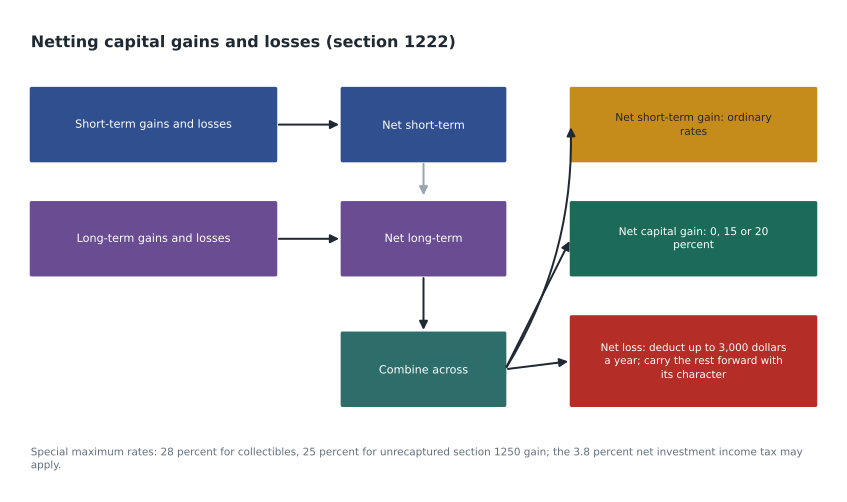
Section 1222 sets out a netting process. Short-term gains and losses are netted against each other, and long-term gains and losses are netted against each other. If one category produces a net gain and the other a net loss, they are netted against each other. A net capital gain is the excess of net long-term capital gain over net short-term capital loss, and only that amount receives the preferential rates. A net short-term gain is taxed as ordinary income.
If the result is a net loss, section 1211 allows individuals to deduct up to 3,000 dollars a year, or 1,500 dollars if married filing separately, against ordinary income. Unused losses carry forward indefinitely under section 1212 and keep their short-term or long-term character. Corporations may deduct capital losses only against capital gains, with a three-year carryback and five-year carryforward. The 3,000 dollar limit has not changed since 1978.
Worked problem
Netting a year's sales
Using illustrative numbers, an investor has these 2026 sales: short-term gain of 5,000 dollars, short-term loss of 8,000 dollars, long-term gain of 10,000 dollars and long-term loss of 4,000 dollars. What is the result? What if the long-term gain had been only 2,000 dollars?
Show solution
- Short-term net: 5,000 minus 8,000 is a net short-term loss of 3,000 dollars.
- Long-term net: 10,000 minus 4,000 is a net long-term gain of 6,000 dollars.
- Cross-netting: 6,000 minus 3,000 leaves a net capital gain of 3,000 dollars, taxed at long-term rates.
- Alternative: with a long-term gain of only 2,000 dollars, the long-term net is a loss of 2,000 dollars, and the total is a net loss of 5,000 dollars.
- The investor deducts 3,000 dollars against ordinary income. The remaining 2,000 dollars carries forward. Under section 1212, short-term losses are treated as used first, so the carryforward is long-term: the 3,000 dollar short-term loss was absorbed by the deduction, leaving 2,000 dollars of long-term loss.
Answer: In the first case the investor has a 3,000 dollar net capital gain. In the second, the investor deducts 3,000 dollars of loss and carries forward a 2,000 dollar long-term capital loss.
Rates for 2026
Net capital gain and qualified dividends are taxed at 0, 15 or 20 percent, depending on the taxpayer's taxable income. Section 1(h) stacks capital gain on top of ordinary income, so ordinary income fills the brackets first and capital gain is taxed at the rate for the bracket it falls into. For 2026, the 0 percent rate applies to capital gain that falls within taxable income up to 49,450 dollars for single filers, 98,900 dollars for joint filers and 66,200 dollars for heads of household. The 20 percent rate applies to capital gain falling above 545,500 dollars, 613,700 dollars and 579,600 dollars, respectively. The 15 percent rate applies in between.
| Filing status | 0 percent up to | 15 percent up to | 20 percent above |
|---|---|---|---|
| Single | 49,450 dollars | 545,500 dollars | 545,500 dollars |
| Married filing jointly | 98,900 dollars | 613,700 dollars | 613,700 dollars |
| Head of household | 66,200 dollars | 579,600 dollars | 579,600 dollars |
Two categories carry higher maximum rates. Gain on collectibles such as art, antiques, coins, stamps and precious metals, including many precious-metal funds, is taxed at up to 28 percent. Unrecaptured section 1250 gain, the gain on real property attributable to earlier straight-line depreciation, is taxed at up to 25 percent. In addition, the net investment income tax of section 1411 adds 3.8 percent on capital gains and other investment income of taxpayers whose modified adjusted gross income exceeds 200,000 dollars, or 250,000 dollars for joint filers; those thresholds are not indexed for inflation. The highest federal rate on long-term gains is therefore 23.8 percent.
Worked problem
Stacking capital gain on ordinary income
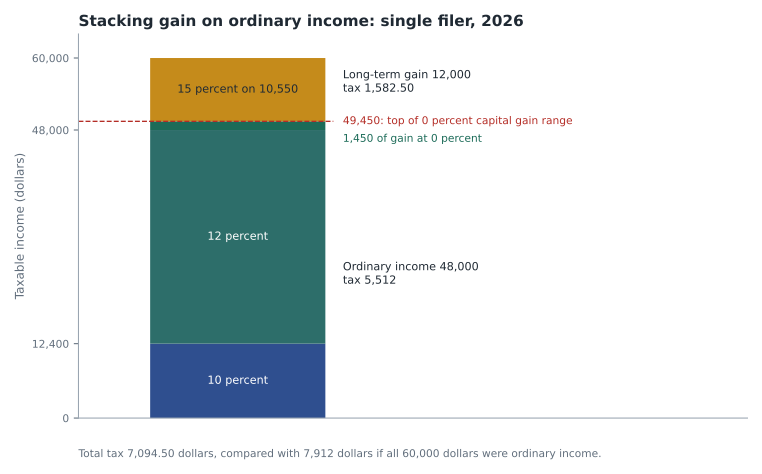
Using illustrative numbers, a single filer has 2026 taxable income of 60,000 dollars, consisting of 48,000 dollars of ordinary income and 12,000 dollars of long-term capital gain. What is her tax?
Show solution
- Tax on the 48,000 dollars of ordinary income under the 2026 single schedule: 10 percent of 12,400, which is 1,240 dollars, plus 12 percent of the 35,600 dollars from 12,400 to 48,000, which is 4,272 dollars, for 5,512 dollars.
- Stack the gain on top. The 0 percent rate applies up to 49,450 dollars of taxable income, so the first 1,450 dollars of gain, from 48,000 to 49,450, is taxed at 0 percent.
- The remaining 10,550 dollars of gain, from 49,450 to 60,000, is taxed at 15 percent: 1,582.50 dollars.
- Total tax: 5,512 plus 0 plus 1,582.50 equals 7,094.50 dollars.
- Compare: if all 60,000 dollars were ordinary income, the tax would be 1,240 plus 4,560 plus 22 percent of 9,600, which is 2,112, for a total of 7,912 dollars.
Answer: Her tax is 7,094.50 dollars, which is 817.50 dollars less than it would be if the gain were ordinary income.
Section 1231 property
Depreciable property and real property used in a trade or business and held for more than one year are not capital assets, but section 1231 gives them the best of both worlds. All section 1231 gains and losses for the year, including gains and losses from involuntary conversions of such property and of capital assets held in connection with a business, are netted. If the result is a net gain, every item is treated as long-term capital gain. If it is a net loss, every item is treated as ordinary loss, fully deductible. A five-year lookback rule recaptures as ordinary income any net section 1231 gain to the extent of net section 1231 losses deducted as ordinary in the previous five years, preventing taxpayers from timing gains and losses in alternate years. Depreciation recapture under section 1245 is applied first, so only the remaining gain enters the section 1231 netting.
Wash sales and other loss limits
Section 1091 disallows a loss on the sale of stock or securities if the taxpayer buys substantially identical stock or securities, or an option to buy them, within 30 days before or after the sale. The disallowed loss is added to the basis of the new shares, and their holding period includes that of the old ones, so the loss is deferred rather than lost. The rule prevents investors from harvesting losses while keeping the same investment. Section 267 disallows losses on sales between related parties, such as family members and controlled corporations. Digital assets are treated as property under IRS Notice 2014-21, so gains and losses on cryptocurrency are capital for investors; whether the wash sale rule applies to them depends on whether they are stock or securities, a question Congress has considered but not settled.
Qualified small business stock
Section 1202 excludes gain on qualified small business stock issued by a domestic C corporation engaged in an active business, other than excluded fields such as professional services, finance and hospitality. For stock acquired after July 4, 2025, the 2025 act created a tiered exclusion of 50 percent after three years, 75 percent after four years and 100 percent after five years, raised the per-issuer cap on excludable gain to the greater of 15,000,000 dollars, indexed after 2026, or ten times basis, and raised the limit on the corporation's gross assets at issuance to 75,000,000 dollars. Stock acquired earlier keeps the prior rules, generally a 100 percent exclusion after five years with a 10,000,000 dollar cap.
Summary and key terms
- Long-term capital gains receive preferential rates, justified by inflation, lock-in, bunching and double taxation, and criticized as regressive.
- Section 1221 defines capital assets by exclusion; Arkansas Best limits Corn Products to the inventory and hedging context.
- Gains and losses are netted within and then across the short-term and long-term categories; net losses are deductible up to 3,000 dollars a year.
- For 2026 the 0 percent rate reaches 49,450, 98,900 and 66,200 dollars of taxable income for single, joint and head of household filers.
- Collectibles face a 28 percent maximum, unrecaptured section 1250 gain 25 percent, and the net investment income tax adds 3.8 percent above fixed thresholds.
- Section 1231 treats net business property gains as capital and net losses as ordinary; section 1091 defers wash sale losses; section 1202 now has a tiered exclusion.
Practice problems
Work each problem on paper first, then reveal the answer to check.
Is land held by a real estate developer for subdivision and sale a capital asset?
Show answer
No. It is property held primarily for sale to customers in the ordinary course of business.
Why was the stock in Arkansas Best a capital asset despite its business purpose?
Show answer
It did not fall within any statutory exception, and motive for acquisition does not matter under section 1221.
An investor sells stock at a 6,000 dollar loss and buys the same stock 20 days later. What happens to the loss?
Show answer
It is disallowed under section 1091 and added to the basis of the new shares.
A single filer has 40,000 dollars of ordinary taxable income and 5,000 dollars of long-term gain in 2026. What rate applies to the gain?
Show answer
0 percent, because total taxable income of 45,000 dollars is below 49,450 dollars.
Lesson quiz · 5 questions
Score 60% or more to complete this lesson.
Create a free account to save your progress, take quizzes and earn a certificate.