
LAWU-212 · Lesson 6 of 12 · 21 min
Timing
▶ Video coming soon A video version of this lesson is on the way.
Penwarden's third framing question is "When is it taxed?" Students often treat timing as a technical afterthought, but he insists it is one of the most valuable questions in practice. A deduction this year rather than next, or income next year rather than this, is worth money because of the time value of money. At an interest rate of 5 percent a year, 10,000 dollars of tax paid ten years from now costs only about 6,140 dollars in today's money, so the deferral is worth about 3,860 dollars, nearly 40 percent of the tax itself. Much of tax planning, and much of the Code, is about timing.
This lesson covers the annual accounting period and its exceptions, the two main methods of accounting, the doctrines that determine when cash-method and accrual-method taxpayers report income and deductions, and installment sales. Lesson 7 continues the theme with realization and nonrecognition.
The annual accounting period
Income tax is computed for a taxable year, which for individuals is almost always the calendar year. Each year stands on its own. In Burnet v. Sanford & Brooks Co. (1931), a contractor lost money on a dredging contract over several years and later recovered damages for breach of the contract. The Supreme Court held that the recovery was income in the year received, even though, viewed over the life of the contract, the company had no profit. The Court explained that the government needs revenue at regular intervals and that taxpayers must report the results of each year as they stand at the end of it.
Strict annual accounting can produce harsh results, so the Code softens it in several ways. A net operating loss, which arises when business deductions exceed income, may be carried forward to later years. For losses arising after 2017, the carryforward is indefinite, but a carried-forward loss may offset only 80 percent of taxable income in the year used, and carrybacks are generally not allowed except for farming losses. Separately, section 461(l) limits the ability of noncorporate taxpayers to use excess business losses against wages and investment income in the year they arise; the 2025 act made that limit permanent, and disallowed amounts carry forward to later years.
Claim of right and repayments
North American Oil Consolidated v. Burnet (1932) established the claim of right doctrine. If a taxpayer receives earnings under a claim of right and without restriction on their disposition, the taxpayer has income, even though the taxpayer may later have to return them. In United States v. Lewis (1951), an employee received a bonus that a court later held was computed incorrectly, and he repaid part of it. He had to include the whole bonus in the year received and deduct the repayment in the year repaid. If his tax rate was lower in the repayment year, the deduction was worth less than the tax he had paid.
Congress responded with section 1341. If a taxpayer repays more than 3,000 dollars that was included in income in an earlier year because it appeared that the taxpayer had an unrestricted right to it, the taxpayer may either deduct the repayment in the current year or reduce the current year's tax by the amount by which tax in the earlier year would have decreased if the item had been excluded, whichever gives the lower tax. The provision preserves annual accounting while removing the rate mismatch.
Embezzled funds, discussed in Lesson 2 under James v. United States, are taxable when taken even though the embezzler has no claim of right, and repayment produces a deduction. Loans are not income at all, because the borrower has an obligation to repay from the start. The distinction between a claim of right and a loan depends on whether, when the money was received, the parties recognized an obligation to repay.
The tax benefit rule
The tax benefit rule handles the opposite problem: a taxpayer deducts an amount in one year and recovers it in a later year. Under the inclusionary part of the rule, the recovery is income in the later year, to the extent the earlier deduction reduced tax. Section 111 codifies the exclusionary part: a recovery is excluded to the extent the earlier deduction did not reduce tax. A familiar application is a state income tax refund. If a taxpayer itemized and deducted state income taxes last year, a refund this year is income to the extent the deduction produced a benefit. If the taxpayer took the standard deduction, the refund is excluded. In Hillsboro National Bank v. Commissioner (1983), the Supreme Court held that the rule applies whenever a later event is fundamentally inconsistent with the premise of the earlier deduction.
Methods of accounting
Section 446 requires taxpayers to compute income under the method of accounting they regularly use in keeping their books, provided the method clearly reflects income. The two principal methods are the cash receipts and disbursements method and the accrual method. Most individuals and small businesses use the cash method. Section 448 bars C corporations and partnerships with C corporation partners from using it once their average annual gross receipts exceed an inflation-adjusted threshold, which was 31,000,000 dollars for 2025, and bars tax shelters from using it at all. Businesses with inventories generally must account for purchases and sales of inventory under an accrual method, though small businesses below the same threshold are relieved of that requirement. A taxpayer may change methods only with the consent of the IRS, usually through automatic procedures.
The cash method
A cash-method taxpayer reports income when cash or its equivalent is actually or constructively received and deducts expenses when paid. Receipt of a check counts as receipt of cash, even if the check is deposited in the next year, unless it bounces. Receipt of property or services counts at fair market value. Payment by credit card counts as payment when charged, because the taxpayer has incurred a debt to a third party.
Under the constructive receipt doctrine in Treasury Regulation section 1.451-2, income is received when it is credited to the taxpayer's account, set apart or otherwise made available so that the taxpayer could draw on it at any time, unless the taxpayer's control is subject to substantial limitations or restrictions. A taxpayer cannot defer income by refusing to pick up a paycheck that is ready or by asking the payer to hold a check that could be paid now. But a taxpayer may bargain, before the services are performed, to be paid later, and the deferred amount is not constructively received merely because the payer could have paid sooner. The IRS accepted that principle in Revenue Ruling 60-31.
Closely related is the cash equivalence doctrine. A promise to pay in the future generally is not income to a cash-method taxpayer, but a promise that is unconditional, assignable, not subject to set-offs and of a kind frequently transferred at a discount may be treated as the equivalent of cash, as the Fifth Circuit held in Cowden v. Commissioner (1961). The economic benefit doctrine reaches amounts irrevocably set aside for the taxpayer in a trust or fund beyond the reach of the payer's creditors. Today, deferred compensation arrangements are governed largely by section 409A, which requires that elections to defer be made before the services are performed and that payment occur only on specified events, and by section 83 for transfers of property in connection with services.
A cash-method taxpayer cannot accelerate deductions simply by prepaying. Prepaid expenses that create benefits extending substantially beyond the year must be capitalized, subject to a twelve-month rule in the regulations, and prepaid interest is deductible only over the period of the loan.
The accrual method
An accrual-method taxpayer reports income when all events have occurred that fix the right to receive it and the amount can be determined with reasonable accuracy, whether or not the cash has arrived. Since 2018, section 451(b) adds that income must be included no later than the year it is reported as revenue on an applicable financial statement, such as an audited financial statement.
Advance payments raise the most litigated questions. In a series of cases, including American Automobile Association v. United States (1961) and Schlude v. Commissioner (1963), the Supreme Court held that accrual-method taxpayers must include prepaid fees for future services when received, rejecting the accounting practice of spreading them over the service period. Section 451(c), enacted in 2017, now allows an accrual-method taxpayer to defer advance payments for goods or services to the following year, to the extent the income is deferred on its financial statements, but no further. Deposits are different. In Commissioner v. Indianapolis Power and Light Co. (1990), the Court held that customer deposits securing payment of future utility bills were not income, because the utility had an obligation to refund them and the customers controlled whether they would be applied to bills or returned.
On the deduction side, an accrual-method taxpayer deducts an expense when all events have occurred that establish the fact of the liability, the amount can be determined with reasonable accuracy and economic performance has occurred. The economic performance requirement in section 461(h), enacted in 1984, means that a liability for services is not deductible until the services are performed, a liability for property until the property is provided, and liabilities for torts and workers' compensation until payment. It prevents taxpayers from deducting today the full amount of a liability that will be paid decades later, which would overstate the true cost in present-value terms. A recurring item exception allows certain routine liabilities to be deducted slightly earlier.
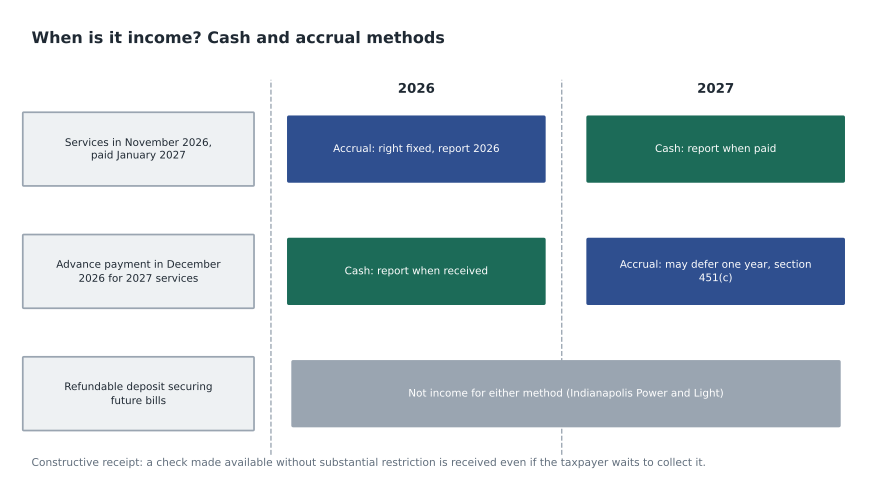
Rosa uses the cash method for her first-aid business. If she teaches a class in December 2026 and the employer that booked it pays in January 2027, the fee is 2027 income. If the employer hands her a check on December 30, 2026, the fee is 2026 income even if she deposits it in January. If an employer prepays in December 2026 for a series of classes in 2027, the fee is 2026 income, because section 451(c) deferral is available only to accrual-method taxpayers. And if a client tells her on December 28 that her check is ready at the front desk and she chooses to collect it in January, she has constructively received it in 2026.
Installment sales
Section 453 lets a taxpayer who sells property and receives at least one payment after the year of sale report the gain as payments are received, rather than all at once. The rationale is that the seller may lack the cash to pay tax on gain not yet collected. Each payment is divided between recovery of basis and gain using the gross profit ratio, which is the gross profit divided by the contract price. Interest on the deferred payments is separately taxable as ordinary income.
The method is not available for sales of inventory or by dealers, for sales of publicly traded stock or securities, or for gain from depreciation recapture, which must be reported in the year of sale. If the face amount of installment obligations held at year end exceeds 5,000,000 dollars, section 453A charges interest on the deferred tax. And under section 453(e), if a seller sells to a related person who resells within two years, the seller may have to recognize the deferred gain at the time of the second sale. A taxpayer may elect out of installment reporting, for example to use a capital loss in the year of sale.
Worked problem
An installment sale of land
Using illustrative numbers, a cash-method investor sells vacant land with a basis of 40,000 dollars for 100,000 dollars in 2026. The buyer pays 20,000 dollars at closing and promises to pay 20,000 dollars a year for the next four years, with interest at a market rate. How much gain does the investor report each year?
Show solution
- Gross profit is the selling price minus basis: 100,000 minus 40,000 equals 60,000 dollars.
- The contract price is the total amount the seller will receive, here 100,000 dollars.
- The gross profit ratio is 60,000 divided by 100,000, or 60 percent.
- In 2026 the investor receives 20,000 dollars. Gain is 20,000 times 60 percent, or 12,000 dollars; the remaining 8,000 dollars is a tax-free recovery of basis.
- In each of 2027 through 2030, the investor receives 20,000 dollars of principal and reports 12,000 dollars of gain, plus the interest received as ordinary income.
- Check: five payments of 12,000 dollars of gain total 60,000 dollars, the full gross profit, and five recoveries of 8,000 dollars total the 40,000 dollar basis.
Answer: The investor reports 12,000 dollars of gain in each of the five years. The character of the gain is fixed by the property, so on land held for investment more than a year it is long-term capital gain each year.
Why timing rules matter
Penwarden returns to the present-value point. Because a dollar of tax paid later costs less than a dollar paid today, rules that allow deferral are economically similar to partial exemptions, and rules that require acceleration are economically similar to extra tax. The economic performance rules, the limits on prepaid expenses and the original issue discount rules for debt all exist to stop taxpayers from exploiting that gap. In practice, he says, the first question in a timing case is always the method of accounting, the second is whether a specific statute overrides it, and the third is whether the taxpayer has done anything, such as refusing a payment that was available, to manipulate the result.
Summary and key terms
- Timing is valuable because of the time value of money; deferral resembles a partial exemption.
- Each taxable year stands alone, softened by net operating loss carryforwards, the claim of right relief in section 1341 and the tax benefit rule.
- Cash-method taxpayers report income on actual or constructive receipt and deduct expenses when paid, subject to capitalization of long-term prepayments.
- Accrual-method taxpayers use the all events test, the financial statement rule of section 451(b) and the economic performance requirement of section 461(h).
- Advance payments are income when received, subject to one-year deferral under section 451(c) for accrual-method taxpayers; true deposits are not income.
- Installment sales spread gain over the payments using the gross profit ratio, with exceptions for dealers, public securities and recapture.
Practice problems
Work each problem on paper first, then reveal the answer to check.
A cash-method lawyer receives a client's check on December 31 and deposits it on January 3. When is the fee income?
Show answer
In the year of receipt, December 31, because a check is treated as cash when received.
A taxpayer who took the standard deduction last year receives a state income tax refund. Is it income?
Show answer
No. Under section 111 and the tax benefit rule, the earlier payment produced no tax benefit.
Why were the deposits in Indianapolis Power and Light not income?
Show answer
The utility was obligated to refund them and the customers controlled whether they were applied to bills, so the utility lacked complete dominion.
Land with a basis of 30,000 dollars is sold for 50,000 dollars, half paid now and half next year. What gain is reported now?
Show answer
Gross profit ratio is 20,000 divided by 50,000, or 40 percent; 40 percent of 25,000 is 10,000 dollars.
Lesson quiz · 5 questions
Score 60% or more to complete this lesson.
Create a free account to save your progress, take quizzes and earn a certificate.