
LAWU-212 · Lesson 12 of 12 · 31 min
Capstone: solving a federal income tax problem
▶ Video coming soon A video version of this lesson is on the way.
Penwarden closes the course the way he closed every case file in the Office of Chief Counsel: by putting all the pieces together on one return. He sets aside Rosa Delgado's file, which Section B has followed all term, and hands out a new and entirely fictional problem about a married couple in Brennan Falls, Westmarch. "On an exam, and in practice, no one tells you which lesson a fact belongs to," he says. "You have to sort the facts yourself, and a method keeps you from missing one."
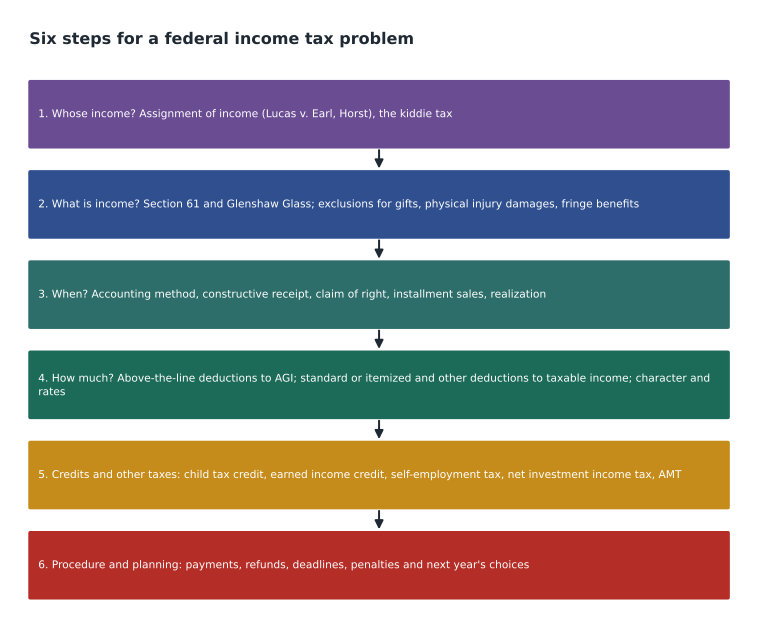
His method follows the four framing questions from Lesson 1, with two steps added at the end. First, whose income is it? Second, what is it: is it income at all, and if so, is any of it excluded? Third, when is it taxed? Fourth, how much: what deductions apply, what is the character of each item, and what rates apply? Fifth, what credits and other taxes apply? Sixth, what procedural issues and planning opportunities remain? This lesson works through the full problem, using 2026 law and figures, and computes the couple's tax.
The facts
Nathan and Adaeze Thornbury are married, live in Brennan Falls and file a joint return for 2026. They have two children, aged 6 and 14 at the end of the year, both of whom live with them and have Social Security numbers. All numbers are illustrative.
| Item | Facts |
|---|---|
| Nathan's salary | Software engineer; W-2 box 1 wages of 142,000 dollars after 10,000 dollars of elective deferrals to his 401(k) plan; salaried and exempt from overtime rules; employer-paid health insurance |
| Dependent care | Nathan contributed 5,000 dollars through his employer's dependent care plan, used for after-school care for the 6-year-old while both parents worked |
| Adaeze's design business | Freelance graphic designer using the cash method; 46,000 dollars of fees received in 2026, including 2,000 dollars paid in December for work to be done in January 2027, and 3,000 dollars that one client, at her request, paid directly to her sister |
| Business costs | 6,500 dollars of software subscriptions, stock images and a coworking membership; a new laptop bought in February for 3,000 dollars, used only for the business |
| Investments | 900 dollars of savings account interest; 1,200 dollars of qualified dividends |
| Stock sales | Sold shares inherited from Adaeze's father, who died in 2025 when they were worth 40,000 dollars, for 49,000 dollars; sold other shares bought eight months earlier for 12,000 dollars at a price of 10,000 dollars, and did not buy them back |
| Other receipts | A 10,000 dollar cash gift from Nathan's mother; a 25,000 dollar settlement paid to Adaeze for a broken wrist suffered when a delivery van hit her bicycle |
| Home and car | Qualified residence interest of 14,200 dollars on a 420,000 dollar mortgage taken out to buy their home; 1,400 dollars of interest on a loan for a new car assembled in the United States, bought in 2026 for personal use |
| Taxes and gifts | State income tax of 11,000 dollars and property tax of 6,500 dollars paid in 2026; 3,000 dollars of cash gifts to a public charity, with receipts; 4,000 dollars of unreimbursed medical expenses |
| Payments | 17,500 dollars of federal income tax withheld from Nathan's wages; 4,000 dollars of estimated tax payments |
Step 1: whose income is it?
Each spouse's earnings are ultimately reported on the joint return, so the assignment of income question between them does not matter. It does matter for the 3,000 dollars that Adaeze's client paid to her sister. Under Lucas v. Earl, Adaeze earned the fee by performing the services, so she is taxed on it as if she had received it and then given it to her sister. The payment to the sister is a gift from Adaeze, excluded from the sister's income and well within the annual gift tax exclusion of 19,000 dollars, so no gift tax return is needed. The children have no income, so the kiddie tax does not arise.
Step 2: what is income, and what is excluded?
Section 61 and Glenshaw Glass start from the premise that every accession to wealth is income unless excluded. Penwarden lists each receipt and asks whether a specific provision removes it.
| Receipt | Treatment | Authority |
|---|---|---|
| Nathan's wages of 142,000 dollars | Included | Section 61(a)(1) |
| 10,000 dollars of 401(k) deferrals | Excluded now; taxed when distributed | Section 402(e)(3) |
| Employer-paid health insurance | Excluded | Section 106 |
| 5,000 dollars of dependent care benefits | Excluded; limit is 7,500 dollars from 2026 | Section 129 |
| Adaeze's fees of 46,000 dollars, including the 3,000 dollars paid to her sister | Included as business gross income | Sections 61(a)(2) and Lucas v. Earl |
| Interest of 900 dollars and qualified dividends of 1,200 dollars | Included | Section 61(a)(4) and (7) |
| Gain on stock sales | Included as net gain, computed in Step 4 | Sections 61(a)(3) and 1001 |
| 10,000 dollar gift from Nathan's mother | Excluded | Section 102 and Duberstein |
| 25,000 dollar injury settlement | Excluded as damages on account of personal physical injury | Section 104(a)(2) |
Two points deserve comment. The injury settlement is excluded in full because the claim arose from a physical injury; if any part had been punitive damages or interest, that part would have been taxable, as Lesson 3 showed with Rosa's settlement. And the gift is excluded because Nathan's mother acted from affection, not in exchange for anything, so Duberstein's test of detached and disinterested generosity is easily met.
Step 3: when is it taxed?
Adaeze uses the cash method. The 2,000 dollars received in December for January 2027 work is income in 2026, when received. Section 451(c) deferral is available only to accrual-method taxpayers, and Schlude and American Automobile Association make advance payments income on receipt in any event. If she had refused to accept the check until January, the result would depend on whether the money was made available to her without substantial restriction; a client's unconditional tender on December 30 would be constructively received.
The stock sales are realization events under section 1001, so gain and loss are recognized in 2026. The inherited shares take a basis of 40,000 dollars under section 1014, their value at the father's death, and are automatically long-term under section 1223(9). The other shares were held only eight months, so their loss is short-term. Because the couple did not buy back substantially identical shares within 30 days, the wash sale rule does not apply.
Step 4: how much? From gross income to adjusted gross income
Begin with Adaeze's business. Her 6,500 dollars of ordinary and necessary expenses are deductible under section 162. The laptop is a capital expenditure, but because it was acquired after January 19, 2025 and has a five-year recovery period, it qualifies for 100 percent bonus depreciation under section 168(k), so the full 3,000 dollars is deducted in 2026. Alternatively, it falls within the de minimis safe harbor only if the invoice amount is 2,500 dollars or less, which it is not, so bonus depreciation is the route.
Worked problem
Adaeze's business income and self-employment tax
Compute Adaeze's net profit, her self-employment tax and the above-the-line deduction for half of it.
Show solution
- Gross receipts: 46,000 dollars.
- Expenses: 6,500 dollars plus 3,000 dollars of bonus depreciation, which equals 9,500 dollars.
- Net profit: 46,000 minus 9,500, which equals 36,500 dollars.
- Net earnings from self-employment: 36,500 times 92.35 percent equals 33,707.75 dollars.
- Self-employment tax at 15.3 percent: about 5,157 dollars, rounded to whole dollars. Her earnings are far below the Social Security wage base, and the couple's combined earnings are below the 250,000 dollar threshold for the additional Medicare tax.
- Half of the self-employment tax, rounded, is 2,579 dollars, deductible above the line under section 164(f).
Answer: Net profit is 36,500 dollars, self-employment tax is about 5,157 dollars and the above-the-line deduction is 2,579 dollars.
Next, the capital transactions. The inherited shares produce a long-term gain of 49,000 minus 40,000, or 9,000 dollars. The other shares produce a short-term loss of 12,000 minus 10,000, or 2,000 dollars. Netting under section 1222 gives a net long-term gain of 9,000 dollars and a net short-term loss of 2,000 dollars, for a net capital gain of 7,000 dollars. Together with the 1,200 dollars of qualified dividends, 8,200 dollars of their income will be taxed at the preferential rates.
Worked problem
Adjusted gross income
Compute the Thornburys' adjusted gross income.
Show solution
- Wages: 142,000 dollars.
- Business net profit: 36,500 dollars.
- Interest: 900 dollars. Qualified dividends: 1,200 dollars.
- Net capital gain: 7,000 dollars.
- Gross income items total 142,000 plus 36,500 plus 900 plus 1,200 plus 7,000, which equals 187,600 dollars.
- Subtract the deduction for half of self-employment tax, 2,579 dollars.
Answer: Adjusted gross income is 187,600 minus 2,579, which equals 185,021 dollars.
Step 4 continued: from adjusted gross income to taxable income
Now the personal deductions. Medical expenses of 4,000 dollars are far below the floor of 7.5 percent of adjusted gross income, which is about 13,877 dollars, so none is deductible. State income and property taxes total 17,500 dollars, under the 2026 cap of 40,400 dollars, and their modified adjusted gross income is far below the 505,000 dollar phase-down threshold. Mortgage interest of 14,200 dollars is qualified residence interest on acquisition debt under the 750,000 dollar limit. Charitable gifts of 3,000 dollars are reduced by the new floor of 0.5 percent of adjusted gross income, which is 925 dollars, leaving 2,075 dollars.
Worked problem
Itemize or take the standard deduction
Should the Thornburys itemize, and what other deductions reduce taxable income?
Show solution
- Itemized deductions: 17,500 plus 14,200 plus 2,075 equals 33,775 dollars.
- Standard deduction for a joint return in 2026: 32,200 dollars. Taking it would also allow up to 2,000 dollars of the non-itemizer charitable deduction, for 34,200 dollars in total.
- Compare: itemizing gives 33,775 dollars, while the standard route gives 34,200 dollars. Only 2,000 dollars of their 3,000 dollars of gifts count on the standard route, but they sit on top of a larger base, so the standard route wins by 425 dollars.
- Penwarden notes that most of the class instinctively chose to itemize, because 33,775 dollars exceeds the 32,200 dollar standard deduction by itself. The new non-itemizer charitable deduction changes the comparison, which is why each step must be checked.
- Car loan interest: the loan was for a new, American-assembled car bought for personal use in 2026, and their modified adjusted gross income is below the 200,000 dollar joint phase-out threshold, so the full 1,400 dollars is deductible whether or not they itemize.
- Nathan is salaried and exempt from federal overtime rules, so there is no overtime deduction; neither spouse is 65, so there is no senior deduction; and neither receives tips.
Answer: The Thornburys deduct 34,200 dollars through the standard deduction and the non-itemizer charitable deduction, plus 1,400 dollars of car loan interest. Taxable income before the qualified business income deduction is 185,021 minus 34,200 minus 1,400, which equals 149,421 dollars.
Finally, the qualified business income deduction under section 199A. The couple's taxable income is well below the threshold at which the wage and property limits and the specified service business rules apply, so the deduction is 20 percent of qualified business income, limited to 20 percent of taxable income minus net capital gain. Adaeze's qualified business income is her net profit reduced by the deductible half of self-employment tax: 36,500 minus 2,579, or 33,921 dollars. Twenty percent of that is 6,784 dollars, after dropping cents. The limit is 20 percent of 149,421 minus 8,200, or 141,221 dollars, which is 28,244 dollars, so the limit does not bind.
Taxable income is therefore 149,421 minus 6,784, which equals 142,637 dollars.
Step 4 continued: character and rates
Worked problem
Computing the regular income tax
Compute the Thornburys' regular income tax on taxable income of 142,637 dollars, of which 8,200 dollars is net capital gain and qualified dividends.
Show solution
- Ordinary taxable income: 142,637 minus 8,200, which equals 134,437 dollars.
- Tax on ordinary income under the 2026 joint schedule: 10 percent of 24,800 is 2,480 dollars; 12 percent of the 76,000 dollars from 24,800 to 100,800 is 9,120 dollars; 22 percent of the 33,637 dollars from 100,800 to 134,437 is 7,400.14 dollars. The total is 19,000.14 dollars.
- The 0 percent capital gain rate applies only to taxable income up to 98,900 dollars, and their ordinary income alone exceeds that, so all 8,200 dollars of preferential income is taxed at 15 percent: 1,230 dollars.
- Regular income tax: 19,000.14 plus 1,230, which equals 20,230.14 dollars.
Answer: The Thornburys' regular income tax is about 20,230 dollars. Their marginal rate on ordinary income is 22 percent, and their average rate on taxable income is about 14.2 percent.
Step 5: credits and other taxes
Both children are under 17 at the end of the year, live with their parents for the whole year and have Social Security numbers, so each is a qualifying child for the child tax credit of 2,200 dollars, for a total of 4,400 dollars. The couple's modified adjusted gross income of 185,021 dollars is far below the 400,000 dollar joint phase-out threshold. They cannot claim the child and dependent care credit for the 5,000 dollars of after-school care, because those expenses were paid with excluded dependent care benefits; the same expenses cannot generate both an exclusion and a credit. Their income is too high for the earned income credit.
The net investment income tax does not apply, because their modified adjusted gross income is below 250,000 dollars. The alternative minimum tax is not a concern. Because they take the standard deduction, their alternative minimum taxable income is roughly their taxable income of 142,637 dollars, only slightly above the 2026 joint exemption of 140,200 dollars, so their tentative minimum tax is a few hundred dollars, far below their regular tax. In practice, software performs the computation, but a lawyer should recognize when the alternative minimum tax is a real risk: large state tax deductions under the higher cap, incentive stock options and certain private activity bond interest.
Worked problem
Total tax and the refund
Compute the Thornburys' total tax and whether they owe or receive a refund.
Show solution
- Regular income tax: 20,230.14 dollars.
- Subtract the child tax credit of 4,400 dollars: 15,830.14 dollars.
- Add self-employment tax of 5,157 dollars: total tax of 20,987.14 dollars.
- Payments: 17,500 dollars withheld plus 4,000 dollars of estimated payments, which equals 21,500 dollars.
- Refund: 21,500 minus 20,987.14, which equals 512.86 dollars.
Answer: The Thornburys' total tax is about 20,987 dollars, and they are due a refund of about 513 dollars. Because their withholding and estimated payments exceeded their total tax, no estimated tax penalty should apply, provided the estimated payments were made on the quarterly due dates.
Step 6: procedure and planning
The return is due April 15, 2027. Adaeze must file Schedule C and Schedule SE, and the couple must report the stock sales on Form 8949 and Schedule D, using the stepped-up basis for the inherited shares, which the brokerage may report incorrectly as the father's original cost. Penwarden warns that this is a common error: if the return used the broker's figure, the couple would overstate their gain, and if they fail to document the date-of-death value, an examiner could challenge the basis. They should keep the estate's appraisal or brokerage statement showing the value on the date of death.
Several planning points follow. First, Adaeze should make quarterly estimated payments large enough to cover her self-employment tax and the income tax on her business profit, or ask Nathan to increase his withholding, to avoid penalties under section 6654. Second, Nathan's employer allows up to 7,500 dollars of dependent care benefits from 2026, so increasing his contribution would exclude more income at their 22 percent rate plus payroll taxes. Third, Adaeze could establish a retirement plan such as a SEP or solo 401(k), which would reduce both income tax and, through the qualified business income computation, interact with her 199A deduction. Fourth, because the couple's itemized deductions are close to the standard deduction, they might bunch charitable gifts and property tax payments into alternating years, itemizing in one year and taking the standard deduction in the next. Fifth, the sister's 3,000 dollar payment should be documented as Adaeze's income and gift, not as the sister's earnings.
If the IRS later examined the return and proposed a deficiency, the couple would have the options described in Lesson 11: an appeal, a Tax Court petition within 90 days of a notice of deficiency, or payment and a refund suit. Accurate records of each step above, especially the basis of the inherited shares and the business use of the laptop, would be their best defense against accuracy-related penalties.
Lessons from the capstone
Penwarden draws three conclusions from the problem. First, most of the analysis is identifying which facts matter: the gift and the settlement are large amounts that turn out to have no tax effect, while a 3,000 dollar payment to a sister and a 2,000 dollar December check require careful analysis. Second, the order of the formula matters: adjusted gross income must be computed before the charitable floor, the itemizing decision and the qualified business income limit. Third, every conclusion should be checked. The class's first instinct to itemize was wrong by 425 dollars once the new non-itemizer charitable deduction was considered, a reminder that the 2025 act changed many familiar answers. "The Code rewards the patient," he says. "Read the section, run the numbers and then run them again."
Summary and key terms
- A disciplined method, following whose, what, when and how much, then credits and procedure, keeps an analyst from missing issues.
- Large receipts such as gifts and physical injury settlements may be fully excluded, while small payments redirected to others may raise assignment of income issues.
- Cash-method taxpayers include advance payments when received; inherited stock has a stepped-up basis and long-term holding period.
- The order of the formula matters: adjusted gross income first, then floors, the itemizing choice and the qualified business income limit.
- The 2025 act changed familiar answers: the non-itemizer charitable deduction, the car loan interest deduction and the higher dependent care exclusion all affected this couple.
- Every computation should be checked, and records supporting basis and business use are the taxpayer's best protection in an examination.
Practice problems
Work each problem on paper first, then reveal the answer to check.
Why is the 25,000 dollar bicycle accident settlement excluded?
Show answer
It is damages received on account of personal physical injury under section 104(a)(2).
Why may the couple not claim the dependent care credit for the after-school care?
Show answer
The expenses were paid with excluded dependent care benefits under section 129, and the same expenses cannot support both.
If Adaeze had paid an additional 2,000 dollars of business expenses, how would that affect her self-employment tax?
Show answer
It would reduce net profit to 34,500 dollars and her self-employment tax by about 2,000 times 92.35 percent times 15.3 percent, or about 283 dollars.
Why did the standard deduction beat itemizing on these facts?
Show answer
Itemized deductions of 33,775 dollars were less than the 32,200 dollar standard deduction plus the 2,000 dollar non-itemizer charitable deduction.
Lesson quiz · 5 questions
Score 60% or more to complete this lesson.
Create a free account to save your progress, take quizzes and earn a certificate.