
LAWU-212 · Lesson 2 of 12 · 20 min
Gross income
▶ Video coming soon A video version of this lesson is on the way.
Penwarden starts the second class by reading section 61(a) aloud. Except as otherwise provided, gross income means all income from whatever source derived, including but not limited to compensation for services, gross income derived from business, gains derived from dealings in property, interest, rents, royalties, dividends, annuities, income from life insurance and endowment contracts, pensions, income from discharge of indebtedness, distributive shares of partnership income, income in respect of a decedent and income from an interest in an estate or trust. "Look at what the list does not do," he tells the class. "It does not define income. It gives examples, and it tells you the list is not exhaustive. The definition comes from the cases."
The first rule of the course, he says, is that income is broad and exclusions are narrow. A taxpayer who receives something of value starts with a presumption that it is income. The burden is on the taxpayer to find a specific Code provision that excludes it. Students who try to argue that something is not income because it does not feel like income usually lose. Students who look for an exclusion often win.
Glenshaw Glass and the modern definition
The leading case is Commissioner v. Glenshaw Glass Co. (1955). Glenshaw Glass received punitive damages for fraud and antitrust violations, and a second company received the punitive two-thirds of treble damages under the antitrust laws. Both argued that punitive damages were a windfall, not income, relying on an older definition from Eisner v. Macomber (1920) that described income as gain derived from capital, from labor, or from both combined. The Supreme Court rejected the argument. Chief Justice Warren wrote that the Macomber definition was not meant to provide a touchstone for all future gross income questions, and that Congress intended to tax all gains except those specifically exempted.
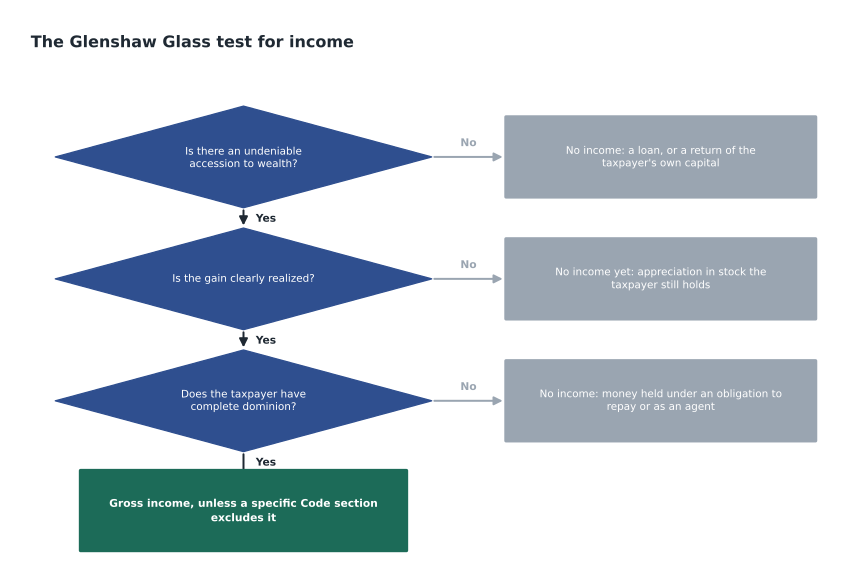
The Court described income as undeniable accessions to wealth, clearly realized, over which the taxpayers have complete dominion. That phrase has become the working definition of income. It has three parts, and Penwarden makes Section B apply each one to every new receipt. First, is there an accession to wealth, meaning the taxpayer is better off? Second, is the gain clearly realized, meaning some event has fixed it, such as a payment, a sale or an exchange? Third, does the taxpayer have complete dominion, meaning control over the funds without an obligation to repay?
Compensation in any form
Compensation for services is the most common kind of income, and its form does not matter. Treasury Regulation section 1.61-1(a) states that gross income includes income realized in any form, whether in money, property or services. A lawyer paid in shares of a client's stock has income equal to the value of the stock. A mechanic paid in groceries has income equal to the value of the groceries. Two neighbors who trade services, such as a lawyer drafting a will for a painter who paints the lawyer's house, each have income equal to the value of what they received, as the IRS explained in Revenue Ruling 79-24. Barter exchanges and online platforms do not change the rule.
Old Colony Trust Co. v. Commissioner (1929) adds a corollary. The employer of William Wood, an executive, paid his federal income taxes directly to the government. Wood argued that he never received that money. The Supreme Court held that the payment of the taxes was income to him, because discharging a person's obligation is the same as paying him the money. The principle reaches far beyond taxes. When an employer pays an employee's rent, loan payments or personal bills, the employee has income unless a specific exclusion applies. The result also creates a gross-up problem: if the employer pays the tax on the extra income, that payment is itself more income, and so on.
Found property, prizes and windfalls
Glenshaw Glass made clear that windfalls are income. In Cesarini v. United States (1969), a couple bought a used piano for 15 dollars and, seven years later, found almost 4,500 dollars in old currency inside it. The court held that the found money was income in the year they found it and reduced it to undisputed possession, relying on a Treasury regulation treating treasure trove as income. Prizes and awards are income under section 74, with narrow exceptions for certain employee achievement awards and for awards transferred directly to charity. Gambling winnings are income; gambling losses are deductible only by itemizers and only up to winnings, and the 2025 act limited that deduction further beginning in 2026 so that only 90 percent of losses can be counted.
Penwarden uses these cases to make a point about realization. The Cesarinis had no income when they bought the piano, even though, as it turned out, it contained money. They had income when they found the money and held it. A person who discovers that a painting bought at a garage sale is worth far more than she paid has no income until she sells it. The difference is that the piano money was cash in hand, while the painting's value is unrealized appreciation in property she already owns.
Things that are not income
Some receipts fail the Glenshaw Glass test because they are not accessions to wealth. A loan is the clearest example. When Rosa borrows 20,000 dollars to rebuild her garage, she receives cash, but she also takes on an equal obligation to repay. Her net worth does not change, so the loan is not income, and repaying it is not a deduction. The exclusion for loans depends on a genuine obligation to repay. A transfer labeled a loan with no expectation of repayment may be recharacterized as compensation, a gift or a dividend, depending on the relationship.
Money held as an agent or under a claim that must be returned is not income to the holder, because the holder lacks complete dominion. A lawyer who receives a settlement check into a client trust account does not have income from the client's share. But if a taxpayer receives money under a claim of right, treating it as his own without restriction, he has income even if he may later have to give it back. Lesson 6 covers the claim of right doctrine and the relief section 1341 provides when the money is returned. Even illegal gains are income: in James v. United States (1961), the Court held that embezzled funds are taxable to the embezzler, overruling an earlier case that had treated them as loans.
A return of capital is not income either. If Rosa sells a share of stock for exactly what she paid for it, she has no gain, because she has merely recovered her investment. Gain is the excess of what she receives over her basis, a concept Lesson 8 develops. Similarly, a recovery of damages that restores lost capital, as opposed to replacing lost income, can reduce basis rather than produce income, although most personal injury damages are handled by the specific exclusion in section 104, discussed in Lesson 3.
Imputed income
Some benefits are accessions to wealth in an economic sense but are not taxed as a practical matter. Economists call them imputed income. When Rosa lives in a house she owns, she enjoys the rental value of the house without paying rent. When she cooks her own meals or cares for her own child, she produces services that she would otherwise have to buy. None of that is taxed. The usual explanations are administrative difficulty, the absence of a market transaction and a long tradition of not taxing self-help. Penwarden notes that the failure to tax imputed rent on owner-occupied homes is one of the largest tax preferences for homeowners, larger in economic terms than the mortgage interest deduction that gets more attention.
The line between imputed income and taxable barter is the existence of an exchange. Rosa's teaching her own son first aid is not taxable. Rosa's teaching her neighbor's son first aid in exchange for the neighbor's mowing her lawn is barter, and both have income equal to the value of what they received.
Discharge of indebtedness
Section 61(a)(11) lists income from discharge of indebtedness. The leading case is United States v. Kirby Lumber Co. (1931). Kirby Lumber issued bonds and later repurchased some of them in the market for less than their face amount. The Supreme Court held that the difference was income, because the company had been freed from a liability without paying it in full, making assets that the debt had offset available to the company. The logic follows from the treatment of loans. Borrowed money is not income because of the obligation to repay. When the obligation disappears without full repayment, the earlier exclusion no longer has a justification, and the forgiven amount becomes income.
Section 108 contains important exclusions. Discharge income is excluded if it occurs in a bankruptcy case, or to the extent the taxpayer is insolvent immediately before the discharge, with insolvency measured as the excess of liabilities over the fair market value of assets. There are also exclusions for certain farm debt, qualified real property business debt and qualified principal residence debt, an exclusion Congress has extended for limited periods, so a lawyer must check whether it covers the year in question. Student loans discharged because of death or total and permanent disability are excluded. The price of most exclusions is a reduction in the taxpayer's tax attributes, such as net operating losses and basis in property, so the exclusion often defers tax rather than eliminating it.
Some reductions are not discharge income at all. If the seller of property reduces the purchase price owed by the buyer, section 108(e)(5) treats the reduction as a price adjustment rather than discharge income, provided the buyer is solvent and not in bankruptcy. A genuine dispute about how much is owed, settled for less than the claimed amount, can also be treated as resolving a contested liability rather than forgiving a fixed one, though courts disagree about how far that idea reaches. And a debt forgiven as a gift, such as a parent forgiving a child's loan out of affection, is excluded under section 102 rather than taxed as discharge income.
Worked problem
Credit card debt and insolvency
Rosa's cousin Lucía owed a credit card company 6,000 dollars. In 2026 the company accepted nothing and canceled the debt. Just before the cancellation, Lucía's liabilities totaled 50,000 dollars and the fair market value of her assets was 46,000 dollars. How much discharge income must she include? The numbers are illustrative.
Show solution
- Start with the amount discharged: 6,000 dollars, which is gross income under section 61(a)(11) unless an exclusion applies.
- Measure insolvency immediately before the discharge: liabilities of 50,000 dollars minus assets of 46,000 dollars equals 4,000 dollars.
- Section 108(a)(1)(B) excludes discharge income only to the extent of insolvency, so 4,000 dollars is excluded.
- The remaining 2,000 dollars is included in gross income.
- Under section 108(b), Lucía must reduce her tax attributes, such as any loss carryovers or basis in property, by the 4,000 dollars excluded.
Answer: Lucía includes 2,000 dollars and excludes 4,000 dollars, reducing tax attributes by the excluded amount. The creditor will likely send her a Form 1099-C reporting the full 6,000 dollars, so her return must show the exclusion.
Income from illegal activity and the duty to report
Penwarden spends a few minutes on a question students always ask. Must a drug dealer or a thief report illegal income? Yes. Section 61 makes no exception for unlawful gains, and James v. United States confirmed that embezzled funds are taxable. The government's most famous use of the rule was the 1931 conviction of Al Capone for tax evasion. Taxpayers may invoke the Fifth Amendment privilege against self-incrimination as to the source of income, but not as a reason to refuse to report the amount, as the Court held in United States v. Sullivan (1927). Penwarden tells the class that a criminal defense lawyer who ignores the tax side of a client's case may miss a second prosecution.
Applying the definition to Rosa
Penwarden opens the first folder in Rosa Delgado's file. In 2026 Rosa received wages of 88,000 dollars from the hospital, including overtime pay. She received 31,000 dollars in fees from her weekend first-aid classes. She borrowed 20,000 dollars from a credit union to rebuild her garage. Her hospital paid 600 dollars of her nursing license renewal and continuing education fees. She found 140 dollars in a coat she bought at a thrift shop. Her brother repaid 1,500 dollars he had borrowed from her. And her product liability case settled.
Section B works through the list. The wages are compensation for services and are income, whatever special treatment the overtime premium may receive later, as Lesson 5 explains. The class fees are gross income from business, which Lesson 4 will reduce by her business expenses. The loan is not income because of her obligation to repay. The license and education fees may be excludable as a working condition fringe under section 132, a question for Lesson 3. The found money is income under Cesarini, small though it is. The brother's repayment is a return of capital, not income. The settlement requires its own analysis, also in Lesson 3. "Do you see the pattern?" Penwarden asks. "Start with income. Then hunt for the exclusion."
Summary and key terms
- Section 61 lists examples of income but does not define it; income is broad and exclusions are narrow.
- Glenshaw Glass defines income as undeniable accessions to wealth, clearly realized, over which the taxpayer has complete dominion.
- Compensation in any form, payment of a person's obligations by another (Old Colony), windfalls and illegal gains are income.
- Loans, amounts held as agent, returns of capital and imputed income are not taxed.
- Canceled debt is income under Kirby Lumber, subject to section 108 exclusions such as bankruptcy and insolvency, usually at the cost of reducing tax attributes.
Practice problems
Work each problem on paper first, then reveal the answer to check.
Why is a loan not income?
Show answer
The borrower takes on an equal obligation to repay, so there is no accession to wealth.
What did Old Colony Trust hold?
Show answer
An employer's payment of an employee's income taxes is income to the employee, because discharging a person's obligation is equivalent to paying him.
When does found money become income?
Show answer
In the year it is reduced to undisputed possession, as in Cesarini.
What is the cost of most section 108 exclusions?
Show answer
The taxpayer must reduce tax attributes such as loss carryovers and basis, so the exclusion often defers rather than eliminates tax.
Lesson quiz · 5 questions
Score 60% or more to complete this lesson.
Create a free account to save your progress, take quizzes and earn a certificate.