
LAWU-212 · Lesson 8 of 12 · 23 min
Basis, debt and gain
▶ Video coming soon A video version of this lesson is on the way.
Basis is the tax system's memory. It records how much after-tax money a taxpayer has invested in property, so that the investment can be recovered tax-free when the property is sold and only the gain is taxed. Every rule about basis answers one question: how much of what the taxpayer receives on a disposition has already been taxed, or was never income in the first place? Penwarden draws a simple account on the board. Money goes in through purchase, improvements and income already taxed. Money comes out tax-free through depreciation deductions and through basis offset on sale. If the account is kept correctly, every dollar of economic gain is taxed exactly once.
This lesson covers the basis rules for purchased, gifted and inherited property; the treatment of borrowed money, which the Supreme Court addressed in two of the most important tax cases, Crane and Tufts; and the recapture rules that convert some gain into ordinary income.
Cost basis and adjustments
Section 1012 provides that the basis of property is generally its cost: the money paid plus the fair market value of property given in exchange, plus acquisition costs such as commissions, title fees and transfer taxes. Property received as compensation takes a basis equal to the amount included in income, a rule sometimes called tax cost basis. If an employer gives an employee a car worth 30,000 dollars as a bonus, the employee includes 30,000 dollars in income and takes a 30,000 dollar basis, so selling it immediately for 30,000 dollars produces no further gain.
Under section 1016, basis is increased by capital expenditures such as additions and improvements, and decreased by depreciation, amortization, casualty losses and other recoveries of capital. Depreciation reduces basis by the amount allowed or allowable, so a taxpayer who fails to claim depreciation still loses the basis. When a taxpayer owns several lots of the same stock bought at different times and prices, the taxpayer may identify which shares are sold; otherwise the first shares bought are treated as the first sold.
Personal-use property such as a car or furniture has a basis, but because losses on personal-use property are not deductible, basis matters mainly for gain. If property converts from personal to business use, its basis for depreciation and loss is the lower of its adjusted basis and its value at conversion, so the taxpayer cannot deduct a decline in value that occurred during personal use.
Property acquired by gift
Section 1015 gives a donee the donor's adjusted basis, a carryover basis. In Taft v. Bowers (1929), the Supreme Court upheld the rule against a donee's argument that taxing her on appreciation that occurred while the donor owned the stock taxed something other than her income. The Court reasoned that Congress could treat the donee as stepping into the donor's shoes. Carryover basis means that gifts shift built-in gain from donor to donee, which is why families give appreciated assets to relatives in lower brackets, subject to the kiddie tax discussed in Lesson 10.
Built-in losses do not shift. If the property's fair market value at the time of the gift is less than the donor's basis, the donee's basis for computing loss is the fair market value at the time of the gift. The donee's basis for gain remains the donor's basis. If the donee sells for an amount between the two, there is neither gain nor loss. Section 1015(d) increases basis by the portion of any gift tax paid that is attributable to the appreciation, though because of the large exemption few gifts now generate gift tax.
Worked problem
The dual basis rule for gifts
Using illustrative numbers, Rosa's aunt gives Rosa shares that the aunt bought for 10,000 dollars and that are worth 6,000 dollars on the date of the gift. What is Rosa's gain or loss if she later sells the shares for 4,000 dollars, for 12,000 dollars or for 8,000 dollars?
Show solution
- Basis for gain is the aunt's basis, 10,000 dollars. Basis for loss is the lower value at the time of the gift, 6,000 dollars.
- Sale for 4,000 dollars: use the loss basis. 4,000 minus 6,000 is a loss of 2,000 dollars. The 4,000 dollar decline during the aunt's ownership cannot be deducted by anyone.
- Sale for 12,000 dollars: use the gain basis. 12,000 minus 10,000 is a gain of 2,000 dollars.
- Sale for 8,000 dollars: using the gain basis gives a loss, and using the loss basis gives a gain, so neither applies. There is no gain or loss.
Answer: Rosa has a 2,000 dollar loss, a 2,000 dollar gain or no gain or loss, depending on the price. The aunt would usually do better to sell the shares herself, deduct the loss and give Rosa the cash.
A part-gift, part-sale, such as selling property worth 100,000 dollars to a child for 40,000 dollars, is treated as a sale to the extent of the payment. Under the regulations, the parent recognizes gain only if the 40,000 dollars exceeds the parent's entire basis, and the child's basis is the greater of the amount paid or the parent's basis. Bargain sales to charities follow different rules that allocate basis between the sale and the gift portions.
Property acquired from a decedent
Section 1014 gives property acquired from a decedent a basis equal to its fair market value on the date of death, or on the alternate valuation date six months later if the estate elects it. This is usually a stepped-up basis, and the appreciation during the decedent's life is never subject to income tax. It can also be a stepped-down basis if the property has declined in value, so a dying person with loss property should usually sell it before death. Inherited property is treated as held for more than one year, so any gain on its sale is long-term. In community property states, both halves of community property receive a new basis at the first spouse's death.
The step-up is one of the most expensive features of the income tax. Congress briefly replaced it with carryover basis for estates of decedents dying in 2010, when the estate tax was repealed for one year, but it has otherwise survived many reform proposals. Section 1014(e) blocks one abuse: if a person gives appreciated property to a dying relative who leaves it back to the donor within one year, the donor takes the decedent's basis rather than a stepped-up basis.
| How acquired | Basis rule | Code section | Effect on built-in gain |
|---|---|---|---|
| Purchase | Cost, including acquisition expenses | 1012 | None yet; gain accrues from purchase |
| Compensation | Amount included in income | 1012 and regulations | Already taxed as compensation |
| Gift | Donor's basis; for loss, the lower of that and value at gift | 1015 | Built-in gain shifts to the donee; built-in loss disappears |
| Inheritance | Fair market value at death | 1014 | Built-in gain or loss is eliminated |
| Transfer between spouses | Transferor's basis | 1041 | Built-in gain or loss shifts to the recipient |
| Like-kind exchange | Old basis minus boot plus gain recognized | 1031(d) | Deferred gain preserved in the new property |
Debt and basis: Crane
Borrowed money is not income, because the borrower has an equal obligation to repay. Consistently, a taxpayer who buys property with borrowed money includes the borrowed amount in basis, because the taxpayer is treated as having invested the money in the property and will pay it back with after-tax dollars. A buyer who pays 50,000 dollars down and borrows 450,000 dollars to buy a 500,000 dollar building has a 500,000 dollar basis and may depreciate the full amount.
Crane v. Commissioner (1947) addressed what happens on the other end. Beulah Crane inherited an apartment building subject to a nonrecourse mortgage, meaning the lender could look only to the building for repayment, not to her personally. Her basis under section 1014 included the mortgage. She claimed depreciation for years and then sold the building subject to the mortgage for a small amount of cash. She argued that her amount realized was only the cash. The Supreme Court held that the amount realized included the mortgage debt from which she was relieved, because the buyer took the property subject to it. Otherwise she would have recovered tax-free, through depreciation, an investment that the mortgage represented and that she never repaid.
Tufts and debt exceeding value
Crane noted in a famous footnote that the result might differ if the property was worth less than the debt. Commissioner v. Tufts (1983) resolved the question. A partnership built an apartment complex financed almost entirely with a nonrecourse loan. After depreciation and a decline in the local real estate market, the property was worth less than the debt, and the partners sold their interests to a buyer who took the property subject to the loan. The Court held that the full amount of the nonrecourse debt was included in the amount realized, even though it exceeded the property's value. The partnership had been allowed to include the debt in basis on the assumption that it would be repaid; when it was not, the debt had to be included in amount realized to balance the account.
Treasury Regulation section 1.1001-2 implements the rules. When property secured by nonrecourse debt is sold, foreclosed or otherwise transferred, the full debt is included in amount realized. When property secured by recourse debt, for which the borrower is personally liable, is transferred in satisfaction of the debt, the transaction is split in two: a sale of the property for its fair market value, producing gain or loss, and cancellation of the remaining debt, producing ordinary income from discharge of indebtedness that may be excluded under section 108, as Lesson 2 explained. The character difference matters: gain on the sale may be capital or section 1231 gain, while cancellation income is ordinary but may be excludable for insolvent or bankrupt debtors.
Worked problem
Foreclosure with nonrecourse and recourse debt
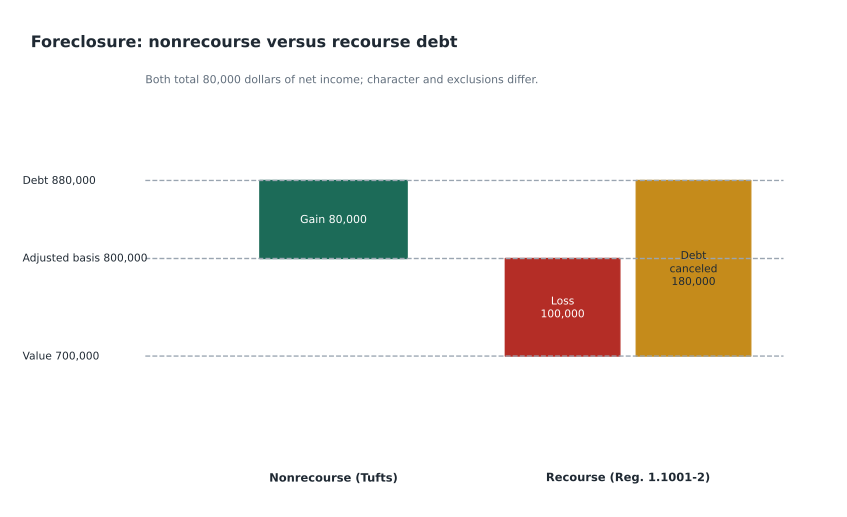
Using illustrative numbers, an investor bought a rental building for 1,000,000 dollars, paying 100,000 dollars in cash and borrowing 900,000 dollars. Over several years she claimed 200,000 dollars of depreciation and paid the loan down to 880,000 dollars. The building is now worth 700,000 dollars, and the lender forecloses. What are her tax consequences if the loan is nonrecourse, and if it is recourse and the lender forgives the deficiency? Assume she is solvent.
Show solution
- Adjusted basis is 1,000,000 minus 200,000 of depreciation, which equals 800,000 dollars.
- Nonrecourse: under Tufts, amount realized is the full debt of 880,000 dollars. Gain is 880,000 minus 800,000, which equals 80,000 dollars. There is no cancellation of debt income.
- Recourse: the transaction is bifurcated. Amount realized on the sale is the fair market value of 700,000 dollars. The result is 700,000 minus 800,000, a loss of 100,000 dollars on the building.
- Recourse, continued: the debt exceeds the value by 880,000 minus 700,000, which equals 180,000 dollars. When the lender forgives it, she has 180,000 dollars of ordinary cancellation of debt income, not excludable because she is solvent.
- Check: under both approaches her net result is 80,000 dollars of income, since 180,000 minus 100,000 equals 80,000. Only the character and timing differ.
Answer: With nonrecourse debt she has 80,000 dollars of gain. With recourse debt she has a 100,000 dollar loss on the building and 180,000 dollars of ordinary cancellation of debt income. For a rental building held more than a year, the loss would generally be a section 1231 loss and the gain partly unrecaptured section 1250 gain.
Two further cases mark the limits. In Estate of Franklin v. Commissioner (1976), the Ninth Circuit held that nonrecourse debt that substantially exceeded the property's value at purchase was not genuine debt and could not be included in basis, because no rational buyer would pay it off. And section 7701(g) provides that in determining gain or loss, the value of property is treated as not less than any nonrecourse debt to which it is subject, codifying Tufts. In Diedrich v. Commissioner (1982), the Supreme Court held that a donor who made a gift on condition that the donee pay the donor's gift tax realized income to the extent the tax paid exceeded the donor's basis, applying the same principle that relief from a liability is an amount realized.
Depreciation recapture
Depreciation deductions offset ordinary income, but gain on the later sale of the property might be taxed at lower capital gain rates. Without a correction, a taxpayer could convert ordinary income into capital gain simply by depreciating property and selling it. Section 1245 provides the correction for personal property such as equipment, vehicles and machinery: gain on the sale is ordinary income to the extent of all depreciation previously allowed, and only gain above the original cost can be capital or section 1231 gain.
For real property, section 1250 historically recaptured only depreciation in excess of straight-line, and because buildings placed in service after 1986 must use straight-line depreciation, little is recaptured under section 1250 itself. Instead, gain attributable to straight-line depreciation on real property, called unrecaptured section 1250 gain, is taxed at a maximum rate of 25 percent, as Lesson 9 explains. Recapture income must be reported in the year of sale even in an installment sale.
Rosa's first-aid equipment illustrates section 1245. She deducted the full 9,000 dollar cost through bonus depreciation in 2026, leaving a basis of zero. If she sells the mannequins for 5,000 dollars in 2028, her gain is 5,000 dollars, all of it ordinary income under section 1245, because it is less than the 9,000 dollars of depreciation she claimed. If she instead traded them in for new equipment, the exchange would be taxable, because section 1031 no longer applies to personal property.
Keeping the account balanced
Penwarden ends by returning to his account metaphor. Every rule in this lesson can be tested by asking whether the account balances: does the taxpayer recover tax-free exactly the after-tax dollars invested, and is every other dollar taxed once? Crane and Tufts balance the account when borrowed money that went into basis is never repaid. Recapture balances the character of deductions and later gain. Carryover basis for gifts keeps gain in the system, while stepped-up basis at death is the great exception, a deliberate hole in the account that Congress has repeatedly chosen to keep.
Summary and key terms
- Basis records after-tax investment; it starts at cost, rises with improvements and falls with depreciation.
- Gifts take carryover basis, with a lower basis for loss when value at the gift is less than the donor's basis.
- Inherited property takes a basis equal to value at death, eliminating income tax on lifetime appreciation.
- Borrowed money is included in basis; under Crane and Tufts, relief from nonrecourse debt is included in amount realized in full, even above value.
- For recourse debt, a foreclosure splits into a sale at fair market value and cancellation of debt income for the excess.
- Section 1245 recaptures depreciation on personal property as ordinary income; unrecaptured section 1250 gain on buildings is taxed at up to 25 percent.
Practice problems
Work each problem on paper first, then reveal the answer to check.
A donor's basis is 20,000 dollars and the value at the gift is 25,000 dollars. The donee sells for 30,000 dollars. What is the gain?
Show answer
10,000 dollars, using the donor's 20,000 dollar carryover basis.
Why must nonrecourse debt be included in amount realized?
Show answer
It was included in basis and supported tax-free depreciation; when it is not repaid, including it in amount realized balances the account.
A taxpayer inherits stock worth 40,000 dollars that the decedent bought for 5,000 dollars, and sells it two weeks later for 41,000 dollars. What is the gain and its character?
Show answer
1,000 dollars of long-term capital gain; inherited property has a stepped-up basis and is treated as held more than one year.
Equipment bought for 50,000 dollars has been depreciated to 20,000 dollars and is sold for 35,000 dollars. How much is ordinary income?
Show answer
All 15,000 dollars of gain, because it is less than the 30,000 dollars of depreciation claimed.
Lesson quiz · 5 questions
Score 60% or more to complete this lesson.
Create a free account to save your progress, take quizzes and earn a certificate.