
LAWU-212 · Lesson 5 of 12 · 21 min
Personal deductions and the standard deduction
▶ Video coming soon A video version of this lesson is on the way.
Lesson 4 dealt with the costs of earning income. This lesson deals with deductions that have nothing to do with earning income: payments for medical care, state and local taxes, home mortgage interest and gifts to charity, together with the standard deduction that most taxpayers take instead. These provisions are not required by any theory of net income. They are policy choices, many of them expensive, and Congress changed several of them in the One Big Beautiful Bill Act of July 4, 2025. Penwarden puts it bluntly: "Personal deductions are where the Code stops measuring income and starts handing out subsidies. Read each one as a spending program and ask who gets the money."
The lesson also explains a structural point that confuses many students: where a deduction sits in the tax formula matters as much as whether it exists. A deduction taken in computing adjusted gross income helps every taxpayer who qualifies. An itemized deduction helps only taxpayers whose itemized deductions exceed the standard deduction. And a new group of deductions created in 2025 sits in between, available to taxpayers who do not itemize.
Above the line and below the line
Section 62 defines adjusted gross income as gross income minus a list of deductions. These are called above-the-line deductions, after the line on the return where adjusted gross income appears. They include the trade or business deductions of Lesson 4 for self-employed people, losses from the sale of property, rental and royalty expenses, half of self-employment tax, health insurance premiums of the self-employed, contributions to health savings accounts and traditional individual retirement accounts within their limits, interest on qualified student loans up to 2,500 dollars, alimony paid under divorce instruments executed before 2019, and a small deduction for teachers' classroom costs.
Adjusted gross income matters beyond the deductions themselves. Many other provisions use it, or a modified version of it, as a measuring stick: the floor for medical expenses, the ceilings on charitable gifts, the phase-outs of credits and of the new 2025 deductions, the taxation of Social Security benefits and the net investment income tax. Reducing adjusted gross income therefore can unlock other benefits, while increasing it can cost more than the marginal rate suggests.
After adjusted gross income, the taxpayer subtracts either the standard deduction or itemized deductions, whichever is larger, then the qualified business income deduction under section 199A and the new deductions for tips, overtime, car loan interest and seniors. The personal exemption, once a deduction of a few thousand dollars for each family member, was set to zero from 2018 through 2025 and was eliminated permanently by the 2025 act; its function is now served by the larger standard deduction and the child tax credit.
The standard deduction
The standard deduction is a flat amount that a taxpayer may subtract instead of itemizing. It simplifies the system by sparing most households from tracking personal expenses, and it guarantees that a basic amount of income is untaxed. For 2026 it is 16,100 dollars for a single filer, 32,200 dollars for a married couple filing jointly and 24,150 dollars for a head of household. Taxpayers who are 65 or older or blind receive an additional amount for each condition: 2,050 dollars if unmarried and 1,650 dollars for each qualifying spouse if married. A person who can be claimed as a dependent on someone else's return receives a limited standard deduction.
Because the 2017 legislation nearly doubled the standard deduction and limited several itemized deductions, the share of households that itemize fell from roughly three in ten to about one in ten. The 2025 act made the larger standard deduction permanent. For most of Penwarden's future clients, he says, the practical question is not which itemized deductions they have but whether the total clears the standard deduction at all.
The 2025 deductions for tips, overtime, car loans and seniors
The 2025 act created four deductions for tax years 2025 through 2028 that are taken after adjusted gross income but are available whether or not the taxpayer itemizes. Each requires a valid Social Security number and each phases out at higher incomes.
| Deduction | Annual limit | Phase-out begins (modified AGI) | Key conditions |
|---|---|---|---|
| Qualified tips | 25,000 dollars per return | 150,000 dollars; 300,000 dollars joint | Voluntary cash or charged tips in an occupation that customarily received tips before 2025, as listed by Treasury; reported to the taxpayer |
| Qualified overtime compensation | 12,500 dollars; 25,000 dollars joint | 150,000 dollars; 300,000 dollars joint | Only the premium portion of overtime required by section 7 of the Fair Labor Standards Act, such as the extra half in time and a half |
| Car loan interest | 10,000 dollars | 100,000 dollars; 200,000 dollars joint | Loan incurred after 2024 to buy a new personal-use vehicle with final assembly in the United States, secured by the vehicle |
| Senior deduction | 6,000 dollars per eligible person | 75,000 dollars; 150,000 dollars joint | Taxpayer or spouse aged 65 or older by the end of the year; reduced by 6 percent of modified AGI above the threshold |
Married taxpayers must file jointly to claim the tips, overtime and senior deductions. The tips and overtime deductions phase out by 100 dollars for each 1,000 dollars of modified adjusted gross income above the threshold. These deductions reduce income tax only; tips and overtime remain fully subject to Social Security and Medicare taxes. Penwarden points out the line-drawing problems they create: which occupations count as customarily tipped, how to identify the overtime premium when a state law or union contract requires more overtime than federal law, and whether a mandatory service charge is a tip. Treasury guidance answers some of these questions, and practitioners should read it closely.
Rosa qualifies for the overtime deduction. Her hospital pays time and a half for hours over forty a week, as federal law requires. Of her 88,000 dollars of wages, 12,000 dollars is overtime pay, of which one third, or 4,000 dollars, is the premium portion. She may deduct 4,000 dollars, which is under the 12,500 dollar limit, and her modified adjusted gross income is well below 150,000 dollars. The 8,000 dollars of straight-time pay for those hours remains fully taxable.
Itemized deductions: medical expenses
Section 213 allows a deduction for unreimbursed expenses for medical care of the taxpayer, spouse and dependents, but only to the extent they exceed 7.5 percent of adjusted gross income. Medical care includes amounts paid for the diagnosis, cure, mitigation, treatment or prevention of disease, prescription drugs, health insurance premiums paid with after-tax dollars and long-term care within limits. Cosmetic surgery is excluded unless it corrects a deformity from a congenital abnormality, accident or disease. The floor means that the deduction helps mainly households facing very large medical bills relative to their income.
State and local taxes
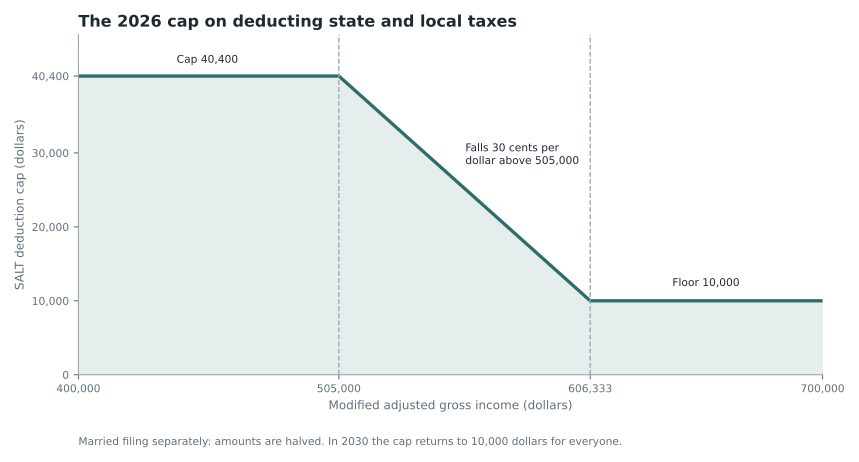
Section 164 allows a deduction for state and local income taxes, or general sales taxes instead, and real and personal property taxes. The deduction has long been defended as a matter of federalism and attacked as a subsidy for high-tax states. The 2017 legislation capped the deduction at 10,000 dollars a year. The 2025 act raised the cap to 40,000 dollars for 2025, increasing by 1 percent each year through 2029, so the cap is 40,400 dollars for 2026. The higher cap phases down by 30 percent of modified adjusted gross income above 500,000 dollars in 2025, a threshold that also rises by 1 percent a year to 505,000 dollars in 2026, but the cap never falls below 10,000 dollars. For married people filing separately, the amounts are halved. In 2030, the cap returns to 10,000 dollars.
The cap applies to individuals' personal taxes. Taxes paid in carrying on a trade or business, such as property taxes on business property, remain deductible under section 162 without the cap. Many states responded to the 2017 cap by enacting pass-through entity taxes, which let partnerships and S corporations pay state income tax at the entity level and deduct it as a business expense; the IRS accepted that approach in Notice 2020-75, and the 2025 act left it in place.
Home mortgage interest
Section 163(h) disallows personal interest, such as interest on credit cards and most consumer loans, but allows qualified residence interest. That is interest on acquisition indebtedness used to buy, build or substantially improve a principal residence or one other residence, secured by the residence. Debt incurred after December 15, 2017 qualifies only up to 750,000 dollars, or 1,000,000 dollars for older debt. The 2025 act made the 750,000 dollar limit permanent and restored the deduction for mortgage insurance premiums as interest. Interest on a home equity loan is deductible only if the proceeds were used to buy, build or substantially improve the home.
Rosa's 20,000 dollar loan from the credit union to build a garage shows how the rules apply. If the loan is secured by her house, building a garage is a substantial improvement, and the interest is qualified residence interest. If the loan is unsecured, the interest is nondeductible personal interest, even though the money went into the house. The tracing and security rules control, not the label the lender uses.
Charitable contributions
Section 170 allows a deduction for contributions to qualified charitable organizations, including churches, schools, hospitals, public charities and private foundations, and to governments for public purposes. A contribution must be a gift, made with detached and disinterested generosity in the sense used in Duberstein; if the donor receives goods or services in return, only the excess of the payment over their value is deductible. Gifts of cash are deductible up to 60 percent of adjusted gross income, a limit the 2025 act made permanent. Gifts of appreciated long-term capital gain property to public charities are generally deductible at fair market value, up to 30 percent of adjusted gross income, which means the donor never pays tax on the appreciation. Excess amounts carry forward for five years. Contributions of 250 dollars or more require a contemporaneous written acknowledgment from the charity, and noncash gifts over 5,000 dollars generally require a qualified appraisal.
The 2025 act made three changes starting in 2026. First, taxpayers who do not itemize may deduct up to 1,000 dollars, or 2,000 dollars on a joint return, of cash gifts to public charities, though not to donor-advised funds or supporting organizations. Second, itemizers may deduct charitable contributions only to the extent they exceed 0.5 percent of their contribution base, which is generally adjusted gross income. Third, corporations may deduct charitable contributions only to the extent they exceed 1 percent of taxable income.
Limits on itemized deductions for high earners
From 1991 through 2017, the Pease limitation reduced itemized deductions for high-income taxpayers by a percentage of income above a threshold. It was suspended from 2018 through 2025. The 2025 act repealed it and replaced it with a different limit beginning in 2026, sometimes called the 2/37 rule. A taxpayer in the 37 percent bracket must reduce itemized deductions by 2/37 of the lesser of the deductions or the amount of taxable income above the start of the 37 percent bracket. The effect is to cap the value of each dollar of itemized deductions at 35 cents rather than 37 cents for the highest earners.
Worked problem
Itemize or take the standard deduction?
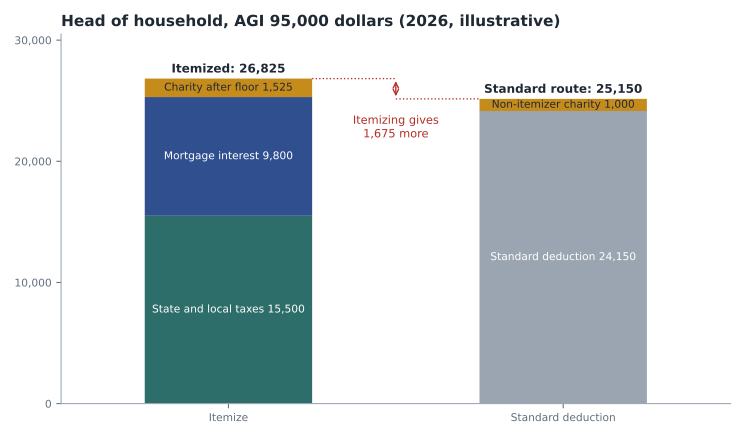
Suppose, using illustrative figures, that a head of household has adjusted gross income of 95,000 dollars in 2026. She paid 15,500 dollars of state income and property taxes, 9,800 dollars of qualified residence interest and 2,000 dollars of cash gifts to her church. Should she itemize, and how much larger is her deduction if she does?
Show solution
- State and local taxes: 15,500 dollars, which is under the 40,400 dollar cap, so all of it counts.
- Mortgage interest: 9,800 dollars of qualified residence interest counts in full.
- Charitable gifts: the 0.5 percent floor is 0.005 times 95,000, or 475 dollars. The deductible amount is 2,000 minus 475, which is 1,525 dollars.
- Total itemized deductions: 15,500 plus 9,800 plus 1,525 equals 26,825 dollars.
- Standard deduction for a head of household in 2026: 24,150 dollars. If she took the standard deduction instead, she could also deduct her 2,000 dollars of cash gifts as a non-itemizer, but only up to 1,000 dollars on a single or head of household return, for a total of 25,150 dollars.
- Compare: 26,825 dollars itemized versus 25,150 dollars standard plus the non-itemizer charitable deduction.
Answer: She should itemize. Her itemized deductions of 26,825 dollars exceed the alternative of 25,150 dollars by 1,675 dollars, which in the 22 percent bracket saves about 368.50 dollars of tax. Without the new non-itemizer charitable deduction, the difference would have been 2,675 dollars.
Other personal deductions and losses
Personal casualty and theft losses, such as damage to a home from a storm, are deductible only if attributable to a federally declared disaster, a restriction the 2025 act made permanent while extending it to certain state-declared disasters. Gambling losses are deductible as itemized deductions only to the extent of gambling winnings, and from 2026 only up to 90 percent of losses, so a gambler who wins and loses equal amounts now has some taxable income. Investment interest is deductible up to net investment income under section 163(d). The deductions for moving expenses, except for members of the armed forces and certain intelligence personnel, and for unreimbursed employee expenses remain unavailable.
Why the structure matters
Penwarden closes by asking who benefits from each deduction. An itemized deduction is worth the taxpayer's marginal rate times the amount by which it raises total deductions above the standard deduction, so it is worth more to high earners and nothing to the large majority who take the standard deduction. A credit, by contrast, is worth the same to everyone who can use it. Scholars call deductions that serve policy goals tax expenditures, and the Joint Committee on Taxation estimates their cost each year. Thinking of the mortgage interest deduction as a housing subsidy that gives the most to people with the largest mortgages and the highest rates is, he says, the beginning of tax policy.
Summary and key terms
- Above-the-line deductions reduce adjusted gross income and help everyone who qualifies; itemized deductions help only those whose total exceeds the standard deduction.
- For 2026 the standard deduction is 16,100 dollars single, 32,200 dollars joint and 24,150 dollars head of household, and the personal exemption is permanently gone.
- The 2025 act added temporary deductions for tips, overtime premiums, car loan interest and seniors, available to non-itemizers through 2028.
- The SALT cap is 40,400 dollars for 2026, phased down for high incomes to a floor of 10,000 dollars, and returns to 10,000 dollars in 2030.
- The mortgage interest limit of 750,000 dollars is permanent; interest on unsecured or non-home debt is nondeductible personal interest.
- From 2026, non-itemizers may deduct some cash gifts to charity, itemizers face a 0.5 percent floor, and top-bracket taxpayers face the 2/37 limit.
Practice problems
Work each problem on paper first, then reveal the answer to check.
Why does it matter whether a deduction is above or below the line?
Show answer
Above-the-line deductions reduce adjusted gross income for everyone; itemized deductions help only those who itemize, and AGI drives many phase-outs and floors.
An hourly worker earns 6,000 dollars of time-and-a-half overtime pay. How much is deductible as qualified overtime?
Show answer
The premium portion, one third, or 2,000 dollars, subject to the limits and phase-outs.
What is the 2026 SALT cap for a single filer with modified AGI of 300,000 dollars?
Show answer
40,400 dollars, because the phase-down starts only above 505,000 dollars.
Is interest on a 15,000 dollar unsecured loan used to remodel a kitchen deductible?
Show answer
No. Qualified residence interest requires that the debt be secured by the residence.
Lesson quiz · 5 questions
Score 60% or more to complete this lesson.
Create a free account to save your progress, take quizzes and earn a certificate.