
LAWU-212 · Lesson 4 of 12 · 20 min
Deductions
▶ Video coming soon A video version of this lesson is on the way.
Penwarden begins the lesson on deductions with a maxim from the Supreme Court: deductions are a matter of legislative grace. In New Colonial Ice Co. v. Helvering (1934) and many later cases, the Court said that a taxpayer may deduct an expense only if a statute clearly allows it, and the taxpayer bears the burden of proving entitlement. "Income is presumed," he tells Section B. "Deductions must be earned. Find the section, satisfy its conditions and keep the receipts." This lesson covers the deductions for the costs of earning income in a trade or business, which are the most important deductions in the Code. Lesson 5 covers personal deductions and the standard deduction.
The basic idea is that an income tax should tax net income, not gross receipts. A business that takes in 100,000 dollars and spends 80,000 dollars earning it is 20,000 dollars better off, and that is what the tax should reach. The difficulty lies at the edges: separating business costs from personal consumption, which is not deductible, and separating costs that produce income this year from costs that produce income over many years, which must be capitalized and recovered over time.
Section 162: ordinary and necessary business expenses
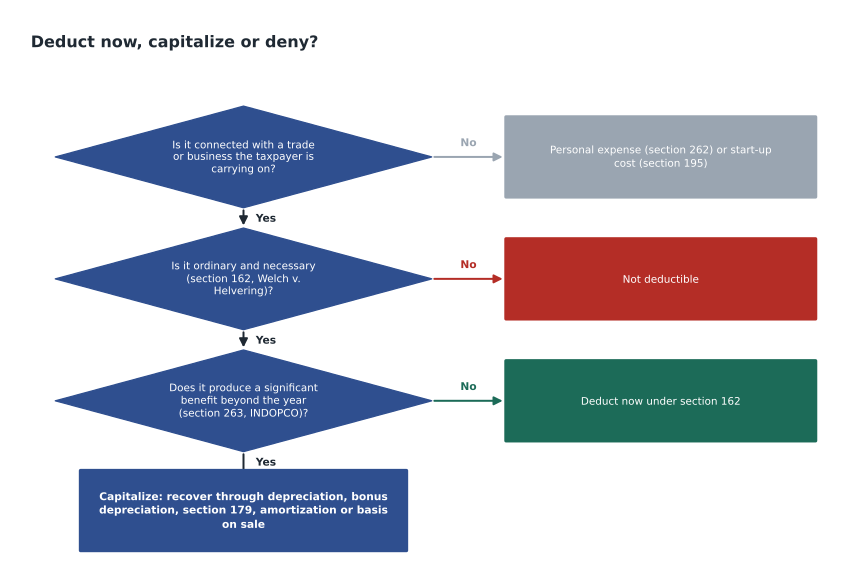
Section 162(a) allows a deduction for all the ordinary and necessary expenses paid or incurred during the taxable year in carrying on any trade or business. Each word matters. The expense must be paid or incurred in the year, depending on the taxpayer's accounting method. It must be connected with a trade or business, meaning an activity carried on with continuity and regularity and with the primary purpose of making a profit, as the Supreme Court explained in Commissioner v. Groetzinger (1987). It must be carried on, which excludes start-up costs before the business begins. And it must be ordinary and necessary.
Welch v. Helvering (1933) is the classic case on ordinary. Thomas Welch had been secretary of a grain company that failed and was discharged in bankruptcy. Later, starting his own grain business, he paid off some of the old company's debts to restore his reputation with former customers. The Supreme Court held that the payments were not ordinary expenses. Justice Cardozo wrote that people do not ordinarily pay the debts of others, and that the payments were more like capital expenditures to acquire goodwill. His opinion acknowledged that the line is hard to draw: life in all its fullness must supply the answer to the riddle. Ordinary does not mean habitual for the particular taxpayer; it means normal or customary in the type of business, even if the particular expense happens only once in a lifetime.
Necessary means appropriate and helpful, not indispensable. Courts rarely second-guess a business's judgment about whether an expense was wise. The harder questions concern expenses that mix business and personal elements, which the Code addresses in several specific rules discussed below, and expenses that are lavish or extravagant, which section 162(a)(2) and the regulations disallow to the extent unreasonable. Reasonable compensation is deductible as salary; excessive payments to shareholder-employees may be recharacterized as nondeductible dividends.
Personal and business expenses
Section 262 provides that no deduction is allowed for personal, living or family expenses unless the Code expressly allows it. Commuting between home and a regular workplace is personal, as the Court held in Commissioner v. Flowers (1946), even though the commute is necessary to work. Ordinary clothing is personal even if worn only to work, unless it is a uniform unsuitable for general wear. Child care is personal, though a credit exists for it, as Lesson 11 explains.
Several sections draw the line in specific settings. Travel away from home overnight on business is deductible, including lodging and half the cost of meals, but a taxpayer's tax home is the principal place of business. Section 274 imposes strict substantiation requirements for travel, gifts and listed property such as cars, disallows deductions for entertainment entirely since 2018, and generally limits business meals to 50 percent. Section 280A allows a home office deduction only if part of the home is used regularly and exclusively as the principal place of business or for meeting clients; employees cannot claim it at all, because unreimbursed employee expenses are no longer deductible.
That last point reflects a major change. Before 2018, employees could deduct unreimbursed business expenses, such as professional dues, work tools and job-search costs, as miscellaneous itemized deductions above a floor of 2 percent of adjusted gross income. The 2017 legislation suspended those deductions through 2025, and the 2025 act eliminated them permanently, with a narrow exception for teachers' classroom expenses. Rosa, as a hospital employee, cannot deduct the cost of her own stethoscope or nursing shoes. If she buys the same items for her first-aid business, she can deduct them, because she is then a self-employed person carrying on a trade or business.
Hobbies and profit-seeking activities
An activity that is not engaged in for profit is a hobby. Section 183 historically allowed hobby expenses up to hobby income as miscellaneous itemized deductions, which means that after 2017 hobby expenses became effectively nondeductible while hobby income remained fully taxable. Whether an activity is a business depends on the taxpayer's actual and honest profit objective, judged under nine factors in Treasury Regulation section 1.183-2, including the manner in which the activity is carried on, the expertise of the taxpayer, the time and effort spent, the history of income or losses and the elements of personal pleasure. A presumption of profit motive arises if the activity shows a profit in three of five consecutive years.
Rosa's first-aid classes pass the test easily. She is certified as an instructor, she advertises, she keeps books, she charges market rates and she has made a profit every year. Penwarden contrasts a fictional friend of Rosa's who breeds show dogs, has lost money for nine years and spends most of the losses on travel to dog shows. That activity looks like a hobby, and the losses cannot shelter wage income.
Capital expenditures
Section 263 denies a current deduction for amounts paid for new buildings or permanent improvements that increase the value of property. The idea is matching: a cost that produces benefits over many years should be deducted over those years, not all at once. In INDOPCO, Inc. v. Commissioner (1992), the Supreme Court held that a target corporation's legal and investment banking fees for a friendly takeover had to be capitalized, because they produced significant long-term benefits for the company, even though they did not create a separate asset. Treasury later issued detailed regulations under section 263(a) that identify which costs to acquire or create intangibles must be capitalized and that give safe harbors, including a rule that benefits lasting no more than twelve months generally may be deducted.
For tangible property, the regulations distinguish repairs, which are deductible, from improvements, which must be capitalized. An improvement is a betterment, a restoration or an adaptation of the property to a new use. Replacing a few shingles on a roof is a repair; replacing the whole roof is a restoration. Businesses may elect a de minimis safe harbor to expense items costing up to 2,500 dollars per invoice or item, or 5,000 dollars for businesses with audited financial statements, and a routine maintenance safe harbor for recurring work expected to be needed more than once during the property's life.
Depreciation and cost recovery
Capitalized costs of property used in a business or held for the production of income are recovered through depreciation under sections 167 and 168, amortization under section 197 for most acquired intangibles such as goodwill, or not at all until disposition for land and other non-wasting assets. The modified accelerated cost recovery system assigns each type of property a recovery period, such as five years for computers and cars, seven years for office furniture and most machinery, 27.5 years for residential rental buildings and 39 years for nonresidential buildings, and specifies methods and conventions that front-load deductions for most personal property.
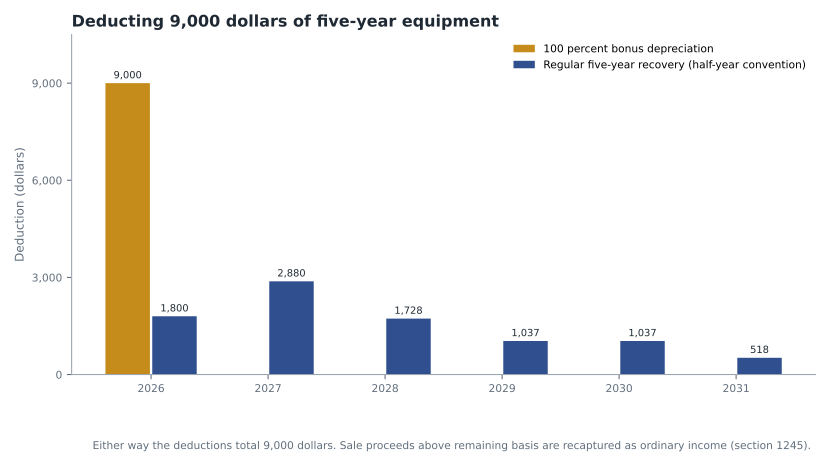
Two provisions let businesses deduct much more in the first year. Section 168(k) bonus depreciation allows an immediate deduction of a percentage of the cost of qualifying property, generally new or used tangible property with a recovery period of twenty years or less. The 2017 legislation set bonus depreciation at 100 percent and then phased it down after 2022. The 2025 act restored 100 percent bonus depreciation permanently for qualifying property acquired after January 19, 2025. Section 179 separately allows small and medium businesses to expense the cost of qualifying property up to a dollar limit, which the 2025 act raised to 2,500,000 dollars, phasing out dollar for dollar once the cost of property placed in service exceeds 4,000,000 dollars, with both amounts indexed for inflation.
Deductions for depreciation reduce the basis of the property. When the property is sold, the earlier deductions are recaptured as ordinary income to the extent of gain on personal property under section 1245, and gain on real property attributable to straight-line depreciation is taxed at a maximum 25 percent rate. Lesson 9 returns to recapture. Penwarden warns that immediate expensing is a timing benefit, not a permanent exclusion: the deduction today reduces basis and increases taxable gain later.
Losses, start-up costs and other business deductions
Section 165 allows a deduction for losses sustained during the year and not compensated by insurance, but individuals may deduct losses only if incurred in a trade or business, in a transaction entered into for profit or, for personal casualty and theft losses, in limited cases now generally restricted to federally declared disasters. Section 195 allows a business to deduct up to 5,000 dollars of start-up costs in the year it begins, reduced by start-up costs above 50,000 dollars, and to amortize the rest over fifteen years. Section 174, as amended in 2025, again allows an immediate deduction for domestic research and experimental costs.
Section 162 also contains several public policy limits. No deduction is allowed for illegal bribes and kickbacks under section 162(c), for fines and penalties paid to a government for violating a law under section 162(f), with an exception for restitution and amounts paid to come into compliance, or for most lobbying and political expenditures under section 162(e). Expenses of an illegal business are otherwise deductible, a result the Court reached in Commissioner v. Sullivan (1958), except that section 280E denies deductions other than cost of goods sold to businesses trafficking in controlled substances listed in Schedule I or II.
The qualified business income deduction
Owners of sole proprietorships, partnerships and S corporations may claim the section 199A deduction, which generally equals 20 percent of qualified business income from the business. The deduction was enacted in 2017 to give pass-through businesses a benefit comparable to the reduced corporate rate, and it was scheduled to expire after 2025. The 2025 act made it permanent, widened the income ranges over which limitations phase in and added a minimum deduction of 400 dollars for taxpayers with at least 1,000 dollars of qualified business income from businesses in which they materially participate. Above certain taxable income levels, the deduction is limited by wages paid and property owned, and is phased out for specified service businesses such as law, medicine and consulting. The deduction is taken after adjusted gross income and is available whether or not the taxpayer itemizes.
Worked problem
Rosa's first-aid business
In 2026, Rosa's weekend first-aid business earns 31,000 dollars in class fees. She pays 1,200 dollars for advertising, 1,800 dollars for gloves and bandage supplies used in classes and 2,400 dollars to rent a community room. In March she buys training mannequins and automated defibrillator trainers for 9,000 dollars, all new property with a five-year recovery period. She also buys a 400 dollar winter coat to wear to class. What is her net profit, and what is her self-employment tax? The numbers are illustrative.
Show solution
- Advertising, supplies and room rental are ordinary and necessary expenses under section 162: 1,200 plus 1,800 plus 2,400 equals 5,400 dollars.
- The equipment is a capital expenditure, but because it was acquired after January 19, 2025, it qualifies for 100 percent bonus depreciation: 9,000 dollars deducted in 2026, leaving a basis of zero.
- The coat is ordinary clothing suitable for general wear, so it is a personal expense under section 262 and is not deductible.
- Net profit is 31,000 minus 5,400 minus 9,000, which equals 16,600 dollars.
- Self-employment tax applies to 92.35 percent of net earnings: 16,600 times 0.9235 equals 15,330.10 dollars. At 15.3 percent, the tax is about 2,345.51 dollars, because her wages are below the Social Security wage base.
- Half of the self-employment tax, about 1,172.75 dollars, is deductible above the line under section 164(f).
Answer: Rosa's net profit is 16,600 dollars and her self-employment tax is about 2,345.51 dollars, half of which she deducts in computing adjusted gross income. Her business income may also support a section 199A deduction, computed after other adjustments.
Substantiation and the burden of proof
Penwarden ends with records. A taxpayer must keep books and records sufficient to establish the amount of deductions. Under the Cohan rule, from Cohan v. Commissioner (1930), a court may estimate a deductible expense when the taxpayer proves that some expense was incurred but cannot prove the exact amount, bearing heavily against the taxpayer whose inexactitude is of his own making. Section 274(d) overrides Cohan for travel, gifts and listed property, which require adequate records showing amount, time, place and business purpose. "Clients lose more deductions to missing receipts than to bad law," he says.
Summary and key terms
- Deductions are a matter of legislative grace; the taxpayer must find the provision and prove entitlement.
- Section 162 allows ordinary and necessary expenses of carrying on a trade or business; section 262 denies personal expenses.
- Unreimbursed employee expenses and other miscellaneous itemized deductions were eliminated permanently by the 2025 act, apart from teachers' classroom costs.
- Costs producing long-term benefits must be capitalized under section 263 and INDOPCO and recovered through depreciation or amortization.
- The 2025 act restored permanent 100 percent bonus depreciation for property acquired after January 19, 2025 and raised section 179 expensing to 2,500,000 dollars.
- The section 199A deduction of 20 percent of qualified business income is now permanent.
Practice problems
Work each problem on paper first, then reveal the answer to check.
Why were Welch's payments of the old company's debts not deductible?
Show answer
People do not ordinarily pay others' debts; the payments were more like capital outlays to acquire goodwill.
Can an employee deduct unreimbursed work expenses in 2026?
Show answer
No. Miscellaneous itemized deductions were eliminated permanently by the 2025 act, except for teachers' classroom expenses.
What did INDOPCO hold?
Show answer
Costs that produce significant long-term benefits must be capitalized even if they do not create a separate asset.
Does immediate expensing permanently reduce tax?
Show answer
No. It reduces basis to zero, so the deduction is recaptured as ordinary income if the property is later sold at a gain.
Lesson quiz · 5 questions
Score 60% or more to complete this lesson.
Create a free account to save your progress, take quizzes and earn a certificate.