
LAWU-212 · Lesson 3 of 12 · 20 min
Exclusions from gross income
▶ Video coming soon A video version of this lesson is on the way.
If income is broad, exclusions are where tax lawyers earn their fees. Penwarden tells Section B that every exclusion has the same structure: a category of receipt that Congress chose not to tax, a set of conditions, and limits designed to stop people from fitting ordinary income into the category. "Read the conditions," he says. "Clients lose exclusions because they skipped a condition, not because the exclusion did not exist." This lesson covers the exclusions a general practitioner meets most often: gifts and inheritances, life insurance, scholarships, damages for personal physical injuries, employee fringe benefits and a few others.
Gifts, bequests and inheritances
Section 102(a) excludes the value of property acquired by gift, bequest, devise or inheritance. The donor may owe federal gift tax, though in practice very few do, because each donor may give 19,000 dollars per recipient in 2026 without even using any of the lifetime exemption, and the lifetime exemption for gifts and estates is 15,000,000 dollars per person for 2026 under the 2025 act, indexed for inflation afterwards. The recipient never pays income tax on the gift itself. The recipient does pay tax on income the gift later produces, under section 102(b), and on gain when the property is sold, measured from a basis that Lesson 8 explains.
The hard question is what counts as a gift. In Commissioner v. Duberstein (1960), Duberstein gave a business contact the names of potential customers, and the contact later gave him a Cadillac. In a companion case, a church gave its departing comptroller a gratuity of 20,000 dollars. The Supreme Court held that a gift for income tax purposes must proceed from a detached and disinterested generosity, out of affection, respect, admiration, charity or like impulses. The most critical consideration is the transferor's intention. A transfer made because of a moral or legal duty, or in return for past or expected economic benefit, is not a gift even if the parties call it one.
Duberstein also held that the question is one of fact, to be decided case by case by the trier of fact using experience with the mainsprings of human conduct, and reviewed only for clear error. The result is that similar transfers can come out differently, and the outcome depends heavily on evidence about motive. Penwarden notes that this makes gift cases good practice for trial lawyers: the documents, the relationship and the timing tell the story.
Congress narrowed the question for employees. Section 102(c) provides that the gift exclusion does not apply to any amount transferred by or for an employer to or for the benefit of an employee. A holiday bonus is compensation regardless of the employer's warm feelings. Small holiday gifts of nominal value, such as a turkey, may be excluded as de minimis fringe benefits under section 132(e), and employee achievement awards of tangible property for length of service or safety are excludable within limits under section 74(c). Cash and gift cards are not de minimis.
The gift exclusion also matters for tips. Tips are not gifts, even though customers give them voluntarily, because they are paid in connection with services. Tips have always been gross income. The 2025 act created a temporary deduction for qualified tips, covered in Lesson 5, but that deduction does not make tips excludable from gross income, and the difference matters for computing adjusted gross income, self-employment tax and state taxes that follow federal adjusted gross income.
Life insurance and annuities
Section 101(a) excludes amounts received under a life insurance contract if paid by reason of the death of the insured. A surviving spouse who collects 500,000 dollars of life insurance owes no income tax on it. If the proceeds are paid in installments with interest, the interest element is taxable. The exclusion is limited by the transfer for value rule: if a policy is sold to someone who is not within certain exempt categories, the buyer may exclude only what he paid plus later premiums. Accelerated death benefits paid to a terminally ill or chronically ill insured are also excluded within limits.
Annuity payments are partly taxable and partly excluded under section 72. Each payment is treated as part return of the investment and part income, using an exclusion ratio equal to the investment divided by the expected return. Once the investment has been recovered, later payments are fully taxable. If the annuitant dies before recovering the investment, the unrecovered amount is deductible on the final return. The approach reflects the principle from Lesson 2 that a return of capital is not income.
Scholarships and education benefits
Section 117 excludes qualified scholarships received by degree candidates, but only to the extent used for qualified tuition and related expenses, meaning tuition, fees, books, supplies and equipment required for courses. Amounts used for room, board and travel are taxable. The exclusion does not apply to any part of a scholarship that represents payment for teaching, research or other services required as a condition of receiving it, with exceptions for certain health professions programs. A law student who receives a full-tuition scholarship excludes it; a law student who receives a stipend for living expenses includes the stipend.
Employers may provide up to 5,250 dollars a year of educational assistance tax-free under section 127, including payments on employees' student loans; the 2025 act made the student loan payment option permanent and indexed the dollar limit for inflation after 2026. Rosa's hospital pays some of her continuing education costs, which may qualify under section 127 or as a working condition fringe benefit.
Damages for personal physical injuries
Section 104(a)(2) excludes the amount of any damages, other than punitive damages, received by suit or agreement on account of personal physical injuries or physical sickness. The exclusion is one of the most important in practice, because personal injury settlements are common and large. Since 1996, the statute has required that the injury be physical. Emotional distress is not treated as a physical injury or sickness, except that damages for medical care attributable to emotional distress are excludable, and emotional distress damages that flow from a physical injury are excluded as part of the physical injury recovery.
Once there is a physical injury, all compensatory damages on account of it are excluded, including damages for pain and suffering, medical expenses and lost wages. The exclusion of lost wages is generous, because the wages themselves would have been taxed. Congress has chosen not to tax them when they come as damages for a physical injury. The main exception is the tax benefit rule: if the taxpayer deducted medical expenses in an earlier year and later recovers them, the recovery is taxable to the extent the earlier deduction produced a tax benefit.
Punitive damages are never excluded under section 104(a)(2), as the Supreme Court held in O'Gilvie v. United States (1996) and as the statute now says expressly, except for punitive damages in wrongful death cases under state laws that allow only punitive damages. Interest on a judgment or settlement is taxable. Damages for nonphysical claims, such as employment discrimination, defamation or breach of contract, are taxable unless they are on account of a physical injury. The origin of the claim controls: courts ask what the payment was intended to replace.
Attorney fees create a trap. In Commissioner v. Banks (2005), the Supreme Court held that when a plaintiff recovers taxable damages and pays a contingent fee, the plaintiff's gross income includes the portion paid to the lawyer, under the anticipatory assignment of income doctrine that Lesson 10 develops. Congress has provided an above-the-line deduction for attorney fees in unlawful discrimination cases and certain whistleblower claims, under section 62(a)(20) and (21). For other taxable recoveries, such as punitive damages in a personal injury case, the fee could once be deducted only as a miscellaneous itemized deduction. Those deductions were suspended in 2018 and eliminated permanently by the 2025 act. The result is that a plaintiff may be taxed on money she never receives.
Worked problem
Allocating Rosa's settlement
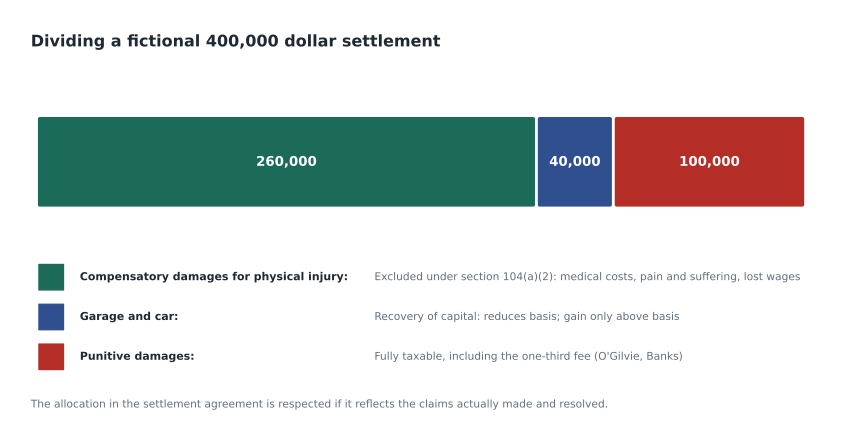
Rosa's product liability case settles for 400,000 dollars. The agreement allocates 260,000 dollars to compensatory damages for her burns, including medical costs, pain and suffering and lost wages; 40,000 dollars to the damage to her garage and car; and 100,000 dollars to punitive damages. Her lawyer takes a one-third contingent fee from the whole settlement. Rosa never deducted the medical expenses, and her basis in the damaged garage and car exceeds 40,000 dollars. How much is taxable? The numbers are illustrative.
Show solution
- Compensatory damages for physical injuries, 260,000 dollars, are excluded under section 104(a)(2), including the lost wages and the pain and suffering.
- The property damages of 40,000 dollars are a recovery of capital. Because her basis in the property exceeds 40,000 dollars, they reduce her basis rather than producing income.
- The punitive damages of 100,000 dollars are taxable under section 104(a)(2) and O'Gilvie.
- Under Banks, Rosa's gross income includes the full 100,000 dollars of punitive damages, even though one-third, about 33,333 dollars, goes to her lawyer.
- No above-the-line deduction applies, because the claim is not for discrimination or whistleblowing, and miscellaneous itemized deductions are no longer allowed.
Answer: Rosa includes 100,000 dollars of punitive damages in gross income, though she nets about 66,667 dollars of them. The rest of the settlement is excluded or reduces basis. A careful lawyer negotiates the allocation before signing, because a reasonable allocation in the agreement usually controls.
Penwarden draws a practical lesson. Settlement agreements should allocate damages to specific claims, and the allocation should reflect the real litigation. Courts generally respect an allocation reached at arm's length in adversarial negotiation, but they disregard allocations that are inconsistent with the pleadings and evidence or designed only to avoid tax. A lawyer who leaves allocation to chance may cost the client tens of thousands of dollars.
Employee fringe benefits
Section 61 includes fringe benefits in gross income unless a specific provision excludes them. Several provisions do. Section 132 excludes no-additional-cost services, such as an airline employee's standby seat; qualified employee discounts, within limits; working condition fringes, meaning property or services that would be deductible as a business expense if the employee paid for them; de minimis fringes so small that accounting for them is unreasonable; qualified transportation fringes, up to 340 dollars a month in 2026 for transit passes or parking; and on-premises athletic facilities. The working condition fringe is why Rosa's hospital can pay her license renewal and continuing education fees without creating income for her.
Section 119 excludes the value of meals furnished on the employer's business premises for the employer's convenience, and lodging that the employee must accept on the premises as a condition of employment. The rule grew out of Benaglia v. Commissioner (1937), in which the manager of a resort hotel lived and ate at the hotel because his job required him to be available at all hours. In Commissioner v. Kowalski (1977), the Supreme Court held that cash meal allowances paid to state troopers were not excludable, because section 119 covers only meals in kind. The employer's deduction for such meals is also being limited under section 274.
Health coverage is the largest fringe benefit of all. Employer contributions to accident and health plans are excluded under section 106, and benefits paid under them are excluded under sections 104(a)(3) and 105. Employer contributions to qualified retirement plans are not taxed until benefits are paid. Dependent care assistance is excludable under section 129; the 2025 act raised the annual limit from 5,000 dollars to 7,500 dollars beginning in 2026. Each of these exclusions shapes how employers design compensation.
Other exclusions worth knowing
Interest on state and local government bonds is excluded under section 103, a long-standing subsidy to state and local borrowing that is limited for private activity bonds. Gain on the sale of a principal residence is excluded up to 250,000 dollars, or 500,000 dollars for many married couples, under section 121, covered in Lesson 7. Qualified disaster relief payments are excluded under section 139. Certain public benefits, such as payments based on need, are excluded under the general welfare doctrine developed by the IRS. Child support is not income to the recipient. Under the 2017 legislation, alimony paid under divorce or separation instruments executed after 2018 is neither deductible by the payer nor income to the recipient.
Social Security benefits are partly taxable under section 86, depending on the recipient's other income. Unemployment compensation is fully taxable. Workers' compensation for occupational injury or sickness is excluded under section 104(a)(1). Penwarden tells the class that clients often assume that any payment from the government, an insurer or an employer is tax-free, and that the lawyer's job is to find the provision and check its conditions.
Applying the exclusions to Rosa
Back in Rosa's file, Section B reviews the items flagged in Lesson 2. The hospital's payment of her license and education fees is excluded as a working condition fringe or under section 127. Her employer-paid health coverage is excluded. The settlement is excluded except for the punitive damages. A cash holiday bonus of 300 dollars from the hospital is taxable compensation under section 102(c), even though the card said it was a gift. A 2,000 dollar check from her aunt to help with the garage is a gift under Duberstein and section 102, assuming it came from affection rather than any expectation. And the 600 dollars of interest her savings account earned is taxable, because section 102 never excludes income from property.
Summary and key terms
- Exclusions are specific and conditional; the taxpayer must satisfy every condition.
- Gifts require detached and disinterested generosity under Duberstein, and transfers from employers to employees are never excludable gifts.
- Life insurance paid by reason of death is excluded; scholarships are excluded only for tuition and required costs.
- Section 104(a)(2) excludes compensatory damages for personal physical injuries, including lost wages, but not punitive damages, interest or damages for nonphysical claims.
- Under Banks, contingent fees on taxable recoveries are included in the client's income, and outside discrimination and whistleblower cases there is no deduction to offset them.
- Fringe benefits are taxable unless sections such as 106, 119, 127, 129 or 132 exclude them.
Practice problems
Work each problem on paper first, then reveal the answer to check.
Is a cash holiday bonus labeled a gift excludable?
Show answer
No. Section 102(c) denies the gift exclusion for transfers from an employer to an employee.
Are lost wages recovered in a car accident settlement taxable?
Show answer
No, if they are compensatory damages on account of personal physical injuries under section 104(a)(2).
What did Commissioner v. Kowalski hold?
Show answer
Cash meal allowances are not excludable under section 119, which covers only meals furnished in kind.
Why might a plaintiff pay tax on money that went to her lawyer?
Show answer
Under Banks, a contingent fee on taxable damages is income to the client, and outside discrimination and whistleblower claims no deduction is available.
Lesson quiz · 5 questions
Score 60% or more to complete this lesson.
Create a free account to save your progress, take quizzes and earn a certificate.