
LAWU-212 · Lesson 7 of 12 · 22 min
Realization, recognition and nonrecognition
▶ Video coming soon A video version of this lesson is on the way.
A share of stock bought for 1,000 dollars that is worth 5,000 dollars at year end has made its owner 4,000 dollars richer. An economist would call that income. The federal income tax does not, at least not yet. Under the realization requirement, gains and losses in the value of property are generally taxed only when a realization event, usually a sale or exchange, occurs. This lesson explains where that requirement comes from, how section 1001 measures gain and loss when realization occurs, and the many provisions that defer recognition of realized gain or loss. Penwarden calls it the lesson on "the gap between getting richer and getting taxed."
The realization requirement
In Eisner v. Macomber (1920), the Supreme Court held that a pro rata stock dividend, which gave each shareholder more shares but did not change any shareholder's proportionate interest in the corporation, was not income. The Court defined income as gain derived from capital, from labor or from both combined, and described gain as something severed from capital and received by the taxpayer for separate use. It suggested that taxing unrealized gain would exceed Congress's power under the Sixteenth Amendment.
Later cases moved away from Macomber's constitutional framing. In Helvering v. Bruun (1940), a landlord who regained possession of land on which a tenant had built a new building was held to realize income when the lease ended, even though nothing was sold, because the landlord acquired something of value in an exchange-like event. Glenshaw Glass in 1955 described income as accessions to wealth, clearly realized, over which the taxpayer has complete dominion, treating realization as part of the statutory definition rather than a constitutional limit. And Congress now taxes some unrealized gains directly: securities dealers mark their inventory to market under section 475, holders of regulated futures contracts are taxed on year-end values under section 1256, and certain wealthy expatriates are taxed on unrealized gains when they give up citizenship.
In Moore v. United States (2024), taxpayers challenged the mandatory repatriation tax of 2017, which taxed American shareholders on undistributed earnings of foreign corporations. The Supreme Court upheld the tax on the narrow ground that the corporation had realized the income and Congress may attribute it to shareholders, as it does with partnerships and S corporations. The Court expressly declined to decide whether realization is a constitutional requirement, leaving open the question that would govern any proposed tax on unrealized gains, such as an annual tax on the wealth of billionaires.
Today realization is best understood as a rule of administrative convenience grounded in the statute. Valuing every asset every year would be costly and contentious, and taxpayers might lack the cash to pay tax on paper gains. The cost of the rule is that it creates the lock-in effect, encouraging people to hold appreciated assets, and lets taxpayers choose when to realize gains and losses, which they will use to their advantage.
What counts as a realization event
Section 1001(a) says that gain from the sale or other disposition of property is the excess of the amount realized over the adjusted basis, and loss is the excess of adjusted basis over the amount realized. The regulations add that the exchange of property for other property differing materially either in kind or in extent is a realization event. In Cottage Savings Association v. Commissioner (1991), a savings and loan exchanged interests in one group of residential mortgages for interests in another group with substantially the same economic value. A federal regulator had designed the transactions so that the institution could claim tax losses without recording them for regulatory purposes. The Supreme Court held that the exchange realized the losses, because the two sets of mortgages embodied legally distinct entitlements, involving different obligors and different homes. The test of material difference, the Court said, is easy to meet.
Cottage Savings means that almost any exchange of non-identical property is a realization event. A gift is not, because the donor receives nothing; Lesson 8 explains how basis carries over to the donee. Death is not either, but section 1014 gives heirs a basis equal to the fair market value at death, so gain accrued during the decedent's life escapes income tax entirely. Borrowing against appreciated property is not a realization event, which is why the strategy sometimes called buy, borrow, die is attractive to wealthy families.
Measuring gain and loss
The amount realized under section 1001(b) is the money received plus the fair market value of any other property received. It also includes liabilities of the seller that the buyer assumes or takes the property subject to, as Lesson 8 explains. Selling expenses, such as brokers' commissions, reduce the amount realized. Adjusted basis is generally the cost of the property, increased by capital improvements and reduced by depreciation and other recoveries.
When property is exchanged for other property in a taxable exchange, the value of the property received measures the amount realized. In Philadelphia Park Amusement Co. v. United States (1954), the Court of Claims held that the basis of property received in a taxable exchange is its fair market value, which ensures that the gain recognized on the exchange is not taxed again later. If the value of the property received cannot be determined, courts presume that the values of the two sides of an arm's-length exchange are equal.
Section 1001(c) provides that the entire realized gain or loss is recognized, meaning it is taken into account in computing taxable income, unless the Code provides otherwise. The Code provides otherwise often enough that Penwarden asks students to make a habit of the two-step question: first, was gain or loss realized and how much? Second, is it recognized now, or does a nonrecognition provision defer it?
Like-kind exchanges
Section 1031 provides that no gain or loss is recognized on the exchange of real property held for productive use in a trade or business or for investment if it is exchanged solely for real property of a like kind that will be held for either purpose. Since 2018 the provision has applied only to real property; exchanges of equipment, vehicles and artwork are taxable. Like kind refers to the nature of the property, not its grade or quality, so almost any real property in the United States is like kind to any other: an apartment building for farmland, a warehouse for vacant land. Real property in the United States is not like kind to foreign real property. A personal residence does not qualify, nor does property held primarily for sale, such as a developer's lots.
The rationale is that a taxpayer who continues an investment in a similar form has not cashed out, and taxing the exchange might discourage efficient reallocation of property. Nonrecognition is mandatory if the requirements are met, which matters when the taxpayer would prefer to recognize a loss.
If the taxpayer also receives money or other non-like-kind property, called boot, section 1031(b) requires recognition of realized gain up to the amount of boot. Loss is never recognized in a like-kind exchange. Relief from a liability counts as boot, netted against any liability the taxpayer assumes. Under section 1031(d), the basis of the replacement property equals the basis of the property given up, decreased by money received and increased by gain recognized. The effect is to preserve the unrecognized gain in the new property. The holding period of the new property includes the holding period of the old.
Most exchanges today are deferred exchanges through a qualified intermediary. The taxpayer sells the relinquished property, the intermediary holds the proceeds, and the taxpayer must identify replacement property within 45 days and acquire it within 180 days, as section 1031(a)(3) requires. Starker v. United States (1979) first allowed delayed exchanges, and regulations now supply detailed safe harbors.
Worked problem
A like-kind exchange with boot
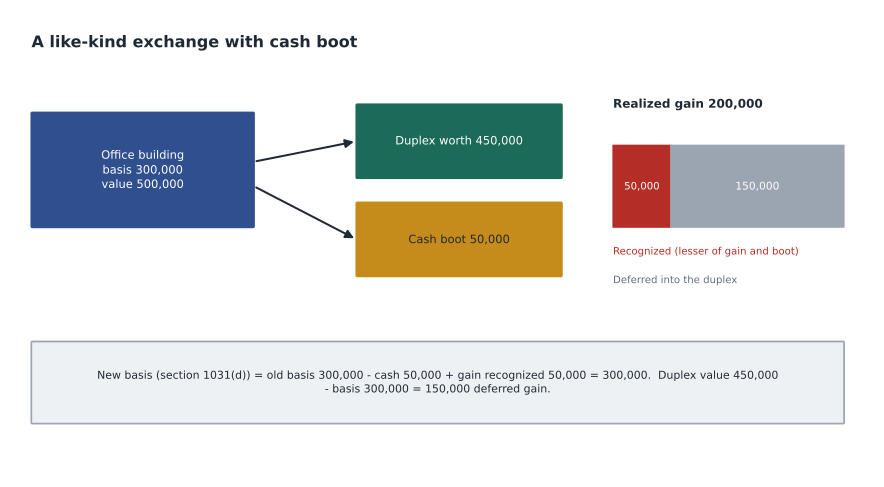
Using illustrative numbers, an investor owns a small office building held for investment with an adjusted basis of 300,000 dollars and a fair market value of 500,000 dollars. She exchanges it for a rental duplex worth 450,000 dollars plus 50,000 dollars in cash. Neither property is subject to a mortgage. How much gain does she realize and recognize, and what is her basis in the duplex?
Show solution
- Amount realized is 450,000 dollars of property plus 50,000 dollars of cash, which equals 500,000 dollars.
- Realized gain is 500,000 minus 300,000, which equals 200,000 dollars.
- The cash is boot. Under section 1031(b), recognized gain is the lesser of the realized gain and the boot: 50,000 dollars.
- Under section 1031(d), the basis of the duplex is the old basis of 300,000 dollars, minus the 50,000 dollars of cash received, plus the 50,000 dollars of gain recognized, which equals 300,000 dollars.
- Check: the duplex is worth 450,000 dollars and has a basis of 300,000 dollars, so it carries the 150,000 dollars of gain not yet recognized. Recognized gain of 50,000 dollars plus deferred gain of 150,000 dollars equals the 200,000 dollars realized.
Answer: She realizes 200,000 dollars of gain, recognizes 50,000 dollars and takes a 300,000 dollar basis in the duplex, which preserves the remaining 150,000 dollars of gain for later.
Involuntary conversions
Section 1033 allows a taxpayer whose property is destroyed, stolen, condemned or sold under threat of condemnation to elect not to recognize gain if the taxpayer buys similar or related property within the replacement period. Gain is recognized only to the extent the amount realized, such as insurance proceeds or a condemnation award, exceeds the cost of the replacement property. The replacement period generally ends two years after the end of the first taxable year in which any gain is realized, or three years for condemned business or investment real property. The basis of the replacement property is its cost reduced by the unrecognized gain. Unlike section 1031, section 1033 is elective for conversions into money and does not apply to losses, which are recognized under the usual rules.
Sale of a principal residence
Section 121 excludes up to 250,000 dollars of gain on the sale of a principal residence, or 500,000 dollars for a married couple filing jointly. The taxpayer must have owned and used the property as a principal residence for periods totaling at least two years during the five years ending on the date of sale. For the 500,000 dollar exclusion, either spouse may meet the ownership test but both must meet the use test, and neither may have used the exclusion in the prior two years. A taxpayer who fails the two-year tests because of a change in employment, health or certain unforeseen circumstances may claim a reduced exclusion. Gain attributable to periods of nonqualified use after 2008, such as when the home was a rental before becoming the residence, and gain equal to depreciation claimed after May 6, 1997 are not excluded. Losses on the sale of a personal residence are not deductible at all, because the home is personal-use property.
Worked problem
Section 121 for a married couple
Using illustrative numbers, a married couple filing jointly bought their home in 2012 for 300,000 dollars and spent 50,000 dollars on a new kitchen and an addition. They sell it in 2026 for 1,000,000 dollars and pay 50,000 dollars in selling costs. Both have lived there throughout. What is their taxable gain?
Show solution
- Amount realized is 1,000,000 minus 50,000 of selling costs, which equals 950,000 dollars.
- Adjusted basis is 300,000 plus 50,000 of improvements, which equals 350,000 dollars.
- Realized gain is 950,000 minus 350,000, which equals 600,000 dollars.
- Both spouses meet the ownership and use tests and filed jointly, so up to 500,000 dollars is excluded under section 121.
- Taxable gain is 600,000 minus 500,000, which equals 100,000 dollars.
Answer: The couple reports 100,000 dollars of long-term capital gain. Because the exclusion amounts have not been indexed for inflation since 1997, more homeowners in high-cost areas now have taxable gains on sale.
Transfers between spouses and other nonrecognition rules
Section 1041 provides that no gain or loss is recognized on a transfer of property between spouses, or between former spouses if incident to divorce, and the recipient takes the transferor's basis. The provision overruled United States v. Davis (1962), in which a husband who transferred appreciated stock to his wife in a divorce settlement was taxed on the gain. Today the recipient spouse takes over the built-in gain and pays tax when she eventually sells.
Many other nonrecognition provisions appear in the courses on business entities: section 351 for transfers to controlled corporations, section 721 for contributions to partnerships, and the reorganization provisions of section 368. Each follows the same pattern as section 1031: no current recognition, a substituted basis that preserves the gain or loss, a tacked holding period and recognition to the extent of boot. Section 1036 allows tax-free exchanges of common stock for common stock in the same corporation, and section 1035 does the same for certain insurance contracts.
Policy
Penwarden ends with the policy debate. Defenders of the realization requirement point to valuation and liquidity problems. Critics note that it lets wealthy people defer tax indefinitely, and combined with stepped-up basis at death, avoid it entirely. Proposals to tax unrealized gains at death, as Canada does, or annually for very large fortunes, have been introduced in Congress but not enacted, and Moore leaves their constitutionality unresolved.
Summary and key terms
- Gains and losses are generally taxed only on realization; Eisner v. Macomber suggested a constitutional basis, and Moore v. United States (2024) left the question open.
- Cottage Savings holds that an exchange of materially different property, a low bar, realizes gain or loss.
- Section 1001 measures gain as amount realized minus adjusted basis, and all realized gain or loss is recognized unless the Code provides otherwise.
- Section 1031 defers gain on exchanges of like-kind real property, with recognition up to boot and a substituted basis.
- Section 1033 allows deferral for involuntary conversions if replacement property is bought within the replacement period.
- Section 121 excludes up to 250,000 or 500,000 dollars of gain on a principal residence, and section 1041 makes transfers between spouses tax-free with carryover basis.
Practice problems
Work each problem on paper first, then reveal the answer to check.
Why was the stock dividend in Eisner v. Macomber not income?
Show answer
Each shareholder's proportionate interest was unchanged, so nothing was severed from capital or received for separate use.
Can a business exchange a delivery truck for another truck without recognizing gain in 2026?
Show answer
No. Since 2018 section 1031 applies only to real property.
In a like-kind exchange, a taxpayer realizes 30,000 dollars of gain and receives 40,000 dollars of cash boot. How much is recognized?
Show answer
30,000 dollars, the lesser of realized gain and boot.
A divorcing husband transfers stock with a basis of 10,000 dollars and a value of 60,000 dollars to his wife. What are the tax consequences?
Show answer
None at transfer under section 1041; the wife takes his 10,000 dollar basis.
Lesson quiz · 5 questions
Score 60% or more to complete this lesson.
Create a free account to save your progress, take quizzes and earn a certificate.