
LAWU-212 · Lesson 11 of 12 · 20 min
Family taxation, credits and tax procedure
▶ Video coming soon A video version of this lesson is on the way.
The earlier lessons asked what income is, when it is taxed and whose it is. This lesson turns to the household and to the system that enforces the tax. Filing status and dependents determine which rate schedule and standard deduction apply. Credits, which reduce tax dollar for dollar, now deliver a large share of the Code's benefits to families with children and to low-income workers. And tax procedure, the rules on returns, audits, deficiencies, refunds and penalties, determines how disputes are resolved. Penwarden spent twelve years trying cases for the IRS, and he tells Section B that procedure is where most tax lawyers spend most of their time: "A client with a winning argument and a missed deadline has a losing case."
Filing status
There are five filing statuses: single, married filing jointly, married filing separately, head of household and qualifying surviving spouse. Marital status is determined on the last day of the year, so a couple who marries on December 31 is married for the whole year. Married couples may file jointly, combining their income on one return with joint and several liability for the tax, or separately, which rarely saves tax but may protect one spouse from liability for the other's return.
Head of household status, which offers wider brackets and a larger standard deduction than single status, is available to an unmarried taxpayer who pays more than half the cost of keeping up a home that is the principal home for more than half the year of a qualifying child or certain other dependents. Rosa qualifies: she is unmarried, she owns and pays for her home, and her sixteen-year-old son lives with her all year. A qualifying surviving spouse with a dependent child may use the joint return rates for the two years after the spouse's death.
The joint return creates marriage bonuses and penalties. For 2026, the joint brackets are exactly double the single brackets up through the 35 percent bracket, so most couples pay no more, and couples with one earner pay less, than if they were single. But the 37 percent bracket begins at 768,700 dollars for joint filers, less than double the single threshold of 640,600 dollars, and some credits and phase-outs are not doubled, so high-earning two-income couples and some low-income couples claiming the earned income credit can pay a marriage penalty.
Dependents
A dependent is either a qualifying child or a qualifying relative. A qualifying child must have a specified relationship to the taxpayer, such as a child, stepchild, sibling or descendant of one of them; must live with the taxpayer for more than half the year; must be under 19 at year end, or under 24 if a full-time student, or permanently disabled; must not provide more than half of his or her own support; and generally must not file a joint return. Tie-breaker rules decide which taxpayer may claim a child who qualifies for more than one, and divorced parents may allocate the child to the noncustodial parent by a signed release. A qualifying relative is a relative or member of the household with gross income below an indexed amount for whom the taxpayer provides more than half of the support.
Credits for families
A credit reduces tax directly. A nonrefundable credit can reduce tax to zero but no further; a refundable credit is paid to the taxpayer even if it exceeds the tax. That difference determines whether a credit helps households that owe little or no income tax.
The child tax credit of section 24 was 2,000 dollars per child under the 2017 legislation. The 2025 act made it permanent at 2,200 dollars per qualifying child under 17 for 2025 and indexed it for inflation afterward; for 2026 it remains 2,200 dollars, of which up to 1,700 dollars is refundable as the additional child tax credit for families with earned income above 2,500 dollars. The credit phases out by 50 dollars for each 1,000 dollars, or part of 1,000 dollars, of modified adjusted gross income above 200,000 dollars, or 400,000 dollars for joint filers. The 2025 act requires a Social Security number for the child and for at least one parent. A separate nonrefundable credit of 500 dollars applies to other dependents, such as children aged 17 or 18 and qualifying relatives.
The earned income tax credit of section 32 is a refundable credit for low- and moderate-income workers. It rises with earnings up to a maximum, stays flat over a range and then phases out. For 2026, the maximum credit is 664 dollars for a worker with no qualifying children, 4,427 dollars with one child, 7,316 dollars with two and 8,231 dollars with three or more. Taxpayers with investment income above a modest indexed limit are ineligible. The credit is one of the largest federal antipoverty programs, and also one with a high rate of improper payments, which is why the IRS audits it closely and why preparers must meet special due diligence rules.
The child and dependent care credit of section 21 helps parents pay for care that allows them to work. Qualifying expenses are capped at 3,000 dollars for one qualifying person and 6,000 dollars for two or more. Beginning in 2026, the 2025 act raised the maximum credit rate from 35 to 50 percent of expenses for lower-income families, phasing down as income rises, and raised the exclusion for employer dependent care assistance under section 129 from 5,000 to 7,500 dollars. The two benefits cannot be claimed for the same expenses.
For higher education, the American opportunity tax credit provides up to 2,500 dollars a year per student for the first four years of college, 40 percent of it refundable, and the lifetime learning credit provides up to 2,000 dollars a year per return for any postsecondary courses. Both phase out between 80,000 and 90,000 dollars of modified adjusted gross income, or 160,000 and 180,000 dollars on a joint return, amounts that are not indexed. Other notable credits include the adoption credit, which is 17,670 dollars per child for 2026 and now partly refundable, and the premium tax credit for health insurance bought through the exchanges.
The 2025 act also created a new kind of tax-favored savings account for children, called Trump accounts, with a one-time federal contribution of 1,000 dollars for eligible children born from 2025 through 2028 and annual contributions by families and employers allowed within limits beginning in July 2026. Penwarden mentions them only briefly; Treasury guidance on their operation was still developing when this course was written.
Worked problem
The child tax credit phase-out
Using illustrative numbers, a married couple filing jointly in 2026 has two children aged 8 and 12, both with Social Security numbers, and modified adjusted gross income of 430,000 dollars. What child tax credit may they claim? What would Rosa, a head of household with one son aged 16 and modified adjusted gross income well under 200,000 dollars, claim?
Show solution
- The couple's maximum credit is 2 times 2,200 dollars, which equals 4,400 dollars.
- Their income exceeds the 400,000 dollar joint threshold by 30,000 dollars.
- The credit is reduced by 50 dollars for each 1,000 dollars of excess: 30 times 50 dollars equals 1,500 dollars.
- Their credit is 4,400 minus 1,500, which equals 2,900 dollars.
- Rosa's son is under 17 at the end of 2026 and lives with her, so he is a qualifying child. Her income is below the 200,000 dollar threshold, so she receives the full 2,200 dollars.
Answer: The couple may claim 2,900 dollars, and Rosa may claim 2,200 dollars. Because Rosa will owe more than 2,200 dollars of income tax, the refundability limit of 1,700 dollars does not affect her.
Filing and assessment
The federal income tax relies on self-assessment. Individuals must file a return by April 15 of the following year if their gross income exceeds a threshold tied to the standard deduction, and an automatic six-month extension is available for filing but not for paying. Wages are subject to withholding, and self-employed people like Rosa, for her first-aid business, must make quarterly estimated tax payments or face an addition to tax under section 6654, with safe harbors based on the prior year's tax.
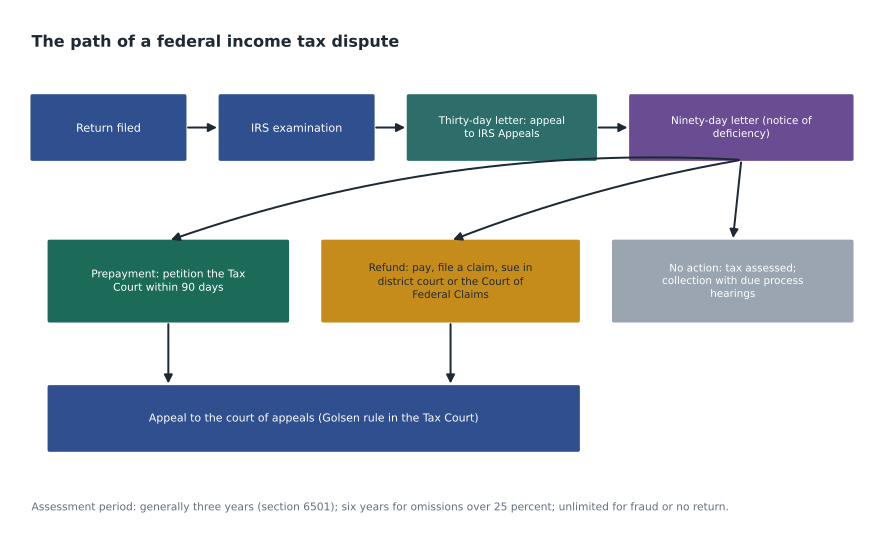
The IRS selects returns for examination through computer scoring, information-matching programs that compare returns with forms such as W-2s and 1099s, and targeted initiatives. Most examinations are correspondence audits. If the examiner proposes adjustments that the taxpayer does not accept, the IRS issues a thirty-day letter offering an appeal to the independent Office of Appeals, which settles most disputed cases.
Information reporting is the backbone of compliance. Employers report wages on Form W-2; banks, brokers and businesses report interest, dividends, stock sales and payments to independent contractors on the Form 1099 series; and payment settlement entities report card and app payments above reporting thresholds. Studies by the IRS consistently find that income subject to both withholding and information reporting is reported almost completely, while income subject to little or no reporting, such as cash receipts of small businesses, is substantially underreported. Rosa's hospital wages appear on a W-2, and employers that book her first-aid classes generally send her Forms 1099-NEC, so Penwarden urges her to reconcile those forms with her own records before filing; a mismatch is one of the most common triggers for an automated notice proposing additional tax.
Under section 6501, the IRS generally must assess additional tax within three years after the return is filed. The period is six years if the taxpayer omitted more than 25 percent of gross income stated on the return, and unlimited if the return was fraudulent or no return was filed. A taxpayer may agree to extend the period, and often does to allow an appeal to proceed.
Litigating a tax dispute
Before the IRS can assess a deficiency in income tax, it must mail a notice of deficiency under section 6212, often called the ninety-day letter. The taxpayer then has 90 days, or 150 days if addressed outside the country, to petition the United States Tax Court without paying the tax. The Tax Court is a specialized court whose judges hear only tax cases, and it decides the great majority of tax litigation. A small tax case procedure is available for disputes of 50,000 dollars or less per year, with simpler rules and no appeal. Tax Court decisions are appealable to the court of appeals for the taxpayer's residence, and under the Golsen rule discussed in Lesson 1, the Tax Court follows the precedent of that circuit.
Alternatively, the taxpayer may pay the tax, file a claim for refund with the IRS and, if the claim is denied or not acted on within six months, sue for a refund in a federal district court, where a jury trial is available, or in the Court of Federal Claims. Under Flora v. United States (1960), the full assessed tax must generally be paid before a refund suit. Under section 6511, a refund claim must be filed within three years after the return was filed or two years after the tax was paid, whichever is later. The choice of forum depends on precedent, cost, the need to pay first and whether a jury might be sympathetic.
Penalties
Civil penalties are an important part of practice. Section 6662 imposes a 20 percent accuracy-related penalty on underpayments attributable to negligence or disregard of rules, a substantial understatement of income tax, meaning an understatement exceeding the greater of 10 percent of the correct tax or 5,000 dollars, and several other categories. The penalty does not apply to the extent the taxpayer had reasonable cause and acted in good faith under section 6664, which often turns on reasonable reliance on a competent professional's advice after full disclosure of the facts, and a substantial understatement may be reduced for positions with substantial authority or adequately disclosed positions with a reasonable basis. Section 6663 imposes a 75 percent penalty on the portion of an underpayment attributable to fraud, which the government must prove by clear and convincing evidence. Separate additions to tax apply for failing to file, generally 5 percent of the unpaid tax per month up to 25 percent, and for failing to pay, generally 0.5 percent per month up to 25 percent. Interest runs on unpaid tax and on most penalties.
Willful tax evasion is a felony under section 7201, and willful failure to file is a misdemeanor under section 7203. Spouses who filed joint returns may seek innocent spouse relief under section 6015 from liability for understatements attributable to the other spouse.
Practice before the IRS
Attorneys, certified public accountants and enrolled agents who represent taxpayers before the IRS are governed by Treasury Department Circular 230, which imposes duties of diligence, competence and candor and standards for written advice. In Loving v. Internal Revenue Service (2014), the D.C. Circuit held that the IRS lacked statutory authority to require unenrolled paid preparers to pass a competency examination and meet continuing education requirements, limiting Circular 230's reach over preparers who do not represent clients in examinations or appeals. Section 7525 extends a limited privilege to communications with federally authorized tax practitioners in noncriminal tax matters, and the Taxpayer Bill of Rights in section 7803(a)(3) lists ten rights the IRS must respect.
Summary and key terms
- Filing status, set on December 31, determines the rate schedule and standard deduction; joint returns create marriage bonuses and penalties.
- Dependents are qualifying children or qualifying relatives, each defined by specific tests.
- For 2026 the child tax credit is 2,200 dollars, with 1,700 dollars refundable, and the maximum earned income credit ranges from 664 to 8,231 dollars.
- The 2025 act enlarged the dependent care credit and exclusion from 2026 and created Trump accounts for children.
- The IRS generally has three years to assess; a taxpayer may contest a deficiency in Tax Court before paying or sue for a refund after paying.
- Accuracy, fraud, failure to file and failure to pay penalties enforce compliance; Circular 230 governs practitioners.
Practice problems
Work each problem on paper first, then reveal the answer to check.
A couple marries on December 30, 2026. What filing status may they use for 2026?
Show answer
Married filing jointly or separately; marital status is determined on the last day of the year.
What is the advantage of litigating in the Tax Court?
Show answer
The taxpayer need not pay the disputed tax first, and the judges are tax specialists.
A taxpayer's return omitted 40 percent of the gross income it stated. How long does the IRS have to assess?
Show answer
Six years under section 6501(e), because more than 25 percent was omitted.
When does the accuracy-related penalty not apply even if there is a substantial understatement?
Show answer
When the taxpayer shows reasonable cause and good faith, or the position had substantial authority or was adequately disclosed with a reasonable basis.
Lesson quiz · 5 questions
Score 60% or more to complete this lesson.
Create a free account to save your progress, take quizzes and earn a certificate.