
LAWU-212 · Lesson 1 of 12 · 24 min
How the federal income tax works
▶ Video coming soon A video version of this lesson is on the way.
Professor Harold Penwarden opens Federal Income Tax by writing three short questions on the whiteboard: Whose income is it? What is it? When is it taxed? "Almost every problem in this course," he tells Section B, now in the winter of their second year, "is one of those three questions wearing a disguise. If you can name the question, you can usually find the rule." Then he adds a fourth line underneath, in smaller letters: How much? "That one," he says, "is arithmetic. You will do some of it, but you are training to be lawyers, not calculators. The arithmetic matters because it shows you what is at stake for the client."
Penwarden spent twelve years in the Internal Revenue Service's Office of Chief Counsel, most of them trying cases in the United States Tax Court, and then eight years as a tax partner at a regional law firm advising families and small businesses. He tells the class that he has argued about the same provisions from both sides of the table, and that the government and the taxpayer read the Internal Revenue Code with the same tools: text, structure, purpose and the cases. The people and businesses in his running examples are fictional. The Code sections, regulations, cases and dollar figures are real, and he warns the class that the dollar figures change every year.
His running file for the semester follows a person Section B already knows. Rosa Delgado, the emergency room nurse whose e-bike battery caught fire in her garage in the Civil Procedure course, is imagined as a client preparing her return for the 2026 tax year. In Penwarden's version she is a single parent with one young son, she works overtime shifts at the hospital, she teaches first-aid classes on weekends as a small side business, and her product liability case against the e-bike companies has settled. "Every lesson," he says, "we will open one more folder in Rosa's file. By the end of the semester you will be able to tell her what she owes and why." All of it is a teaching hypothetical.
Why the income tax matters to every lawyer
Students who do not plan to practice tax law sometimes treat this course as a requirement to survive. Penwarden argues the opposite. Divorce lawyers decide who pays tax on support and property transfers. Personal injury lawyers structure settlements so that the client keeps as much as the law allows. Employment lawyers negotiate severance and back pay. Business lawyers choose entities partly for tax reasons. Estate planners work almost entirely in the shadow of the income, gift and estate taxes. Criminal defense lawyers meet tax charges more often than they expect. "You do not have to be a tax lawyer," he says, "but you have to know when to call one, and you have to avoid giving advice that costs your client money."
The federal income tax is also the largest source of federal revenue. Individual income taxes bring in roughly half of all federal receipts in a typical year, with payroll taxes the next largest share and corporate income taxes well behind. The income tax is therefore not only a set of technical rules but a central tool of government policy. Congress uses it to encourage home ownership, saving for retirement, charitable giving, work, education and, after 2025, specific kinds of income such as tips and overtime pay. Each of those choices creates a provision that a lawyer must read.
Where the income tax comes from
The Constitution gave Congress the power to lay and collect taxes, but it also required that direct taxes be apportioned among the states by population. In Pollock v. Farmers' Loan and Trust Co. (1895), the Supreme Court held that a federal tax on income from property was a direct tax that had to be apportioned, which made a general income tax impractical. The Sixteenth Amendment, ratified in 1913, responded by authorizing Congress to tax incomes from whatever source derived without apportionment. Congress enacted an income tax the same year. The modern statute is the Internal Revenue Code of 1986, which has been amended many times since and is codified in Title 26 of the United States Code.
The Court revisited the meaning of income in the Sixteenth Amendment in Moore v. United States (2024). The Moores challenged the mandatory repatriation tax enacted in 2017, which taxed American shareholders on undistributed earnings of certain foreign corporations. They argued that income must be realized by the taxpayer before it can be taxed. The Court, in an opinion by Justice Kavanaugh, upheld the tax on a narrower ground: Congress may attribute the realized income of an entity to its shareholders or partners, as it has long done for partnerships and S corporations. The Court expressly declined to decide whether the Constitution requires realization at all. Lesson 7 returns to realization as a statutory concept, which matters far more in daily practice.
The sources a tax lawyer reads
The first and most important source is the Code itself. Penwarden insists that students read the statute before reading anything about it. Code sections are long, cross-referenced and full of defined terms, and the definitions often appear far from the operative rule. A tax lawyer learns to read section 1 for rates, section 61 for gross income, section 62 for adjusted gross income, section 63 for taxable income and then whatever specific section governs the question at hand.
The second source is Treasury regulations. Section 7805 gives the Secretary of the Treasury general authority to prescribe all needful rules and regulations, and many Code sections direct the Secretary to write rules on specific points. Final regulations go through notice and comment rulemaking. Temporary regulations take effect immediately but expire within three years. Proposed regulations are not binding but signal the government's position. For decades, courts reviewed Treasury's interpretations of the Code under Chevron deference, which the Supreme Court applied to tax regulations in Mayo Foundation for Medical Education and Research v. United States (2011).
That changed in Loper Bright Enterprises v. Raimondo (2024), which overruled Chevron. Courts now decide for themselves the best reading of a statute, giving respectful consideration to the agency's view under Skidmore v. Swift and Co. but not binding deference. Where a Code section expressly delegates to Treasury the power to define a term or fill in details, courts still respect that delegation within its limits. Penwarden tells the class that tax regulations have become more vulnerable to challenge since 2024, and that the first question about any regulation is now whether the statute gave Treasury the job or whether Treasury is simply interpreting the words Congress used. Administrative Law, the companion course this winter, covers Loper Bright in detail.
The third source is IRS guidance below the level of regulations. Revenue rulings apply the law to specific facts and bind the IRS, and taxpayers may rely on them. Revenue procedures announce procedures and, every fall, the inflation adjustments for the coming year; Revenue Procedure 2025-32 contains the figures for the 2026 tax year used in this course. Private letter rulings answer one taxpayer's question and may not be cited as precedent, though lawyers read them to see how the IRS thinks. Notices, announcements, publications and the instructions to forms help but do not bind the courts. Chief Counsel advice and similar documents are released in redacted form.
The fourth source is the case law. Tax cases begin in one of three trial-level forums. The United States Tax Court hears deficiency cases without requiring the taxpayer to pay first. A taxpayer who pays and sues for a refund may instead go to a federal district court, where a jury is available, or to the Court of Federal Claims. Appeals go to the regional courts of appeals, or to the Federal Circuit from the Court of Federal Claims, and then to the Supreme Court. Because the Tax Court follows the law of the circuit to which a case is appealable, under Golsen v. Commissioner (1970), the same issue can come out differently for taxpayers in different parts of the country until the Supreme Court resolves a split.
The tax formula
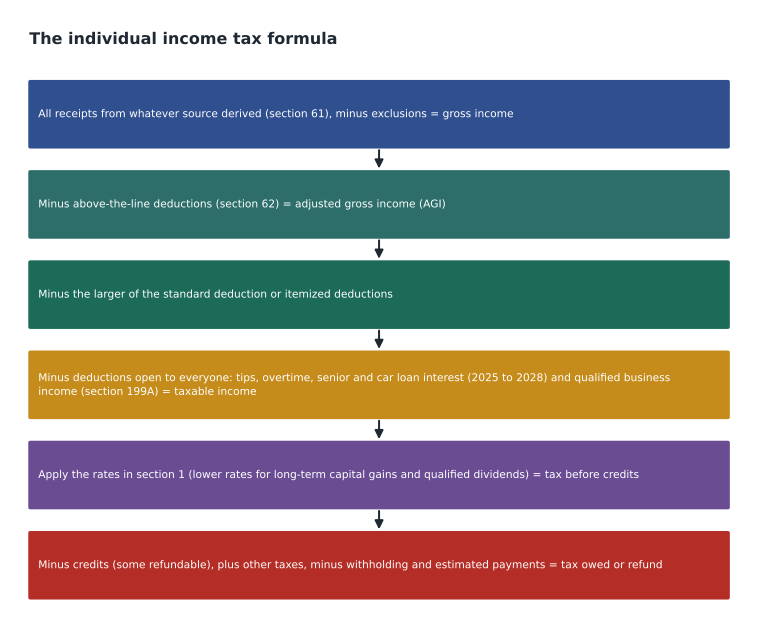
Every individual return follows the same basic formula, and Penwarden makes the class memorize it in words before they ever see a form. Start with gross income, which section 61 defines as all income from whatever source derived, unless a specific provision excludes it. Subtract the deductions listed in section 62, often called above-the-line deductions, to reach adjusted gross income. Adjusted gross income matters on its own because many provisions phase out or apply floors based on it. Then subtract either the standard deduction or itemized deductions, whichever is larger, along with certain deductions that are available whether or not the taxpayer itemizes. The result is taxable income.
Apply the rates in section 1 to taxable income to get the tentative tax, using the lower rates for net capital gain and qualified dividends where they apply. Subtract credits, which reduce tax dollar for dollar rather than reducing income. Some credits are refundable, meaning the government pays the excess to the taxpayer even if it exceeds the tax. Add any other taxes, such as self-employment tax on business income or the additional tax on net investment income, and compare the total with what the taxpayer already paid through withholding and estimated payments. The difference is the balance due or the refund.
The distinction between deductions and credits is worth absorbing early. A deduction reduces taxable income, so its value depends on the taxpayer's marginal rate. A deduction of 1,000 dollars saves 120 dollars for someone in the 12 percent bracket and 370 dollars for someone in the 37 percent bracket. A credit of 1,000 dollars saves 1,000 dollars for anyone with enough tax to absorb it, and a refundable credit helps even someone with no tax at all. Policy debates about whether to use deductions or credits are often debates about who should benefit.
Rates, brackets and the 2025 legislation
The individual income tax uses graduated rates applied to brackets of taxable income. For 2026 the rates are 10, 12, 22, 24, 32, 35 and 37 percent. These are the rates first enacted for 2018 through 2025 by the 2017 legislation commonly called the Tax Cuts and Jobs Act. They were scheduled to expire after 2025, which would have restored higher pre-2018 rates. On July 4, 2025, the President signed Public Law 119-21, the reconciliation act widely called the One Big Beautiful Bill Act, which made the lower rates permanent along with the larger standard deduction and many other provisions, and which added new temporary deductions that Lesson 5 covers.
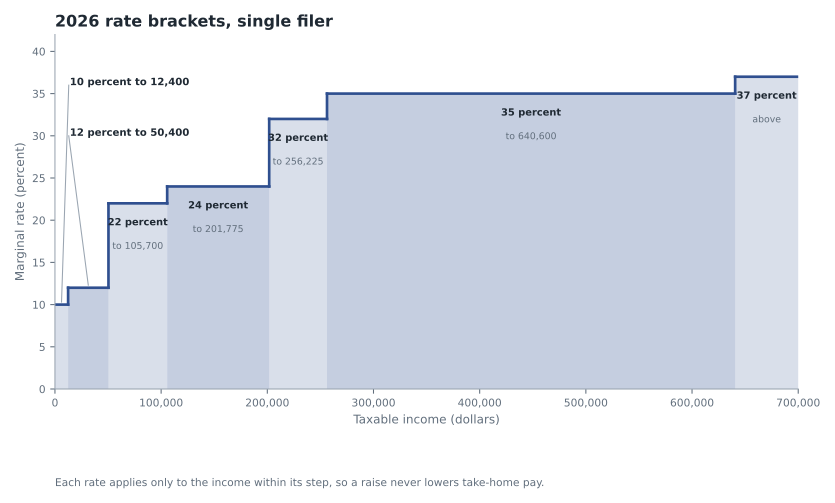
Each filing status has its own brackets, adjusted every year for inflation. For a single filer in 2026, the 10 percent rate applies to the first 12,400 dollars of taxable income, the 12 percent rate to income above 12,400 dollars up to 50,400 dollars, the 22 percent rate up to 105,700 dollars, the 24 percent rate up to 201,775 dollars, the 32 percent rate up to 256,225 dollars and the 35 percent rate up to 640,600 dollars, with the 37 percent rate above that. For married couples filing jointly, most thresholds are double the single amounts until the higher brackets: the 37 percent rate begins above 768,700 dollars. Heads of household have their own schedule, with the 10 percent bracket running to 17,700 dollars and the 12 percent bracket to 67,450 dollars.
Marginal and average rates
The most common misunderstanding about the income tax is the belief that moving into a higher bracket raises the tax on all of a person's income. It does not. Each rate applies only to the income within its bracket. A raise that pushes a taxpayer from the 12 percent bracket into the 22 percent bracket increases the tax only on the dollars above the threshold. The marginal rate is the rate on the next dollar of income, which is what matters for decisions about earning, deducting or deferring income. The average rate, sometimes called the effective rate, is total tax divided by income, which is always lower than the top marginal rate for a taxpayer with graduated brackets.
Worked problem
Marginal and average rates for a single filer
Penwarden asks Section B to compute the 2026 regular tax on 80,000 dollars of taxable income for a single filer with no capital gains, and to state the marginal and average rates. The numbers are illustrative.
Show solution
- Apply 10 percent to the first 12,400 dollars: 1,240 dollars.
- Apply 12 percent to the income from 12,400 dollars to 50,400 dollars, which is 38,000 dollars: 4,560 dollars.
- Apply 22 percent to the income from 50,400 dollars to 80,000 dollars, which is 29,600 dollars: 6,512 dollars.
- Add the three amounts: 1,240 plus 4,560 plus 6,512 equals 12,312 dollars.
- The marginal rate is 22 percent, because the next dollar of income falls in the 22 percent bracket. The average rate is 12,312 divided by 80,000, or about 15.4 percent.
Answer: The tax is 12,312 dollars, the marginal rate is 22 percent and the average rate is about 15.4 percent. An extra 1,000 dollars of wages would add 220 dollars of income tax, not 22 percent of all 81,000 dollars.
Who must file, and filing status
Not everyone must file a return. Filing thresholds are generally tied to the standard deduction, so a single person under 65 with only wage income below the standard deduction usually has no filing obligation, though many file anyway to recover withholding or claim refundable credits. Self-employed people must file if net earnings from self-employment reach 400 dollars, because self-employment tax applies even when income tax does not.
Filing status affects the brackets, the standard deduction and eligibility for many benefits. The five statuses are single, married filing jointly, married filing separately, head of household and qualifying surviving spouse. Marital status is determined on the last day of the year. A head of household is an unmarried person who pays more than half the cost of keeping up a home that is the principal home of a qualifying person, usually a child, for more than half the year. Rosa Delgado, an unmarried parent who keeps up a home for her son, files as head of household, which gives her a larger standard deduction and wider low-rate brackets than a single filer.
Other federal taxes on income
The income tax is not the only federal tax measured by income. Employees and employers each pay Social Security tax of 6.2 percent on wages up to an annual wage base and Medicare tax of 1.45 percent on all wages. Self-employed people pay both halves as self-employment tax on net earnings, and may deduct half of it in computing adjusted gross income. High earners pay an additional Medicare tax of 0.9 percent on wages and self-employment income above 200,000 dollars for a single filer or 250,000 dollars for a joint return, and a 3.8 percent net investment income tax on investment income above the same thresholds, which are not indexed for inflation. The alternative minimum tax runs parallel to the regular tax for a small number of taxpayers. For 2026 the exemption is 90,100 dollars for unmarried taxpayers and 140,200 dollars for joint filers, phasing out above 500,000 and 1,000,000 dollars.
Penwarden spends little time on the alternative minimum tax, because the 2017 changes and their extension in 2025 sharply reduced the number of people who owe it. He spends more time on self-employment tax, because it surprises clients like Rosa, whose weekend first-aid business generates net earnings subject to both income tax and self-employment tax.
How to read a Code section
Penwarden closes the first class with a method. Read the operative words first and identify the subject, the verb and the object: who must include, deduct or recognize what. Then find every defined term and follow it to its definition, which may be in the same section, in section 7701 or somewhere else entirely. Note every cross-reference and every exception, including exceptions to exceptions. Check effective dates, because recent amendments often apply only to years after a certain date, and the 2025 legislation in particular changed some rules permanently and others only for 2025 through 2028. Finally, ask what the provision is trying to do. Purpose does not override clear text, but it helps resolve ambiguity and spot traps.
He gives the class a short example: section 102(a) says that gross income does not include the value of property acquired by gift, bequest, devise or inheritance. Section 102(b) then says that the exclusion does not apply to income from such property, so the interest on an inherited bond is taxable even though the bond itself is not. Section 102(c) says the exclusion does not apply to any amount transferred by or for an employer to an employee. Three short subsections, he points out, contain a general rule, a limit and an anti-abuse rule. Most of the Code is built that way.
Summary and key terms
- Almost every tax problem asks whose income it is, what it is, when it is taxed and how much tax results.
- The Sixteenth Amendment allows an income tax without apportionment; Moore v. United States (2024) upheld attribution of entity income to owners and left the realization question open.
- Tax lawyers read the Code first, then Treasury regulations, IRS guidance and cases; after Loper Bright (2024), courts decide the best reading of the Code themselves, with respect for express delegations.
- The formula runs from gross income to adjusted gross income to taxable income, then to tax, credits and payments.
- The 2025 act, Public Law 119-21, made the 10 to 37 percent rate structure and larger standard deduction permanent; 2026 brackets come from Revenue Procedure 2025-32.
- Each rate applies only to income within its bracket, so the average rate is lower than the marginal rate.
Practice problems
Work each problem on paper first, then reveal the answer to check.
What is the difference between a deduction and a credit?
Show answer
A deduction reduces taxable income, so its value depends on the marginal rate; a credit reduces tax dollar for dollar, and a refundable credit can produce a payment.
What did Moore v. United States (2024) decide?
Show answer
It upheld the mandatory repatriation tax because Congress may attribute an entity's realized income to its shareholders, and it declined to decide whether the Constitution requires realization.
How did Loper Bright change review of Treasury regulations?
Show answer
Courts no longer give Chevron deference; they decide the best reading of the Code, giving respectful consideration to Treasury's view, while respecting express delegations of authority.
Why does moving into a higher bracket not raise tax on all income?
Show answer
Each rate applies only to the income within its bracket, so only the dollars above the threshold are taxed at the higher rate.
Lesson quiz · 5 questions
Score 60% or more to complete this lesson.
Create a free account to save your progress, take quizzes and earn a certificate.