
LAWU-212 · Lesson 10 of 12 · 20 min
Assignment of income
▶ Video coming soon A video version of this lesson is on the way.
Penwarden's first framing question, "Whose income is it?", matters because the income tax is progressive and each person is a separate taxpayer. If a parent in the 35 percent bracket could shift 50,000 dollars of income to a child in the 10 percent bracket, the family would save thousands of dollars a year without changing anything real. The assignment of income doctrine stops that. It holds that income from services is taxed to the person who performs the services, and income from property is taxed to the person who owns the property, regardless of who receives the cash. This lesson traces the doctrine through its leading cases, then turns to the statutory rules that now do much of the work: the joint return, the kiddie tax, the grantor trust rules and the rules for below-market loans.
Income from services: Lucas v. Earl
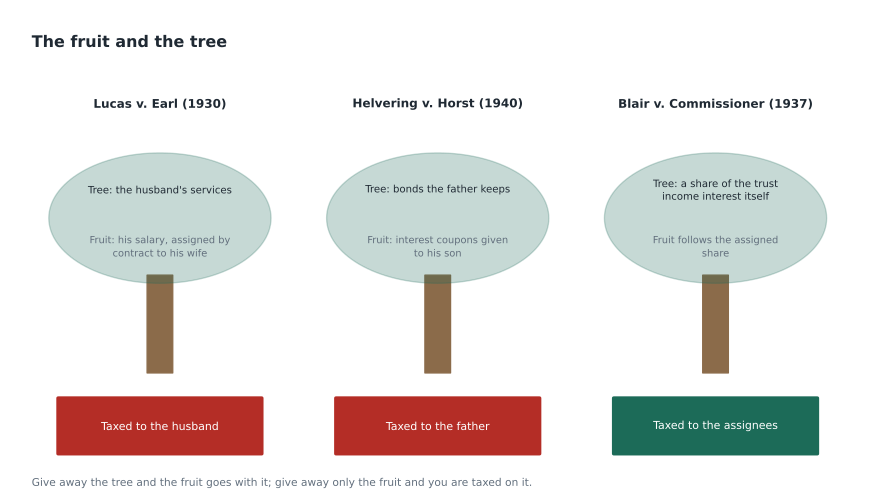
In 1901, years before the modern income tax, Guy Earl and his wife signed a contract agreeing that all property and earnings either of them acquired would be owned by them as joint tenants. When the income tax arrived, Earl argued that only half of his salary and legal fees was his income. In Lucas v. Earl (1930), the Supreme Court disagreed. Justice Holmes wrote that the tax could not be escaped by anticipatory arrangements and contracts, however skillfully devised, to prevent the salary when paid from vesting even for a second in the man who earned it. In his famous metaphor, the fruits cannot be attributed to a different tree from that on which they grew.
The principle is that the person who earns income by performing services is taxed on it, even if a contract directs payment to someone else. Rosa cannot avoid tax on a 1,500 dollar class fee by asking the employer that booked her to pay it straight to her brother, whether as a gift or to repay a debt. She earned the fee, so she is taxed on it, and the payment to her brother is treated as if she received the money and passed it on.
There are limits. A person who refuses compensation outright, without directing where it goes, is not taxed on it. In Commissioner v. Giannini (1942), a bank president told his board he would not accept further compensation for the year and suggested it do something worthwhile with the money; the bank gave it to a university, and he was not taxed. The IRS has similarly ruled, in Revenue Ruling 66-167, that an executor who waives fees in a timely manner before performing services does not have income. And a person who works as an agent for an organization to which all earnings must be paid, such as a member of a religious order who has taken a vow of poverty and works on the order's behalf, is not taxed on the earnings.
Community property: Poe v. Seaborn
Later in the same year, in Poe v. Seaborn (1930), the Court reached the opposite result for a married couple in Washington, a community property state. Under state law, the wife owned half of her husband's earnings from the moment they were earned, not by contract but by operation of law. The Court held that each spouse could report half. The two cases together meant that married couples in community property states paid much less tax than couples elsewhere, and several states adopted community property regimes in the 1940s to obtain the benefit.
Congress solved the problem in 1948 by introducing the joint return with income splitting, which allows any married couple to be taxed as if each earned half of their combined income. The joint return largely ended the significance of Lucas v. Earl between spouses but created the marriage penalties and bonuses discussed in Lesson 11. Today the doctrine matters mainly for shifts of income to children, to other relatives and to entities.
Income from property: Horst and Blair
Income from property is taxed to the owner of the property. In Helvering v. Horst (1940), a father who owned negotiable bonds detached the interest coupons shortly before they were due and gave them to his son, who collected the interest. The Supreme Court held that the father was taxed on the interest. He had retained the bonds, the tree, and given away only the fruit, and by directing the payment to his son he had enjoyed the economic benefit of the income as surely as if he had collected it and handed over the cash.
Blair v. Commissioner (1937) shows the other side. A beneficiary of a testamentary trust who was entitled to its income for life assigned fractional interests in that income stream for the rest of his life to his children. The Court held that the children, not the father, were taxed on the assigned income, because he had transferred a property interest in the trust itself, not merely the right to particular payments. The distinction between Blair and Horst is between assigning the property, or a vertical slice of it that includes all future income from that slice, and assigning only income while keeping the property. Penwarden's shorthand: "Give away the tree, or part of the tree, and the fruit goes with it. Give away only fruit, and you are taxed on it."
Helvering v. Eubank (1940), decided the same day as Horst, applied the services principle to an insurance agent who assigned his right to renewal commissions on policies he had already sold. Even though the commissions arose from past work, they were earned by his services, so he was taxed when they were paid to the assignee. A person cannot convert services income into property income by waiting until the services are complete and then assigning the right to be paid.
Worked problem
Giving a bond, or only its interest
Using illustrative numbers, a parent owns a 100,000 dollar corporate bond that pays 6,000 dollars of interest each December 31. On July 1, 2026, the parent gives it to a 25-year-old daughter, who is not anyone's dependent and is in a lower bracket. Who is taxed on the 6,000 dollars paid on December 31? What if the parent had instead kept the bond and given her only the right to the December interest payment?
Show solution
- Gift of the bond itself: the daughter owns the property from July 1, so interest accruing after the gift is hers. Interest accrues at 6,000 dollars a year, or 3,000 dollars for each half year.
- Interest that accrued before the gift, the 3,000 dollars for January through June, was already earned by the parent's property and is taxed to the parent when paid, even though the daughter collects it.
- Result of the gift of the bond: the parent reports 3,000 dollars and the daughter reports 3,000 dollars of the December payment.
- Gift of only the interest payment: under Helvering v. Horst, the parent kept the tree and gave away the fruit, so the parent is taxed on the full 6,000 dollars, and the transfer to the daughter is a gift.
Answer: If the bond is given, the parent and the daughter each report 3,000 dollars; if only the interest is given, the parent reports all 6,000 dollars. In either case the gift is excluded from the daughter's income under section 102, and future interest is hers only if she owns the bond.
Contingent fees and the plaintiff
In Commissioner v. Banks (2005), the Supreme Court applied the doctrine to contingent fee agreements. Plaintiffs argued that the portion of a taxable recovery paid to their lawyers was the lawyers' income, not theirs. The Court held that a litigant's recovery is income to the litigant even if part is paid directly to the attorney, because the claim is the plaintiff's property, the tree, and the lawyer is the plaintiff's agent. Lesson 3 showed the practical result for Rosa's punitive damages: she is taxed on the full award even though a third goes to her lawyer. Congress has softened the result for employment discrimination and certain whistleblower claims with an above-the-line deduction for attorneys' fees, but for most other taxable recoveries, including punitive damages in personal injury cases, the fee is now nondeductible because miscellaneous itemized deductions are permanently gone.
Shifting income within the family today
Reasonable compensation for real services is not an assignment of income. A parent who runs a business may pay a child a reasonable wage for actual work, and the wage is the child's income. Rosa's sixteen-year-old son helps set up and clean the training rooms at her weekend classes. If she pays him 15 dollars an hour, a market rate, for 200 hours of documented work in 2026, she may deduct the 3,000 dollars as a business expense and he reports 3,000 dollars of wages, which his standard deduction will shelter entirely, because a dependent's standard deduction is at least his earned income plus a small amount, up to the regular amount. Because Rosa is a sole proprietor and her son is under eighteen, his wages are also exempt from Social Security and Medicare taxes under section 3121(b)(3). Paying him for work he did not do, or at an inflated rate, would be an assignment of her income and a nondeductible gift.
Family partnerships and corporations raise similar issues. Under section 704(e), a person who owns a capital interest in a partnership in which capital is a material income-producing factor is recognized as a partner, but the donor-partner must receive reasonable compensation for services before profits are allocated by capital. Section 482 allows the IRS to reallocate income among businesses under common control to reflect arm's-length dealings, and the courts may disregard sham entities or treat an individual as the true earner of income nominally paid to a personal service corporation.
The kiddie tax
The most important statutory limit on shifting investment income to children is the kiddie tax of section 1(g). It applies to a child who is under 19 at year end, or under 24 if a full-time student whose earned income does not exceed half of the child's support, and who has at least one living parent. The child's net unearned income, meaning investment income above a threshold that is adjusted each year for inflation and was 2,700 dollars in 2025, is taxed at the parents' marginal rate rather than the child's. Earned income, such as Rosa's son's wages, is not subject to the kiddie tax. The 2017 legislation briefly taxed such income at trust rates instead, but Congress restored the parents' rate approach in December 2019.
Grantor trusts
Trusts are separate taxpayers with a compressed rate schedule that reaches the top rate at only a few thousand dollars of retained income, but transferring property to a trust does not shift the income if the grantor keeps too much control. In Helvering v. Clifford (1940), a husband who put securities in a five-year trust for his wife, served as trustee and kept broad powers was taxed on the trust income. Sections 671 through 679, the grantor trust rules, now codify and extend Clifford. A grantor is treated as owning trust property, and is taxed on its income, if the grantor holds a reversionary interest worth more than 5 percent of the trust, a power to revoke, a power to control beneficial enjoyment, certain administrative powers, or if income may be paid to the grantor or the grantor's spouse. Estate planners now often create intentionally defective grantor trusts, which are outside the grantor's estate for estate tax purposes but are grantor trusts for income tax purposes, so the grantor pays the income tax and thereby transfers more wealth tax-free.
Below-market loans
Before 1984, a parent could lend a child a large sum interest-free; the child would invest it and report the income, while the parent reported nothing. Section 7872 now recharacterizes below-market loans between family members, between employers and employees and between corporations and shareholders. For a gift loan, the lender is treated as transferring the forgone interest to the borrower as a gift and the borrower as paying it back as interest, so the lender has interest income. A de minimis exception covers gift loans between individuals of 10,000 dollars or less that are not used to buy income-producing assets, and for gift loans of up to 100,000 dollars the imputed interest is limited to the borrower's net investment income, treated as zero if that income is 1,000 dollars or less.
Applying the doctrine
Penwarden gives Section B a three-step routine for any assignment problem. First, identify the source: is the income from services, from property or from both? Second, find the tree: for services, who performed them; for property, who owned it when the income accrued and what exactly was transferred. Third, check the statutes: the joint return, the kiddie tax, the grantor trust rules, section 7872 and section 482 may override or supplement the common law answer. "Most modern assignment cases," he says, "are won or lost on the statutes, but the statutes only make sense once you understand the fruit and the tree."
Summary and key terms
- Income from services is taxed to the earner; contracts redirecting payment, as in Lucas v. Earl, do not shift the tax.
- Community property splits income by operation of law under Poe v. Seaborn; the 1948 joint return extended income splitting to all married couples.
- Income from property is taxed to its owner; Horst taxes a donor who gives away only income, while Blair shifts income when an interest in the property itself is transferred.
- Commissioner v. Banks taxes plaintiffs on the full recovery, including the contingent fee paid to their lawyers.
- Reasonable wages for real services may shift income to family members; sham payments may not.
- The kiddie tax, grantor trust rules and section 7872 limit shifting investment income to children, trusts and borrowers.
Practice problems
Work each problem on paper first, then reveal the answer to check.
A doctor directs a hospital to pay her fee for a surgery directly to her son. Who is taxed?
Show answer
The doctor, under Lucas v. Earl; the payment is treated as received by her and then given to her son.
How does Blair differ from Horst?
Show answer
In Blair the taxpayer assigned a property interest in the trust income for life; in Horst he kept the bonds and gave away only coupons.
A 12-year-old has 6,000 dollars of dividend income. How is it taxed?
Show answer
Net unearned income above the annual threshold is taxed at the parents' marginal rate under the kiddie tax.
What does section 7872 do to an interest-free 200,000 dollar loan from a parent to a child?
Show answer
It imputes interest at the federal rate: the parent has interest income and is treated as making a gift of the forgone interest.
Lesson quiz · 5 questions
Score 60% or more to complete this lesson.
Create a free account to save your progress, take quizzes and earn a certificate.