
LAWU-204 · Lesson 9 of 12 · 22 min
Organizational and government clients
▶ Video coming soon A video version of this lesson is on the way.
Oyelaran asks the class a deceptively simple question: when a lawyer represents Juniper Hill Creamery, who is the client? Priya Natarajan says the creamery. Jordan Kimura says Lena and Owen Marsh, who own and run it. Hannah Lindqvist asks what happens if Lena and Owen disagree. "Hannah has found the problem," Oyelaran says. "An organization can only speak through people. The people are not the client. Sometimes the people are the client's biggest risk." This lesson covers representing organizations under Rule 1.13, the federal up-the-ladder reporting rules for securities lawyers, and the special rules for government lawyers and lawyers moving between government and private practice under Rule 1.11.
The entity is the client: Rule 1.13(a)
Rule 1.13(a) provides that a lawyer employed or retained by an organization represents the organization acting through its duly authorized constituents. Constituents include officers, directors, employees and shareholders, and for other organizations their equivalents. The lawyer takes instructions from authorized constituents, owes duties of loyalty and confidentiality to the organization, and does not represent the constituents personally unless the lawyer also agrees to do so. When a company's CEO tells the company's lawyer something in confidence, the information belongs to the company, not to the CEO, and the company's board may decide what to do with it.
This entity theory has practical consequences. A lawyer for a corporation does not represent its subsidiaries or affiliates merely because of the relationship, although ABA Formal Opinion 95-390 noted that circumstances, such as shared management or an agreement, may make them clients for conflict purposes. A lawyer for a partnership represents the partnership, not each partner. A lawyer for a closely held company often finds the line between the company and its owners blurred, especially when the owners are a married couple or a family, and must make clear in writing whom the lawyer represents.
When constituents act wrongfully: Rule 1.13(b)
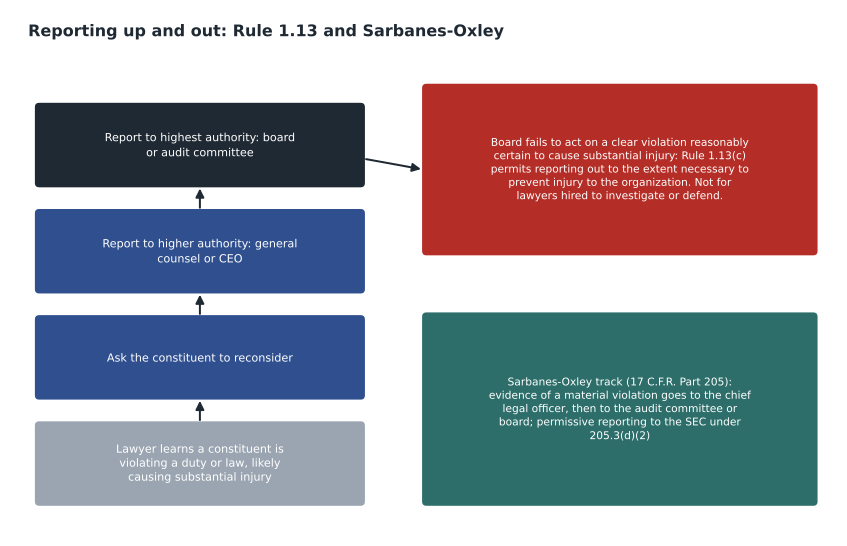
Rule 1.13(b) addresses the situation every corporate lawyer fears. If a lawyer for an organization knows that an officer, employee or other person associated with the organization is engaged in action, intends to act or refuses to act in a matter related to the representation that is a violation of a legal obligation to the organization, or a violation of law that reasonably might be imputed to the organization, and that is likely to result in substantial injury to the organization, the lawyer shall proceed as is reasonably necessary in the best interest of the organization. Unless the lawyer reasonably believes it is not necessary in the best interest of the organization, the lawyer shall refer the matter to higher authority in the organization, including, if warranted, to the highest authority that can act on its behalf, usually the board of directors.
This is called reporting up, or going up the ladder. Before 2003, the Model Rule made reporting up one option among several. After Enron, the ABA made it the presumptive course. Comment 4 explains that the lawyer may first ask the constituent to reconsider, but that if the matter is serious, reporting to higher authority is generally necessary. The lawyer does not need to prove wrongdoing; the trigger is knowledge, which can be inferred from circumstances, and the lawyer cannot ignore the obvious.
Reporting out: Rule 1.13(c)
Rule 1.13(c) allows, but does not require, reporting outside the organization in limited circumstances. If, despite the lawyer's efforts under paragraph (b), the highest authority that can act on behalf of the organization insists upon or fails to address in a timely and appropriate manner an action or a refusal to act that is clearly a violation of law, and the lawyer reasonably believes that the violation is reasonably certain to result in substantial injury to the organization, the lawyer may reveal information relating to the representation whether or not Rule 1.6 permits such disclosure, but only if and to the extent the lawyer reasonably believes necessary to prevent substantial injury to the organization. Rule 1.13(d) says the reporting-out permission does not apply to a lawyer retained to investigate an alleged violation of law or to defend the organization against a claim arising out of one.
Rule 1.13(e) protects lawyers who are fired or who withdraw because of actions under paragraphs (b) or (c). The lawyer shall proceed as reasonably necessary to assure that the organization's highest authority is informed of the lawyer's discharge or withdrawal. Some courts have allowed in-house lawyers to bring retaliatory discharge claims when fired for refusing to violate ethics rules, as in General Dynamics Corp. v. Superior Court (Cal. 1994), while others have refused, reasoning that the ethics rules themselves protect the public, as in Balla v. Gambro, Inc. (Ill. 1991).
Sarbanes-Oxley and the SEC's Part 205 rules
Section 307 of the Sarbanes-Oxley Act of 2002 directed the SEC to issue rules of professional conduct for lawyers appearing and practicing before the Commission in the representation of public companies. The SEC's rules, in 17 C.F.R. Part 205, require a lawyer who becomes aware of evidence of a material violation of securities law, breach of fiduciary duty or similar violation by the company or its agents to report it to the company's chief legal officer, or to both the chief legal officer and the chief executive officer. If the response is not appropriate within a reasonable time, the lawyer must report up to the audit committee, another committee of independent directors, or the full board. Companies may instead create a qualified legal compliance committee to receive reports.
The SEC's standard for triggering the duty is lower than knowledge: credible evidence, based upon which it would be unreasonable, under the circumstances, for a prudent and competent attorney not to conclude that it is reasonably likely that a material violation has occurred, is ongoing or is about to occur. Part 205 also permits, but does not require, a lawyer to reveal confidential information to the SEC without the company's consent to the extent reasonably necessary to prevent a material violation likely to cause substantial financial injury to the company or investors, to prevent perjury or fraud on the SEC in an investigation, or to rectify the consequences of a violation in which the lawyer's services were used. Because the federal rules preempt conflicting state rules, a securities lawyer in a state with a narrower confidentiality exception may still disclose to the SEC as Part 205 allows.
Talking with constituents: Rule 1.13(f) and the corporate Miranda
Rule 1.13(f) requires a lawyer dealing with an organization's constituents to explain the identity of the client when the lawyer knows or reasonably should know that the organization's interests are adverse to those of the constituents with whom the lawyer is dealing. This is the ethics counterpart to the Upjohn warning discussed in lesson 6. In an internal investigation, a company lawyer interviewing an employee who may have done wrong should explain that the lawyer represents the company, that the employee may want a personal lawyer, that the conversation is privileged but the company controls the privilege, and that the company may share what the employee says with the government. Failure to give a clear warning can lead to findings that the lawyer implicitly represented the employee, creating a conflict that disqualifies the lawyer from representing the company.
Rule 1.13(g) allows a lawyer to represent both the organization and its constituents, subject to Rule 1.7. If the organization's consent to the dual representation is required, it must be given by an appropriate official other than the individual to be represented, or by the shareholders. Joint representation of a company and its executives in a government investigation is common at the start but often becomes impossible as interests diverge, for example when the company decides to cooperate by blaming individual employees.
Derivative suits and closely held companies
Comment 13 addresses derivative actions, in which shareholders sue on behalf of the corporation, usually against directors or officers. The corporation is nominally a defendant but is really the beneficiary of the claim. The comment says that most derivative actions are a normal incident of an organization's affairs, to be defended by the organization's lawyer like any other suit, but that if the claim involves serious charges of wrongdoing by those in control of the organization, a conflict may arise between the lawyer's duty to the organization and the lawyer's relationship with the board, and independent counsel may be needed for the directors. In closely held companies, where the owners are also the managers, lawyers often represent the company and then find themselves in the middle of a dispute between owners.
| Issue | Model Rule 1.13 | SEC Part 205 |
|---|---|---|
| Who is covered | Any lawyer for any organization | Lawyers appearing and practicing before the SEC for issuers |
| Trigger for reporting up | Knowledge of a violation likely to cause substantial injury | Credible evidence of a reasonably likely material violation |
| Reporting up | Presumptively required, to highest authority if warranted | Required to CLO or CEO, then audit committee or board |
| Reporting out | Permitted to prevent substantial injury to the organization | Permitted to the SEC in specified circumstances |
| Exception for investigating or defending lawyers | Yes, under 1.13(d) | Limited provisions for lawyers retained to investigate |
Government lawyers: who is the client?
Comment 9 to Rule 1.13 notes that the duty defined in the rule applies to governmental organizations, but that defining precisely the identity of the client and prescribing the resulting obligations may be more difficult in the government context. A lawyer for a federal agency may represent the agency, the executive branch, or in some sense the government as a whole or the public interest. Courts and commentators have taken different positions. The answer affects whom the lawyer reports wrongdoing to, whether the lawyer may disclose misconduct by officials, and how conflicts are analyzed. Government lawyers also operate under statutes such as the federal conflict-of-interest laws in 18 U.S.C. sections 201 through 209 and agency ethics regulations, which often impose stricter limits than the Model Rules.
Prosecutors are a special category of government lawyer, governed by Rule 3.8 and discussed in lesson 10. Their client is the sovereign, but their duty, in the words of Berger v. United States (1935), is not that it shall win a case, but that justice shall be done.
The revolving door: Rule 1.11
Lawyers often move between government and private practice. Rule 1.11 balances two concerns: preventing lawyers from exploiting public office for private clients, and not discouraging talented lawyers from entering government service. Under Rule 1.11(a), a lawyer who formerly served as a public officer or employee of the government is subject to Rule 1.9(c), so the lawyer may not use or reveal confidential government information, and shall not otherwise represent a client in connection with a matter in which the lawyer participated personally and substantially as a public officer or employee, unless the appropriate government agency gives its informed consent, confirmed in writing.
The test differs from the private-client test in important ways. It asks whether the lawyer participated personally and substantially in the same matter, not whether matters are substantially related. Matter is defined in Rule 1.11(e) to mean a judicial or other proceeding, application, request for a ruling, contract, claim, controversy, investigation, charge, accusation, arrest or other particular matter involving a specific party or parties. Drafting general regulations or policies is usually not a matter under this definition, so a lawyer who helped write an agency's rules may later represent clients in disputes about them. And imputation is avoided by screening: under Rule 1.11(b), other lawyers in the firm may take the matter if the former government lawyer is timely screened, apportioned no part of the fee, and written notice is promptly given to the government agency.
Rule 1.11(c) addresses confidential government information, meaning information obtained under governmental authority that the government is prohibited by law from disclosing or has a legal privilege not to disclose and that is not otherwise available to the public. A former government lawyer who has such information about a person may not represent a private client whose interests are adverse to that person in a matter in which the information could be used to the person's material disadvantage. Rule 1.11(d) addresses the reverse move: a lawyer currently serving in government is subject to Rules 1.7 and 1.9 and may not participate in a matter in which the lawyer participated personally and substantially while in private practice, unless the government agency consents, and may not negotiate for private employment with a party or lawyer involved in a matter in which the lawyer is participating personally and substantially. Rule 1.12 applies parallel rules to former judges, arbitrators, mediators and law clerks.
Worked problem
The creamery's falsified test results
Gordon Ashworth is outside counsel to Juniper Hill Creamery, now a company with outside investors and a five-member board. While preparing a response to a state food safety inquiry, he discovers emails showing that the plant manager, with the knowledge of Owen Marsh, the company's president, falsified bacteria test results for three months to avoid shutting down a production line. Owen asks Ashworth to keep it quiet, saying the problem has been fixed. What must Ashworth do?
Show solution
- Identify the client: under Rule 1.13(a), the creamery is the client, not Owen or the plant manager.
- Apply Rule 1.13(b): he knows of conduct by constituents that violates the law, could be imputed to the company and is likely to cause substantial injury, such as regulatory penalties, recalls and lawsuits. He must proceed in the company's best interest, which presumptively means reporting to higher authority.
- Go up the ladder: because the president is involved, Ashworth should report to the board, or a committee of independent directors, describing the facts and recommending corrective action, including disclosure to regulators if required by law.
- Consider Rule 1.13(c): if the board refuses to act on a clear violation reasonably certain to cause substantial injury to the company, he may report outside, to the extent necessary to prevent injury to the company. If the falsification threatens public health, Rule 1.6(b)(1) may separately permit disclosure to prevent reasonably certain substantial bodily harm.
- Handle constituents carefully: in speaking with Owen and the plant manager, give clear Rule 1.13(f) warnings that he represents the company and that they may want their own lawyers.
- Protect himself: if the board refuses and he cannot continue without assisting the cover-up, Rule 1.16(a) requires withdrawal, and Rule 1.13(e) requires him to ensure the board knows why he withdrew.
Answer: Ashworth cannot follow Owen's instruction. He must report the falsification to the board, give the individuals Rule 1.13(f) warnings, and recommend corrective action. If the board fails to act on a clear violation reasonably certain to cause substantial injury to the company, he may report out under Rule 1.13(c), and if public health is at risk, Rule 1.6(b)(1) may also permit disclosure; he must withdraw rather than assist.
Summary and key terms
- A lawyer for an organization represents the organization through its authorized constituents, not the constituents themselves.
- Rule 1.13(b) presumptively requires reporting up a constituent's violation likely to cause substantial injury, to the highest authority if warranted.
- Rule 1.13(c) permits limited reporting out when the highest authority fails to address a clear violation reasonably certain to cause substantial injury, except for lawyers hired to investigate or defend.
- Sarbanes-Oxley section 307 and Part 205 require securities lawyers to report evidence of material violations up the ladder and permit some disclosure to the SEC.
- Rule 1.13(f) requires explaining whom the lawyer represents when interests may be adverse; Rule 1.13(g) allows dual representation subject to Rule 1.7.
- Rule 1.11 bars former government lawyers from matters in which they participated personally and substantially, allows screening to avoid imputation, protects confidential government information, and restricts current government lawyers.
Practice problems
Work each problem on paper first, then reveal the answer to check.
Does a lawyer for a corporation automatically represent its CEO personally?
Show answer
No. Under Rule 1.13(a) the lawyer represents the corporation, unless the lawyer separately agrees to represent the CEO, subject to Rule 1.7.
May a lawyer hired to defend a company in a fraud suit report the company's fraud outside it under Rule 1.13(c)?
Show answer
No. Rule 1.13(d) excludes lawyers retained to investigate or defend claims arising from the alleged violation.
May a lawyer who helped draft an agency's general regulations later represent a private client challenging them?
Show answer
Generally yes, because drafting general rules is usually not a particular matter involving specific parties under Rule 1.11(e).
What standard triggers reporting under the SEC's Part 205 rules?
Show answer
Credible evidence on which it would be unreasonable for a prudent and competent lawyer not to conclude that a material violation is reasonably likely.
Lesson quiz · 5 questions
Score 60% or more to complete this lesson.
Create a free account to save your progress, take quizzes and earn a certificate.