
LAWU-204 · Lesson 8 of 12 · 22 min
Former clients, prospective clients and imputation
▶ Video coming soon A video version of this lesson is on the way.
Oyelaran begins with a problem every lawyer meets sooner or later. A lawyer leaves one firm for another. At the old firm she worked on a contract dispute for a manufacturer. At the new firm, the partners want her to help sue that same manufacturer over a different product. Can she? Can the new firm, if she stays away from the case? "Lawyers move," Oyelaran says. "Firms merge and split. Clients come and go. The former-client and imputation rules decide whether the past follows you, and whether it follows everyone you work with." This lesson covers Rule 1.9 on former clients, Rule 1.18 on prospective clients, and Rule 1.10 on imputing conflicts to a whole firm and screening lawyers to avoid it.
Duties to former clients: Rule 1.9(a)
When a representation ends, the client becomes a former client, and the lawyer's duty of loyalty largely ends with it. A lawyer may generally take on matters adverse to a former client. But two duties remain. The first is a narrow form of loyalty: Rule 1.9(a) forbids a lawyer who has formerly represented a client in a matter to represent another person in the same or a substantially related matter in which that person's interests are materially adverse to the former client, unless the former client gives informed consent, confirmed in writing. The second is confidentiality: Rule 1.9(c), discussed below, forbids using or revealing the former client's information.
The same matter test is straightforward: a lawyer who drafted a contract for a client may not later represent the other party in a suit challenging that contract. The substantially related test does the real work. Comment 3 explains that matters are substantially related if they involve the same transaction or legal dispute or if there otherwise is a substantial risk that confidential factual information as would normally have been obtained in the prior representation would materially advance the client's position in the subsequent matter. The test does not require proof that the lawyer actually learned particular secrets. Courts look at what a lawyer in that role would normally learn, which spares the former client from having to reveal its confidences to prove that they exist.
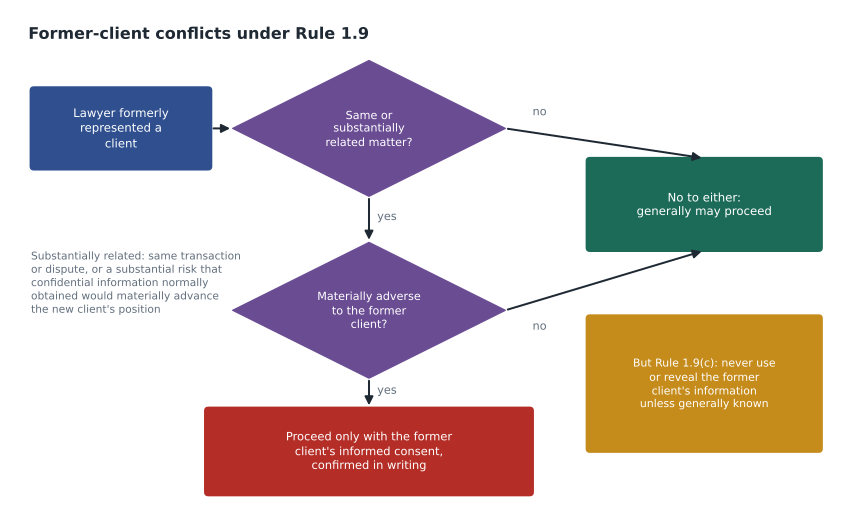
Applying the substantially related test
Comment 3 gives examples. A lawyer who represented a businessperson and learned extensive private financial information may not then represent that person's spouse in seeking a divorce. A lawyer who helped a developer obtain environmental permits for a shopping center would be precluded from representing neighbors seeking to oppose rezoning of the property on the basis of environmental considerations, but would not be precluded, on the grounds of substantial relationship, from defending a tenant of the completed shopping center in resisting eviction for nonpayment of rent. General knowledge of a client's policies and practices ordinarily will not preclude a later representation, but knowledge of specific facts gained in a prior representation that are relevant to the matter in question ordinarily will.
Time matters too. Comment 3 notes that information disclosed to the public or to other parties adverse to the former client ordinarily will not be disqualifying, and that information acquired in a prior representation may have been rendered obsolete by the passage of time. A lawyer who represented a company in an employment matter ten years ago, when the company had different managers and different policies, may be free to sue it today on a new employment claim, while a lawyer who handled its personnel policies last year probably is not.
The hot potato doctrine
Because duties to current clients are stronger than duties to former clients, a lawyer might be tempted to drop a current client in order to turn it into a former client and escape Rule 1.7. Courts have consistently refused to allow this. Under what is often called the hot potato doctrine, a firm that drops a current client like a hot potato to take on a more lucrative representation adverse to it will still be treated as having a current-client conflict. Courts recognize exceptions when the conflict was thrust upon the firm, such as when a corporate merger suddenly makes two existing clients adverse, in which case the firm may be allowed to withdraw from one representation and continue the other.
Confidentiality after the representation: Rule 1.9(c)
Rule 1.9(c) forbids a lawyer who formerly represented a client, or whose present or former firm did, to use information relating to the representation to the disadvantage of the former client except as the rules would permit or require for a current client, or when the information has become generally known, and forbids revealing such information except as the rules would permit or require for a current client. The generally known exception applies to use, not to revealing. In August 2026 the ABA amended comment 8 to Rule 1.9 to explain more fully when information is generally known: the fact that information appears somewhere in a public record does not by itself make it generally known, and the question is whether it is widely recognized by members of the public in the relevant geographic area or in the former client's industry, profession or trade.
Lawyers who move: Rule 1.9(b)
Rule 1.9(b) addresses a lawyer whose former firm represented a client. The lawyer may not knowingly represent a person in the same or a substantially related matter in which that firm had previously represented a client whose interests are materially adverse to the person, and about whom the lawyer had acquired information protected by Rules 1.6 and 1.9(c) that is material to the matter, unless the former client gives informed consent, confirmed in writing. The rule turns on actual knowledge. A junior associate who never worked on a matter and learned nothing about it is not personally disqualified merely because her old firm handled it, while a lawyer who sat in meetings or read the file is.
Prospective clients: Rule 1.18
People often consult lawyers who never take their cases. Rule 1.18, added in 2002, protects them. A prospective client is a person who consults with a lawyer about the possibility of forming a client-lawyer relationship with respect to a matter. Even when no relationship results, the lawyer may not use or reveal information learned in the consultation, except as Rule 1.9 would permit for a former client. And the lawyer may not represent a client with interests materially adverse to the prospective client in the same or a substantially related matter if the lawyer received information from the prospective client that could be significantly harmful to that person in the matter.
Comment 2 limits who counts as a prospective client. A person who communicates information unilaterally to a lawyer, without any reasonable expectation that the lawyer is willing to discuss the possibility of forming a relationship, is not a prospective client. A person who emails a lawyer's website with a long account of a dispute, when the website clearly warns that sending information does not create a relationship and that confidential information should not be sent, may not be protected. A person who calls specifically to disqualify a lawyer, by consulting every good divorce lawyer in town so that the spouse cannot hire any of them, is not a prospective client either, because the consultation is not made in good faith to seek representation.
Rule 1.18 also allows firms to avoid imputation. If the lawyer who consulted with the prospective client is disqualified, the firm may still take the adverse matter if both the affected and new clients give informed consent, confirmed in writing, or if the lawyer took reasonable measures to avoid exposure to more disqualifying information than was reasonably necessary to decide whether to represent the prospective client, the disqualified lawyer is timely screened and receives no part of the fee, and written notice is promptly given to the prospective client. Comment 4 recommends that lawyers limit initial interviews to the information needed to check conflicts and decide whether to take the case.
Imputation: Rule 1.10(a)
Rule 1.10(a) provides that while lawyers are associated in a firm, none of them shall knowingly represent a client when any one of them practicing alone would be prohibited from doing so by Rules 1.7 or 1.9. The rule rests on the idea that lawyers in a firm share information and loyalty: a firm is treated as a single lawyer for conflicts purposes. If one partner cannot sue a former client because of a substantially related matter, neither can anyone else in the firm. Firm is defined broadly in Rule 1.0(c) to include law partnerships, professional corporations, sole proprietorships, legal services organizations and the legal department of a corporation.
There are two exceptions in Rule 1.10(a). First, conflicts based on a personal interest of the disqualified lawyer are not imputed if they do not present a significant risk of materially limiting the representation by the other lawyers. A lawyer's strong personal political views about a client's cause, or a lawyer's family relationship with opposing counsel, generally affect only that lawyer. Second, since 2009, Rule 1.10(a)(2) allows a firm to avoid imputation of a conflict that arises from a lateral lawyer's work at a prior firm under Rule 1.9(a) or (b), by screening the lawyer.
| Source of the conflict | Imputed to the firm? | Can a screen avoid imputation? |
|---|---|---|
| Current-client conflict under Rule 1.7 (not personal) | Yes | No; consent is needed |
| Lawyer's personal interest with no significant risk to others | No | Not needed |
| Lateral lawyer's conflict from a prior firm (Rule 1.9) | Yes, unless screened | Yes, under Model Rule 1.10(a)(2), if the state has adopted it |
| Consultation with a prospective client (Rule 1.18) | Yes, unless screened | Yes, with limited exposure, screen, no fee share and notice |
| Former government lawyer (Rule 1.11) | Yes, unless screened | Yes (lesson 9) |
| Former judge or neutral (Rule 1.12) | Yes, unless screened | Yes |
Screening lateral lawyers: Rule 1.10(a)(2)
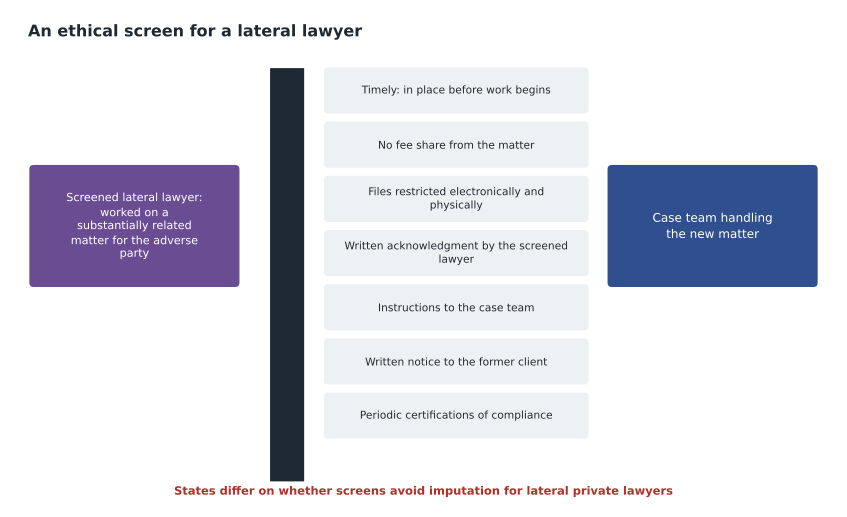
A screen, sometimes called an ethical wall, isolates a disqualified lawyer from a matter. Under Rule 1.10(a)(2), a lateral conflict is not imputed if the disqualified lawyer is timely screened from any participation in the matter and is apportioned no part of the fee from it; written notice is promptly given to the affected former client describing the screening procedures and including a statement of the firm's and lawyer's compliance with the rules, a statement that review may be available before a tribunal, and an agreement to respond promptly to inquiries; and certifications of compliance are provided to the former client at reasonable intervals and on request, and on termination of the screening procedures.
Comment 9 to Rule 1.0 describes effective screening. The screened lawyer should acknowledge the obligation not to communicate with anyone in the firm about the matter, other lawyers should be told not to discuss it with the screened lawyer, files should be locked or electronically restricted, and the screen should be in place when the need arises, not after the other side complains. The adoption of lateral screening in 2009 was controversial, and states remain divided. Many permit screening only when the lawyer had limited involvement in the prior matter; some permit it broadly; others do not permit nonconsensual screening of lateral private lawyers at all. A lawyer changing firms must check the rules of the relevant state.
When the lawyer leaves: Rule 1.10(b)
Rule 1.10(b) addresses the firm a lawyer leaves behind. When a lawyer has terminated an association with a firm, the firm may represent a person with interests materially adverse to a client represented by the departed lawyer, if the client is no longer represented by the firm, unless the matter is the same or substantially related to the one in which the departed lawyer represented the client, and any lawyer remaining in the firm has information protected by Rules 1.6 and 1.9(c) that is material to the matter. If a partner leaves and takes a client with her, the old firm may later sue that client in a new matter, provided no one left at the old firm has material confidential information from the prior work.
Disqualification in practice
Courts deciding disqualification motions consider the ethics rules but also the client's interest in counsel of choice, the stage of the litigation, the prejudice from delay and whether the motion is being used tactically. A party that waits until the eve of trial to move to disqualify, despite knowing the facts for a year, may be found to have waived the objection. In federal courts, disqualification standards come from the court's local rules, which usually adopt the state's ethics rules, and from federal common law. Disqualification is not the only remedy; courts may also order screening, deny fees or simply admonish counsel.
Worked problem
Rachel's former client
Before joining Ashworth Lattimore, Rachel Abernathy spent two years at a larger firm, where she worked for six months on the defense of Northline Feed, a farm supply company, in a lawsuit claiming that its contaminated cattle feed sickened a herd. She reviewed Northline's internal testing records and its quality control manuals. Now a dairy farmer asks Ashworth Lattimore to sue Northline over a different shipment of feed that, he says, was contaminated in the same way two years later. Gordon Ashworth wants to take the case. What are the issues?
Show solution
- Rachel's personal conflict under Rule 1.9(a): the new suit is materially adverse to Northline, her former client. It is likely substantially related, because she learned confidential information about Northline's testing and quality control that would materially advance the farmer's claim of a recurring contamination problem.
- Imputation under Rule 1.10(a): her conflict is imputed to Ashworth Lattimore unless an exception applies. It is not a personal-interest conflict.
- Screening under Rule 1.10(a)(2): if Westmarch has adopted the Model Rule, the firm may avoid imputation by timely screening Rachel, giving her no part of the fee, notifying Northline in writing with the required statements, and certifying compliance. If Westmarch limits screening to lawyers with limited involvement, her substantive work may make a screen unavailable.
- Confidentiality under Rule 1.9(c): regardless of the screen, Rachel may never use or reveal what she learned about Northline.
- Alternatives: seek Northline's informed consent, confirmed in writing, which is unlikely, or decline the case and refer the farmer elsewhere.
Answer: Rachel personally cannot work on the case. Whether the firm can take it depends on Westmarch's version of Rule 1.10: under the Model Rule, a timely screen with notice and certifications would allow the firm to proceed; under a stricter version, the firm should decline. In either case, the screen must be in place before anyone discusses the matter with her.
Summary and key terms
- Rule 1.9(a) bars representation materially adverse to a former client in the same or a substantially related matter without informed consent confirmed in writing.
- The substantially related test asks what confidential information a lawyer would normally have obtained, not what the lawyer actually remembers; general knowledge and stale information usually do not disqualify.
- Firms may not drop current clients to escape Rule 1.7 (hot potato doctrine), except for conflicts thrust upon them.
- Rule 1.9(c) forbids using a former client's information to its disadvantage unless generally known, and forbids revealing it; a 2026 comment clarifies generally known.
- Rule 1.18 protects good-faith prospective clients and allows screening if the lawyer limited exposure to information.
- Rule 1.10(a) imputes conflicts to the whole firm, except personal-interest conflicts and, under the 2009 amendment, screened lateral conflicts; states differ on lateral screening.
Practice problems
Work each problem on paper first, then reveal the answer to check.
May a lawyer who represented a company in a contract dispute later sue the company on an unrelated tort claim?
Show answer
Generally yes, if the matters are not substantially related, but the lawyer may not use or reveal confidential information from the prior work.
Is a person who emails a long account of a dispute to a lawyer's website, despite a clear disclaimer, a prospective client?
Show answer
Probably not, because the person had no reasonable expectation that the lawyer was willing to discuss forming a relationship (comment 2 to Rule 1.18).
What must a screen under Model Rule 1.10(a)(2) include?
Show answer
A timely screen, no fee share for the screened lawyer, prompt written notice to the former client with the required statements, and periodic certifications of compliance.
Does Rule 1.9(c) allow a lawyer to reveal a former client's information that has become generally known?
Show answer
No. The generally known exception allows use of the information, not revealing it.
Lesson quiz · 5 questions
Score 60% or more to complete this lesson.
Create a free account to save your progress, take quizzes and earn a certificate.