
LAWU-204 · Lesson 1 of 12 · 25 min
Regulating lawyers
▶ Video coming soon A video version of this lesson is on the way.
Professor Margaret Oyelaran opens Professional Responsibility by asking Section B, now in its second year, to name the person who decides whether a lawyer keeps a license. Daniel Reyes guesses the state bar association. Hannah Lindqvist guesses the legislature. Marcus Webb, who has read ahead, says the state supreme court. "Marcus is right in nearly every state," Oyelaran says, "and the reason matters for everything we do this semester. Lawyers are officers of the court. The court that admits you is the court that can take your license away, and the rules you will spend this course learning are, in most states, rules of court rather than statutes."
Oyelaran spent twelve years as disciplinary counsel in the attorney regulation office of the Westmarch Supreme Court, prosecuting lawyers who stole from trust accounts, lied to judges and abandoned clients. She then spent eight years on the other side, defending lawyers in discipline and malpractice cases. She tells the class that the two jobs taught her the same lesson from opposite directions: almost every lawyer she prosecuted or defended was not a villain but a busy person who stopped paying attention to a rule that seemed like paperwork. The State of Westmarch, the City of Brennan Falls and the law firms in her examples are fictional. The ABA Model Rules of Professional Conduct, the cases and the regulatory structures she describes are real.
Her running file for the semester is Ashworth Lattimore LLP, a fictional fourteen-lawyer firm in Brennan Falls. Gordon Ashworth, the managing partner, handles business clients. Rachel Abernathy, a third-year associate, handles a little of everything, which is why most of the problems land on her desk. Some of the firm's clients will be familiar from first year: the Delgado products case, Juniper Hill Creamery and the State v. Pike prosecution all reappear, now seen from the point of view of the lawyers handling them.
Why lawyers are regulated at all
Most occupations are regulated by statute and by agencies in the executive branch. Lawyers are different. In almost every state, the highest court claims the inherent power to regulate the practice of law, a power that flows from the courts' authority over their own officers and proceedings. Some state courts have held that legislatures may not interfere with that power at all; others allow legislation that supports it, such as statutes making unauthorized practice a crime. The practical result is that bar admission, the rules of professional conduct, lawyer discipline and continuing legal education are usually run by the state supreme court, often through a bar association or an agency acting under the court's authority.
The traditional justification is that clients cannot easily judge legal services. A client who hires a lawyer usually cannot tell whether the advice was good until long after it is too late. Lawyers also hold enormous power over other people's money, secrets and liberty, and they work inside a justice system that depends on their honesty. Critics answer that self-regulation by the profession protects lawyers more than it protects the public, keeps prices high and blocks cheaper alternatives. That debate runs through the whole course, and it has become sharper as states experiment with new kinds of legal service providers.
The sources of the law governing lawyers
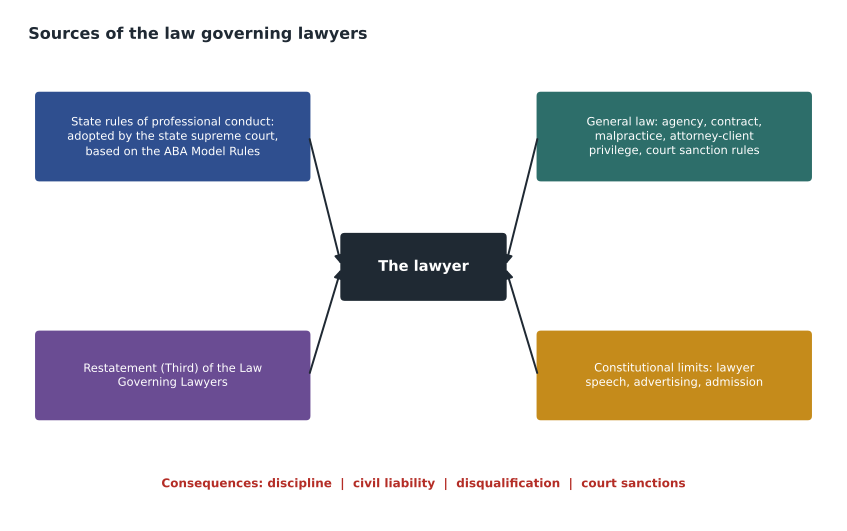
The law that governs lawyers comes from several sources, and a careful lawyer checks all of them. The first and most important is the state's rules of professional conduct, adopted by the state supreme court. Every state has adopted rules based, in whole or in part, on the ABA Model Rules of Professional Conduct, first adopted by the American Bar Association in 1983 to replace the older Model Code of Professional Responsibility. California was the last state to move to the Model Rules format, in 2018. The ABA itself has no power to discipline anyone. Its Model Rules matter because states copy them, and its formal ethics opinions matter because courts and state bars often find them persuasive.
The second source is the general law: agency, contract, tort, evidence and procedure. A lawyer is an agent of the client, so agency law supplies duties of loyalty and obedience. Malpractice is a tort claim. The attorney-client privilege and the work product doctrine come from evidence and procedure law, not from the ethics rules. Court rules such as Federal Rule of Civil Procedure 11 and statutes such as 28 U.S.C. section 1927 let judges sanction lawyers directly. The third source is the Restatement (Third) of the Law Governing Lawyers, published by the American Law Institute in 2000, which collects the general law in one place and is often cited by courts. The fourth is constitutional law, which limits how far states may regulate lawyer advertising, speech and admission.
How the Model Rules are organized
The Model Rules are numbered in eight groups. The 1 series covers the client-lawyer relationship: competence, scope, communication, fees, confidentiality and conflicts. The 2 series covers the lawyer as counselor. The 3 series covers the lawyer as advocate: candor to the tribunal, fairness to the opposing party, trial publicity and the special duties of prosecutors. The 4 series covers dealings with people other than clients. The 5 series covers law firms, supervision and the unauthorized practice of law. The 6 series covers public service. The 7 series covers advertising and solicitation. The 8 series covers bar admission, discipline and misconduct generally.
Each rule has black-letter text followed by comments. The Scope section of the Model Rules explains that the comments are guides to interpretation while the text is authoritative. The rules use the word shall for mandatory duties and may for matters of professional discretion, and the Terminology section in Rule 1.0 defines words such as knowingly, reasonable, informed consent and confirmed in writing. Students often skip Rule 1.0. Oyelaran tells them not to, because a surprising number of discipline cases turn on whether a lawyer knew something, as Rule 1.0(f) defines knowledge, or whether a client's consent was informed, as Rule 1.0(e) defines it.
| Series | Subject | Examples |
|---|---|---|
| 1 | Client-lawyer relationship | Competence (1.1), confidentiality (1.6), conflicts (1.7 to 1.10) |
| 2 | Counselor | Advisor (2.1), evaluation for third persons (2.3) |
| 3 | Advocate | Candor to the tribunal (3.3), trial publicity (3.6), prosecutors (3.8) |
| 4 | Transactions with others | Truthfulness (4.1), represented persons (4.2) |
| 5 | Law firms and associations | Supervision (5.1 to 5.3), nonlawyer ownership (5.4), unauthorized practice (5.5) |
| 6 | Public service | Pro bono (6.1), accepting appointments (6.2) |
| 7 | Information about legal services | Communications (7.1), advertising (7.2), solicitation (7.3) |
| 8 | Integrity of the profession | Bar admission (8.1), reporting misconduct (8.3), misconduct (8.4), choice of law (8.5) |
Becoming a lawyer: admission
Admission to the bar usually requires a law degree, a passing score on a bar examination, a passing score on the Multistate Professional Responsibility Examination in nearly every state, and a finding of good moral character and fitness. Some states now offer alternative paths, such as supervised practice programs, and Wisconsin admits graduates of its two law schools without a bar exam under its diploma privilege. The details belong to the bar preparation courses, but the ethics angle belongs here. Rule 8.1 forbids an applicant to make a knowingly false statement of material fact in connection with a bar application, or to fail to disclose a fact needed to correct a misapprehension the applicant knows has arisen. The rule also binds lawyers who write references or answer questions about applicants.
Character and fitness committees look at criminal records, academic discipline, financial irresponsibility, substance use and, above all, candor. A committee that would forgive an old shoplifting charge often refuses admission to an applicant who hid it. The Supreme Court has placed some constitutional limits on the process. In Schware v. Board of Bar Examiners (1957), it held that a state cannot deny admission on grounds that have no rational connection to fitness to practice, such as past membership in the Communist Party standing alone. Oyelaran warns the class that the duty of candor starts long before admission: law school applications, clerkship applications and the bar application itself are all places where a careless omission can become a fitness problem.
Discipline: how lawyers lose their licenses
Rule 8.4 defines professional misconduct broadly. It is misconduct to violate the rules or to help someone else violate them, to commit a criminal act that reflects adversely on honesty, trustworthiness or fitness as a lawyer, to engage in conduct involving dishonesty, fraud, deceit or misrepresentation, to engage in conduct prejudicial to the administration of justice, to state or imply an ability to improperly influence a government official, or to knowingly assist a judge in violating judicial conduct rules. Rule 8.4(g), added to the Model Rules in 2016, makes it misconduct to engage in harassment or discrimination related to the practice of law on grounds such as race, sex, religion, disability and sexual orientation. States have split on it: some adopted it, several rejected it, and others adopted narrower versions. In Greenberg v. Lehocky (3d Cir. 2023), a challenge to Pennsylvania's version was dismissed for lack of standing, leaving the free speech questions unresolved.
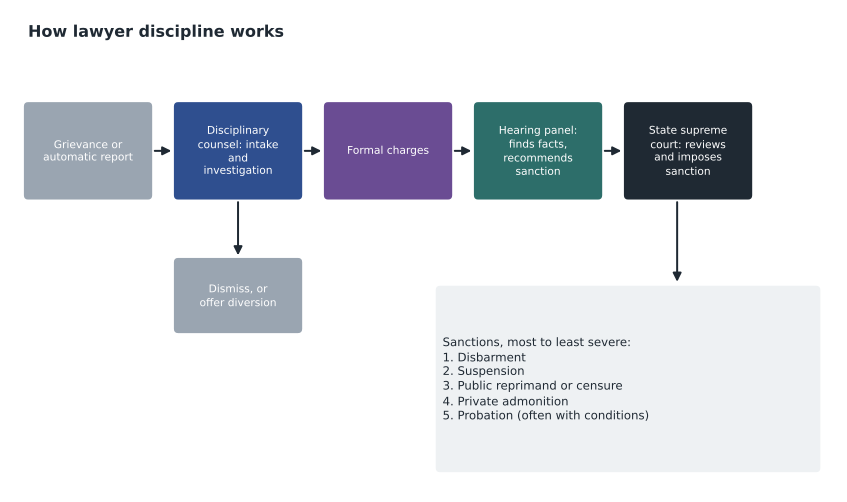
Discipline usually begins with a grievance filed by a client, a judge, opposing counsel or another lawyer, or with an automatic report such as a bank's notice that a trust account check bounced. Disciplinary counsel investigates, may dismiss or seek a diversion agreement, and if the matter is serious files formal charges. A hearing panel or referee takes evidence and recommends a sanction, and the state supreme court decides. Most states use the ABA Standards for Imposing Lawyer Sanctions, which weigh the duty violated, the lawyer's mental state, the injury caused and aggravating or mitigating factors. The usual sanctions, from most to least severe, are disbarment, suspension, public reprimand or censure, private admonition and probation, often combined with conditions such as restitution or ethics training.
The duty to report other lawyers
Rule 8.3(a) requires a lawyer who knows that another lawyer has committed a violation that raises a substantial question about that lawyer's honesty, trustworthiness or fitness as a lawyer to inform the appropriate professional authority. Rule 8.3(b) imposes the same duty about judges. The duty does not require disclosure of information protected by Rule 1.6, and it does not reach information learned in a lawyer assistance program. Few lawyers are ever disciplined for failing to report, but the duty is real. In In re Himmel (Ill. 1988), the Illinois Supreme Court suspended a lawyer for a year for failing to report that his client's former lawyer had converted settlement funds, even though the client had asked him not to report it in exchange for a promise of repayment.
Malpractice and other civil liability
Discipline protects the public; it does not compensate the client. A client harmed by a lawyer's carelessness sues for malpractice. A legal malpractice claim usually requires a duty, arising from an attorney-client relationship or in some states a duty to an intended beneficiary; a breach, measured by the skill and care ordinarily exercised by lawyers in similar circumstances; causation; and damages. Causation is where most claims fail. In litigation malpractice, the client usually must prove a case within a case: that the underlying claim or defense would have succeeded if the lawyer had handled it properly. In Togstad v. Vesely, Otto, Miller and Keefe (Minn. 1980), a lawyer who told a woman in a brief office consultation that she probably had no case, without warning her about the limitation period, was held liable when the period ran, even though she never signed an engagement letter.
The ethics rules do not themselves create civil liability. The Scope section says that a violation of a rule should not itself give rise to a cause of action, though courts often treat the rules as evidence of the standard of care. Lawyers also face liability for breach of fiduciary duty, which may lead to disgorgement of fees even without proof of other damages, and for aiding and abetting a client's fraud or breach of duty. Most states do not require malpractice insurance, but Oregon has long required lawyers in private practice to carry coverage through its Professional Liability Fund, and Idaho added a requirement in 2018. Many other states require lawyers to disclose whether they carry insurance.
Unauthorized practice and the boundaries of the profession
Every state forbids people who are not licensed lawyers from practicing law, and Rule 5.5 forbids a lawyer to practice in a jurisdiction where the lawyer is not admitted or to help someone else engage in unauthorized practice. Defining the practice of law is famously hard. Courts usually focus on applying legal knowledge to a particular person's situation: drafting documents for someone, giving advice tailored to a person's facts, or representing someone in court. Selling a book of forms is generally not the practice of law; filling in the form for a particular customer may be. Software has made the line harder to draw, and state courts and legislatures have reached different answers about online document services.
Rule 5.5 was revised in 2002 to address multijurisdictional practice. Under Rule 5.5(c), a lawyer admitted in one state may provide temporary legal services in another state in limited situations, such as when working with a local lawyer, when the matter is reasonably related to a pending or anticipated proceeding where the lawyer is or expects to be admitted, or when the work arises out of the lawyer's practice in the home state. In-house lawyers and lawyers providing services authorized by federal law are covered by Rule 5.5(d). ABA Formal Opinion 495 (2020) concluded that a lawyer may work remotely from a state where the lawyer is not admitted, serving clients in the home jurisdiction, as long as the lawyer does not hold out a local office or local admission, unless the host state forbids it.
Regulatory reform: new providers and new owners
Rule 5.4 of the Model Rules forbids lawyers to share legal fees with nonlawyers or to practice in a firm in which a nonlawyer owns an interest. Supporters say it protects lawyers' independent judgment from investors. Critics say it blocks capital and innovation that could make legal services cheaper. Two states have broken from it. Arizona eliminated its version of Rule 5.4 effective January 1, 2021, and began licensing alternative business structures, entities in which nonlawyers may hold ownership interests, under the supervision of the state supreme court. Arizona has since licensed more than a hundred such entities and has adjusted the rules as concerns arose. Utah opened a regulatory sandbox in 2020, a supervised program in which approved entities may offer legal services through new models, including nonlawyer ownership and technology-based services, with data reporting to the court.
Several states also license trained professionals who are not lawyers to provide limited legal services. Arizona licenses legal paraprofessionals; Utah licenses licensed paralegal practitioners; Colorado, Minnesota and Oregon have their own programs. Washington created limited license legal technicians in 2012 but stopped admitting new ones in 2020. The District of Columbia has long allowed nonlawyer partners in limited circumstances under its own version of Rule 5.4. Oyelaran asks the class to watch these experiments closely. "Whether you think they are the future of access to justice or a threat to the profession," she says, "you will practice in a market they are changing."
Worked problem
Rachel Abernathy's bar application
Before joining Ashworth Lattimore, Rachel Abernathy applied for admission in Westmarch. In college she received a citation for possessing an open container of alcohol in a park, paid a fine and never thought about it again. The bar application asks whether she has ever been cited, arrested, charged or convicted for any violation of law other than minor traffic offenses. She is unsure whether to list it. What should she do, and what are the risks?
Show solution
- Identify the governing rule: Rule 8.1(a) forbids a knowingly false statement of material fact in connection with a bar application, and Rule 8.1(b) forbids knowingly failing to disclose a fact needed to correct a misapprehension.
- Read the question as written: it asks about any citation other than minor traffic offenses, so the open-container citation falls within it.
- Weigh the consequences: the citation itself is unlikely to matter, but omitting it can be treated as a lack of candor, which character and fitness committees take far more seriously than the underlying conduct.
- Consider the remedy if she has already filed: applicants have a continuing duty to update and correct their applications until admission.
Answer: She should disclose the citation, with a short factual explanation. The underlying event is minor; concealing it is the real risk, because candor is the core of the fitness inquiry and an omission discovered later can delay or defeat admission or lead to discipline after admission.
How the course is organized
The rest of the course follows the life of a representation. Lessons 2 through 4 cover forming and ending the relationship, the duties of competence, diligence and communication, and fees and client property. Lessons 5 and 6 cover confidentiality and the related but separate law of privilege and work product. Lessons 7 through 9 cover conflicts of interest: current clients, former and prospective clients and imputation, and organizational and government clients. Lesson 10 turns to the lawyer's duties to courts, including candor and the limits of zealous advocacy, and ends with an overview of judicial ethics. Lesson 11 covers duties to third parties, advertising and solicitation, and access to justice. Lesson 12 is a capstone problem that draws on all of it.
Each lesson cites the Model Rules by number. When a state's version differs in an important way, Oyelaran says so, but she reminds the class that in practice they must read the rules of the jurisdiction whose rules apply. Rule 8.5 decides that question. A lawyer admitted in a state is subject to its discipline wherever the conduct occurs, and for conduct before a tribunal, the rules of the jurisdiction where the tribunal sits generally apply. For other conduct, the rules of the jurisdiction where the conduct occurred apply, unless its predominant effect is in another jurisdiction.
Summary and key terms
- In nearly every state the supreme court regulates lawyers under its inherent power, through rules of professional conduct based on the ABA Model Rules.
- The law governing lawyers also includes agency, tort, evidence and procedure law, the Restatement and constitutional limits.
- Admission requires candor: Rule 8.1 forbids false statements and misleading omissions on bar applications.
- Rule 8.4 defines misconduct broadly, and discipline runs from grievance through investigation, hearing and a sanction imposed by the state supreme court.
- Rule 8.3 requires lawyers to report serious misconduct by other lawyers and judges, subject to confidentiality.
- Malpractice is a civil claim for compensation and usually requires proof of a case within a case; the ethics rules are evidence of the standard of care but do not create liability by themselves.
- Rule 5.5 forbids unauthorized practice, with exceptions for temporary multijurisdictional practice; Arizona and Utah have loosened ownership rules and several states license limited legal service providers.
Practice problems
Work each problem on paper first, then reveal the answer to check.
Who usually adopts the rules of professional conduct that bind lawyers in a state?
Show answer
The state's highest court, exercising its inherent power to regulate the practice of law.
Does a violation of the Model Rules by itself create a cause of action for malpractice?
Show answer
No. The Scope section says a violation should not itself give rise to a cause of action, although courts often treat the rules as evidence of the standard of care.
What did In re Himmel hold?
Show answer
That a lawyer could be disciplined for failing to report another lawyer's conversion of client funds, even though the client asked him not to report it.
Under ABA Formal Opinion 495, may a lawyer admitted only in Westmarch work remotely from a home in another state for Westmarch clients?
Show answer
Generally yes, if the lawyer does not hold out a local office or local admission in the host state and the host state does not forbid it.
Lesson quiz · 5 questions
Score 60% or more to complete this lesson.
Create a free account to save your progress, take quizzes and earn a certificate.