
LAWU-204 · Lesson 6 of 12 · 22 min
Attorney-client privilege and work product
▶ Video coming soon A video version of this lesson is on the way.
Professor Oyelaran opens by reminding Section B that they met the attorney-client privilege in Evidence with Professor Hartigan, as Federal Rule of Evidence 501 and a list of cases. "In Evidence," she says, "you learned the privilege as a rule about what a court can make a witness say. Here you will learn it as a lawyer's tool and a lawyer's trap. Most privileges are not lost in court. They are lost months earlier, in an email copied to the wrong person, a memo forwarded to a consultant, or a meeting where the client brought a friend." This lesson covers the elements of the privilege, its application to organizations, the work product doctrine, the main exceptions and the ways privileges are waived.
The elements of the privilege
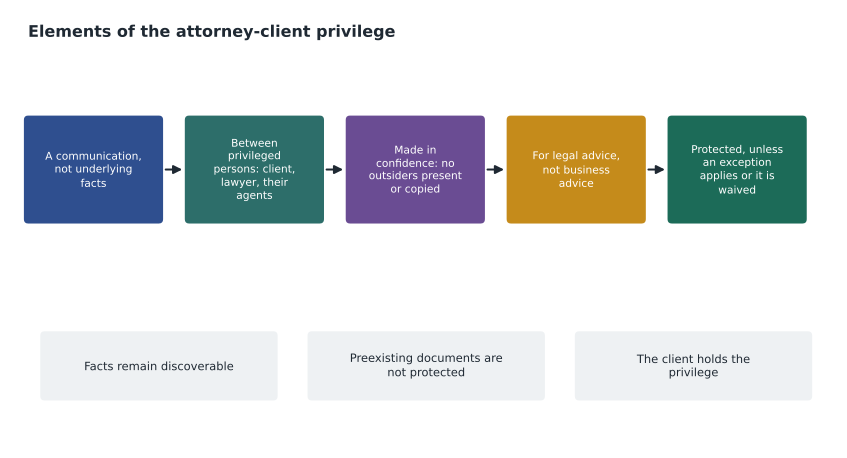
The attorney-client privilege protects communications between a client and a lawyer, made in confidence, for the purpose of obtaining or providing legal advice. Each element matters. The communication must be between privileged persons: the client, the lawyer, and agents of either who help the communication, such as a paralegal, an interpreter or in some circumstances an accountant hired to help the lawyer understand complex financial data, as in United States v. Kovel (2d Cir. 1961). It must be made in confidence, meaning the parties intended and reasonably expected it to remain private. And it must be for the purpose of legal advice, not business, personal or other advice.
The privilege protects communications, not facts. A client who tells a lawyer that she ran a red light cannot be made to reveal what she told the lawyer, but she can be asked under oath whether she ran the light. Documents created before the representation do not become privileged by being handed to a lawyer; a client's preexisting business records are not protected because they sit in a lawyer's file. The privilege belongs to the client, who alone may waive it, although the lawyer has a duty to assert it on the client's behalf when someone seeks the information. In federal courts, Rule 501 provides that the common law, as interpreted in light of reason and experience, governs privileges in federal question cases, while state privilege law governs claims and defenses based on state law.
Why the privilege exists
The usual justification is instrumental: clients will speak frankly only if they know their lawyers cannot be forced to repeat what they say, and frank communication lets lawyers give better advice, including advice to comply with the law. Courts also invoke the client's dignity and privacy. Critics argue that the privilege keeps relevant evidence from courts and that the empirical claim, that clients would stop talking without it, has never been proven. Because the privilege suppresses evidence, courts often say it must be narrowly construed. In practice, that means the party claiming the privilege bears the burden of proving each element.
Organizational clients: Upjohn
When the client is a corporation, which employees' communications are privileged? Before 1981, many federal courts used the control group test, which protected only communications from senior managers who controlled the company's response to legal advice. In Upjohn Co. v. United States (1981), the Supreme Court rejected that test for federal courts. Upjohn's general counsel had sent questionnaires to managers around the world as part of an internal investigation into questionable payments to foreign officials. The Court held that the communications were privileged because they were made by employees at the direction of superiors to secure legal advice, concerned matters within the employees' duties, and were treated as confidential. The Court declined to announce a general test but emphasized that the privilege must protect the flow of information to lawyers from the employees who actually know the facts.
Upjohn left the privilege with the corporation, not the employee. When a company lawyer interviews an employee, the corporation holds the privilege and may waive it, for example by sharing interview notes with prosecutors to obtain credit for cooperation. That is why lawyers give employees what is now called an Upjohn warning: an explanation that the lawyer represents the company, not the employee, that the conversation is privileged but the privilege belongs to the company, and that the company may decide to waive it and disclose what the employee says. Rule 1.13(f), covered in lesson 9, requires a similar explanation whenever a lawyer knows or reasonably should know that the organization's interests are adverse to the constituent's. Some states, including Illinois, still use a version of the control group test for their own privilege law.
Work product: Hickman v. Taylor and Rule 26(b)(3)
The work product doctrine protects materials prepared in anticipation of litigation, even when they are not communications with a client. In Hickman v. Taylor (1947), a tugboat sank and five crew members died. The tug owner's lawyer interviewed the survivors and took written statements. A plaintiff's lawyer demanded copies and the lawyer's memoranda of oral interviews. The Supreme Court held that the materials were not privileged, because they were not client communications, but that they were protected from discovery because allowing one side to take the other's trial preparation would demoralize the profession and encourage inefficiency. The Court distinguished ordinary materials, which might be discovered on a showing of need, from the lawyer's mental impressions, which deserve near-absolute protection.
Federal Rule of Civil Procedure 26(b)(3) now codifies the doctrine for documents and tangible things. Materials prepared in anticipation of litigation or for trial by or for a party or its representative, including its attorney, consultant, insurer or agent, are discoverable only if the requesting party shows substantial need and cannot obtain the substantial equivalent without undue hardship. Even then, the court must protect against disclosure of the mental impressions, conclusions, opinions or legal theories of a party's attorney or other representative, called opinion work product. Many states have similar rules, and Federal Rule of Criminal Procedure 16 provides parallel protection in criminal cases. Unlike the privilege, work product protection may belong to the lawyer as well as the client.
| Question | Attorney-client privilege | Work product |
|---|---|---|
| What it protects | Confidential lawyer-client communications for legal advice | Materials prepared in anticipation of litigation |
| Source | Common law and statutes; FRE 501 | Hickman v. Taylor; FRCP 26(b)(3) |
| Strength | Absolute unless an exception applies | Ordinary: overcome by substantial need; opinion: nearly absolute |
| Who holds it | The client | The client and, in some respects, the lawyer |
| Waiver by disclosure | Disclosure to third parties generally waives | Waived only by disclosure that substantially increases the chance adversaries will obtain it |
Anticipation of litigation and dual-purpose documents
Not everything a lawyer writes is work product. The material must be prepared because of the prospect of litigation, not in the ordinary course of business. A company's routine accident report, prepared whether or not anyone sues, is usually not work product even if a lawyer later reads it; an investigation commissioned by counsel after a claim letter arrives usually is. Courts divide on how to treat documents with both legal and business purposes. Most federal circuits ask whether the document was prepared because of the prospect of litigation; some apply a narrower primary purpose test. The same question arises for the privilege when a communication mixes legal and business advice. In In re Grand Jury (2023), the Supreme Court dismissed as improvidently granted a case that asked how the privilege applies to dual-purpose communications, leaving the circuit split in place.
Exceptions: crime-fraud and others
The most important exception is the crime-fraud exception. Communications made to further a future or ongoing crime or fraud are not privileged, because the privilege exists to protect advice about past conduct and compliance with law, not to help people break the law. The client's intent controls; the lawyer may be entirely innocent. In United States v. Zolin (1989), the Supreme Court held that a court may review the allegedly privileged material itself, in camera, to decide whether the exception applies, once the party seeking disclosure shows a factual basis adequate to support a good faith belief that review may reveal evidence establishing the exception. The work product doctrine has a similar exception.
Other exceptions are narrower. When the client sues the lawyer, or the lawyer sues the client for fees, the privilege does not prevent either from revealing communications relevant to the dispute, mirroring Rule 1.6(b)(5). When two clients consult a lawyer jointly about a common matter, their communications are privileged against outsiders but not against each other in a later dispute between them. When a client puts the lawyer's advice at issue, such as by claiming that she relied on her lawyer's advice that a transaction was lawful, the client impliedly waives the privilege as to that advice. This at-issue waiver often catches clients by surprise.
Waiver: how privileges are lost
Disclosure to a third party generally waives the attorney-client privilege, because it shows the communication was not confidential. A client who forwards her lawyer's advice to a friend, posts about it online or discusses it with a reporter usually waives the privilege for that communication. Bringing a family member to a meeting with the lawyer can destroy the privilege for that meeting unless the family member is necessary to the communication, such as an interpreter or a caregiver for a client who needs help. Disclosure of part of a communication may waive the privilege for the rest on the same subject, so that a party cannot reveal favorable advice and hide unfavorable advice, a principle called subject matter waiver.
Federal Rule of Evidence 502, adopted in 2008, limits the harsh consequences of waiver in modern discovery, where millions of documents are produced. Under Rule 502(a), a disclosure in a federal proceeding that waives the privilege extends to undisclosed communications on the same subject only if the waiver was intentional, the disclosed and undisclosed material concern the same subject, and they ought in fairness to be considered together. Under Rule 502(b), an inadvertent disclosure does not waive the privilege if the holder took reasonable steps to prevent disclosure and promptly took reasonable steps to rectify the error. Rule 502(d) lets a federal court order that disclosure in the litigation does not waive the privilege at all, and such orders are now routine in large cases.
Inadvertent receipt: Rule 4.4(b)
The ethics rules address the lawyer on the receiving end. Rule 4.4(b) requires a lawyer who receives a document or electronically stored information relating to the representation of the lawyer's client, and who knows or reasonably should know that it was inadvertently sent, to promptly notify the sender. The rule does not say whether the receiving lawyer must return the document or may read it; those questions are left to other law, such as Federal Rule of Civil Procedure 26(b)(5)(B), which requires a party that receives notice of a privilege claim to return, sequester or destroy the material and not use it until the claim is resolved. Many lawyers stop reading as soon as they realize a document was sent by mistake, both as a courtesy and to avoid disqualification motions.
In-house lawyers, government lawyers and AI tools
Communications with in-house counsel are privileged in the United States when the lawyer acts in a legal capacity, but courts scrutinize them closely because in-house lawyers often give business advice too. A lawyer who sits on a company's business committee and comments on pricing and marketing may find those comments unprotected. Government agencies have an attorney-client privilege for communications with their lawyers, but some courts have refused to recognize it against a federal grand jury investigating government officials, as in In re Lindsey (D.C. Cir. 1998), which concerned a White House lawyer during the Clinton administration. Government lawyers also face public records laws that may require disclosure of material a private client could protect.
New technology raises fresh waiver questions. A client who pastes a lawyer's advice into a consumer chatbot that retains inputs for training may have disclosed it to a third party, and courts have only begun to address whether that waives the privilege. Lawyers who use cloud services and AI tools for client work must consider whether the provider's terms allow access to the content, consistent with Rule 1.6(c) and Formal Opinion 512. Oyelaran tells the class to explain these risks to clients in plain words, early, because clients rarely think of an app as a third party.
Worked problem
The Juniper Hill investigation
Juniper Hill Creamery suffers a listeria recall. Gordon Ashworth is retained to investigate and advise the company about possible lawsuits and an FDA inquiry. He interviews six plant employees, writes summaries with his own impressions, and hires a food safety consultant to review the plant's records and report to him. The company's operations manager forwards Ashworth's preliminary advice memo to the company's outside public relations firm. Six months later, customers sue and demand everything. What is protected?
Show solution
- Employee interviews: under Upjohn, the employees' communications with Ashworth are privileged for the company if made at management's direction to obtain legal advice about matters within their duties, and Ashworth should have given Upjohn warnings.
- Interview summaries: they are also opinion work product, prepared in anticipation of litigation and reflecting his mental impressions, and are nearly absolutely protected.
- The consultant's report: it is likely work product prepared for counsel in anticipation of litigation, and possibly privileged under Kovel if the consultant helped Ashworth understand technical data for legal advice; the underlying plant records are not protected.
- The memo sent to the PR firm: disclosure to a third party generally waives the privilege, unless the PR firm was necessary to the legal advice, which most courts reject for ordinary public relations work. The memo may still be work product, because disclosure to a nonadversary does not necessarily waive work product protection.
- Underlying facts: the employees can still be deposed about what happened at the plant; only their communications with counsel are protected.
Answer: The interviews and summaries are protected by privilege and opinion work product; the consultant's report is likely protected as work product; the plant's own records and the underlying facts are discoverable; and the memo forwarded to the PR firm has probably lost its privilege, though it may keep work product protection. The lesson for the company is to route communications through counsel and to keep legal advice away from outside vendors unless counsel engages them for legal purposes.
Summary and key terms
- The privilege protects confidential communications between privileged persons for legal advice; it protects communications, not facts or preexisting documents, and belongs to the client.
- Upjohn rejected the control group test in federal courts; the company holds the privilege, so lawyers give employees Upjohn warnings.
- Work product protects materials prepared in anticipation of litigation; ordinary work product yields to substantial need, but opinion work product is nearly absolute.
- The crime-fraud exception removes protection for communications furthering future or ongoing crime or fraud; Zolin allows in camera review.
- Disclosure to third parties usually waives the privilege; at-issue and subject matter waiver can extend the loss.
- FRE 502 limits waiver from inadvertent production and allows non-waiver orders; Rule 4.4(b) requires notice to the sender of inadvertently sent documents.
Practice problems
Work each problem on paper first, then reveal the answer to check.
Can a client refuse to answer a deposition question about facts she discussed with her lawyer?
Show answer
No. She can refuse to reveal what she told the lawyer, but the underlying facts are not privileged.
What test did Upjohn reject?
Show answer
The control group test, which protected only communications with senior managers who controlled the corporation's legal decisions.
When may a court overcome ordinary work product protection?
Show answer
When the requesting party shows substantial need and cannot obtain the substantial equivalent without undue hardship; opinion work product remains protected.
What must a lawyer do on receiving an email the lawyer realizes opposing counsel sent by mistake?
Show answer
Promptly notify the sender under Rule 4.4(b), and follow procedural rules such as FRCP 26(b)(5)(B) about returning or sequestering it.
Lesson quiz · 5 questions
Score 60% or more to complete this lesson.
Create a free account to save your progress, take quizzes and earn a certificate.