
LAWU-204 · Lesson 2 of 12 · 23 min
The client relationship
▶ Video coming soon A video version of this lesson is on the way.
Professor Oyelaran begins the second class with a story from her years as disciplinary counsel. A lawyer met a man at a neighborhood barbecue, listened to him describe a dispute with his landlord, and said, "That sounds like a strong claim, you should hold onto those emails." The man went home believing he had a lawyer. The lawyer went home believing he had made small talk. Eight months later the limitation period ran. "Most of the grievances I saw about abandonment," Oyelaran says, "were really about a relationship that one side thought existed and the other did not. Today's lesson is about the beginning and the end, because that is where most of the trouble is."
When does an attorney-client relationship begin?
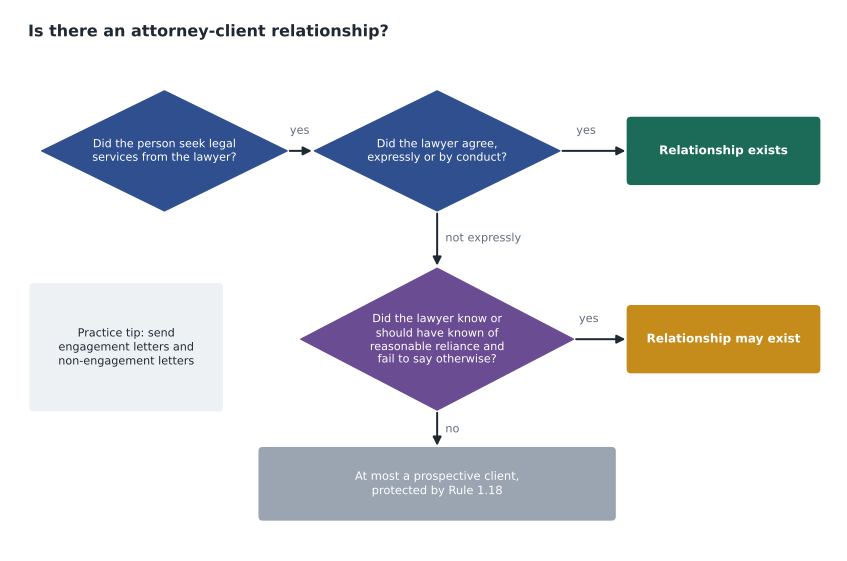
An attorney-client relationship usually begins by agreement, but the agreement need not be written or even explicit. Under the Restatement (Third) of the Law Governing Lawyers, section 14, a relationship arises when a person manifests an intent that a lawyer provide legal services and the lawyer either manifests consent or fails to manifest a lack of consent when the lawyer knows or reasonably should know that the person reasonably relies on the lawyer. The test looks at reasonable expectations, not at whether a fee was paid or a retainer signed. Togstad v. Vesely, the Minnesota case from lesson 1, is the classic illustration: a brief consultation and an offhand assessment created enough of a relationship to support a malpractice claim.
A court can also appoint a lawyer to represent a person, and a lawyer may be bound by duties to prospective clients who never become clients. Rule 1.18, covered in lesson 8, protects information a prospective client shares in a consultation even if no relationship follows. The practical lesson for lawyers is to make the status of every conversation clear. Many firms send non-engagement letters to people they decline to represent, stating that the firm does not represent them and warning that limitation periods may apply. Oyelaran calls these the cheapest malpractice insurance a firm can buy.
Accepting or declining a representation
A lawyer is generally free to decline a representation for any reason that is not unlawful discrimination. The Model Rules encourage lawyers to accept unpopular clients and court appointments: Rule 6.2 says a lawyer should not seek to avoid a court appointment except for good cause, such as a conflict, an unreasonable financial burden, or a client or cause so repugnant to the lawyer that it would impair the representation. Rule 1.2(b) adds an important principle: representing a client does not constitute an endorsement of the client's political, economic, social or moral views or activities. A lawyer who defends an accused murderer does not approve of murder, and a lawyer who represents a polluter is not endorsing pollution.
A lawyer must decline a representation in some situations. Rule 1.16(a) requires a lawyer to decline or withdraw if the representation will result in a violation of the rules or other law, if the lawyer's physical or mental condition materially impairs the ability to represent the client, or if the lawyer is discharged. Rule 1.1 means a lawyer should decline work the lawyer cannot competently handle unless the lawyer can become competent through study or by associating with an experienced lawyer. Conflicts of interest, covered in lessons 7 through 9, are the most common reason firms turn down otherwise attractive matters.
The 2023 amendment: the duty to inquire
In August 2023 the ABA amended Rule 1.16 and its comments to address a problem that had drawn public attention: lawyers being used, knowingly or not, to help clients launder money or carry out fraud. New Rule 1.16(a)(4) requires a lawyer to decline or withdraw if the client or prospective client seeks to use or persists in using the lawyer's services to commit or further a crime or fraud, despite the lawyer's discussion with the client about the limits of what the lawyer can do. Revised comments explain that a lawyer has a duty to inquire into and assess the facts and circumstances of a representation at the outset and as it continues. The level of inquiry is risk-based: a long-time local client asking for a routine lease needs little scrutiny, while an anonymous overseas entity that wants to move large sums through the lawyer's trust account for a vague purpose needs a great deal. ABA Formal Opinion 513 later explained how the duty works in practice.
Oyelaran links the amendment to Rule 1.2(d), which has long forbidden a lawyer to counsel a client to engage, or assist a client, in conduct the lawyer knows is criminal or fraudulent. The amendment did not change the knowledge standard for discipline under Rule 1.2(d), but it makes it harder for a lawyer to claim ignorance after ignoring warning signs. Courts have long treated deliberate avoidance of knowledge as a form of knowledge, and the comments now say expressly that a lawyer cannot simply look away.
Who decides what: Rule 1.2 and the allocation of authority
Rule 1.2(a) divides decision-making between client and lawyer. The client decides the objectives of the representation, and the lawyer consults with the client about the means. Certain decisions belong to the client alone: whether to settle a civil matter, and in a criminal case, what plea to enter, whether to waive a jury trial and whether the client will testify. The lawyer may take actions impliedly authorized to carry out the representation, and lawyers usually decide technical and tactical questions, such as which witnesses to call or which motions to file, after consulting the client. When lawyer and client disagree about means, the comments suggest the lawyer should defer to the client on matters such as expense and concern for third persons, and that a fundamental disagreement may justify withdrawal.
The Supreme Court has addressed this allocation in criminal cases. In Jones v. Barnes (1983), it held that appointed appellate counsel need not raise every nonfrivolous issue a defendant requests, because choosing which issues to press is a matter of professional judgment. In McCoy v. Louisiana (2018), it held that a defendant has the right to insist that counsel refrain from admitting guilt, even when counsel believes conceding guilt offers the best chance to avoid a death sentence, because the objective of the defense is the client's to decide. In Garza v. Idaho (2019), it held that counsel who refuses a client's instruction to file a notice of appeal is presumptively ineffective, even if the client signed an appeal waiver.
| Decision | Who decides | Authority |
|---|---|---|
| Objectives of the representation | Client | Rule 1.2(a) |
| Whether to accept a settlement offer | Client | Rule 1.2(a) |
| Plea, jury waiver, whether to testify (criminal) | Client | Rule 1.2(a) |
| Whether to concede guilt | Client | McCoy v. Louisiana (2018) |
| Whether to file a notice of appeal | Client | Garza v. Idaho (2019) |
| Which nonfrivolous issues to raise on appeal | Lawyer, after consultation | Jones v. Barnes (1983) |
| Tactics such as witnesses and motions | Lawyer, after consultation | Rule 1.2(a) and comments |
Limiting the scope of a representation
Rule 1.2(c) allows a lawyer to limit the scope of a representation if the limitation is reasonable under the circumstances and the client gives informed consent. Limited scope representation, sometimes called unbundling, has grown rapidly as a way to make legal help affordable. A lawyer might review a lease without negotiating it, draft a complaint for a self-represented litigant to file, coach a client for a single hearing, or advise only on the tax consequences of a deal that other lawyers are handling. Many states have adopted court rules that let a lawyer enter a limited appearance and that protect lawyers who ghostwrite documents for self-represented people, though some require the document to disclose that a lawyer helped prepare it.
The limitation must be reasonable. A lawyer cannot agree to give advice so narrow that it would be misleading or incompetent, such as reviewing only the first page of a settlement agreement. The duty of competence still applies within the agreed scope, and a lawyer who sees a serious problem just outside the scope should at least warn the client about it. Oyelaran recommends putting every limitation in writing, describing both what the lawyer will do and what the lawyer will not do, and explaining in plain terms what the client must handle alone.
Engagement letters
The Model Rules do not require a written engagement agreement for most representations, though Rule 1.5(b) requires that the scope of the representation and the basis of the fee be communicated, preferably in writing, before or within a reasonable time after commencing the representation, and Rule 1.5(c) requires a writing signed by the client for contingent fees. Many states go further. Prudent lawyers use engagement letters for every matter. A good letter identifies the client, which matters greatly when a lawyer is hired by a company, a family or a group; describes the scope and any limits; explains fees, expenses and billing; describes how the lawyer will communicate; addresses conflicts and any waivers; and explains how the representation will end.
Identifying the client is not a formality. When a parent pays for an adult child's criminal defense, the child is the client, and Rule 1.8(f) forbids the lawyer to let the parent interfere with the lawyer's independent judgment or receive confidential information without the child's informed consent. When a lawyer forms a business for three friends, the lawyer must decide whether the client is the new company, each of the founders, or all of them jointly, and must say so. Ambiguity about who the client is lies behind many of the conflicts problems the class will meet later.
Clients with diminished capacity
Rule 1.14 governs representation of a client whose capacity to make adequately considered decisions is diminished because of age, mental impairment or another reason. The basic rule is that the lawyer must, as far as reasonably possible, maintain a normal client-lawyer relationship. In February 2026 the ABA House of Delegates adopted a revised Rule 1.14 that places greater emphasis on supported decision-making: helping a client make the client's own decisions with assistance from trusted people, rather than having someone else decide for the client. Protective action, such as consulting family members or seeking a guardian, remains available when the client is at risk of substantial harm and cannot adequately act in the client's own interest, but it is treated as a last resort and should be the least restrictive option that will work. States are now considering whether to adopt the revision.
Ending the relationship: mandatory and permissive withdrawal
A representation ends when the matter is completed, when the client discharges the lawyer, or when the lawyer withdraws. A client may fire a lawyer at any time, with or without cause, subject to liability for fees earned. Rule 1.16(a) lists the situations in which a lawyer must withdraw, already described above. Rule 1.16(b) lists situations in which a lawyer may withdraw: if withdrawal can be accomplished without material adverse effect on the client; if the client persists in conduct involving the lawyer's services that the lawyer reasonably believes is criminal or fraudulent; if the client has used the lawyer's services to commit a crime or fraud; if the client insists on action the lawyer considers repugnant or with which the lawyer has a fundamental disagreement; if the client fails substantially to fulfill an obligation to the lawyer, such as paying fees, after reasonable warning; if the representation will result in an unreasonable financial burden or has been rendered unreasonably difficult by the client; or for other good cause.
Withdrawal in litigation needs the court's permission if the tribunal's rules require it, and Rule 1.16(c) says a lawyer must continue the representation when ordered to do so even if good cause exists. Courts often deny withdrawal on the eve of trial. When a lawyer seeks leave to withdraw because of a client's misconduct, the lawyer should usually say only that professional considerations require withdrawal, without revealing confidences. Rule 1.16(d) requires a withdrawing or discharged lawyer to take reasonable steps to protect the client's interests, such as giving reasonable notice, allowing time to hire other counsel, surrendering papers and property to which the client is entitled, and refunding any advance fee that has not been earned. A lawyer may keep papers to the extent other law permits, but most states sharply limit retaining liens when keeping the file would prejudice the client.
Ashworth Lattimore and the silent client
Oyelaran turns to her running file. Two years ago Rachel Abernathy drafted a will for Walter Kessler, a retired machinist, and in the same meeting answered a few questions about a dispute over the boundary of his lake cabin. She billed only for the will. Last month Kessler emailed her: the neighbor had sued him over the boundary, and he assumed she was handling it because she had told him two years ago to keep his survey and his old photographs. He had been served three weeks earlier. The answer is due in a week.
Worked problem
Is Rachel Kessler's lawyer on the boundary dispute?
Using Restatement section 14 and the Model Rules, decide whether Abernathy has an attorney-client relationship with Kessler on the boundary lawsuit, and what she should do now, whether or not she wants the case.
Show solution
- Ask whether Kessler manifested an intent that she provide legal services on the boundary matter: he asked her questions about it and followed her advice to keep his survey.
- Ask whether she manifested consent or failed to manifest a lack of consent while knowing he might rely on her: she gave specific advice and never said she would not handle the dispute.
- Recognize that even if a court finds no full relationship, her duties to a person who reasonably relied on her advice, and her duties of competence, make silence dangerous.
- Identify what must happen now regardless: the answer deadline must be protected, either by her firm or by another lawyer, and Kessler must be told clearly, in writing, whether Ashworth Lattimore is representing him.
- If the firm declines, protect him under the spirit of Rule 1.16(d): tell him the deadline, recommend that he seek a lawyer immediately, return his documents and consider seeking an extension on his behalf only if the firm is willing to appear.
Answer: There is a real risk that Kessler reasonably believed Abernathy was his lawyer on the boundary matter, given her specific advice and her silence. Whether or not a court would find a relationship, she must act at once: either the firm takes the case and protects the deadline, or she sends a clear written non-engagement letter that states the deadline, urges him to hire counsel immediately and returns his papers. Doing nothing is the worst choice.
Oyelaran closes with the habits that prevent these problems: clear engagement letters, clear non-engagement letters, written limits on scope, a calendar entry for every deadline the lawyer mentions, and a closing letter when a matter ends. "A closing letter," she says, "is your proof that a relationship ended. Without one, a former client may argue years later that you were still their lawyer and should have warned them."
Summary and key terms
- A relationship can arise without a written agreement when a person reasonably relies on a lawyer who does not disclaim it (Restatement section 14; Togstad).
- Lawyers may decline most matters, but Rule 1.16(a) requires declining or withdrawing when the work would violate the rules, when the lawyer is impaired, on discharge, and since 2023 when a client persists in using the lawyer's services for crime or fraud.
- The 2023 amendments add a risk-based duty to inquire into the facts of a representation.
- Under Rule 1.2(a) the client controls objectives, settlement, plea, jury waiver and testifying; McCoy and Garza add the decisions to maintain innocence and to appeal.
- Rule 1.2(c) allows reasonable limited scope representation with informed consent.
- Engagement letters should identify the client, scope and fees; Rule 1.8(f) protects clients whose fees are paid by others.
- Withdrawal may need court permission, and Rule 1.16(d) requires steps to protect the client, including returning papers and unearned fees.
Practice problems
Work each problem on paper first, then reveal the answer to check.
Must a lawyer withdraw if a client refuses to pay the agreed fee?
Show answer
No. Nonpayment after reasonable warning permits withdrawal under Rule 1.16(b)(5), but does not require it, and a court may still refuse leave in a pending case.
Who decides whether a criminal defendant will testify?
Show answer
The client, under Rule 1.2(a), after consulting the lawyer.
What did McCoy v. Louisiana hold?
Show answer
That a defendant has the right to insist that counsel not concede guilt, even if counsel thinks conceding offers the best strategy.
Is a lawyer who drafts a pleading for a self-represented litigant engaged in a permissible limited representation?
Show answer
Usually yes, if the limitation is reasonable and the client gives informed consent, but the lawyer must check local rules, some of which require disclosure of the lawyer's help.
Lesson quiz · 5 questions
Score 60% or more to complete this lesson.
Create a free account to save your progress, take quizzes and earn a certificate.