
LAWU-204 · Lesson 12 of 12 · 23 min
Capstone: solving a professional responsibility problem
▶ Video coming soon A video version of this lesson is on the way.
For the last session, Oyelaran puts a single file on the table. "This is the kind of week that ends careers when lawyers take it one email at a time," she says. "Nothing in it is exotic. Every issue is one we have covered. The skill I want you to leave with is not memorizing Rule 1.9 or Rule 3.3. It is seeing, in a messy set of facts, which relationships exist, which duties they create, which rules are triggered, and what the lawyer should do next. Discipline is only one consequence. Disqualification, fee forfeiture, malpractice liability, sanctions and the loss of a client's trust are just as real."
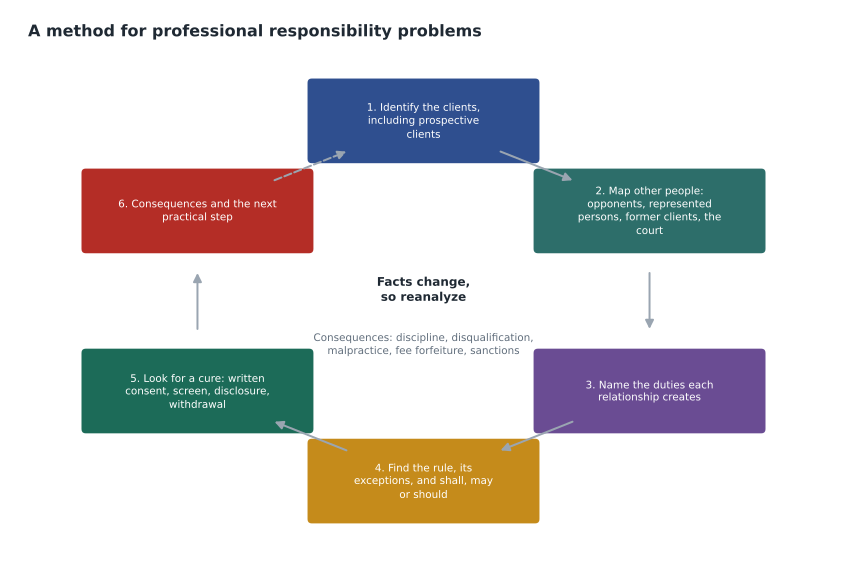
A method for professional responsibility problems
Oyelaran gives Section B a six-step method. First, identify the client or clients, and anyone who might reasonably believe they are a client, such as a prospective client or a constituent of an organization. Second, list the other people the lawyer is dealing with: opposing parties, represented and unrepresented persons, former clients, courts and third parties. Third, for each relationship, identify the duties: competence, diligence, communication, loyalty, confidentiality, candor and fairness. Fourth, find the specific rule, read its text and its exceptions, and note whether the rule says shall, may or should. Fifth, ask whether consent, screening, disclosure or withdrawal can cure the problem, and what form consent must take. Sixth, identify the consequences and the practical next step, including what the lawyer should put in writing.
The facts
On a Monday, Delia Brennecke, the former chief financial officer of Pemberton Freight Lines, a fictional regional trucking company, meets with Gordon Ashworth and Rachel Abernathy at Ashworth Lattimore. She says she was fired two weeks after telling Pemberton's chief executive that the company was overstating its revenues to its lenders. She wants to sue for retaliatory discharge and asks whether the firm will take the case on contingency. During the meeting she hands Abernathy a flash drive. It contains files she copied from her work laptop before she left, including a folder labeled Legal containing emails between Pemberton's general counsel and its outside lawyers about the revenue issue. She says that she cannot afford to pay costs and asks whether the firm could also lend her money for rent until the case settles.
Later that day, the firm's conflict check reveals two things. Four years ago, Ashworth Lattimore represented Pemberton in negotiating a warehouse lease; the matter closed and the firm has done no work for Pemberton since. And Laurel Quist, a partner who joined Ashworth Lattimore last month from a larger firm in Brennan Falls, had worked at her prior firm on Pemberton's lender negotiations last year, including meetings at which the revenue figures were discussed.
Over the following weeks, more happens. Abernathy wants to run the flash drive's contents through the firm's AI document review tool to build a timeline. She also wants to call Pemberton's controller, who reported to Brennecke and who still works there, to ask what he saw, and Pemberton's former human resources director, who left the company in the spring. At her deposition, Brennecke testifies that she copied the files months before she was fired, as part of her normal work, when Abernathy knows from Brennecke's own statement in the first meeting that she copied them the night before she cleaned out her office. And after the deposition, Ashworth tells Abernathy he would like to post on the firm's social media account that the firm is taking on a corporate fraud at Pemberton, with a link to the complaint.
Issue one: Brennecke as prospective client and the conflict check
Brennecke is at least a prospective client under Rule 1.18 from the moment she consulted with the firm about possibly forming a relationship. Even if the firm declines the case, it may not use or reveal information she provided, except as Rule 1.9 would permit for a former client. Once the firm agrees to represent her, she is a current client and the full set of duties applies. The engagement should be confirmed in writing, defining its scope under Rule 1.2(c) and setting out the fee under Rule 1.5.
The firm's former representation of Pemberton raises Rule 1.9(a). The firm may not represent Brennecke in the same or a substantially related matter in which her interests are materially adverse to Pemberton's unless Pemberton gives informed consent, confirmed in writing. The warehouse lease and a retaliatory discharge claim about revenue reporting are not the same transaction and, on these facts, are unlikely to be substantially related. Comment 3 asks whether there is a substantial risk that confidential factual information as would normally have been obtained in the prior representation would materially advance Brennecke's position. Lease terms four years old will rarely do that, though the firm should confirm that the lease file contains nothing about revenues or lender covenants. Rule 1.9(c) still forbids the firm to use information from the lease representation to Pemberton's disadvantage unless it has become generally known.
Laurel Quist's prior work is the harder problem. At her old firm she worked on a matter that is closely connected to the revenue issue at the center of Brennecke's case, and she likely acquired material confidential information. Under Rule 1.9(b) she is personally disqualified. Under Rule 1.10(a)(2), her disqualification is not imputed to Ashworth Lattimore if she is timely screened from any participation in the matter and apportioned no part of the fee, and written notice is promptly given to Pemberton so it can ascertain compliance. The firm must build the screen now, before Quist hears anything about the case, and document it. Some states do not permit nonconsensual screening of laterals, or limit it where the lateral was substantially involved, so the firm must check Westmarch's version of Rule 1.10. Even where the rules permit screening, a court considering a disqualification motion applies its own standards, and an ineffective or late screen invites a motion that could cost Brennecke her chosen counsel.
Issue two: the flash drive and the privileged emails
The flash drive raises questions of evidence law, employment law and professional responsibility at once. Rule 4.4(b) applies only to documents a lawyer knows or reasonably should know were inadvertently sent; ABA Formal Opinion 06-440 concluded that it does not cover documents deliberately taken by a client. But other law matters a great deal. Courts have disqualified lawyers who received and used an opponent's privileged documents taken by their client, and Rule 4.4(a) forbids methods of obtaining evidence that violate the legal rights of a third person. Rule 3.4(a) forbids unlawfully obstructing access to or concealing evidence, so the firm also must not destroy or hide the drive.
The prudent course has several parts. Abernathy should not read the folder labeled Legal; the privilege belongs to Pemberton, and its emails with outside counsel about the revenue issue are classic privileged communications under Upjohn. The crime-fraud exception might ultimately apply if the communications were in furtherance of a fraud on the lenders, but that is for a court to decide on a proper showing, not for the firm to assume. The firm should segregate and preserve the drive, research Westmarch law on an employee's taking of employer documents, and consider disclosing the possession to Pemberton or seeking guidance from the court. Abernathy must also advise Brennecke, under Rules 1.2(d) and 1.4, about the legal risks of what she took, including counterclaims for breach of a confidentiality agreement and possible protections under whistleblower statutes, without assisting any further unlawful conduct.
Issue three: fees and financial assistance
A contingent fee is appropriate for a retaliatory discharge claim. Under Rule 1.5(c), the agreement must be in writing, signed by the client, and state the method by which the fee is to be determined, including the percentage accruing in the event of settlement, trial or appeal, litigation and other expenses to be deducted, and whether those expenses are deducted before or after the fee is calculated. It must also notify the client of any expenses for which the client will be liable whether or not she prevails. The percentage must be reasonable under Rule 1.5(a).
Brennecke's request for rent money runs into Rule 1.8(e). A lawyer may advance court costs and litigation expenses, the repayment of which may be contingent on the outcome, but may not provide financial assistance to a client in connection with pending or contemplated litigation. The narrow exception in Rule 1.8(e)(3), added in 2020, permits a lawyer representing an indigent client pro bono, through a nonprofit legal services program or a law school clinic, to give modest gifts for basic living expenses. It does not apply to a fee-paying contingent case. The firm may advance costs but must decline to pay her rent.
Issue four: confidentiality and the AI tool
Running the flash drive's contents through an AI tool raises Rule 1.1 and Rule 1.6(c). ABA Formal Opinion 512 (2024) advises that a lawyer must understand the capabilities and limits of a generative AI tool, review its output, and evaluate the risk that information relating to the representation will be disclosed or accessed by others, including through the tool's use of inputs to train or improve itself. If the tool is a self-learning system that could expose inputs outside the firm, informed consent from the client is needed before putting confidential information into it; boilerplate in an engagement letter is not enough. Here the problem is compounded: the drive contains Pemberton's privileged documents, which the firm should not be reviewing at all. Abernathy may use a properly vetted tool on Brennecke's own materials with appropriate safeguards and review every output, but must exclude the segregated folder entirely.
Issue five: contacting the controller and the former HR director
Pemberton is represented in the dispute once it has counsel for the matter, and Abernathy should assume it does once the complaint is filed or a demand letter is answered by its lawyers. Under Rule 4.2 and comment 7, she may not communicate about the matter with a current constituent who supervises, directs or regularly consults with the organization's lawyer concerning the matter, who has authority to obligate the organization, or whose act or omission in the matter may be imputed to the organization. The controller is a central actor in the revenue reporting; his acts may well be imputed to Pemberton, and he is likely to have consulted with its lawyers. Abernathy should not contact him without Pemberton's counsel's consent; she can seek his testimony through discovery. The former human resources director is a different case. Comment 7 says consent is not required for communication with a former constituent. Abernathy may interview her, subject to Rule 4.3 duties to make clear whom she represents, and Rule 4.4(a), which forbids using methods that violate the person's legal rights. She must not ask the former director to reveal Pemberton's privileged communications, which remain Pemberton's to protect.
Issue six: the false deposition testimony
A deposition is part of an adjudicative proceeding, so Rule 3.3 applies. Abernathy knows that Brennecke's testimony about when she copied the files is false, because Brennecke told her the truth in the first meeting, and the testimony is material because it bears on whether Brennecke took the files in anticipation of litigation. Under Rule 3.3(a)(3) and comment 10, Abernathy must take reasonable remedial measures. She should first remonstrate with Brennecke privately, explaining the duty of candor, the risk of perjury and of sanctions or dismissal, and urge her to correct the testimony, which can be done through an errata sheet or a supplemental deposition. If Brennecke refuses, the firm must consider withdrawal, which in pending litigation requires the court's permission under Rule 1.16(c), and if withdrawal will not undo the effect of the false evidence, the firm must disclose to the tribunal to the extent reasonably necessary, even though the information is otherwise protected by Rule 1.6. The duty lasts until the conclusion of the proceeding. Ashworth, as the supervising partner, shares responsibility under Rule 5.1 if he knows and fails to take remedial action.
Issue seven: the social media post
Ashworth's proposed post raises three rules. Rule 7.1 forbids false or misleading communications about the firm's services; calling the case a corporate fraud states an accusation as fact. Rule 3.6 forbids an extrajudicial statement the lawyer knows or reasonably should know will be disseminated and has a substantial likelihood of materially prejudicing the proceeding; a civil case tried to a jury is less sensitive than a criminal trial, but inflammatory characterizations still carry risk, while the claim involved and information in the public record, such as the complaint, fall within the safe harbor. And Rule 1.6 forbids revealing information relating to the representation without the client's informed consent, which includes information that is in the public record if it has not become generally known. Ashworth should ask Brennecke, explain the risks, and if she agrees, limit the post to a neutral statement that the firm has filed a retaliation complaint, with a link to the public filing.
| Issue | Main rules | Bottom line |
|---|---|---|
| Prior lease work for Pemberton | 1.9(a), 1.9(c) | Likely not substantially related; do not use lease information |
| Lateral partner Quist | 1.9(b), 1.10(a)(2) | Screen at once, no fee share, written notice to Pemberton |
| Privileged emails on the drive | 4.4(a), 3.4(a), 1.2(d) | Do not read; segregate and preserve; research law; advise client |
| Rent money | 1.8(e) | Advance costs only; decline living expenses |
| AI review | 1.1, 1.6(c), Op 512 | Vetted tool, client consent if needed, exclude privileged folder |
| Controller and former HR director | 4.2 cmt 7, 4.3 | No contact with controller; former director permitted with care |
| False deposition testimony | 3.3(a)(3), 3.3(c), 1.16 | Remonstrate, correct, withdraw or disclose as needed |
| Social media post | 7.1, 3.6, 1.6 | Client consent; neutral statement and public filing only |
Looking back over the course
Oyelaran closes by returning to where the semester began. The rules regulate a profession that governs itself through its courts, and the consequences of breaking them reach far beyond discipline. Most of the problems in the Pemberton file could have been avoided by habits rather than heroics: running the conflict check before the first meeting, documenting a screen, writing the fee agreement, asking whether a document should be read before reading it, reading a tool's terms before uploading client information, and asking who is represented before picking up the phone. The one problem habits cannot prevent, a client's decision to lie under oath, is the one where the rules are most demanding, because the court's ability to find the truth depends on it. "The MPRE will test whether you know the rules," she tells Section B. "Your clients, your colleagues and the judges in front of whom you appear will test whether you live by them."
Worked problem
A short follow-up: the settlement offer
After the deposition is corrected, Pemberton's lawyer calls Abernathy with an offer to settle for a confidential sum, on two conditions: that Brennecke return all documents and that Ashworth Lattimore agree never to represent any other Pemberton employee in a claim against the company. What should Abernathy do?
Show solution
- Under Rule 1.2(a) and Rule 1.4(a), Abernathy must promptly communicate the offer to Brennecke; whether to settle is Brennecke's decision.
- The return of documents term is a legitimate subject of negotiation and is consistent with how the firm has treated the privileged folder.
- The restriction on future representation violates Rule 5.6(b), which forbids a lawyer to participate in offering or making an agreement in which a restriction on the lawyer's right to practice is part of the settlement of a client controversy. The firm cannot accept that term, and Pemberton's lawyer violates the rule by proposing it.
- Abernathy should tell Brennecke about both conditions, explain that the firm cannot agree to the second, and respond to Pemberton's counsel that the term is not permissible.
Answer: Abernathy must convey the offer to Brennecke, who decides whether to accept. The document return term can be negotiated, but the restriction on the firm's future practice is barred by Rule 5.6(b) and must be refused.
Summary and key terms
- Analyze professional responsibility problems by identifying clients, mapping other relationships, naming duties, finding the rule and its exceptions, looking for a cure and stating consequences and next steps.
- A prior unrelated matter for an opponent rarely bars a representation under Rule 1.9(a), but a lateral who worked on a substantially related matter must be screened under Rule 1.10(a)(2).
- Documents a client took from an opponent fall outside Rule 4.4(b) but raise serious issues under other law; privileged material should be segregated, not read.
- Rule 1.8(e) permits advancing litigation costs but forbids paying a client's living expenses in a fee-paying case.
- Rule 3.3 requires remedial measures when a client gives material false testimony in a deposition, up to disclosure if necessary.
- Rule 4.2 bars contact with key current constituents of a represented organization but not with former constituents.
- Rule 5.6(b) forbids settlement terms restricting a lawyer's future practice.
Practice problems
Work each problem on paper first, then reveal the answer to check.
When must Ashworth Lattimore set up the screen for Laurel Quist?
Show answer
Timely, which means before she has any involvement and as soon as the conflict is identified, with written notice to Pemberton.
May the firm pay Brennecke's rent if she promises to repay it from any recovery?
Show answer
No. Rule 1.8(e) forbids financial assistance beyond costs and expenses of litigation in a fee-paying case, whether or not repayment is promised.
Why may Abernathy interview Pemberton's former HR director but not its controller?
Show answer
Comment 7 to Rule 4.2 does not cover former constituents; the controller is a current constituent whose acts may be imputed to Pemberton.
Is a deposition a proceeding to which Rule 3.3 applies?
Show answer
Yes. Comment 1 to Rule 3.3 applies the rule to ancillary proceedings conducted pursuant to the tribunal's adjudicative authority, such as depositions.
Lesson quiz · 5 questions
Score 60% or more to complete this lesson.
Create a free account to save your progress, take quizzes and earn a certificate.