
LAWU-204 · Lesson 5 of 12 · 22 min
Confidentiality
▶ Video coming soon A video version of this lesson is on the way.
Oyelaran begins the class on confidentiality with an old case that still unsettles students. In Spaulding v. Zimmerman (Minn. 1962), a teenage boy injured in a car accident sued the driver. The defense hired a doctor to examine him, and the doctor found something the boy's own doctors had missed: a life-threatening aortic aneurysm, probably caused by the accident. Defense counsel did not tell the boy or his lawyers and settled the case for a modest sum. The aneurysm was discovered two years later during a routine exam. The trial court later set the settlement aside, because the boy was a minor and the court had approved it without knowing the truth, and the Minnesota Supreme Court affirmed, but the case is remembered for the question it raises: what was the defense lawyer allowed, required or forbidden to say? "Today you will learn the answer under the current rules," Oyelaran says, "and I want you to decide whether you think it is right."
The scope of the duty: Rule 1.6(a)
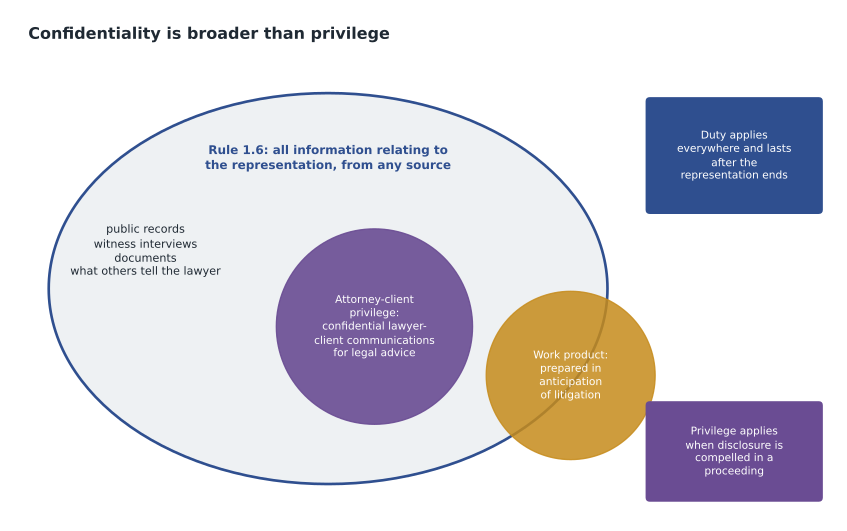
Rule 1.6(a) forbids a lawyer to reveal information relating to the representation of a client unless the client gives informed consent, the disclosure is impliedly authorized to carry out the representation, or the disclosure is permitted by Rule 1.6(b). The phrase information relating to the representation is extraordinarily broad. It covers everything the lawyer learns in the course of the representation, from any source, whether or not the client told the lawyer, whether or not it is secret, embarrassing or harmful, and whether or not anyone else knows it. It covers the identity of the client in many situations, the fact of the representation, documents, conversations with witnesses and information found in public records.
The duty is far broader than the attorney-client privilege, covered in lesson 6. The privilege is an evidentiary rule that lets a client refuse to disclose, and prevent the lawyer from disclosing, confidential communications between lawyer and client made for the purpose of legal advice, when someone tries to compel testimony or production in a legal proceeding. The ethics duty applies everywhere, all the time: at cocktail parties, on social media, in conversations with a spouse, in books written years later. A lawyer who tells a friend over dinner that a well-known local businessman has hired her for a divorce violates Rule 1.6 even though the information is not privileged and even if the friend never repeats it.
The duty continues after the representation ends. Rule 1.9(c), covered in lesson 8, forbids a lawyer to use or reveal information relating to the representation of a former client except as the rules would permit for a current client, or to use it to the former client's disadvantage unless it has become generally known. It continues after the client's death; in Swidler and Berlin v. United States (1998), the Supreme Court held that the attorney-client privilege survives the client's death, and the ethics duty is at least as durable.
Implied authorization and informed consent
Lawyers reveal client information all the time in the ordinary course of work. Comment 5 explains that a lawyer is impliedly authorized to make disclosures that carry out the representation, such as admitting a fact that cannot properly be disputed or disclosing information in negotiations to reach a settlement. Lawyers in a firm may also discuss a client's affairs with each other, unless the client has instructed that particular information be confined to specific lawyers. A lawyer may share information with an expert witness retained for the case. The line is crossed when the disclosure does not serve the client's objectives.
Informed consent under Rule 1.0(e) requires that the lawyer communicate adequate information and explanation about the material risks of and reasonably available alternatives to the proposed course of conduct. A client might consent to disclosure in a press release, in a firm marketing brochure listing representative clients, or in a book about a famous case. Oyelaran warns that general consent in an engagement letter to use the client's name in marketing does not authorize revealing details of the matter, and that consent obtained without explaining the risks is not informed consent at all.
The exceptions: Rule 1.6(b)
Rule 1.6(b) permits, but does not require, a lawyer to reveal information relating to the representation to the extent the lawyer reasonably believes necessary for seven purposes. First, to prevent reasonably certain death or substantial bodily harm. Second, to prevent the client from committing a crime or fraud that is reasonably certain to result in substantial injury to the financial interests or property of another and in furtherance of which the client has used or is using the lawyer's services. Third, to prevent, mitigate or rectify substantial financial injury that is reasonably certain to result or has resulted from the client's crime or fraud in which the client used the lawyer's services. Fourth, to secure legal advice about the lawyer's own compliance with the rules.
Fifth, to establish a claim or defense on behalf of the lawyer in a controversy between the lawyer and the client, to establish a defense to a criminal charge or civil claim against the lawyer based on conduct in which the client was involved, or to respond to allegations in any proceeding concerning the lawyer's representation of the client. This self-defense exception covers fee collection suits, malpractice claims and discipline complaints. Sixth, to comply with other law or a court order. Seventh, to detect and resolve conflicts of interest arising from the lawyer's change of employment or from changes in the composition or ownership of a firm, but only if the revealed information would not compromise the attorney-client privilege or otherwise prejudice the client; this exception, added in 2012, lets lawyers moving between firms run conflict checks.
| Paragraph | Purpose | Key limits |
|---|---|---|
| (b)(1) | Prevent reasonably certain death or substantial bodily harm | Need not involve a crime or the client |
| (b)(2) | Prevent client crime or fraud causing substantial financial injury | Client must be using the lawyer's services |
| (b)(3) | Prevent, mitigate or rectify such financial injury | Client used the lawyer's services |
| (b)(4) | Get ethics advice about the lawyer's own compliance | From another lawyer |
| (b)(5) | Lawyer's claims and defenses; respond to allegations | Fee suits, malpractice, discipline |
| (b)(6) | Comply with other law or a court order | Seek protective measures where possible |
| (b)(7) | Detect conflicts when lawyers change firms | No privilege compromise or prejudice |
How much to reveal, and when the states differ
Every exception is limited by the phrase to the extent the lawyer reasonably believes necessary. Comment 16 says the disclosure should be no greater than necessary to accomplish the purpose, and where practicable the lawyer should first try to persuade the client to take suitable action. When disclosure is made in a proceeding, the lawyer should seek protective orders or other arrangements limiting access to the information. A lawyer suing for an unpaid fee may reveal the fee agreement and the work performed, but not unrelated secrets about the client's business.
The Model Rules make every exception permissive, and comment 17 says a lawyer's decision not to disclose as permitted by Rule 1.6(b) does not violate the rule. States vary widely, and this is one of the areas where reading the local rule matters most. Many states make disclosure mandatory to prevent death or substantial bodily harm, at least where a client's criminal act is involved. Some states require disclosure to prevent a client's serious financial crime. A few, such as Arizona, use the word shall for disclosure needed to prevent a client's criminal act likely to result in death or substantial bodily harm. Others are narrower than the Model Rules and do not permit disclosure to prevent financial fraud at all.
Return now to Spaulding v. Zimmerman. Under current Rule 1.6(b)(1), defense counsel would be permitted, though in most states not required, to reveal the aneurysm to prevent reasonably certain death or substantial bodily harm. The exception does not require that the harm be caused by the client or by a crime; it was revised in 2002 to cover any reasonably certain death or substantial bodily harm. Most students think disclosure is plainly right. Some point out that the defense lawyer's duty runs to the client, and that the client's insurer may have wanted the case settled cheaply. Oyelaran asks whether a lawyer who stayed silent in that situation could live with the decision, permitted or not.
The financial fraud exceptions and the Enron era
The financial fraud exceptions in paragraphs (b)(2) and (b)(3) were added in 2003, after the collapse of Enron and other corporate scandals in which lawyers' work had helped clients carry out frauds. The ABA had rejected similar proposals for years, and the change remains controversial. Both exceptions require that the client used the lawyer's services in the crime or fraud. A lawyer who learns that a client cheated someone in a transaction the lawyer had nothing to do with may not reveal it under these exceptions. The exceptions work alongside Rule 1.2(d), which forbids assisting client crime or fraud, and Rule 1.16, which may require withdrawal. Rule 4.1(b), covered in lesson 11, requires disclosure of a material fact to avoid assisting a client's crime or fraud, unless disclosure is prohibited by Rule 1.6.
Comment 10 to Rule 4.1 and comment 3 to Rule 1.16 describe a related device, the noisy withdrawal: a lawyer who withdraws because the client has used the lawyer's work to defraud may give notice of the fact of withdrawal and may disaffirm any opinion, document or affirmation the lawyer prepared. The withdrawal itself signals to others that something is wrong, without the lawyer necessarily revealing the underlying information. Federal law adds its own layer for securities lawyers, covered in lesson 9: the Sarbanes-Oxley Act and the SEC's rules in 17 C.F.R. Part 205 require lawyers appearing and practicing before the SEC to report evidence of material violations up the ladder within the company.
Reasonable efforts to protect information: Rule 1.6(c)
In 2012 the ABA added Rule 1.6(c), which requires a lawyer to make reasonable efforts to prevent the inadvertent or unauthorized disclosure of, or unauthorized access to, information relating to the representation of a client. Comment 18 lists factors for deciding what efforts are reasonable: the sensitivity of the information, the likelihood of disclosure if additional safeguards are not used, the cost and difficulty of implementing safeguards, and the extent to which safeguards would make it harder to represent the client. A client may require special security measures or may give informed consent to forgo them.
The ABA has applied Rule 1.6(c) to technology in a series of opinions. Formal Opinion 477R (2017) concluded that lawyers may generally use unencrypted email for routine communications but must take special precautions, such as encryption, when the information is highly sensitive or the client's circumstances require it. Formal Opinion 483 (2018) addressed data breaches, concluding that lawyers must monitor for breaches, act to stop them, restore systems and inform current clients when a breach involves or has a substantial likelihood of involving material client information. Formal Opinion 498 (2021) addressed virtual practice. Opinion 512 on generative AI, discussed in lesson 3, builds on the same framework.
Social media, online reviews and talking about work
Lawyers increasingly get into trouble for what they say online. Formal Opinion 480 (2018) warned lawyers who blog or post about their work that Rule 1.6 applies to public commentary, including information already in public court records, and that hypotheticals must not be so detailed that readers can identify the client. Responding to negative online reviews is a recurring problem. Several state courts have disciplined lawyers who revealed client information while answering bad reviews, and the ABA's Formal Opinion 496 (2021) concluded that a lawyer may not reveal information relating to the representation in response to an online review, because the self-defense exception in Rule 1.6(b)(5) does not extend to informal online criticism.
In August 2026 the ABA House of Delegates amended comment 10 to Rule 1.6 to reflect that position: a client's or former client's online criticism, standing alone, is not a controversy or proceeding that permits disclosure under paragraph (b)(5). A lawyer may respond with a statement that does not reveal confidential information, such as saying that professional obligations prevent a detailed response and that the lawyer disagrees with the review, or may choose not to respond at all. Oyelaran's advice is blunt: "The best response to a bad review is usually silence, followed by better client service."
Worked problem
The threatening client
Rachel Abernathy represents a man named Carl Brisco in a bitter custody dispute. After a hearing goes badly, Brisco tells her in her office that if the judge awards custody to his former wife, he will make sure she never gets to enjoy it, and that he has bought a handgun. He is calm and specific. He then says he is only venting. Rachel is shaken. May she, or must she, tell anyone, and whom?
Show solution
- Identify the information: Brisco's statement is information relating to the representation and also a privileged communication, but the privilege's crime-fraud exception and the ethics exceptions both may apply.
- Apply Rule 1.6(b)(1): she may reveal information to the extent she reasonably believes necessary to prevent reasonably certain death or substantial bodily harm. She must judge whether, given his specificity, the gun and the stakes, harm is reasonably certain.
- Check the local rule: many states make disclosure mandatory in this situation; if Westmarch does, she must disclose.
- Limit the disclosure: reveal only what is necessary, such as warning the former wife or the police, rather than her whole file, and consider first trying to talk Brisco down.
- Get help: Rule 1.6(b)(4) allows her to consult another lawyer, such as the firm's general counsel or a bar ethics hotline, about her obligations, and she should document her reasoning.
Answer: If she reasonably believes harm is reasonably certain, Rule 1.6(b)(1) permits her to warn those who can prevent it, and her state's rule may require it. Her disclosure should be limited to what is needed to prevent the harm. She may also need to consider whether she can continue the representation.
Confidentiality and the lawyer's conscience
Oyelaran ends by noting that confidentiality rules are not just constraints on lawyers but the foundation of the adversary system's promise to clients. Clients tell lawyers terrible things because they trust that the lawyer will not repeat them. Without that trust, clients would hide facts, and lawyers would give worse advice, including advice to stop harmful conduct. The exceptions reflect a judgment about where that trust must yield to other values, especially human life. "You will disagree with some of the lines the rules draw," she says. "That is fine. What is not fine is not knowing where they are."
Summary and key terms
- Rule 1.6(a) protects all information relating to the representation, from any source, far beyond the attorney-client privilege, and the duty survives the end of the representation.
- Disclosure is allowed with informed consent, when impliedly authorized, or under one of the seven Rule 1.6(b) exceptions.
- The exceptions cover preventing death or substantial bodily harm, client financial crime or fraud using the lawyer's services, ethics advice, the lawyer's claims and defenses, compliance with law or court orders, and conflict checks.
- Disclosures must be no greater than necessary; the Model Rules make all exceptions permissive, but many states make some mandatory.
- Rule 1.6(c) requires reasonable efforts to safeguard information, applied to email, breaches, virtual practice and AI in Formal Opinions 477R, 483, 498 and 512.
- Responding to an online review is not a proceeding under the self-defense exception (Formal Opinion 496; 2026 amendment to comment 10).
Practice problems
Work each problem on paper first, then reveal the answer to check.
Is information in a public court record protected by Rule 1.6?
Show answer
Yes. Rule 1.6 covers all information relating to the representation, whether or not it is public, though Rule 1.9(c) allows use of generally known information against a former client.
May a lawyer reveal that a client defrauded a customer in a deal the lawyer did not work on?
Show answer
Not under the financial fraud exceptions, which require that the client used the lawyer's services in the crime or fraud.
What did Formal Opinion 483 address?
Show answer
Lawyers' duties after a data breach, including monitoring, stopping the breach and notifying current clients when material client information is involved.
May a lawyer reveal confidential information to rebut a former client's negative online review?
Show answer
No. Online criticism alone is not a controversy or proceeding that triggers the self-defense exception.
Lesson quiz · 5 questions
Score 60% or more to complete this lesson.
Create a free account to save your progress, take quizzes and earn a certificate.