
LAWU-204 · Lesson 7 of 12 · 22 min
Conflicts of interest
▶ Video coming soon A video version of this lesson is on the way.
Oyelaran begins the first of three lessons on conflicts by drawing a triangle on the board: lawyer at the top, two clients at the bottom corners. "Every conflict rule," she says, "is about loyalty and confidentiality pulling in different directions. A client is entitled to a lawyer who is on her side, and to a lawyer who will not use her secrets against her. When a lawyer's other clients, former clients, friends or own wallet get in the way, the rules step in." This lesson covers conflicts involving current clients under Rules 1.7 and 1.8. Lesson 8 covers former and prospective clients and imputation; lesson 9 covers organizations and government lawyers.
Why conflicts matter
Conflicts of interest are the most heavily litigated area of legal ethics, mostly because they are raised in motions to disqualify counsel rather than in discipline proceedings. A disqualified firm loses its client and often its fee, and the client loses the lawyer it chose and pays for a new one to learn the case. Courts decide disqualification motions using the ethics rules as guidance, but they also weigh the client's interest in choosing counsel and the risk that motions are filed for tactical delay. Conflicts also lead to malpractice and fee forfeiture claims, and in criminal cases they can violate the Sixth Amendment right to effective assistance of counsel.
The general rule: Rule 1.7(a)
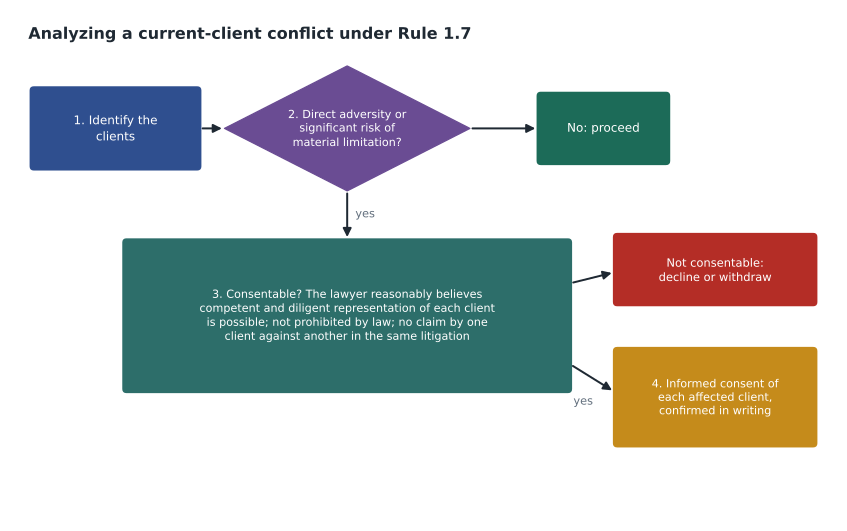
Rule 1.7(a) says a lawyer shall not represent a client if the representation involves a concurrent conflict of interest. A concurrent conflict exists in two situations. The first is direct adversity: the representation of one client will be directly adverse to another client. The second is material limitation: there is a significant risk that the representation of one or more clients will be materially limited by the lawyer's responsibilities to another client, a former client or a third person, or by a personal interest of the lawyer. The two categories overlap, and many conflicts fall into both.
Direct adversity is easy to recognize at its core: a lawyer may not sue a current client, even in an unrelated matter, without consent. Comment 6 explains that a client who is sued by its own lawyer is likely to feel betrayed and that the relationship will be damaged, even if the matters have nothing in common. The rule also bars cross-examining a current client as an adverse witness in another client's case, when the examination is likely to be damaging to the witness. By contrast, comment 6 also explains that representing competitors in unrelated matters, or representing a client whose interests are only economically adverse to another client's, is generally not direct adversity. A lawyer may represent two competing grocery chains in their separate lease negotiations.
Material limitation is subtler. The question is whether there is a significant risk that the lawyer's ability to consider, recommend or carry out an appropriate course of action for the client will be materially limited. A lawyer representing two buyers forming a business may be unable to advise either one fully about how to protect herself from the other. A lawyer whose spouse is a partner in the firm on the other side faces a personal interest conflict. A lawyer who is negotiating for a job with the opposing firm is materially limited, as comment 10 explains, and must disclose and get consent or withdraw.
Consentable conflicts and informed consent: Rule 1.7(b)
Many conflicts can be cured with client consent, but not all. Under Rule 1.7(b), a lawyer may represent a client despite a concurrent conflict only if four conditions are met: the lawyer reasonably believes the lawyer will be able to provide competent and diligent representation to each affected client; the representation is not prohibited by law; the representation does not involve the assertion of a claim by one client against another client represented by the lawyer in the same litigation or other proceeding before a tribunal; and each affected client gives informed consent, confirmed in writing.
The first condition is objective. It asks not whether the clients are willing but whether a disinterested lawyer would conclude that the clients should not agree to the representation. Some conflicts are so severe that no consent can cure them, such as representing both the plaintiff and the defendant in the same lawsuit, which is barred outright by the third condition. Representing both spouses in a contested divorce, or both sides of a hostile negotiation, is almost always nonconsentable in practice. Confirmed in writing, defined in Rule 1.0(b), means the consent is given in writing by the client or the lawyer promptly sends a writing confirming oral consent. Informed consent requires disclosure of the material risks and reasonably available alternatives, including the option of separate counsel.
Advance waivers
Large firms often ask clients to consent in advance to conflicts that may arise in the future, such as the firm representing other clients adverse to the client in unrelated matters. Comment 22 says the effectiveness of such waivers is generally determined by the extent to which the client reasonably understands the material risks the waiver entails. A detailed waiver explaining the types of future matters and adverse parties is more likely to be effective than a general one. A waiver from an experienced user of legal services, such as a corporation advised by its own general counsel, is more likely to be upheld than one from an individual client. An advance waiver cannot cure a conflict that would be nonconsentable under Rule 1.7(b), and courts have refused to enforce vague waivers when the later matter was substantially related to the work the firm did for the client.
Joint representation
Representing several clients in the same matter is common and often efficient: co-defendants in a civil suit, a husband and wife preparing wills, partners forming a business, or buyers purchasing property together. Comments 29 through 33 explain the special risks. If the common representation fails because the clients' interests diverge, the lawyer usually must withdraw from representing all of them, leaving everyone to start over with new counsel. The attorney-client privilege does not protect communications among jointly represented clients from each other in a later dispute. And comment 31 says that, as to confidentiality, the lawyer should tell each client at the outset that information will be shared among them, and that the lawyer will have to withdraw if one client asks the lawyer to keep a material secret from the others.
Joint representation of criminal co-defendants is especially dangerous. Comment 23 says the potential for conflict is so grave that ordinarily a lawyer should decline to represent more than one co-defendant. The Supreme Court has addressed the constitutional side. In Holloway v. Arkansas (1978), it held that a trial court that requires joint representation over a timely conflict objection, without inquiry, violates the Sixth Amendment, and prejudice is presumed. In Cuyler v. Sullivan (1980), it held that when no objection is made, a defendant must show that an actual conflict adversely affected the lawyer's performance. In Wheat v. United States (1988), it held that a trial court may refuse a defendant's waiver of conflict-free counsel and disqualify the defendant's chosen lawyer when there is an actual conflict or a serious potential for one. Federal Rule of Criminal Procedure 44(c) requires courts to inquire into joint representation.
| Situation | Conflict? | Consentable? |
|---|---|---|
| Suing a current client in an unrelated matter | Yes, direct adversity | Usually, with informed consent from both |
| Representing competitors in unrelated deals | Generally no | Not needed |
| Representing plaintiff and defendant in the same suit | Yes | No; barred by Rule 1.7(b)(3) |
| Two co-defendants in a criminal case | Serious potential conflict | Rarely advisable; court may refuse waiver (Wheat) |
| Lawyer interviewing for a job with opposing firm | Yes, personal interest | Disclose and get consent, or withdraw |
| Spouses jointly preparing wills | Potential | Usually yes, with clear terms on sharing information |
Positional conflicts
A lawyer who argues one position of law for one client and the opposite position for another client in a different case faces what is called a positional conflict. Comment 24 says that ordinarily this is not a conflict, because lawyers routinely argue different sides of legal questions. But a conflict exists if there is a significant risk that the lawyer's action on behalf of one client will materially limit the lawyer's effectiveness for another, such as when a ruling in one case will create binding precedent that seriously weakens the other client's position in a case pending before the same court. The factors include where the cases are pending, whether the issue is substantive or procedural, the temporal relationship between the matters, and the significance of the issue to the clients.
Specific rules for personal interests: Rule 1.8
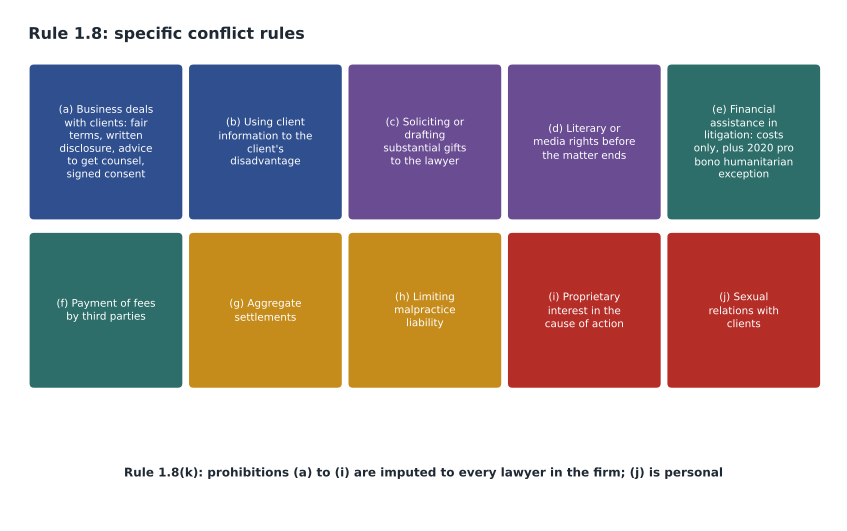
Rule 1.8 lists specific situations in which a lawyer's own interests may conflict with a client's. Rule 1.8(a) governs business transactions with clients and acquiring an ownership, possessory, security or other pecuniary interest adverse to a client. The lawyer may do so only if the terms are fair and reasonable to the client and fully disclosed in writing in a way the client can reasonably understand; the client is advised in writing of the desirability of seeking independent legal advice and is given a reasonable opportunity to do so; and the client gives informed consent, in a writing signed by the client, to the essential terms and to the lawyer's role, including whether the lawyer represents the client in the transaction. The rule applies to a lawyer who invests in a client's business, lends money to a client, or takes stock as a fee.
Rule 1.8(b) forbids a lawyer to use information relating to the representation to the client's disadvantage without informed consent. Rule 1.8(c) forbids soliciting a substantial gift from a client, including a testamentary gift, or preparing an instrument giving the lawyer or a relative a substantial gift, unless the lawyer or recipient is related to the client. Rule 1.8(d) forbids a lawyer, before the representation ends, to negotiate an agreement giving the lawyer literary or media rights to a portrayal based substantially on information relating to the representation. Rule 1.8(e) forbids providing financial assistance to a client in connection with pending or contemplated litigation, except that a lawyer may advance court costs and expenses, the repayment of which may be contingent on the outcome, and may pay costs for an indigent client. A 2020 amendment added a narrow humanitarian exception allowing a lawyer representing an indigent client pro bono to provide modest gifts for basic living expenses, such as food, rent, transportation and medicine.
Rule 1.8(f) allows a lawyer to accept compensation from someone other than the client only if the client gives informed consent, there is no interference with the lawyer's independent judgment or the client-lawyer relationship, and confidentiality is protected. This governs insurance defense, where the insurer pays the lawyer to defend the insured, and many other arrangements. Rule 1.8(g) requires informed consent from each client, in a signed writing, before a lawyer representing two or more clients makes an aggregate settlement of their claims, with disclosure of the existence and nature of all claims and the participation of each person. Rule 1.8(h) forbids agreements prospectively limiting the lawyer's malpractice liability unless the client is independently represented, and limits settling malpractice claims with unrepresented clients. Rule 1.8(i) forbids acquiring a proprietary interest in the cause of action, except for liens to secure fees and reasonable contingent fees. Rule 1.8(j) forbids sexual relations with a client unless a consensual relationship existed before the representation began. Rule 1.8(k) imputes most of these prohibitions to all lawyers in the firm, except 1.8(j).
Personal relationships and family ties
Comment 11 to Rule 1.7 says that when lawyers representing different clients in the same matter are closely related by blood or marriage, there may be a significant risk that client confidences will be revealed and that the lawyer's family relationship will interfere with loyalty and independent judgment. Each client is entitled to know of the relationship before the lawyer agrees to the representation. A lawyer related to another lawyer, such as a parent, child, sibling or spouse, ordinarily may not represent a client in a matter where that lawyer represents another party, unless each client gives informed consent. Unlike most personal interest conflicts, this one is not imputed to other lawyers in the related lawyers' firms.
Ashworth Lattimore's new client
Worked problem
The founders' agreement
Three friends, Joanna Torres, Devin Clarke and Priyanka Rao, ask Gordon Ashworth to form a company for their software startup and to draft their shareholders' agreement. Torres will contribute most of the money; Clarke and Rao will contribute code and work. Ashworth's firm already represents a venture capital fund that may invest in the startup later. Torres offers Ashworth a two percent equity stake as part of his fee. What conflicts must Ashworth address before agreeing?
Show solution
- Identify the client: he must decide whether he represents the company to be formed, the three founders jointly, or one founder, and say so in writing, because their interests diverge on valuation, control and vesting.
- Joint representation: if he represents all three, Rule 1.7(a)(2) is triggered because advising on the shareholders' agreement may be materially limited by duties to each. The conflict is consentable if he reasonably believes he can serve all three, but he must explain the risks, the sharing of information, and the possibility that he will have to withdraw, and get informed consent confirmed in writing.
- The venture fund: if the fund later negotiates to invest, the firm's representation of the fund would be directly adverse to the startup and its founders, so he should address it now, possibly through a limited advance waiver, and must not represent both sides of that negotiation.
- The equity stake: taking stock is a business transaction under Rule 1.8(a) and a fee under Rule 1.5. The terms must be fair and reasonable, disclosed in writing, the clients advised in writing to seek independent counsel, and their signed informed consent obtained; and he must consider whether owning stock will color his advice.
- Document everything in the engagement letter.
Answer: Ashworth may proceed only after deciding whom he represents, getting informed consent confirmed in writing from all affected clients to any joint representation, addressing the venture fund conflict in advance, and complying fully with Rule 1.8(a) for the equity stake. Many lawyers in his position would represent the company only and recommend that each founder consult separate counsel about the shareholders' agreement.
Oyelaran closes by emphasizing process. Firms avoid most conflict disasters not by brilliant analysis but by a reliable conflict-checking system run before any substantive conversation, a clear policy on whom the firm will and will not represent, and engagement letters that name the client. "You cannot analyze a conflict you never noticed," she says. "Run the check first."
Summary and key terms
- Rule 1.7(a) identifies concurrent conflicts by direct adversity to a current client or a significant risk of material limitation.
- Conflicts are consentable only if the lawyer reasonably believes competent and diligent representation is possible, the representation is lawful, and clients are not on opposite sides of the same litigation; each client must give informed consent confirmed in writing.
- Advance waivers are effective to the extent clients understand the risks; joint representations require clear terms about sharing information and the risk of withdrawal.
- Criminal joint representation carries Sixth Amendment risks (Holloway, Cuyler, Wheat).
- Rule 1.8 regulates business transactions, gifts, media rights, financial assistance, third-party payment, aggregate settlements, malpractice limits, proprietary interests and sexual relations with clients; most of it is imputed under 1.8(k).
Practice problems
Work each problem on paper first, then reveal the answer to check.
May a firm sue a current client on behalf of another client in an unrelated matter?
Show answer
Only if the conflict is consentable and both clients give informed consent confirmed in writing; direct adversity exists even when the matters are unrelated.
What did Cuyler v. Sullivan require of a defendant who did not object to joint representation at trial?
Show answer
A showing that an actual conflict of interest adversely affected the lawyer's performance.
May a lawyer advance litigation costs to a client?
Show answer
Yes. Rule 1.8(e) allows advancing court costs and expenses, with repayment contingent on the outcome, and paying them for an indigent client.
Is Rule 1.8(j) on sexual relations with clients imputed to other lawyers in the firm?
Show answer
No. Rule 1.8(k) imputes the other Rule 1.8 prohibitions but expressly excludes paragraph (j).
Lesson quiz · 5 questions
Score 60% or more to complete this lesson.
Create a free account to save your progress, take quizzes and earn a certificate.