
LAWU-204 · Lesson 3 of 12 · 21 min
Competence, diligence, communication and technology
▶ Video coming soon A video version of this lesson is on the way.
Oyelaran starts the third class by putting a statistic on the board without a source: the most common grounds for client grievances are neglect and failure to communicate. "I am not going to give you a percentage," she says, "because every state counts differently. But ask anyone who has worked in a discipline office and they will tell you the same thing. Lawyers are rarely disciplined for not knowing the law. They are disciplined for not doing the work and not returning the calls." This lesson covers the three duties that govern the everyday quality of legal work, Rules 1.1, 1.3 and 1.4, and the way technology, including generative artificial intelligence, has changed what each requires.
Competence under Rule 1.1
Rule 1.1 requires a lawyer to provide competent representation, which the rule defines as the legal knowledge, skill, thoroughness and preparation reasonably necessary for the representation. The comments make several practical points. Competence does not require experience in the particular field: a newly admitted lawyer can be as competent as a veteran in many matters, and a lawyer can become competent through study or by associating with a lawyer of established competence. In an emergency, a lawyer may give advice in a matter the lawyer would not ordinarily handle, but only to the extent reasonably necessary. And competence requires inquiry into and analysis of the facts, not just the law, along with methods and procedures that meet the standards of competent practitioners.
Competence is measured against the matter. A simple uncontested name change requires less preparation than a federal securities class action. A lawyer who handles a matter outside the lawyer's usual practice should do enough research to understand the issues, consult colleagues, or bring in co-counsel. When a lawyer brings in another firm, comment 6 says the lawyer should ordinarily obtain the client's informed consent and must reasonably believe the other lawyers' services will contribute to competent and ethical representation. Discipline for incompetence alone is uncommon and usually involves a pattern or serious harm; one ordinary mistake is more often a malpractice question than a discipline question.
Technology competence: comment 8
In 2012 the ABA amended comment 8 to Rule 1.1 to say that, to maintain the requisite knowledge and skill, a lawyer should keep abreast of changes in the law and its practice, including the benefits and risks associated with relevant technology. Most states have adopted this language or something similar, and several require continuing legal education in technology. The comment does not require lawyers to become engineers. It requires them to understand enough about the tools they use, such as email, cloud storage, electronic discovery platforms, videoconferencing and metadata, to use them competently and safely, or to get help from someone who does.
Electronic discovery is the clearest example. A litigator who does not understand how a client stores data cannot comply with preservation duties, negotiate discovery protocols or recognize when the other side is withholding information. Courts have sanctioned lawyers and parties for failing to preserve electronically stored information, and Federal Rule of Civil Procedure 37(e), amended in 2015, sets out the remedies when such information is lost. Metadata, the hidden information inside electronic documents, is another trap: lawyers have sent documents containing tracked changes and comments that revealed negotiating positions. Competence includes knowing how to remove it before sending.
Generative AI and Formal Opinion 512
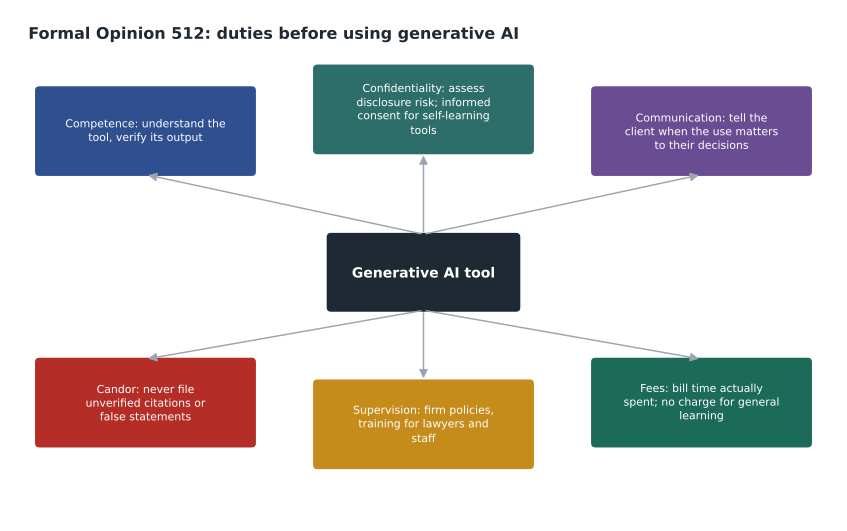
Generative artificial intelligence tools have forced the profession to apply old rules to a new technology. In July 2024 the ABA issued Formal Opinion 512, its first opinion on generative AI. It concluded that lawyers using these tools must consider several existing duties. Under Rule 1.1, a lawyer must have a reasonable understanding of the capabilities and limitations of the specific tool, including its tendency to produce plausible but false output, and must review and verify the output appropriately; the degree of independent verification depends on the task and the tool. Under Rule 1.6, a lawyer must evaluate the risk that information entered into a tool will be disclosed or accessed by others, and for self-learning tools that may use inputs to train the system, the opinion said informed client consent is generally required before entering confidential information.
The opinion also addressed communication, candor and fees. Under Rule 1.4, a lawyer may need to tell a client about the use of AI tools in some situations, such as when the client asks, when the engagement terms require it, or when the use bears on decisions the client must make. Under Rules 3.1, 3.3 and 8.4(c), a lawyer must not submit filings with fabricated citations or false statements. Under Rules 5.1 and 5.3, supervisors must set policies and train lawyers and staff. Under Rule 1.5, a lawyer billing hourly may charge only for time actually spent, which includes time reviewing AI output but not time the tool saved, and may not bill clients for general learning about a tool the lawyer will use across many matters.
The cautionary cases are well known. In Mata v. Avianca, Inc. (S.D.N.Y. 2023), lawyers were sanctioned under Rule 11 after submitting a brief citing nonexistent cases generated by a chatbot and then standing by them when the court asked questions. Courts across the country have since sanctioned lawyers for similar filings, and some judges have issued standing orders requiring lawyers to certify how AI was used or that citations were verified. Oyelaran's rule for her students is simple: "Never sign anything you have not read, and never cite anything you have not opened."
Diligence under Rule 1.3
Rule 1.3 requires a lawyer to act with reasonable diligence and promptness in representing a client. The comments describe the duty broadly: a lawyer should pursue a matter despite opposition, obstruction or personal inconvenience, and should take whatever lawful and ethical measures are required to vindicate a client's cause. But the comments also say that a lawyer is not bound to press for every advantage that might be realized, and that the duty of diligence does not require the use of offensive tactics or preclude treating everyone involved in the legal process with courtesy and respect. Zeal is not a license for rudeness.
The comments call procrastination perhaps the most widely resented professional shortcoming. A lawyer's workload must be controlled so that each matter can be handled competently. Missing a limitation period, failing to file an appeal, letting a default judgment be entered or sitting on a client's settlement check are the classic diligence violations. Comment 5 adds that a sole practitioner should have a plan, in conformity with applicable rules, designating another competent lawyer to review files and notify clients if the practitioner dies or becomes disabled. Some states require such succession plans.
Workload is a special problem for public defenders. ABA Formal Opinion 06-441 concluded that a public defender whose caseload prevents competent and diligent representation must not accept new cases and should seek relief from the court or supervisors. Courts and legislatures have struggled with the problem for decades, and in 2023 the ABA and RAND published new national public defense workload standards that recommend far lower caseloads than many offices carry. The ethics rules make clear that the individual lawyer cannot solve the problem by quietly doing worse work for more clients.
Communication under Rule 1.4
Rule 1.4 requires a lawyer to promptly inform the client of any decision or circumstance requiring the client's informed consent; reasonably consult with the client about the means by which the client's objectives are to be accomplished; keep the client reasonably informed about the status of the matter; promptly comply with reasonable requests for information; and consult with the client about any relevant limitation on the lawyer's conduct when the client expects assistance the rules do not allow. Rule 1.4(b) adds that a lawyer must explain a matter to the extent reasonably necessary to permit the client to make informed decisions.
The duty to convey settlement offers is the most tested application. Comment 2 says a lawyer who receives an offer of settlement in a civil case or a proffered plea bargain in a criminal case must promptly inform the client of its substance, unless the client has previously indicated that such an offer would be acceptable or unacceptable or has authorized the lawyer to accept or reject it. The Supreme Court constitutionalized part of this duty in Missouri v. Frye (2012), holding that defense counsel's failure to communicate a formal plea offer can be ineffective assistance of counsel. Delay in returning calls, failing to tell a client that a motion was lost, and failing to explain the risks of a strategy are the everyday communication violations.
In August 2026 the ABA House of Delegates adopted amendments to the comments to several rules, including a new comment to Rule 1.4 addressing the lawyer's duty to inform a current client of the lawyer's own material errors. The comment reflects a position the ABA had already taken in Formal Opinion 481 (2018): a lawyer must inform a current client of a material error, meaning one that a disinterested lawyer would conclude is reasonably likely to harm or prejudice the client, or of a kind that would reasonably cause a client to consider terminating the representation even without harm. Telling the client is uncomfortable and may lead to a malpractice claim, but hiding the error is worse, both ethically and legally.
Withholding information and the client's interests
Comment 7 to Rule 1.4 allows a lawyer, in limited circumstances, to delay transmitting information when the client would be likely to react imprudently to an immediate communication, such as delaying disclosure of a psychiatric diagnosis to a client in a fragile state when the examining psychiatrist advises it. But a lawyer may not withhold information to serve the lawyer's own interest or convenience, or the interests of another person, and a lawyer must comply with court orders restricting disclosure, such as protective orders limiting who may see discovery materials. Delay is the exception, not a general permission to manage what clients know.
| Conduct | Rule | Comment |
|---|---|---|
| Missing a filing deadline through neglect | 1.3 | Classic diligence violation; also malpractice |
| Not telling a client about a settlement offer | 1.4(a)(1) | Unless the client gave advance instructions |
| Not returning calls for weeks | 1.4(a)(3) and (4) | Duty to keep informed and respond to requests |
| Filing a brief with fabricated AI citations | 1.1, 3.3, 8.4(c) | Also Rule 11 sanctions (Mata v. Avianca) |
| Hiding a material error from a current client | 1.4 | Formal Opinion 481; 2026 comment |
| Taking a case far outside one's knowledge without help | 1.1 | Become competent, or associate co-counsel |
Supervision: Rules 5.1 and 5.3
Competence is not just an individual duty. Rule 5.1 requires partners and lawyers with comparable managerial authority to make reasonable efforts to ensure the firm has measures giving reasonable assurance that all lawyers comply with the rules, and requires lawyers with direct supervisory authority over another lawyer to make reasonable efforts to ensure that lawyer complies. A supervisor is responsible for another lawyer's violation if the supervisor orders or ratifies it, or knows of it in time to avoid or mitigate its consequences and fails to act. Rule 5.2 says a subordinate lawyer is bound by the rules even when acting at a supervisor's direction, but does not violate them by acting in accordance with a supervisor's reasonable resolution of an arguable question of professional duty.
Rule 5.3 applies parallel duties to nonlawyer assistance. In 2012 its title changed from assistants to assistance, to make clear that it covers not just paralegals and secretaries but outside vendors such as cloud storage providers, document review services and, the ABA has since said, technology tools. A lawyer who outsources work must make reasonable efforts to ensure that the provider's conduct is compatible with the lawyer's obligations, especially confidentiality.
Worked problem
The overdue appeal at Ashworth Lattimore
Rachel Abernathy is handling an appeal for Juniper Hill Creamery from a judgment in a contract dispute. Gordon Ashworth asked her to use the firm's new AI research tool to draft the opening brief. The tool produced a polished draft in minutes. Rachel is exhausted from a trial and is tempted to file it after a quick read. The brief is due tomorrow. She has also realized that last month she missed the deadline to file a designation of the record, which the court excused after a late motion, but the creamery has not been told. What must she do?
Show solution
- Competence and candor: under Rule 1.1, Formal Opinion 512 and Rules 3.1 and 3.3, she must check every citation and quotation in the AI draft against the actual sources and confirm that every statement of law is accurate before filing.
- Diligence: under Rule 1.3, if verification cannot be completed in time, she should seek an extension rather than file an unverified brief.
- Communication of the error: under Rule 1.4, Formal Opinion 481 and the 2026 comment, she must consider whether the missed designation was a material error. Because the court excused it, it may not be reasonably likely to harm the client, but she should discuss it with Ashworth and lean toward telling the client.
- Supervision: under Rule 5.1, Ashworth must ensure the firm has policies for AI use, including verification, and that associates are not pressured into filing unreviewed work.
- Fees: she may bill only time actually spent drafting and reviewing, not time the tool saved.
Answer: She must verify the AI draft line by line or seek an extension; filing it unread would risk Rule 11 sanctions and discipline. She should discuss the excused deadline with Ashworth and, unless they conclude it was plainly immaterial, inform the creamery. The firm should treat this as a reason to tighten its AI policy.
Oyelaran closes by asking students to write down three habits they will use in practice to avoid the problems in this lesson. Most write some version of the same list: a calendar system with backup reminders, a rule of returning every client contact within one business day even if only to acknowledge it, and never filing anything they have not personally checked. "If you do those three things," she says, "you will avoid most of the cases I used to prosecute."
Summary and key terms
- Rule 1.1 requires knowledge, skill, thoroughness and preparation reasonable for the matter; a lawyer may become competent by study or by associating with experienced counsel.
- Comment 8 makes understanding the benefits and risks of relevant technology part of competence.
- Formal Opinion 512 applies competence, confidentiality, communication, candor, supervision and fee rules to generative AI; Mata v. Avianca shows the cost of filing unverified output.
- Rule 1.3 requires reasonable diligence and promptness; procrastination and excessive workloads are the usual causes of violations.
- Rule 1.4 requires keeping clients informed, responding to requests, explaining matters and promptly conveying settlement and plea offers.
- A lawyer must tell a current client about a material error (Formal Opinion 481, reflected in a 2026 comment to Rule 1.4).
- Rules 5.1 and 5.3 make supervisors responsible for firm policies and for overseeing lawyers, staff and outside services.
Practice problems
Work each problem on paper first, then reveal the answer to check.
May a newly admitted lawyer accept a matter in an unfamiliar area of law?
Show answer
Yes, if the lawyer can become competent through reasonable preparation or by associating with a lawyer of established competence.
What did Missouri v. Frye hold?
Show answer
That defense counsel's failure to communicate a formal plea offer to the defendant can constitute ineffective assistance of counsel.
Under Formal Opinion 512, may a lawyer bill a client for hours the lawyer would have spent without an AI tool?
Show answer
No. A lawyer billing hourly may bill only for time actually spent, including time reviewing the tool's output.
When is a subordinate lawyer protected by Rule 5.2?
Show answer
When acting in accordance with a supervisor's reasonable resolution of an arguable question of professional duty.
Lesson quiz · 5 questions
Score 60% or more to complete this lesson.
Create a free account to save your progress, take quizzes and earn a certificate.